Don’t Just Tell Employees Organizational Changes Are Coming — Explain Why

To be successful, your story needs to start with the company’s core mission and then offer a compelling and inspiring future vision. You want to answer: How are the changes you make today helping you achieve your vision for tomorrow?
Don’t Just Tell Employees Organizational Changes Are Coming — Explain Why by Morgan Galbraith

I can’t stress enough the importance of proper communication around all changes, from the large transformations on down. Effective communication is effective change management.

I’ve discussed the need to be able to identify changes to strategic plans and use that to inspire, inform, empower, and engage.

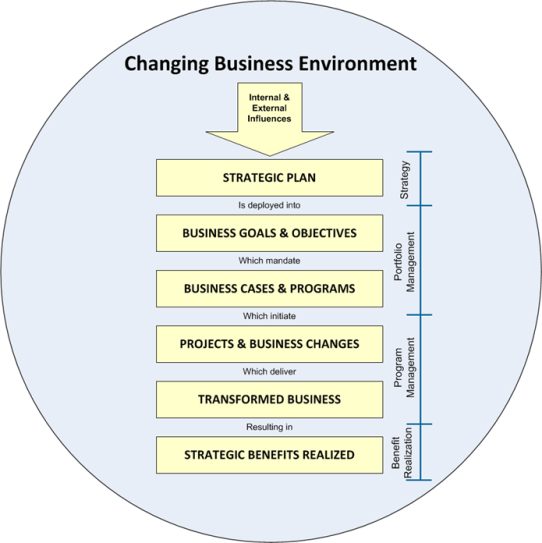
changing business environment

Always spend the time on a good communication plan:

Information to Communicate
(What)
Objective
(Why)
Target Audience
(Who to)
Frequency
(When)
Start Date
(When)
End Date
(When)
Media
(How)
Responsible
(Who from)
Deliverable Comments
What to people need to know o Determine site readiness to start the project

o Define resource needs and availability

Tailor the communication to specific audiences. The same information is sometimes presented different ways How often? Start date End Date From face-to-face to all the other communication tools available in the modern workplace. Be creative Who is responsible for completing the communication What will execution look like  


Change Management of multi-site implementations

A colleague asks in response to my post Group change controls:

… deploying a Learning + documentation system … all around the word [as a global deployment]  … do we I initiate a GLOBAL CC or does each site created a local CC.

The answer is usually, in my experience, both.

Change management is about process, organization, technology and people. Any change control needs to capture the actions necessary to successful implement the change.

so at implementation I would do two sets of changes. A global to capture all the global level changes and to implement the new (hopefully) harmonized system And then a local change control at each site to capture all the site impact.

System Element Global Local
Process Introduce the new global process

Update all global standards, procedures, etc

How will local procedures change? How will local system interactions change – clean up all the local procedures to ensure the point to the new global procedures and are harmonized as necessary.
Technology Computer system validation

Global interfaces

Global migration strategy

Local interfaces (if any) and configurations

Are local technologies being replaced? Plan for decommissioning.

Local migration (tactical)

People What do people do on the global level?

How will people interact within the system in the future?

Global training

What will be different for people at each individual site?

Localized training

Organization Will there be new organizational structures in place? Is this system being run out of a global group? How will communication be run.

System governance and change management

Site organization changes

How will different organizations and sub organizations adopt, adapt and work with the system

If you just have a global change control you are at real risk of missing a ton of local uniqueness and leaving in place a bunch of old ways of thinking and doing things.

If you just do local change controls you will be at risk of not seeing the big picture and getting the full benefits of harmonization. You also will probably have way too many change controls that regurgitate the same content, and then are at risk of divergence – a compliance nightmare.

This structure allows you better capture the diversity of perspectives at the sites. A global change control tends to be dominated by the folks at each site who own the system (all your documents and training folks in this example), while a site change will hopefully include other functions, such as engineering and operations. Trust me, they will have all sorts of impact.

This structure also allows you to have rolling implementations. The global implements when the technology is validated and the core processes are effective. each site then can implement based on their site deliverables. useful when deploying a document management system and you have a lot of migration.
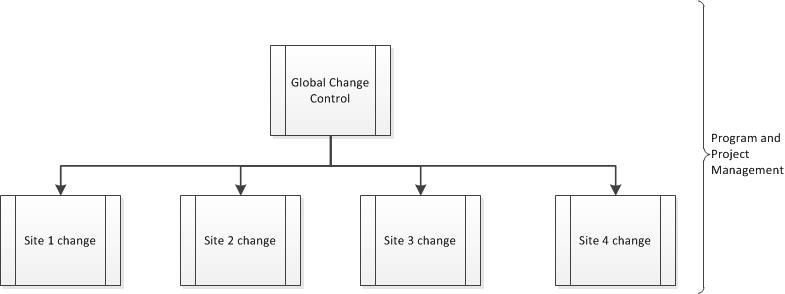
Multisite changes

As part of the deployment make sure to think through matters of governance, especially change management. Once deployed it is easy to imagine many changes just needing a central change control. But be sure to have thought through the criteria that will require site change controls – such as impact other interrelated systems, site validation or different implementation dates.

I’ve done a lot of changes and a lot of deployment of systems. This structure has always worked well. I’ve never done just a global and been happy with the final results, they always leave too much unchanged elements behind that come back to haunt you. In the last year I’ve done 2 major changes to great success with this model, and seen one where the decision not to use this model has left us with lots of little messes to clean up.

As a final comment, keep the questions coming and I would love to hear other folks perspectives on these matters. I’m perpetually learning and I know there are lots of permutations to explore.

Measures of success for changes

A colleague asks:

Is it a compliance risk to extend timelines on a change control?

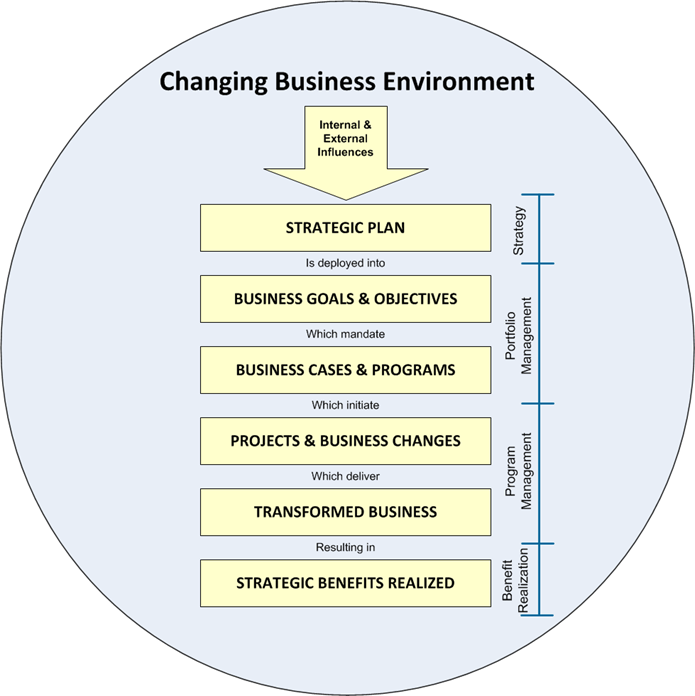
I want to take a step back to an important fundamental of change management to answer this question. All changes are done to realize strategic purposes; a good change management system is all about accelerating change. From the big transformations to the emergency changes to keep product being made each and every change has a strategic goal.

changing business environment

From this alignment to the strategy, each change has success metrics. Success metrics include economic, quality, technical and organization (among others) and they drive the how and the when of our change.

For example, a change driven by a CAPA to prevent reoccurrence will potentially have a different timeline than a change tied to a strategic goal to leverage a new way of working. But both have timelines driven by strategic to the tactical needs, usually filtered through a risk based prioritization tool.

And sometimes these change. The compliance aspect is not so much did you extend, it’s did you know what was happening with the change control in enough time to influence it in such a way to assure meeting the how.

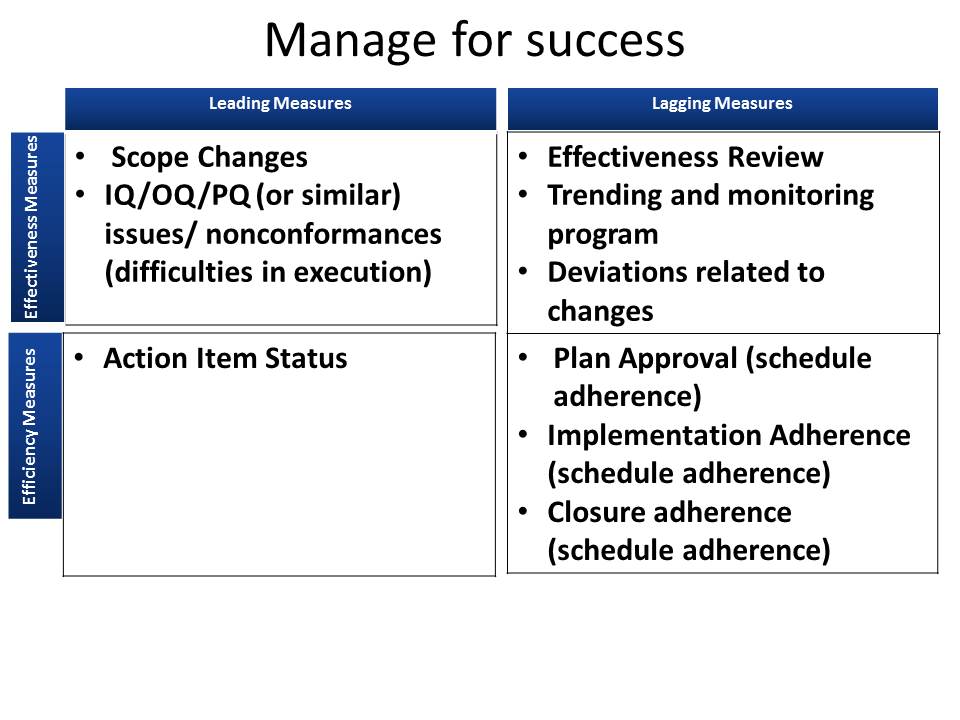
The KPIs and other measures built into your system should monitor and ensure your changes reach the intended benefits.

manage for success

To return to the original question. Unlike deviations/conformances where there is a specific requirements to complete in a timely way, and CAPAs where the root cause needs to be dealt with as soon as possible, change controls have their own internal timeline based on the drivers (which may be a CAPA). Extensions are not bad in a specific one-by-one change control approach. Instead they are indicative of larger troubles in the system and should be dealt with holistically to ensure you get the maximum benefit from your changes in the best possible time.

ASQ Round up of quality blogs – change management

The ASQ Voices of Quality roundup on change management was posted today. I wrote my thoughts last week. After reading all of the consolidated blog posts I have a few more thoughts:

  1. Avoid being reductive on change management. Everyone focuses on people, and then mentions how hard it is. I think part of this is the lack of system thinking. People use processes in an organization enabled by technology.
  2. If you only pull out change management for the transformational projects you aren’t exercising it enough. It needs to be built into all continuous improvement activities.
  3. Change Management is enabled by knowledge management and risk management. Without these in place and well understood, change management will be much harder than it should be.

Change Control- Leveraging regulatory inspection data

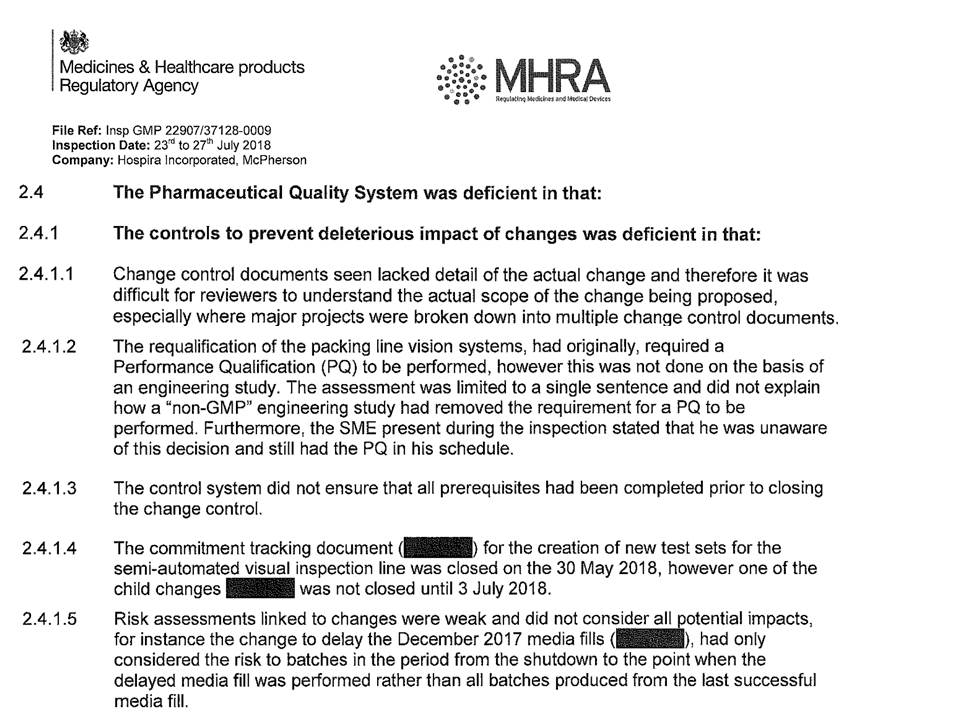
The Pfizer McPherson site has been under a great deal of regulatory scrutiny, and as a result there is a lot we can learn from their findings.

In July the MHRA stated the following:

Hospira McPherson Changes

There is a lot to unpack here, and for most of it I can pull up some previous postings to start with:

Breaking down change controls is both a necessity and a difficulty. I talked about the need for a change strategy when breaking up changes. This connective tissue will help with issues like 2.4.1.1 above and can also serve as a good playbook for discussing the changes with an inspector. This is especially important when you find you need to implement related changes at different times. I talked about the various implementation dates in some detail.

Risk assessments are only getting more important, and for a company with international distribution it is important to consider the risks inherent to your regulatory strategy and distribution strategy and mitigate.

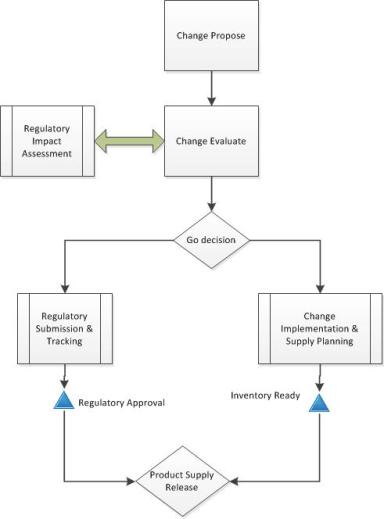
regulatory and change

If you have changes that will have long tails of regulatory approvals, then your change control needs to have the right controls to ensure appropriate and safe supply.

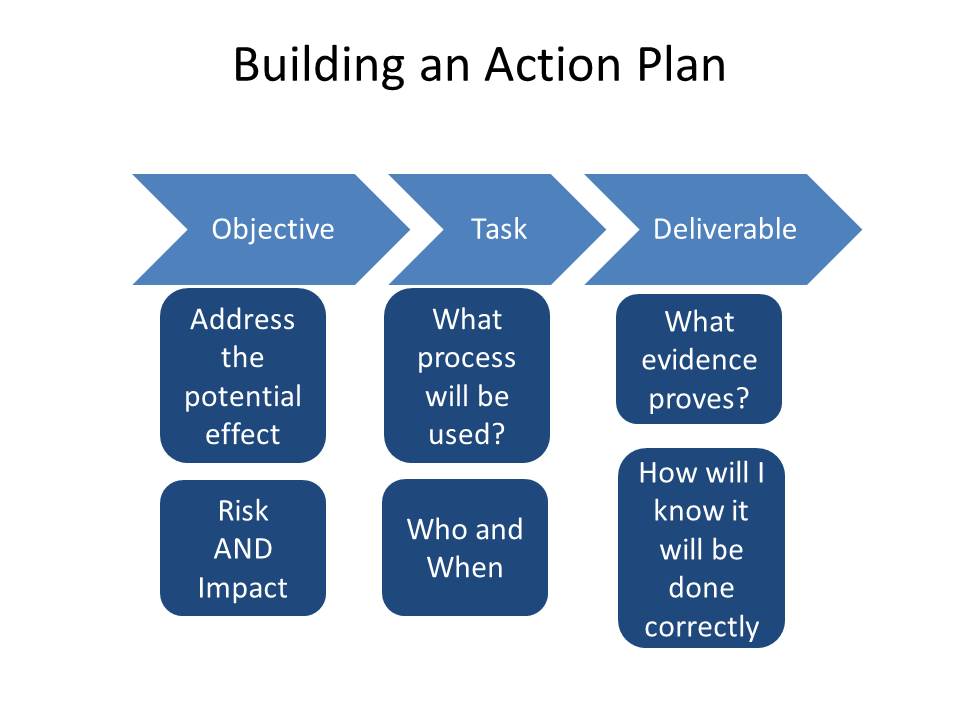
Build your actions to address all risks and impacts and ensure they are appropriately carried through.

action items

Finally ensure your change control process has a way to revise the plan and ensure all stakeholders are included in the decisions.