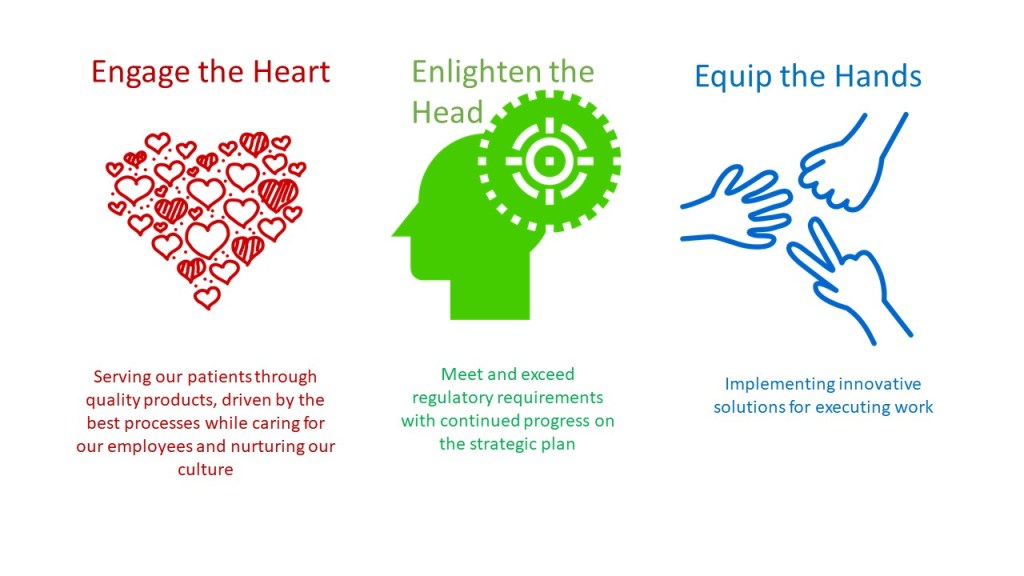
When building a quality organization, we are striving to do three things: get employees (and executives) to feel the need for quality in their bones; get them to understand what quality is and why it is important; and build the process, procedure, and tools to make quality happen. Practitioners in change management often call this heart, head, and hands.
Engage the heart, head and hands to build a quality culture
In our efforts we strive to answer give major themes of questions about why building a culture of quality is critical.
Theme
Questions
Why
Why do we need quality? Why is it important? What are the regulatory expectations? What happens if we do nothing?
What
What results are expected for our patients? Our organization? Our people? What does out destination look and feel like?
How
How will we get there? What’s our plan and process? What new behaviors do we each need to demonstrate?
You
What do you need to fulfill your role in quality? What do we need from you?
Me
What do I commit to as a leader? What will I do to make change a reality? How will I support my team?
Five Themes of Change
The great part of this is that the principles of building a quality culture are the same mindsets we want embedded in our culture. By demonstrating them, we build and strengthen the culture, and will reap the dividends.
Be Preventative: What actions can be taken to prevent undesirable/unintended consequences with employees and other stakeholders. We do this by:
Quality stands in a position, sometimes uniquely in an organization, of engaging with stakeholders to understand what objectives and unique positions the organization needs to assume, and the choices that are making in order to achieve such objectives and positions.
Always include a “do nothing” option: Not every decision or problem demands an action. Sometimes, the best way is to do nothing.
How do you know what you think you know? This should be a question everyone is comfortable asking. It allows people to check assumptions and to question claims that, while convenient, are not based on any kind of data, firsthand knowledge, or research.
Ask tough questions! Be direct and honest. Push hard to get to the core of what the options look like.
Have a dissenting option. It is critical to include unpopular but reasonable options. Make sure to include opinions or choices you personally don’t like, but for which good arguments can be made. This keeps you honest and gives anyone who see the pros/cons list a chance to convince you into making a better decision than the one you might have arrived at on your own.
Consider hybrid choices. Sometimes it’s possible to take an attribute of one choice and add it to another. Like exploratory design, there are always interesting combinations in decision making. This can explode the number of choices, which can slow things down and create more complexity than you need. Watch for the zone of indifference (options that are not perceived as making any difference or adding any value) and don’t waste time in it.
Include all relevant perspectives. Consider if this decision impacts more than just the area the problem is identified in. How does it impact other processes? Systems?
A struggle every organization has is how to think through problems in a truly innovative way. Installing new processes into an old bureaucracy will only replace one form of control with another. We need to rethink the very matter of control and what it looks like within an organization. It is not about change management, on it sown change management will just shift the patterns of the past. To truly transform we need a new way of thinking.
One of my favorite books on just how to do this is Humanocracy: Creating Organizations as Amazing as the People Inside Them by Gary Hamel and Michele Zanini. In this book, the authors advocate that business must become more fundamentally human first. The idea of human ability and how to cultivate and unleash it is an underlying premise of this book.
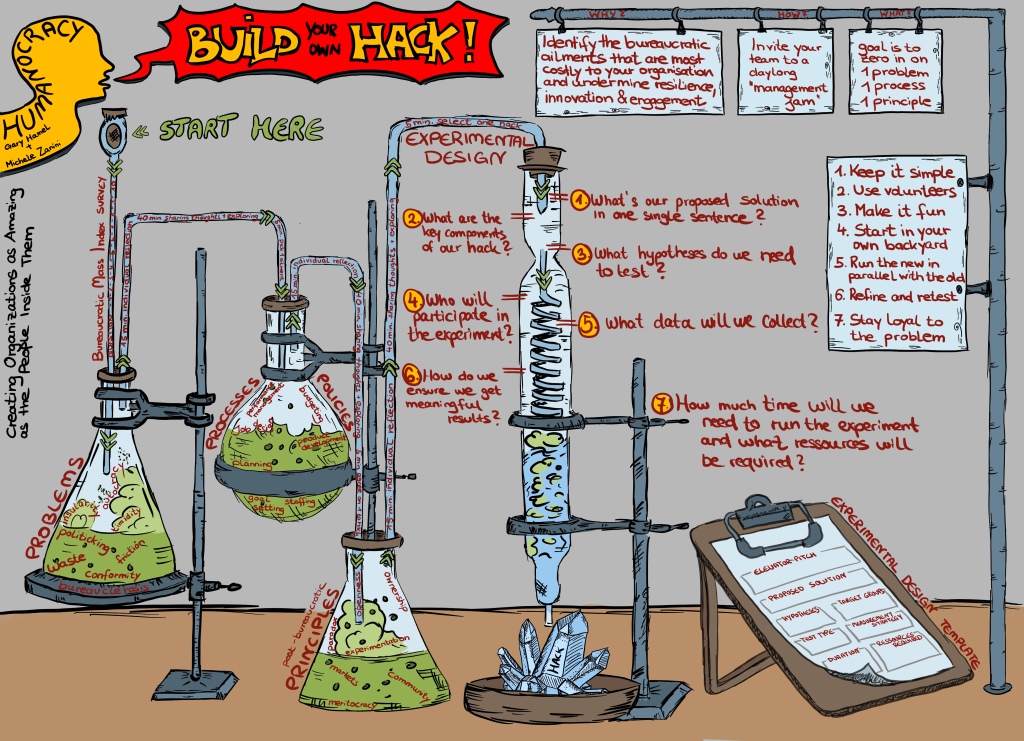
Visualized by Rose Fastus
it’s possible to capture the benefits of bureaucracy—control, consistency, and coordination—while avoiding the penalties—inflexibility, mediocrity, and apathy.
Gary Hamel and Michele Zanini, Humanocracy, p. 15
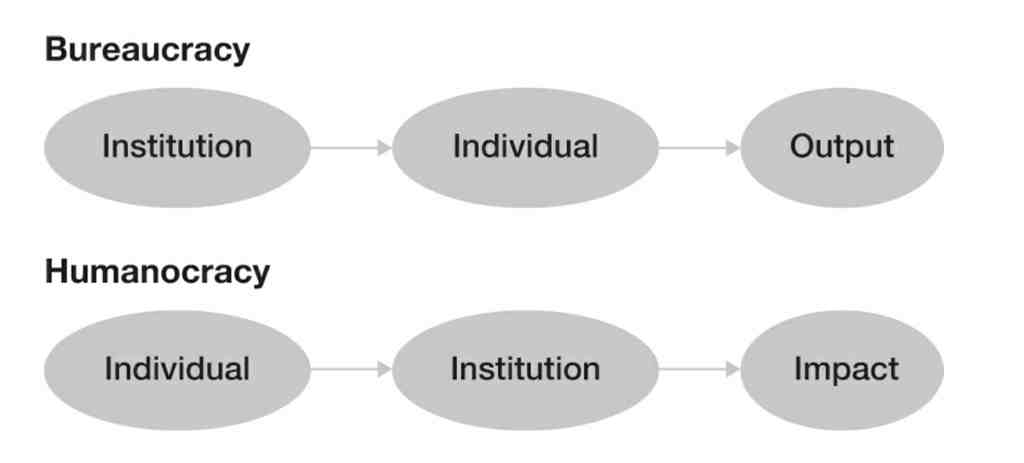
The above quote really encapsulates the heart of this book, and why I think it is such a pivotal read for my peers. This books takes the core question of a bureaurcacy is “How do we get human beings to better serve the organization?”. The issue at the heart of humanocracy becomes: “What sort of organization elicits and merits the best that human beings can give?” Seems a simple swap, but the implications are profound.
Bureaucracy versus Humanocracy. Source: Gary Hamel and Michele Zanini, Humanocracy, p. 48
I would hope you, like me, see the promise of many of the central tenets of Quality Management, not least Deming’s 8th point. The very real tendency of quality to devolve to pointless bureaucracy is something we should always be looking to combat.
Humanocracy’s central point is that by truly putting the employee first in our organizations we drive a human-centered organization that powers and thrives on innovation. Humanocracy is particularly relevant as organizations seek to be more resilient, agile, adaptive, innovative, customer centric etc. Leaders pursuing such goals seek to install systems like agile, devops, flexible teams etc. They will fail, because people are not processes. Resiliency, agility, efficiency, are not new programming codes for people. These goals require more than new rules or a corporate initiative. Agility, resilience, etc. are behaviors, attitudes, ways of thinking that can only work when you change the deep ‘systems and assumptions’ within an organization. This book discusses those deeper changes.
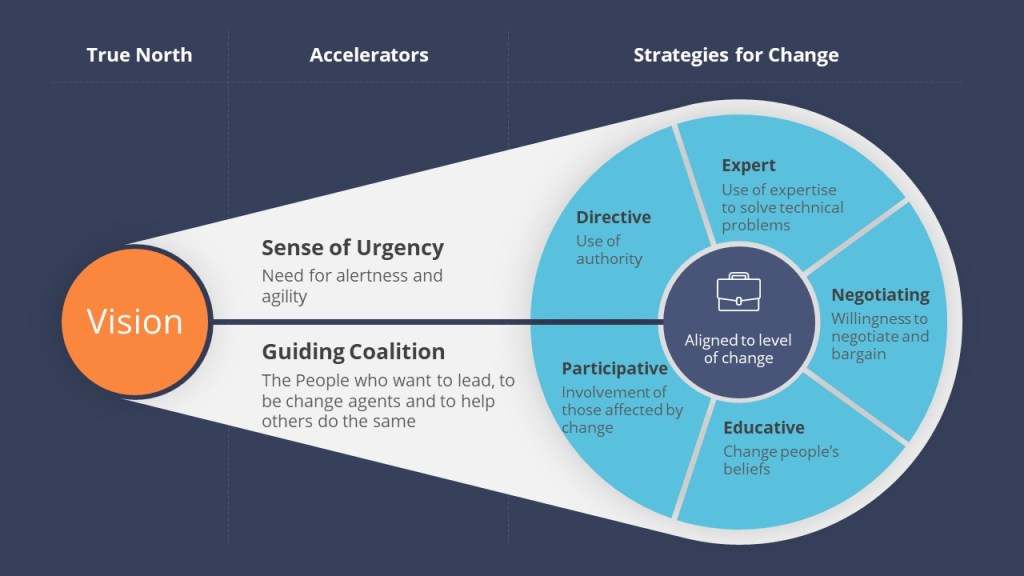
Humanocracy lays out seven tips for success in experimentation. I find they align nicely with Kotter’s 8 change accelerators.
Humanocracy’s Tip
Kotter’s Accelerator
Keep it Simple
Generate (and celebrate) short-term wins
Use Volunteers
Enlist a volunteer army
Make it Fun
Sustain Acceleration
Start in your own backyard
Form a change vision and strategic initiatives
Run the new parallel with the old
Enable action by removing barriers
Refine and Retest
Sustain acceleration
Stay loyal to the problem
Create a Sense of Urgency around a Big Opportunity
Comparison to Kotter’s Eight Accelerators for Change
The change accelerators help us avoid some pretty common errors in change management.
Neglecting Employees’ Individual Interests
It is not enough to present a compelling case for change. Leaders can explain how the specified changes are in the company’s interests and the collective interests of all employees but for individuals to change their behavior, it must be in their individual interests to do so. There are always some costs to employees in any change program, but the behaviors required for change can still be in their individual interests if there are benefits that, on balance, make it rational to get with the program. It’s up to leadership to understand these cost-benefit analyses and tip the scales as needed to make active support of the collective change an individually winning strategy.
This is one the places having a volunteer army is vital. That army will help ensure the individual and well as the collective interests are engaged.
Under-engaging the Extended Leadership Team
It is crucial to get the extended leadership team seriously engaged in cultural transformation. Much of the coalition of change will be drawn from their numbers. What counts as an extended leadership team is different depending on the organization, but as a rule of thumb go to the top and draw a circle down to 3 levels below.
By drawing from the extended leadership team as the guiding coalition, you give them a personal stake in the outcome. Give the extended leadership team members a voice earlier on in the program and they will feel a greater sense of ownership and will contribute more readily. Their involvement should begin as early as the design stage to leverage their knowledge of the workforce and the situation on the ground. Giving them the opportunity for meaningful input will make them feel included in the program and enthusiastic about it, and will also help keep the program free of design flaws.
Allocating “Set-and-Forget” Targets
The hands-off, set-and-forget model for allocating targets has three major shortcomings:
If senior management neglects to inspire ambitions, to monitor progress and make proper course corrections, and to show sufficient engagement, then the initiative leaders will have little reason to go the extra mile. Presented with an annual target, they will likely focus on measures that aim simply to meet it – typically, shortsighted measures such as reducing deviations per batch or CAPA cycle time. After all, such measures are far easier to implement, and far less threatening to the delivery of day-to-day business results, than broad long-term measures such as seeking sustainable savings through increased productivity. Taking the simpler path is the rational choice when you understandably want to minimize disruption. Unfortunately, the short-tern measures don’t change culture fundamentally or sustainably. Sooner or later they are discontinued, and when that happens, the benefits evaporate.
The initiative leaders will likely seek solutions specific to their own silos rather than pursue opportunities that might contribute to collective, cross-department success. Those promising opportunities remain undiscovered since individual departments left to their own devices have no particular incentive to look beyond their silos. They might even have a disincentive to do so, because they may rightly worry that they wouldn’t get their fair share of credit for the results or that it would be a futile mission and damaging to their prospects.
The hands-off model prevents lead-indicator metrics, timely interventions, and course correction. If senior leaders have little visibility into a departmental initiative, they cannot easily realize that things are going off the hands-off model militates against lead-indicator metrics, timely interventions, and course correction. If senior leaders have little visibility into a departmental initiative, they cannot easily realize that things are going off track through the pursuit of unsustainable, short-term measures – until it is too late to do anything about it.




 Investigations of a Dog