Luigi Sille on sharequality answered the June 2019 ASQ Roundtable Topic asks: “How can an individual become a successful Change Leader?” I’m a big fan of both blog carnivals and change management so here goes my answer, which is pretty similar to Luigi’s, and I would guess many other’s – just with my own spin.
A few things immediately come to mind.
Change management (and this is another great example of really meaning people change management) should be a competency on the ladder for any quality professional. It certainly needs to be a core area for anyone in a quality leadership position.
There are a lot of competency models out there for change management. Instead of pointing to just one, let’s try to find what they actually have in common. To do so it is important to set out the critical activities of change management:
Change Management requires the seven skills we should all be developing: communication, content, context, emotional competence, teaching, connections, and an ethical compass
Solid focus on both external and internal signifiers of quality culture. A little basic but very worth reinforcing.
And then I left, skipping the last keynote to get to the airport.
Good conference this year. Overall I felt that many of my choices for sessions ended up being more basic than I thought, but there is a lot of value in that. I will hopefully make the time to turn my thoughts into better blog posts.
At ASQ BOSCON 2019 I spoke on “Knowledge management & effective change management.” From my proposal:
An effective change management system includes active knowledge management, leveraging existing process and product knowledge; capturing new knowledge gained during implementation of the change; and, transferring that knowledge in appropriate ways to all stakeholders. This session will focus on three key areas of knowledge management as it enables change. It will provide an understanding of the principles of knowledge management, including: transforming data into information; the acquisition and creation of knowledge; and the some shared best practices for dissemination and using information and knowledge for the purpose of change management and building a quality culture.
I recently had a discussion with one of the best root cause investigators and problem solvers I know, Thor McRockhammer. Thor had concerns about a case where the expected conditions were not met and there were indications that individuals engaged in troubleshooting and as a result not only made the problem worse but led to a set of issues that seem rather systematic.
Our conversation (which I do not want to go into too much detail on) was a great example of troubleshooting going wrong.
Troubleshooting is defined as “Reactive problem solving based upon quick responses to immediate symptoms. Provides relief and immediate problem mitigation. But may fail to get at the real cause, which can lead to prolonged cycles of firefighting.” Troubleshooting usually goes wrong one of a few ways:
Not knowing when troubleshooting shouldn’t be executed
Using troubleshooting exclusively
Not knowing when to go to other problem solving tools (usually “Gap from standard”) or to trigger other quality systems, such as change management.
Troubleshooting is a reactive process of fixing problems by rapid response and short-term corrective actions. It covers noticing the problem, stopping the damage and preventing spread of the problem.
So if our departure from expected conditions was a leaky gasket, then troubleshooting is to try to stop the leak. If our departure is a missing cart then troubleshooting usually involves finding the cart.
Troubleshooting puts things back into the expected condition without changing anything. It addresses the symptom and not the fundamental problems and their underlying causes. They are carried out directly by the people who experience the symptoms, relying upon thorough training, expertise and procedures designed explicitly for troubleshooting.
With out leaky gasket example, our operators are trained and have procedural guidance to tighten or even replace a gasket. They also know what not to do (for example don’t weld the pipe, don’t use a different gasket, etc). There is also a process for documenting the troubleshooting happened (work order, comment, etc).
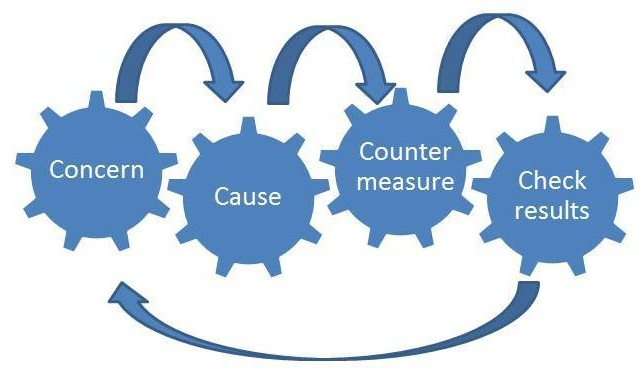
To avoid the problems listed above troubleshooting needs a process that people can be thoroughly trained in. This process needs to cover what to do, how to communicate it, and where the boundaries are.
·What do we known about the exact nature of the problem?
·What do your
standards say about how this concern should be documented?
oFor example,
can be addressed as a comment or does it require a deviation or similar non-conformance
·If the concern stems
from a requirement it must be documented.
Cause
·What do you
know about the apparent (or root) cause of the problem?
·Troubleshooting
is really good at dealing with superficial cause-and-effect relationships. As
the cause deepens, fixing it requires deeper problem-solving.
·The cause can
be a deficiency or departure from a standard
Countermeasure
·What immediate
or temporary countermeasures can be taken to reduce or eliminate the problem?
·Are follow-up
or more permanent countermeasures required to prevent recurrence?
oIf so, do you
need to investigate more deeply?
·Countermeasures
need to be evaluated against change management
·Countermeasures
cannot ignore, replace or go around standards
·Apply good
knowledge management
Check results
·Did the results
of the action have any immediate effect on eliminating the concern or
problem?
·Does the
problem repeat?
oIf so, do you
need to investigate more deeply?
·Recurrence
should trigger deeper problem-solving and be recorded in the quality system.
·Beware troubleshooting
countermeasures becoming tribal knowledge and the new way of working
Trouble shooting is in a box
Think of your standards as a box. This box defines what should happen per our qualified/validated state, our procedures, and the like. We can troubleshoot as much as we want within the box. We cannot change the box in any way, nor can we leave the box without triggering our deviation/nonconformance system (reactive) or entering change management (proactive).
Communication is critical for troubleshooting
Troubleshooting processes need a mechanism for letting supervisors happen. Troubleshooting that happens in the dark is going to cause a disaster.
Operators need to be trained how to document troubleshooting. Sometimes this is as simple as a notation or comment, other-times you trigger a corrective action process.
Engaging in troubleshooting, and not documenting it starts to look a like fraud and is a data integrity concern.
Change Management
The change management process should be triggered as a result of troubleshooting. Operators should be trained to interpret it. This is often were concept of exact replacements and like-for-like come in.
It is trouble shooting to replace a part with an exact part. Anything else (including functional equivalency) is a higher order change management activity. It is important that everyone involved knows the difference.
Covers
Is it troubleshooting?
Like-for- Like
Spare parts that are identical replacements (has the same the same manufacturer, part number, material of construction, version)
Existing contingency procedures (documented, verified, ideally part of qualification/validation)
Yes
This should be built into procedures like corrective maintenance, spare parts, operations and even contingency procedures.
Functionally equivalent
Equivalent, for example, performance, specifications, physical characteristics, usability, maintainability, cleanability, safety
No
Need to understand root cause. Need to undergo appropriate level of change management
New
Anything else
No
Need to understand root cause. Need to undergo appropriate level of change management
This applies to both administrative and technical controls.
ITIL Incident Management
ITIL Incident Management (or similar models) is just troubleshooting and has all the same hallmarks and concerns.
Conclusion
Trouble shooting is an integral process. And like all processes it should have a standard, be trained on, and go through continuous improvement.
One of the hallmarks of a quality culture is learning from our past experiences, to eliminate repeat mistakes and to reproduce success. The more times you do an activity, the more you learn, and the better you get (within limits for simple activities). Knowledge management is an enabler of quality systems, in part, to focus on learning and thus accelerate learning across the organization as a whole, and not just one person or a team.
This is where the” lessons learned” process comes in. There are a lot of definitions of lessons learned out there, but the definition I keep returning to is that a lessons learned is a change in personal or organizational behavior as a result from learning from experience. Ideally, this is a permanent, institutionalized change, and this is often where our quality systems can really drive continuous improvement.
Lessons identified is generate, assess, and share.
Updated processes (and documents) is contextualize, apply and update.
Lessons Learned in the Context of Knowledge Management
Identify Lessons Learned
Identifying lessons needs to be done regularly, the closer to actual change management and control activities the better. The formality of this exercise depends on the scale of the change. There are basically a few major forms:
After action reviews: held daily (or other regular cycle) for high intensity learning. Tends to be very focused on questions of the day.
Retrospective: Held at specific periods (for example project gates or change control status changes. Tends to have a specific focus on a single project.
Consistency discussions: Held periodically among a community of practice, such as quality reviewers or multiple site process owners. This form looks holistically at all changes over a period of time (weekly, monthly, quarterly). Very effective when linked to a set of leading and lagging indicators.
Incident and events: Deviations happen. Make sure you learn the lessons and implement solutions.
The chosen formality should be based on the level of change. A healthy organization will be utilizing all of these.
Level of Change
Form of Lesson Learned
Transactional
Consistency discussion After action (when things go wrong)
Organizational
Retrospective After action (weekly, daily as needed)
Transformational
Retrospective After action (daily)
Successful lessons learned:
Are based on solid performance data: Based on facts and the analysis of facts.
Separate experience from opinion as much as possible. A lesson arises from actual experience and is an objective reflection on the results.
Generate distinct lessons from which others can learn and take action. A good action avoids generalities.
In practice there are a lot of similarities between the techniques to facilitate a good lessons learned and a root cause analysis. Start with a good core of questions, starting with the what:
What were some of the key issues?
What were the success factors?
What worked well?
What did not work well?
What were the challenges and pitfalls?
What would you approach differently if you ever did this again?
From these what questions, we can continue to narrow in on the learnings by asking why and how questions. Ask open questions, and utilize all the techniques of root cause analysis here.
Then once you are at (or close) to a defined issue for the learning (a root cause), ask a future-tense question to make it actionable, such as:
What would your advice be for someone doing this in the future?
What would you do next time?
Press for specifics. if it is not actionable it is not really a learning.
Update the Process
Learning implies memory, and an organization’s memories usually require procedures, job aids and other tools to be updated and created. In short, lessons should evolve your process. This is often the responsibility of the change management process owner. You need to make sure the lesson actually takes hold.
Differences between effectiveness reviews and lesson’s learned
What can we learn from this change for the next change?
Effectiveness reviews are 1 and 2 (based on a risk based approach) while lessons learned is 3. Lessons learned contributes to the health of the system and drives continuous improvements in the how we make changes.
Citations
Lesson learned management model for solving incidents. (2017). 2017 12th Iberian Conference on Information Systems and Technologies (CISTI), Information Systems and Technologies (CISTI), 2017 12th Iberian Conference On, 1.
Fowlin, J. j & Cennamo, K. (2017). Approaching Knowledge Management Through the Lens of the Knowledge Life Cycle: a Case Study Investigation. TechTrends: Linking Research & Practice to Improve Learning, 61(1), 55–64.
Michell, V., & McKenzie, J. (2017). Lessons learned: Structuring knowledge codification and abstraction to provide meaningful information for learning. VINE: The Journal of Information & Knowledge Management Systems, 47(3), 411–428.
Milton, N. J. (2010). The Lessons Learned Handbook : Practical Approaches to Learning From Experience. Burlington: Chandos Publishing.
Paul R. Carlile. (2004). Transferring, Translating, and Transforming: An Integrative Framework for Managing Knowledge across Boundaries. Organization Science, (5), 555.
Secchi, P. (Ed.) (1999). Proceedings of Alerts and Lessons Learned: An Effective way to prevent failures and problems. Technical Report WPP-167. Noordwijk, The Netherlands: ESTEC



 Investigations of a Dog