Changes stems from learning from mistakes

As we build quality culture we need to question our basic assumptions and build new principles of every day interactions. At the heart of this sits a culture where change is viewed as a good thing.

Willingness to change

To what extent are employees willing to continuously review and adapt their own behavior in response to a changing environment? The ideal scenario is for the entire workforce to be willing to change. This willingness to change should not be confined to situations where changes are already being implemented. It means that people should look at environment with open eyes, recognize when there is an opportunity or a need for change and initiate the relevant actions themselves. Willingness to change should be the first principle of culture and is a key enabler of the popular concept often called agility.

Learning Culture

To what extent do employees think that their actions should be guided by data- and fact-based knowledge? The term “knowledge” encompasses any knowledge acquired through targeted observation, by chance, through data-based analysis or from practical experience.

Willingness to make mistakes

Learning cultures attach great importance to mistakes. These organizations have understood that learning and change processes can only be triggered by mistakes. Mistakes provide an opportunity to gain a better understanding of the company’s processes and uncover previously unknown cause-and-effect relationships.

The way an organization deals with mistakes is therefore a key aspect of its culture. Two fundamentally different approaches to mistakes exist.

  • A negative attitude towards mistakes is reflected in a strategy based on the systematic avoidance of errors, strict penalties for making mistakes and the correction of errors as rapidly and unobtrusively as possible. Employees of companies where this culture prevails are not usually willing to disclose mistakes. This attitude inhibits their willingness to change.
  • On the other hand, a culture that recognizes the value of mistakes is characterized by open discussion of mistakes when they occur, systematic error documentation and a determination to find both the causes of the mistakes and their solutions. When investigating mistakes, it is critical to focus on understanding the causes rather than on finding out who is to blame.

Openness to Innovation

Openness to innovation and new ways of doing things is an important capability that is required in order to initiate change and adopt the right measures, even if they may sometimes be rather unconventional.

Social Collaboration

An environment characterized by trust and social relationships provides the basis for open, uninhibited knowledge sharing between employees. Social collaboration, helps to accelerate knowledge sharing within the organization. Good strong social networks build resilience and enable the ability to change.

Open Communication

In order for companies to respond rapidly and to be able to effectively change, employees need to have access to the necessary explicit and implicit knowledge. While explicit knowledge can be provided through the appropriate communication technology, the sharing of implicit knowledge calls for direct communication between the people who possess the knowledge and the people seeking it.

An effective organization needs to abandon the “us and them” mentality. Employees have acquired the capability of open communication if, having taken on board the fact that openly sharing knowledge and working together to achieve a vision increases the total sum of knowledge, they then also act
accordingly. Once the organization’s entire workforce is willing to share knowledge with everyone, it becomes possible to significantly accelerate learning processes within the company.

What Does This Look Like?

Social collaboration exists between employees and with customers and partners. Confidence in systems and processes results in high process stability. People are willing to document their acquired knowledge and share it with others. The democratic leadership style values people for the contribution they make and there is a culture of open communication. The workforce is both receptive and willing to change. They learn systematically from the captured data, are open to innovative approaches and participate in shaping change processes. Employees are also conscious of the need to continuously develop their skills and competencies. While mistakes are still made, people recognize that they are valuable because they have the potential to trigger improvements.

Where we need to be

Jargon and business terms

Does your office have a jargon problem?

The answer is inevitably yes.

In the quality profession we need to be careful to differentiate between jargon, slang, and technical terminology. Avoid the faddish and those terms that require socialization to learn and we’re usually doing okay.

The article from HBR above gives some good advice for striving to communicate as widely as possible. A good thing to think about as we get ready to start a new week.

Teaching Quality People to Listen

Been thinking a lot on what a training program around teaching people to listen and not to talk might look like and how it fits into a development program for quality professionals.

People in quality think a lot on how to make a reasoned argument, a good decision, to provide guidance, get their point across in meetings, persuade or coerce people to follow standards. This is understandable, but it has a cost. There is a fair amount of research out there that indicates that all too often when others are talking, we are getting ready to speak instead of listening.

I think we fail to listen because we are anxious about our own performance, concerned about being viewed as an expert, convinced that our ideas are better than others, comfortable in our expertise, or probably all of the above. As a result we get into conflicts that could be avoided, miss opportunities to advance the conversation, alienate people and diminish our teams’ effectiveness.

When we really listen we create the spaces to make quality decisions. Listening can be improved by these practices:

Ask expansive questions. Stay curious, build on other’s ideas are mantras I think most of us are familiar with. Suppress the urge to interrupt or dominate a conversation and concentrate on the implications of other people’s words. It is very easy for a quality professional to instantly leap to solving the problem, and we need to be able to give space. Focus on open-ended “what” and “how” questions, which encourage people to provide more information, reflect on the situation and feel more heard. Avoid yes-and-no questions which can kill dialogue.

Engage in “self-checks”. Be aware of one’s own tendencies and prepare with ways to identify they are happening and head them off. Doing this will surprisingly allow you to focus on the listener and not yourself moving beyond the words that are being said and being able to take in the speaker’s tone, body language, emotions and perspective, and the energy in the conversation.

Become comfortable with silence. This means communicating attentiveness and respect while you are silent.

Listening needs to be part of our core competencies, and unless we work on it, we don’t get better.

Identify and engage stakeholders

Every change (and lets be frank, most everything involves change) requires understanding the individuals and groups that will participate or are affected – directly or indirectly.

Stakeholder analysis involves identifying the stakeholders and analyzing their various characteristics. These characteristics can include:

  • Level of authority within the organization and the domain of change
  • Attitudes toward or interest in the change
  • Attitudes towards the process
  • Level of decision-making authority

The goal of stakeholder analysis is to choose the best collaboration and communication approaches and to appropriately plan for stakeholder risks.

There are a variety of mechanisms for doing this and then mapping it out.

Start by brainstorming a list of the stakeholders by answering these questions:

  • Who will be impacted?
  • Who will be responsible or accountable
  • Who will have decision authority
  • Who can support
  • Who can obstruct
  • Who has been involved in something similar in the past?

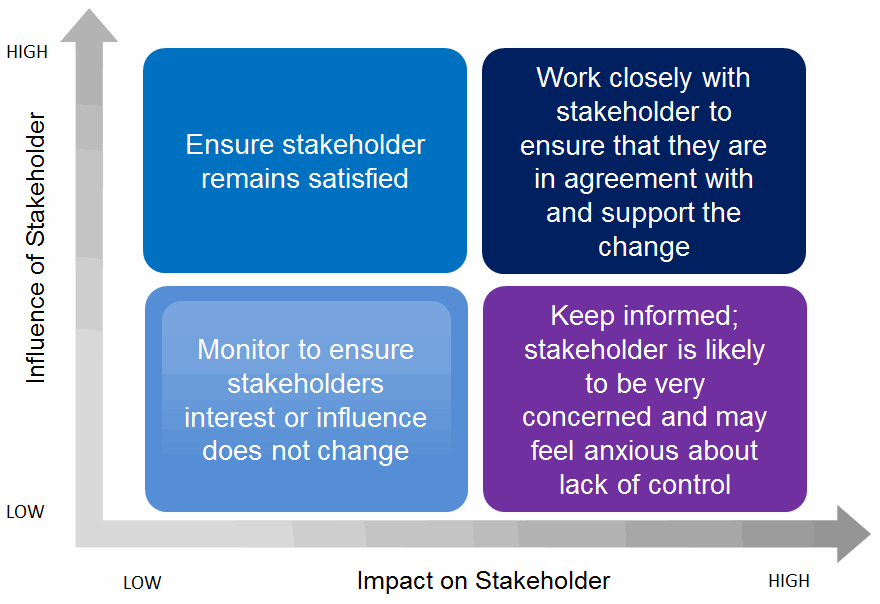
Map these on a stakeholder matrix based on relative power and interest. This should be an iterative process.

Stakeholder Matrix
  • High influence/High Impact: these are key players and effort should be focused here to engage this group regularly
  • High influence/Low impact: these stakeholders have needs that should be met so engage and consult with them while also attempting to increase their level of interest.
  • Low influence/High impact: these stakeholders are supporters and potential goodwill ambassadors. Engage the group for their input and show interests in their needs.
  • Low influence/Low impact: the stakeholders can be kept informed using general communications. Additional targeted engagement may move them into the goodwill ambassador quadrant.

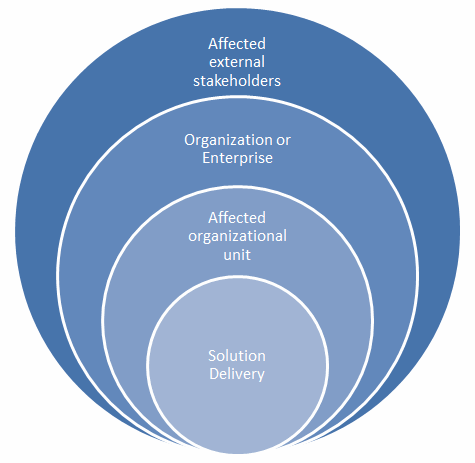
Another way to look at stakeholders is though an onion diagram.

A RACI is another popular way to look at stakeholders.

Once stakeholders are identified is is important to define how communication and engagement will achieved. There is usually no one sized fits all approach and it is important to meet the needs of each stakeholder group to ensure their interest and involvement is maintained. Some considerations include:

  • timing and frequency
  • location
  • tools
  • delivery methods (in-person or virtual)
  • preferences of the stakeholders
  • geographic considerations or impact

Document this in a communication plan, including:

  • what needs to be communicated
  • what is the appropriate delivery method
  • who the appropriate audience is
  • when communication should occur
  • frequency of communication
  • level of detail appropriate for the communication and stakeholder
  • level of formality of communication

Empathy and Feedback as part of Quality Culture

Many of us have had, or given, a talk about how we can learn from children in how to communicate, whether it is being thoughtful in our relationships or learning to adapt and be resilient, or some other point.

Zach Weinersmith, Saturday Morning Breakfast Cereal

What we are really talking about how communicating empathetically is essential, including to building a quality culture and it is a key part of change management.
People need to feel respected and have a sense of self-worth in order to be motivated, confident, innovative, and committed to their work and to appropriately engage in quality culture.

I am not going to pretend to be an expert on empathy. I think it is fair to say that is still (always) one of my key development areas. That said, I think a core skill of any quality leader is that of giving feedback.

People need to feel respected and have a sense of self-worth in order to be motivated, confident, innovative, and committed to their work.

To provide good feedback focus on doing the following:

  • Focus on facts.
  • Respect and support others. Even when people aren’t performing their best, they need to feel your support and to know that they’re valued.
  • Clarify motives. Don’t jump to conclusions. Keep others’ self-esteem in mind, and you’ll be more likely to ask, “What can you tell me about this error?” instead of, “Don’t you care about quality?”

When someone has done a good job, succeeded at a task, or made a contribution, you want to enhance that person’s self-esteem. Some ways to do that are to:

  • Acknowledge good thinking and ideas. Demonstrations of appreciation encourage people to think and contribute, and they support innovation and intellectual risk taking.
  • Recognize accomplishments. People need to hear specifically what they’ve done to contribute to the team’s or organization’s success. This encourages them to sustain or exceed expectations.
  • Express and show confidence. Voicing your trust and then calling on people to show what they can do boosts their confidence and their feelings of self-worth.
  • Be specific and sincere. When you describe in detail what people do well and why it’s effective, they know exactly what you’re recognizing.

Nothing can deflate people’s confidence faster than telling them they’re responsible for something, and then doing it yourself. Conversely, when you provide support without removing responsibility, you build people’s sense of ownership of the task or assignment as well as the confidence that they can accomplish it. When you use this Key Principle, remember to:

  • Help others think and do. Provide your support in two ways: Help others think of ideas, alternatives, and solutions, then support them so that they can execute the plan.
  • Be realistic about what you can do and keep your commitments. Remember that you don’t have to do it all, but be sure to do whatever you agree to.
  • Resist the temptation to take over—keep responsibility where it belongs.

Many quality individuals tend to be action oriented and task driven, so keeping responsibility where it belongs can take resolve, even courage. You might have to overcome the protests of a team member who is reluctant to stretch into new areas or even brave objections from a key manager about your decision to support others rather than take over.

Feedback Conversation Structure

Open

In the OPEN step you ensure that the discussion has a clear purpose and that everyone understands the importance of accomplishing it.

  • Always state purpose and importance clearly in the discussion opening.
  • If you initiate the discussion, explain what you would like to accomplish and why.
  • If someone else is leading the discussion, ask questions if necessary to pinpoint the purpose and importance.
  • Cite how accomplishing the purpose would benefit others in the discussion.
  • Ask if there are any related topics to discuss.

Clarify

There are two types of information to seek and share in this step: facts and figures and issues and concerns. Both are essential to building a complete picture of the situation.

  • Facts and figures are the basic data and background information that people need to understand the situation and make informed decisions.
  • Exploring issues and concerns provides insight into potential barriers to achieving your purpose. It also helps reveal people’s feelings about the situation, which is valid, important information to gather.

Develop

When developing ideas, it’s important to ask questions and include others in the process. Most likely, you’ll have ideas about what to do, and you should share them. However, you should put equal emphasis on seeking others’ ideas. Involving people in thinking about alternative approaches can:

  • Spark their creative energy.
  • Result in more and better ideas than you alone could generate.
  • Build commitment to turning ideas into action.

Agree

It’s important that you and the people involved agree on a plan for following through on the ideas that were developed and for supporting those who will take action. During this step:

  • Specify what will be done, who will do it, and by when.
  • Agree on any follow-up actions needed to track progress in carrying out the plan.
  • Be sure to agree on needed resources or support.

Close

This is the final chance to make sure that everyone is clear on agreements and next steps and committed to following through. Closing discussions involves a summary of actions and agreements as well as a check on the person’s or team’s commitment to carrying them out.