When thinking about root cause analysis it is useful to think of whether the problem is stemming from a cultural level or when it may be coming from an operational. We can think of these problems as hazards stemming from three areas:
Culture/philosophy is the over-arching view of how the organization conducts business from top-level decision-makers on through the corporate culture of an organization.
Policies are the broad specifications of the manner in which operations are performed. This includes the end-to-end processes.
Policies lead to the development of process and procedures, which are specifications for a task or series of tasks to accomplish a predetermined goal leading to a high degree of consistency and uniformity in performance.
Hazards unrecognized (risks not known or correctly appraised)
Hazards forseen (risks anticipated but response not adequate)
Culture/Philosophy Quality not source of corporate pride Regulatory standards seen as maxima
Culture/Philosophy Quality seen as source of corporate pride Regulatory standards seen as minima
Policy Internal monitoring schemes inadequate (e.g. employee concerns not communicated upwards) Insufficient resources allocated to quality Managers insufficiently trained or equipped Reliance on other organization’s criteria (e.g. equipment manufacturer)
Policy Known deficiencies (e.g. equipment, maintenance) not addressed Defenses not adequately monitored Defenses compromised by other policies (e.g. adversarial employee relations, incentive systems, performance monitoring)
Procedures Documentation inadequate Inadequate, or Loop-hole in, controls Procedures conflict with one another or with organizational policy
This approach on problems avoids a focus on the individuals involved and avoids a blame culture, which will optimize learning culture. Blaming the individuals risks creating an unsafe culture and creates difficulties for speaking up which should be an espoused quality value. Focus on deficiencies in the system to truly address the problem.
For all I love the hard dimensions of quality (i.e. process, training, validation, management review, auditing, measurement of KPI) I also stress in my practice how the soft dimension of communication and employee participation, and teamwork are critical to bringing about a culture of excellence. Without a strong quality culture, people will not be ready to commit and involve themselves fully in building and supporting a robust quality management system. The goal is to align top management behavior and the emergent culture to be consistent over time with the quality system philosophy or people will become cynical. In short, organizational culture should be compatible with quality values.
Quality culture is justifiably the rage and it is not going anywhere. If you are not actively engaging with it you are losing one of your mechanisms for success.
Quality Culture really serves as a way to categorize an organizational culture that intends to enhance quality permanently. There are two distinct elements characterizing this culture:
A cultural/psychological element of shared values, beliefs, expectations, and commitment toward quality
A structural/managerial element with defined processes that enhance quality and aim at coordinating individual efforts.
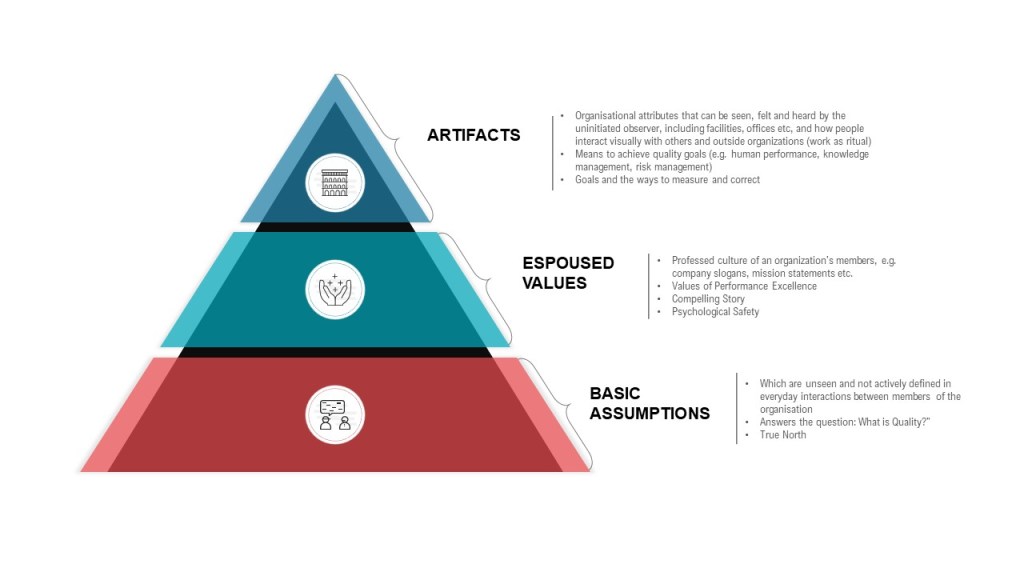
Edgar Schein’s Organizaitonal Culture Model
Schein’s model of organizational culture provides a valuable place to start in assessing quality culture:
The first basic quality assumption to tackle is to answer what do you mean by Quality?
Even amongst quality professionals, we do not all seem to be in agreement on what we mean by Quality. Hence all the presentations at conferences and part of the focus on Quality 4.0 (the other part of the focus is mistaken worship of technology – go back to Deming people!)
Route out the ambiguity that results in:
Uncontrollable fragmentation of quality thinking, discussion, and practices
Superficiality of quality-related information and communication
Conceptual confusion between the quality results and quality enablers, and between quality and many other related factors
Disintegration of the foundation of quality
I like to place front and center the definition of quality from ISO 9000: “degree to which a set of inherent characteristics of an object fulfils requirements.” This definition emphasizes the relative nature of quality (“degree”) that also highlights the subjective perception of quality. The object of quality is defined more generally than for the goods or service products only. The object has its inherent characteristics that consist of all of its features or attributes. “Requirement” means here needs and expectations, which may be related to all interested parties of the object and the interaction. This definition of quality is also compatible the prevailing understanding of quality in everyday language.
For an organization, the definition of quality relates to the organization’s stakeholders. With the definition, we can consider both the quality of the organization as a whole and the quality of the entities being exchanged between the organization and its stakeholders. Products produced and delivered to the organization’s customers are especially significant entities in this context.
Following through with ISO9000’s definition of Quality management implying how the personal, organizational, or societal resources and activities or processes are managed with regard to quality, we are able to the framework for basic quality assumptions in an organization.
Herein usually lies your True North, a term used a lot, that recognizes that quality is a journey: there is no absolute destination point and we will never achieve perfection. Think of True North not as a destination, but as a term used to describe the ideal state of perfection that your organization should be continually striving for.
In espoused quality values we take the shared concept of quality and expand it to performance excellence as an integrated approach to the organizational performance management that results in:
the delivery of ever-improving value to customers and stakeholders, contributing to organizational sustainability
the improvement of overall organizational effectiveness and capabilities
Organizational and personal learning.
We need to have a compelling story around these values.
A compelling story is a narrative that charts a change over time, showing how potential solutions fit into the espoused values. This story can generate more engagement from listeners than any burning platform ever will. By telling a compelling story, you clarify the motivation to develop discontent with the status quo. Let the story show the organization where you have come from and where you might go. The story must be consistent and adopted by all leaders in the organization. The leadership team should weave in the compelling story at all opportunities. They should ask their teams constantly, “What’s next?” “How can we make that even better?” “How did you improve your area today?”
Compelling stories often build on dissatisfaction by positioning against competitors. In the life science sector, it can be more effective to enshrine the patient in the center of the compelling story. People will support change when they see and experience a purposeful connection to an organization’s mission. The compelling story drives that.
Espoused values require strong and constant communication.
Espoused values have more levers for change than basic assumptions. While I placed True North down in assumptions, in all honestly it will for a central part of that compelling story and drive the adoption of the espoused values.
In the post “Driving towards a Culture of Excellence” I provided elements of a high-performing culture that count as artifacts of quality, stemming from the values.
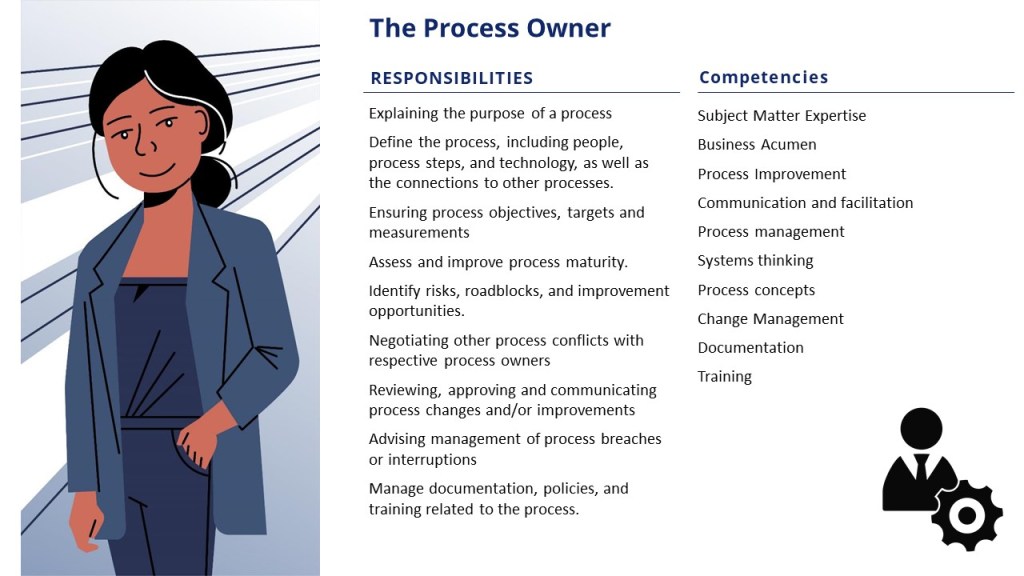
Process owners are a fundamental and visible difference part of building a process oriented organizations and are crucial to striving for an effective organization. As the champion of a process, they take overall responsibility for process performance and coordinate all the interfaces in cross-functional processes.
Being a process owner should be the critical part of a person’s job, so they can shepherd the evolution of processes and to keep the organization always moving forward and prevent the reversion to less effective processes.
The Process Owner’s Role
The process owner plays a fundamental role in managing the interfaces between key processes with the objective of preventing horizontal silos and has overall responsibility of the performance of the end-to-end process, utilizing metrics to track, measure and monitor the status and drive continuous improvement initiatives. Process owners ensure that staff are adequately trained and allocated to processes. As this may result in conflicts arising between process owners, teams, and functional management it is critical that process owners exist in a wider community of practice with appropriate governance and senior leadership support.
Process owners are accountable for designing processes; day-to-day management of processes; and fostering process related learning.
Process owners must ensure that process staff are trained to have both organizational knowledge and process knowledge. To assist in staff training, processes, standards and procedures should be documented, maintained, and reviewed regularly.
Process Owners should be supported by the right infrastructure. You cannot be a SME on a end-to-end-process, provide governance and drive improvement and be expected to be a world class tech writer, training developer and technology implementer. The process owner leads and sets the direction for those activities.
The process owner sits in a central role as we build culture and drive for maturity.
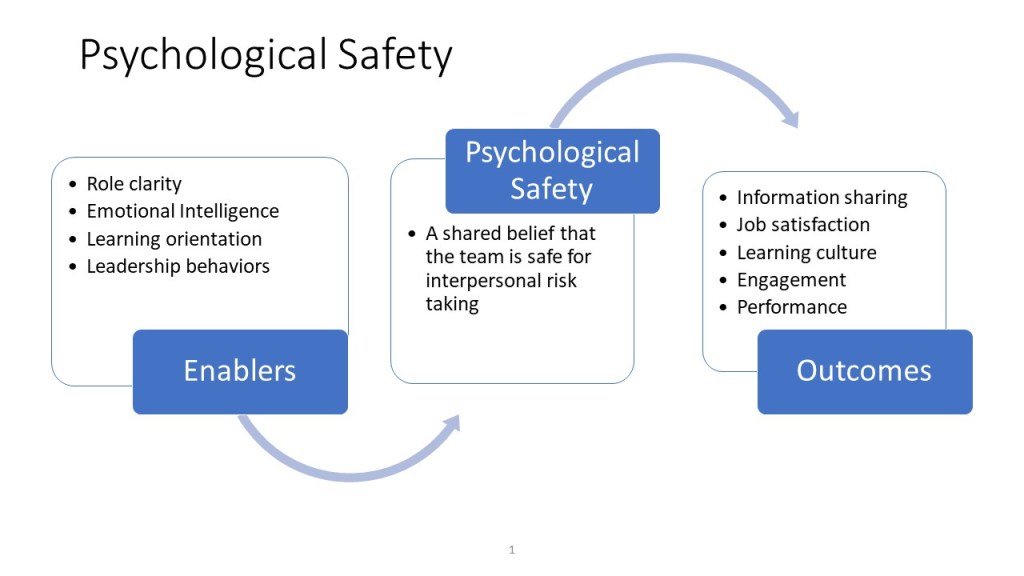
Psychological safety enables individuals to behave authentically, take risks and express themselves candidly. In the workplace, psychological safety captures how comfortable employees feel as team members. Timothy Clark gives four elements of psychological safety:
Psychological safety, Reflexivity and a Learning Culture
Reflexivity is the extent employees reflect upon the work tasks they have completed and identify ways of improving performance – it is the information-processing activity. Using reflexivity, employees develop a better sense of what is done, why and how, and can adjust their behaviors and actions accordingly. Reflexivity is a powerful process that can drive performance in a learning culture that requires psychological safety to flourish. When employees reflect upon their work tasks, they need to have a deeper and better understanding of what they have done, what was done well and not as well, why they engaged in these behaviors, and changes and adaptations needed to result in better performance. People are not likely to engage in reflexivity unless they feel psychologically safe to take interpersonal risks, speak up, and admit failures without feeling uncomfortable or fearful of status and image loss.
Psychological Safety is the magic glue that makes transformative learning possible. Psychological Safety and reflexivity enables a problem solving culture.
Bibliography
Clark, T.R. 2020. The 4 Stages of Psychological Safety. Oakland, CA: Barrett-Koehler
Edmondson, A. 2018. The Fearless Organization: Creating Psychological Safety in the Workplace for Learning, Innovation and Growth. Hoboken, NJ: John Wiley and Sons
West, M.A. 1996. Reflexivity and work group effectiveness: A conceptual integration. In M.A. West (Ed.), Handbook of work group psychology. Chichester, UK: Wiley.
Zak, P.J. 2018. “The Neuroscience of High-Trust Organizations.” Consulting Psychology Journal: Practice and Research 70(1): 45-48
Gemba, as a term, is here to stay. We’re told that gemba comes from the Japanese for “the actual place”, and people who know more than me say it probably should translate as “Genba” but phonetically it uses an “m” instead and as a result, it’s commonly referred to as gemba – so that’s how it is used. Someday I’ll see a good linguistic study of loan words in quality circles, and I have been known to fight against some of the “buzz-terminess” of adopting words from Japanese. But gemba is a term that seems to have settled in, and heck, English is a borrowing language.
Just don’t subject me to any more hour-long talks about how we’re all doing lean wrong because we misunderstood a Japanese written character (I can assure you I don’t know any Japanese written characters). The Lean practitioner community sometimes reminds me of 80s Ninja movies, and can be problematic in all the same ways – you start with “Enter the Ninja” and before long it’s Remo Williams baby!
So let’s pretend that gemba is an English word now, we’ve borrowed it and it means “where the work happens.” It also seems to be a noun and a verb.
And if you know any good studies on the heady blend of Japanophobia mixed with Japanophilia from the 80s and 90s that saturated quality and management thinking, send them my way.
I think we can draw from ethnography more in our methodology.
The Importance of the Gemba Walk
Gemba is a principle from the lean methodology that says “go and see” something happening for real – you need to go and see how the process really works. This principle rightly belongs as one of the center points of quality thinking. This may be fighting words but I think it is the strongest of the principles from Lean because of the straightforward “no duh” of the concept. Any quality idea that feels so straightforward and radical at the same time is powerful.
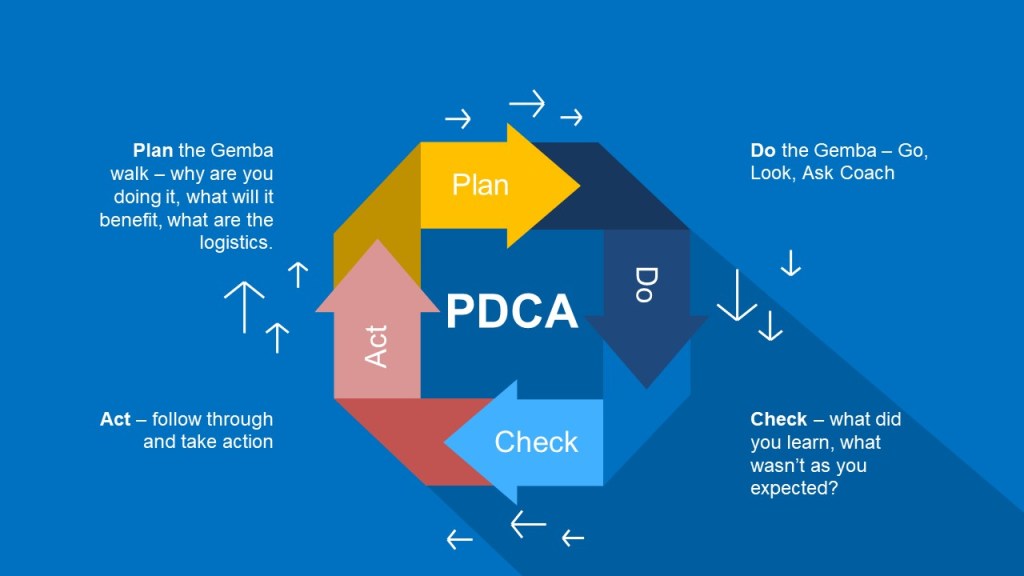
You can think of a gemba through the PDCA lifecycle -You plan, you do it, you decide on the learnings, you follow through.
Gemba seen through the PDCA lense
This is all about building a shared understanding of problems we all face together by:
Observation of specific issues where things don’t go as intended, listening to the people who do the work.
Discussion of what those issues mean both in the details of operations but also on a wider strategic level.
Commitment to problem solving in order to investigate further – not to fix the issue but to have the time to delve deeper. The assumption is that if people understand better what they do, they perform better at every aspects of their job
Gemba walks demonstrate visible commitment from the leadership to all members of the organization. They allow leadership to spread clear messages using open and honest dialogue and get a real indication of the progress of behavioral change at all levels. They empower employees because their contributions to site results are recognized and their ideas for continuous improvements heard.
Conducting a Successful Gemba Walk
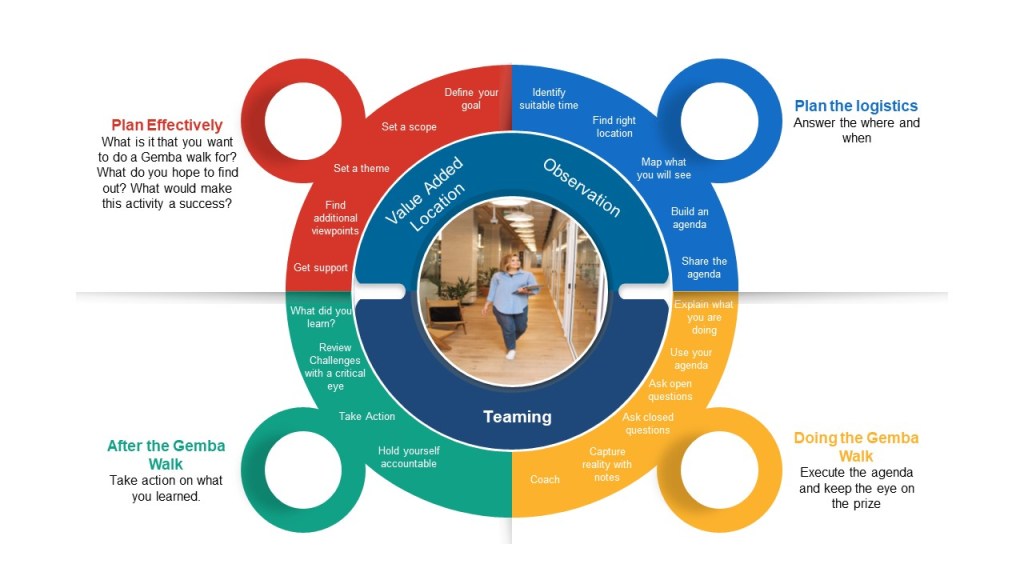
Elements of a Successful Gemba
Plan Effectively
Define your goal
What is it that you want to do a gemba walk for? What do you hope to find out? What would make this activity a success? A successful walk stresses discovery.
Set a scope
Which areas will you observe? A specific process? Team? This will allow you to zoom into more detail and get the most out of the activity.
Set a theme
What challenges or topics will you focus on? Specific and targeted gemba walks are the most effective. For example, having a emba focusing on Data Integrity, or area clearance or error reduction.
Picking the right challenge is critical. Workplaces are complex and confusing, a gemba walk can help find concrete problems and drive improvement linked to strategy.
Find additional viewpoints
Who else can help you? Who could add a “fresh pair of eyes” to see the big questions that are left un-asked. Finding additional people to support will result in a richer output and can get buy in from your stakeholders.
Get support
Bring visibility and sponsorship for your gemba. Ensure all stakeholders are aware and on board.
Plan the Logistics
Identify Suitable Time
Find a suitable time from the process’ perspective. Be sure to also consider times of day, days of the week and any other time-based variations that occur in the process.
Find right location
Where should you see the process? Also, do you need to consider visiting multiple sites or areas?
Map what you’ll see
Define the process steps that you expect to see.
Build an agenda
What parts of the process will you see in what order? Are there any time sensitive processes to observe?
Share that agenda
Sharing your agenda to get help from the operational owner and other subject matter experts.
Doing the Gemba Walk
Explain what you are doing
Put people at ease when you’re observing the process.
When you are on the walk you need to challenge in a productive yet safe manner to create a place where everyone feels they’ve learned something useful and problems can be resolved. It pays to communicate both the purpose and overall approach by explaining the why, the who, and the when.
Use your agenda
Keep some flexibility but also make sure to cover everything.
Open discussion and explore the process challenges.
Ask closed questions
Use this to check your understanding of the process.
Capture reality with notes
Take notes as soon as possible to make sure you recall the reality of the situation.
Coach
As a coach, your objective is not to obtain results – that’s the person you’re coaching’s role – but to keep them striving to improve. Take a step back and focus on dismantling barriers.
What did you learn
What did you expect to see but didn’t? Also, what did you not expect to happen?
The ask questions, coach, learn aspect can be summarized as:
Visualize the ideal performance with your inner eye
Spot the specific difficulty the person is having (they’ll tell you – just listen)
Explain that (though sometimes they won’t want to hear it)
Spell out a simple exercise to practice overcoming the difficulty.
After the Gemba Walk
What did you learn?
Were challenges widespread or just one offs? Review challenges with a critical eye. The best way I’ve heard this explained is “helicopter” thinking – start n a very detailed operational point and ascend to the big picture and then return to the ground.
Resolve challenges with a critical eye
Define next steps and agree which are highest priority. It is a good outcome when what is observed on the gemba walk leads to a project that can transform the organization.
Take action
Follow-through on the agreed upon actions. Make them visible. In order to avoid being seen only as a critic you need to contribute firsthand.
Hold yourself to account
Share your recommendations with others. Engage in knowledge management and ensure actions are complete and effective.
Key points for executing a successful GEMBA
Gemba Walks as Standard Work
You can standardize a lot of the preparation of a gemba walk by creating standard work. I’ve seen this successfully done for data integrity, safety, material management, and other topics.
Build a frequency, and make sure they are often, and then hold leaders accountable.
Who
Best Practice Frequency
Minimum Recommended Frequency
First line supervisors
Each shift, multiple times
Each shift
Team leaders in individual units
Daily covering different shifts
2 per week
Unit/Department heads
1 per day
1 per week
Leadership team
1 per day
1 per month
Internal customers and support (e.g. purchasing, finance, HR)
1 per month
1 per quarter
Frequency recommendation example
Going to the Gemba for a Deviation and Root Cause Analysis
These same principles can apply to golden-hour deviation triage and root cause analysis. This form of gemba means bringing together a cross-functional team meeting that is assembled where a potential deviation event occurred. Going to the gemba and “freezing the scene” as close as possible to the time the event occurred will yield valuable clues about the environment that existed at the time – and fresher memories will provide higher quality interviews. This gemba has specific objectives:
Obtain a common understanding of the event: what happened, when and where it happened, who observed it, who was involved – all the facts surrounding the event. Is it a deviation?
Clearly describe actions taken, or that need to be taken, to contain impact from the event: product quarantine, physical or mechanical interventions, management or regulatory notifications, etc.
Interview involved operators: ask open-ended questions, like how the event unfolded or was discovered, from their perspective, or how the event could have been prevented, in their opinion – insights from personnel experienced with the process can prove invaluable during an investigation.
You will gain plenty of investigational leads from your observations and interviews at the gemba – which documents to review, which personnel to interview, which equipment history to inspect, and more. The gemba is such an invaluable experience that, for many minor events, root cause and CAPA can be determined fairly easily from information gathered solely at the gemba.


 Investigations of a Dog