
Democratic Leadership Style

A building block of Quality culture is learning how to make decisions faster without impairing their quality. We do this by ensuring availability of the right knowledge so that the appropriate measures can be decided on and making the decision-making processes quicker.

Adopting a flexible but consistent approach to decision-making and giving people greater leeway creates the organizational framework for faster decision-making processes. In addition to creating the right framework, however, it is equally important for employees to have confidence in each other so that decisions are not only taken quickly but also implemented swiftly. Rather than merely seeing employees as resources, this requires management to value them as part of the community because of the competencies that they bring to the table. The underlying capability that makes this possible is a democratic leadership style.

Democratic leadership is a style where decision-making is decentralized and shared by all. This style of leadership proposes that decision-making should be shared by the leader and the group where criticisms and praises are objectively given and a feeling of responsibility is developed within the group. Leaders engage in dialogue that offers others the opportunity to use their initiative and make contributions. Once decisions are collectively taken, people are sure of what to do and how to do it with support from leaders to accomplish tasks successfully. It is the “Yes…but…and” style of leadership.

This style requires a high degree of effort in building organizational decision-making capabilities. You need to build a culture that ensures that everyone has an equal interest in an outcome and shared levels of expertise relative to decisions. But nothing provides better motivated employees.

For those keeping track on the leadership style bingo card, this requires mashing democratic and transformational leaders together (with a hefty flavoring of servant leadership). Just the democratic style is not enough, you need a few more aspects of a transformational leader to make it work.

Characteristics of a Democratic Leader

Idealized Influence means being the role model and being seen to be accountable to the culture. Part of this is doing Gemba walks as part of your standard work.

Inspirational Motivation means inspiring confidence, motivation and a sense of purpose. The leader must articulate a clear vision for the future, communicate expectations of the group and demonstrate a commitment to the goals that have been decided upon.

Through Intellectual Stimulation, the leader presents to the organization a number of challenging new ideas that are supposed to stimulate rethinking of new ways of doing things in the organization, thus seeking ideas, opinions and inputs from others to promote creativity, innovation and experimentation of new methods to replace the old ways. The leader articulates True North.

Decentralized decision-making around these new ways of doing are shared by all. Decisions are taken by both the leader and the group where criticisms and praises are objectively given and a feeling of responsibility is developed within the group, thus granting everyone the opportunity to use their initiative and make contributions. Decentralized decision-making ensures everyone empowered to take actions and are responsible for the implementation and effectiveness of these actions. This will drive adaptation and bring accountability.

Reading list

  • Arenas, F.J., Connelly, D.A. and Williams, M.D. (2018), Developing Your Full Range of Leadership, Air University Press, Maxwell AFB
  • Gastil, J. (1994), “A definition and illustration of democratic leadership”, Human Relations, Vol. 47 No. 8,pp. 953-975
  • Hayes, A.F. (2018), Introduction to Mediation, Moderation and Conditional Process Analysis, 2nd ed.,The Guilford Press, New York, N
Anger and the job in difficult times

On Wednesday the United States set a devastating new record in the coronavirus pandemic: 3,124 people dead in one day. This was the first time the daily number of deaths has exceeded 3,000 but I fear it will not be the last. There are over 260k deaths in the US so far, over 1.5 million deaths worldwide. This is crippling, and it is difficult to go day-by-day with the pain of this suffering.

And yet, we need to work, support our families and communities. Get the job done. Amidst all that it is important to remember that is important to grieve and it is okay to be angry.

People grieve in diverse ways with different emotions, from anger, to depression to hopelessness, to resentment over what has been taken from them. Combined with the isolation of the pandemic, this is a recipe for poor mental health and poor coping mechanisms. And then there is a question of just how much and what sort of coping is good. Two-hundred-and-sixty thousand people are dead and there is a lot of evidence this is an underreport and a lot more people are going to die.

I hope you understand that I am angry. All day long. And it is a struggle not to bring that anger to work, not to let it twist my relationships. Yet that anger always exists.

I linked earlier this week to an article on mental health. It is particularly important to make this part of our organizations. Burnout must have a systematic fix.

What we need to give permission to, give space to, is a recognition that we are not in an okay state. And it may not be okay for a very long while, long after vaccines are widely available, and we return to the office.

It is okay to have taken a step back from obligations. I have not, for example, been writing much on this blog. It just did not work for me. Be kind to yourself and be okay with the things you must do less of. And when you are ready, go back to it.

Anger and Culture

Our organizational cultures are full of anger. What we must do is work to establish mechanisms to assure that anger is directed at issues or situations, not people. This will build psychological safety, enable good decisions and enhance our problem solving culture.

Some things we should do:

  • Acknowledge what is happening: Senior leadership needs to be working from compassion and generosity and taking real steps to address.
  • Treat toxic positivity as a bias: Toxic positivity is the assumption, either by one’s self or others, that despite a person’s emotional pain or difficult situation, they should only have a positive mindset. This is especially important as we have talent discussions, evaluate performance, and perform other managerial tasks.
  • Have systems around burnout
  • Focus on decision making quality
  • Build employee judgement feedback loops

We are not done. This winter will be very hard for many. As leaders we need to be ensuring our organizations can get through this and then leverage what we’ve learned to build a better culture.

Identifying Waste in Risk Management

Risk Management often devolves into a check-the-box, non-valued activity in an organization. While many organizations ensure they have the right processes in place, they still end up not protecting themselves against risk effectively. A lot of our organizations struggle to understand risk and apply this mindset in productive ways.

As quality professionals we should be applying the same improvement tools to our risk management processes as we do anything else.

To improve a process, we first need to understand the value from the process. Risk management is the identification, evaluation, and prioritization of risks (defined in ISO 31000 as the effect of uncertainty on objectives) followed by coordinated and economical application of resources to minimize, monitor, and control the probability or impact of unfortunate events or to maximize the realization of opportunities.

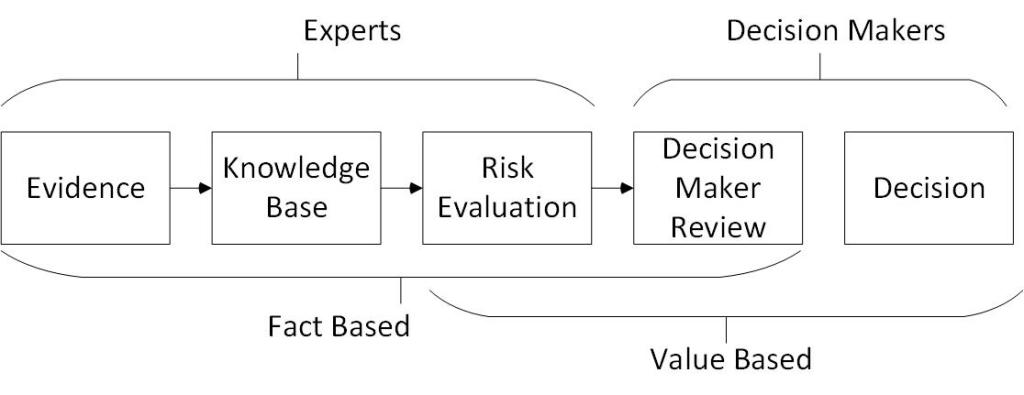
Risk management then is an application of decision quality to reduce uncertainty on objectives. We can represent the process this way:

The risk evaluation is the step where the knowledge base is evaluated, and a summary judgment is reached on the risks and uncertainties involved in the case under investigation. This evaluation must take the values of the decision-makers into account and a careful understanding has to be had on just what the practical burden of proof is in the particular decision.

Does Risk Management then create value for those perceived by the stakeholders? Can we apply a value stream approach and look to reduce wastes?  Some common ones include:

Waste in Risk ManagementExampleReflects
Defective Information“The things that hurts you is never in a risk matrix”  “You have to deliver a risk matrix, but how you got there doesn’t matter”Missing stakeholder viewpoints, poor Risk Management process, lack of considering multiple sources of uncertainty, poor input data, lack of sharing information
Overproduction“if it is just a checklist sitting somewhere, then people don’t use it, and it becomes a wasted effort”Missing standardization, serial processing and creation of similar documents, reports are not used after creation
Stockpiling Information“we’re uncertain what are the effect of the risk as this early stage, I think it would make more sense to do after”Documented risk lay around unutilized during a project, change or operations
Unnecessary movement of people“It can be time consuming walking around to get information about risk”Lack of documentation, risks only retrievable by going around asking employees
Rework“Time spend in risk identification is always little in the beginning of a project because everybody wants to start and then do the first part as quickly as possible.”Low quality initial work, ‘tick the-box’ risk management
Information rot“Risk reports are always out of date”The documents were supposed to be updated and re-evaluated, but was not, thus becoming partially obsolete over time
Common wastes in Risk Management

Once we understand waste in risk management we can identify when it happens and engage in improvement activities. We should do this based on the principles of decision quality and very aware of the role uncertainty applies.

References

  • Anjum, Rani Lill, and Elena Rocca. “From Ideal to Real Risk: Philosophy of Causation Meets Risk Analysis.” Risk Analysis, vol. 39, no. 3, 19 Sept. 2018, pp. 729–740, 10.1111/risa.13187.
  • Hansson, Sven Ove, and Terje Aven. “Is Risk Analysis Scientific?” Risk Analysis, vol. 34, no. 7, 11 June 2014, pp. 1173–1183, 10.1111/risa.12230
  • Walker, Warren E., et al. “Deep Uncertainty.” Encyclopedia of Operations Research and Management Science, 2013, pp. 395–402, 10.1007/978-1-4419-1153-7_1140
  • Willumsen, Pelle, et al. “Value Creation through Project Risk Management.” International Journal of Project Management, Feb. 2019, 10.1016/j.ijproman.2019.01.007

Brainstorming usually sinks your ship

If you work in teams, chances are you use brainstorming, gathering face-to-face in groups so that everyone can share ideas. This technique has been around since the late 1930s and many in quality and excellence pursuits view it as an effective technique.

Unfortunately, the science I’ve read is not quite in agreement. A group of four people typically generates approximately half as many ideas as a nominal group of four does. Production blocking, and a few other problems, lead to some key deficiencies in brainstorming:

  •  When group members are waiting for turn-taking, there are high chances that they may forget the ideas that they had in mind, they may focus on remembering those ideas rather than listening, or they may decide their ideas are no longer relevant.
  • The competing demand for coming up with one’s own idea and listening to other’s ideas makes it difficult to build on the ideas of others.
  • As the size of the group increases, the participants might feel less identifiable or accountable which might lead to decreased social loafing or level of motivation.

Overcoming production blocking requires the use of additional tools, such as brainwriting. Brainwriting encompasses the sharing of ideas through pieces of paper – usually having people write their ideas out on post-it notes for example. This technique makes brainstorming effective by overcoming the problem of verbal brainstorming. Though their seems to be some worry here about social cues kicking in, and there may be more benefit in having folks write all their ideas on one piece of paper, or better yet on their own before the meeting.

Brain writing, to be truly effective, requires solid collaborative evaluation process to follow the idea generation phase this is the foundation of decision quality. The research seems to indicate we see results better than the norm with this combination.

This appears to be an area where more research is needed to examine different variations , the boundary conditions for demonstrating the superiority of brainwriting over nominal groups, the optimum size of the group, and the potential of mixing verbal and nonverbal brainstorming. If anyone knows of good studies in this area, please point me to them.

References

  • Coskun, H. (2005). Cognitive stimulation with convergent and divergent thinking exercises in brainwriting: Incubation, sequence priming, and group context. Small Group Research, 36, 466-498. doi:10.1177/1046496405276475
  • Cragan, J. F., Wright, D. W., & Kasch, C. R. (2009). Communication in small groups : theory, process, skills. Boston, MA: Cengage Learning – Academic and Professional Group.
  • West, M. A. (2012). Effective teamwork : practical lessons from organizational research. Wiley-Blackwell.

A Structured Approach to Strategic Decisions

Making sound strategic decisions is crucial for organizational success, however, human judgment can be unreliable, leading to errors that can significantly impact that success. To address this challenge, a structured approach to strategic decision-making is essential.

Organizations can be viewed as decision factories, where the primary output is not physical products, but rather judgments and choices that shape the company’s future. This perspective, popularized by thinkers like Daniel Kahneman, emphasizes the critical role of decision-making in organizational success.

In a decision factory, every employee is part of the production line, contributing to the quality and efficiency of decisions made. Just as a traditional factory focuses on optimizing its manufacturing processes, a decision factory must refine its decision-making processes to ensure high-quality outcomes. This involves carefully designing the organizational structure, clarifying decision rights, and establishing effective methodologies.

To improve the quality of decisions, organizations should focus on several key areas. First, they need to align their decision-making processes with their strategic direction, ensuring that decisions at all levels support the company’s overall goals. Second, they should implement robust methodologies and processes that facilitate evidence-based analysis. Finally, cultivating a culture that values data-driven insights, encourages diverse perspectives, and promotes accountability is crucial for maintaining a high-performing decision factory.

The Challenge of Evaluative Judgments

These quality decisions are fundamentally evaluative judgments. They require decision-makers to process large amounts of complex information and either:

  1. Assign numerical scores to competing options
  2. Make a yes-no decision on a specific course of action

These judgments are susceptible to errors stemming from cognitive biases and random variations, often referred to as “noise”. Recognizing this unreliability is the first step towards improving the decision-making process.

There are several really good tools, such as Multi-Criteria Decision-Making, to help drive to good decision making. The Mediating Assessments Protocol , a method from the book “Noise”, designed by Daniel Kahneman and Olivier Sibony, “with noise mitigation as a primary objective” is an excellent, if slightly simpler, tool that deserves to be in your toolbox.

The Mediating Assessments Protocol (MAP)

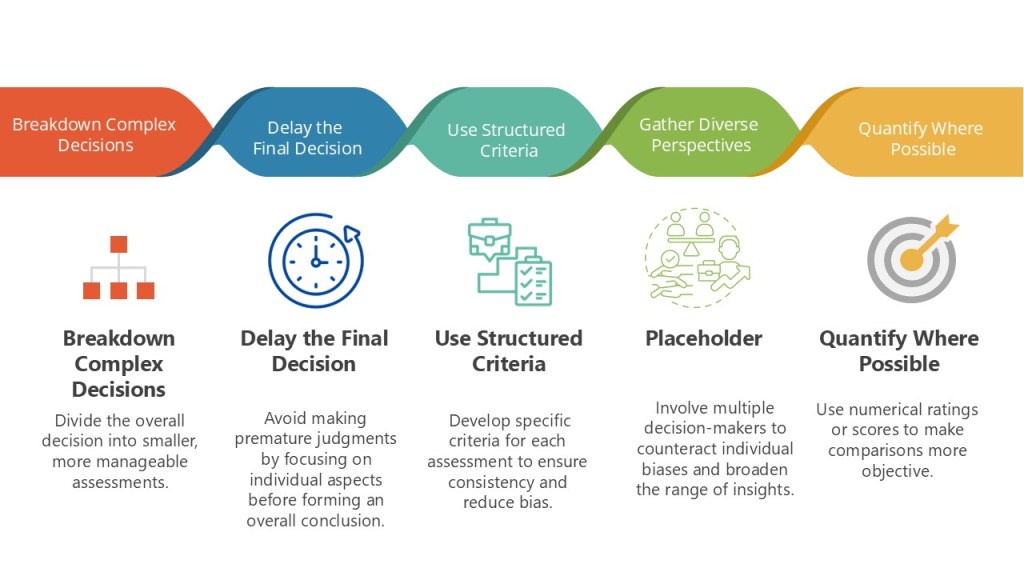
The Mediating Assessments Protocol (MAP) is a structured approach to strategic decision-making aims to reduce errors and improve the quality of judgments. I think this a good tool for the toolbox, as it:

  1. Break down complex decisions: Divide the overall decision into smaller, more manageable assessments.
  2. Delay the final decision: Avoid making premature judgments by focusing on individual aspects before forming an overall conclusion.
  3. Use structured criteria: Develop specific criteria for each assessment to ensure consistency and reduce bias.
  4. Gather diverse perspectives: Involve multiple decision-makers to counteract individual biases and broaden the range of insights.
  5. Quantify where possible: Use numerical ratings or scores to make comparisons more objective.

Implementing a structured approach like MAP can yield several benefits. First and foremost, it significantly reduces bias in the decision-making process. By breaking decisions into smaller components, the influence of initial impressions or irrelevant factors is minimized. This allows decision-makers to focus on each aspect individually, leading to more objective evaluations.

Another key advantage is improved consistency. Structured criteria ensure that all options are evaluated on the same basis, eliminating the variability that often occurs when different decision-makers use their own subjective standards. This consistency not only improves the quality of decisions but also makes it easier to compare and contrast different options.

Enhanced transparency is yet another benefit of a structured approach. The decision-making process becomes clearer and more defensible when each step is well-defined and documented. This transparency can be particularly valuable in organizations where decisions need to be justified to stakeholders or where there’s a need for accountability.

Lastly, a structured approach like MAP can lead to better group dynamics. By providing a framework for evaluation, it helps prevent groupthink and encourages diverse viewpoints. Team members are more likely to voice their opinions when there’s a clear process for considering different aspects of a decision, leading to more robust and well-rounded strategic choices.

To adopt a structured approach to strategic decision-making:

  1. Identify key decisions: Determine which strategic decisions would benefit most from a structured approach.
  2. Develop assessment criteria: Create specific, measurable criteria for each aspect of the decision.
  3. Train decision-makers: Ensure that all involved parties understand the MAP process and its benefits.
  4. Document the process: Keep records of assessments and final decisions for future reference and learning.
  5. Review and refine: Regularly evaluate the effectiveness of your structured approach and make improvements as needed.

By adopting a structured approach like MAP, organizations can significantly improve the quality of their strategic decisions. This method helps mitigate cognitive biases, reduces noise in the decision-making process, and ultimately leads to more reliable and successful outcomes. In an increasingly complex business landscape, such an approach can provide a crucial competitive advantage.


References

  • Kahneman, D., Lovallo, D., & Sibony, O. (2019). A structured approach to strategic decisions. MIT Sloan Management Review, 60(3), 67-73.
  • Sinnaiah, T., Adam, S., & Mahadi, B. (2023). A strategic management process: the role of decision-making style and organisational performance. Journal of Work-Applied Management, 15(1), 37-50.
  • Mintzberg, H., Ahlstrand, B., & Lampel, J. (2020). Strategy safari: A guided tour through the wilds of strategic management. Free Press.
  • Calabretta, G., Gemser, G., & Wijnberg, N. M. (2017). The interplay between intuition and rationality in strategic decision making: A paradox perspective. Organization Studies, 38(3-4), 365-401.
  • Hodgkinson, G. P., & Sadler-Smith, E. (2018). The dynamics of intuition and analysis in managerial and organizational decision making. Academy of Management Perspectives, 32(4), 473-492.
  • Keeney, R. L. (1982). Decision analysis: An overview. Operations Research, 30(5), 803-838.
  • Gregory, R., Failing, L., Harstone, M., Long, G., McDaniels, T., & Ohlson, D. (2012). Structured decision making: A practical guide to environmental management choices. John Wiley & Sons.
  • Eisenhardt, K. M., & Zbaracki, M. J. (1992). Strategic decision making. Strategic Management Journal, 13(S2), 17-37.
  • Hammond, J. S., Keeney, R. L., & Raiffa, H. (1998). The hidden traps in decision making. Harvard Business Review, 76(5), 47-58.
  • Papadakis, V. M., Lioukas, S., & Chambers, D. (1998). Strategic decision-making processes: The role of management and context. Strategic Management Journal, 19(2), 115-147.