Worker’s Rights: The Bedrock of True Quality Management – A May Day Reflection

As we celebrate International Workers’ Day this May 1st, it is an opportune moment to reflect on the profound connection between workers’ rights and effective quality management. The pursuit of quality cannot be separated from how we treat, empower, and respect the rights of those who create that quality daily. Today’s post examines this critical relationship, drawing from the principles I’ve advocated throughout my blog, and challenges us to reimagine quality management as fundamentally worker-centered.

The Historical Connection Between Workers’ Rights and Quality

International Workers’ Day commemorates the historic struggles and gains made by workers and the labor movement. This celebration reminds us that the evolution of quality management has paralleled the fight for workers’ rights. Quality is inherently a progressive endeavor, fundamentally anti-Taylorist in nature. Frederick Taylor’s scientific management approach reduced workers to interchangeable parts in a machine, stripping them of autonomy and creativity – precisely the opposite of what modern quality management demands.

The quality movement, from Deming onwards, has recognized that treating workers as mere cogs undermines the very foundations of quality. When we champion human rights and center those whose rights are challenged, we’re not engaging in politics separate from quality – we’re acknowledging the fundamental truth that quality cannot exist without empowered, respected workers.

Driving Out Fear: The Essential Quality Right

“No one can put in his best performance unless he feels secure,” wrote Deming thirty-five years ago. Yet today, fear remains ubiquitous in corporate culture, undermining the very quality we seek to create. As quality professionals, we must confront this reality at every opportunity.

Fear in the workplace manifests in multiple ways, each destructive to quality:

Source of FearDescriptionImpact on Quality
CompetitionManagers often view anxiety generated by competition between co-workers as positive, encouraging competition for scarce resources, power, and statusUndermines collaboration necessary for system-wide quality improvements
“Us and Them” CultureSilos proliferate, creating barriers between staff and supervisorsPrevents holistic quality approaches that span departmental boundaries
Blame CultureFocus on finding fault rather than improving systems, often centered around the concept of “human error”Discourages reporting of issues, driving quality problems underground

When workers operate in fear, quality inevitably suffers. They hide mistakes rather than report them, avoid innovation for fear of failure, and focus on protecting themselves rather than improving systems. Driving out fear isn’t just humane – it’s essential for quality.

Key Worker Rights in Quality Management

Quality management systems that respect workers’ rights create environments where quality can flourish. Based on workplace investigation principles, these rights extend naturally to all quality processes.

The Right to Information

In any quality system, clarity is essential. Workers have the right to understand quality requirements, the rationale behind procedures, and how their work contributes to the overall quality system. Transparency sets the stage for collaboration, where everyone works toward a common quality goal with full understanding.

The Right to Confidentiality and Non-Retaliation

Workers must feel safe reporting quality issues without fear of punishment. This means protecting their confidentiality when appropriate and establishing clear non-retaliation policies. One of the pillars of workplace equity is ensuring that employees are shielded from retaliation when they raise concerns, reinforcing a commitment to a culture where individuals can voice quality issues without fear.

The Right to Participation and Representation

The Who-What Matrix is a powerful tool to ensure the right people are involved in quality processes. By including a wider set of people, this approach creates trust, commitment, and a sense of procedural justice-all essential for quality success. Workers deserve representation in decisions that affect their ability to produce quality work.

Worker Empowerment: The Foundation of Quality Culture

Empowerment is not just a nice-to-have; it’s a foundational element of any true quality culture. When workers are entrusted with authority to make decisions, initiate actions, and take responsibility for outcomes, both job satisfaction and quality improve. Unfortunately, empowerment rhetoric is sometimes misused within quality frameworks like TQM, Lean, and Six Sigma to justify increased work demands rather than genuinely empowering workers.

The concept of empowerment has its roots in social movements, including civil rights and women’s rights, where it described the process of gaining autonomy and self-determination for marginalized groups. In quality management, this translates to giving workers real authority to improve processes and address quality issues.

Mary Parker Follett’s Approach to Quality Through Autonomy

Follett emphasized giving workers autonomy to complete their jobs effectively, believing that when workers have freedom, they become happier, more productive, and more engaged. Her “power with” principle suggests that power should be shared broadly rather than concentrated, fostering a collaborative environment where quality can thrive.

Rejecting the Great Man Fallacy

Quality regulations often fall into the trap of the “Great Man Fallacy” – the misguided notion that one person through education, experience, and authority can ensure product safety, efficacy, and quality. This approach is fundamentally flawed.

People only perform successfully when they operate within well-built systems. Process drives success by leveraging the right people at the right time making the right decisions with the right information. No single person can ensure quality, and thinking otherwise sets up both individuals and systems for failure.

Instead, we need to build processes that leverage teams, democratize decisions, and drive reliable results. This approach aligns perfectly with respecting workers’ rights and empowering them as quality partners rather than subjects of quality control.

Quality Management as a Program: Centering Workers’ Rights

Quality needs to be managed as a program, walking a delicate line between long-term goals, short-term objectives, and day-to-day operations. As quality professionals, we must integrate workers’ rights into this program approach.

The challenges facing quality today-from hyperautomation to shifting customer expectations-can only be addressed through worker empowerment. Consider how these challenges demand a worker-centered approach:

ChallengeImpact on Quality ManagementWorker-Centered Approach
Advanced AnalyticsRequires holistic data analysis and applicationDevelop talent strategies that upskill workers rather than replacing them
Hyper-AutomationTasks previously done by humans being automatedInvolve workers in automation decisions; focus on how automation can enhance rather than replace human work
Virtualization of WorkRethinking how quality is executed in digital environmentsEnsure workers have input on how virtual quality processes are designed
Shift to Resilient OperationsNeed to adapt to changing risk levels in real-timeEnable employees to make faster decisions by building quality-informed judgment
Digitally Native WorkforceChanged expectations for how work is managedConnect quality to values employees care about: autonomy, innovation, social issues

To meet these challenges, we must shift from viewing quality as a function to quality as an interdisciplinary, participatory process. We need to break down silos and build autonomy, encouraging personal buy-in through participatory quality management.

May Day as a Reminder of Our Quality Mission

As International Workers’ Day approaches, I’m reminded that our quality mission is inseparable from our commitment to workers’ rights. This May Day, I encourage all quality professionals to:

  1. Evaluate how your quality systems either support or undermine workers’ rights
  2. Identify and eliminate sources of fear in your quality processes
  3. Create mechanisms for meaningful worker participation in quality decisions
  4. Reject hierarchical quality models in favor of democratic, empowering approaches
  5. Recognize that centering workers’ rights isn’t just ethical-it’s essential for quality

Quality management without respect for workers’ rights is not just morally questionable-it’s ineffective. The future of quality lies in approaches that are predictive, connected, flexible, and embedded. These can only be achieved when workers are treated as valued partners with protected rights and real authority.

This May Day, let’s renew our commitment to driving out fear, empowering workers, and building quality systems that respect the dignity and rights of every person who contributes to them. In doing so, we honor not just the historical struggles of workers, but also the true spirit of quality that puts people at its center.

What steps will you take this International Workers’ Day to strengthen the connection between workers’ rights and quality in your organization?
Quality, Decision Making and Putting the Human First

Quality stands in a position, sometimes uniquely in an organization, of engaging with stakeholders to understand what objectives and unique positions the organization needs to assume, and the choices that are making in order to achieve such objectives and positions.

The effectiveness of the team in making good decisions by picking the right choices depends on their ability of analyzing a problem and generating alternatives. As I discussed in my post “Design Lifecycle within PDCA – Planning” experimentation plays a critical part of the decision making process. When designing the solution we always consider:

  • Always include a “do nothing” option: Not every decision or problem demands an action. Sometimes, the best way is to do nothing.
  • How do you know what you think you know? This should be a question everyone is comfortable asking. It allows people to check assumptions and to question claims that, while convenient, are not based on any kind of data, firsthand knowledge, or research.
  • Ask tough questions Be direct and honest. Push hard to get to the core of what the options look like.
  • Have a dissenting option. It is critical to include unpopular but reasonable options. Make sure to include opinions or choices you personally don’t like, but for which good arguments can be made. This keeps you honest and gives anyone who see the pros/cons list a chance to convince you into making a better decision than the one you might have arrived at on your own.
  • Consider hybrid choices. Sometimes it’s possible to take an attribute of one choice and add it to another. Like exploratory design, there are always interesting combinations in decision making. This can explode the number of choices, which can slow things down and create more complexity than you need. Watch for the zone of indifference (options that are not perceived as making any difference or adding any value) and don’t waste time in it.
  • Include all relevant perspectives. Consider if this decision impacts more than just the area the problem is identified in. How does it impact other processes? Systems?

A struggle every organization has is how to think through problems in a truly innovative way.  Installing new processes into an old bureaucracy will only replace one form of control with another. We need to rethink the very matter of control and what it looks like within an organization. It is not about change management, on it sown change management will just shift the patterns of the past. To truly transform we need a new way of thinking. 

One of my favorite books on just how to do this is Humanocracy: Creating Organizations as Amazing as the People Inside Them by Gary Hamel and Michele Zanini. In this book, the authors advocate that business must become more fundamentally human first.  The idea of human ability and how to cultivate and unleash it is an underlying premise of this book.

Visualized by Rose Fastus

it’s possible to capture the benefits of bureaucracy—control, consistency, and coordination—while avoiding the penalties—inflexibility, mediocrity, and apathy.

Gary Hamel and Michele Zanini, Humanocracy, p. 15

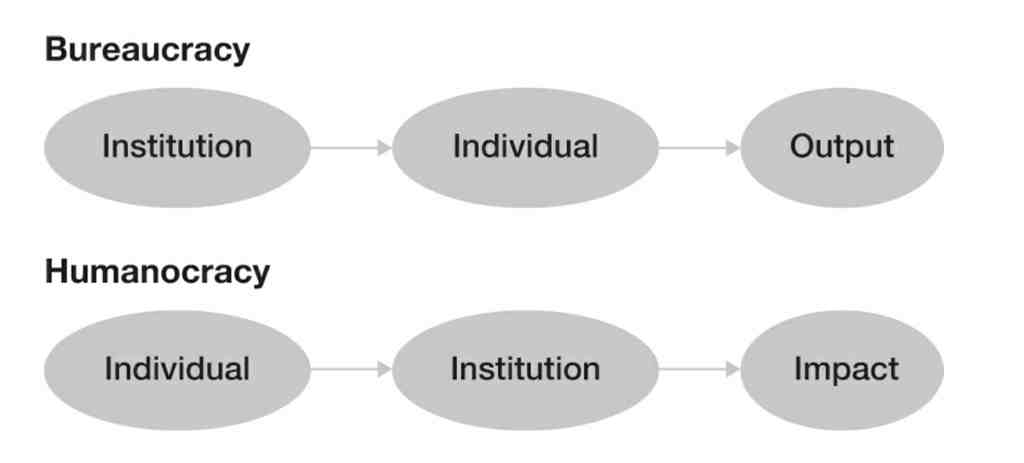
The above quote really encapsulates the heart of this book, and why I think it is such a pivotal read for my peers. This books takes the core question of a bureaurcacy is “How do we get human beings to better serve the organization?”. The issue at the heart of humanocracy becomes: “What sort of organization elicits and merits the best that human beings can give?” Seems a simple swap, but the implications are profound.

Bureaucracy versus Humanocracy. Source: Gary Hamel and Michele Zanini, Humanocracy, p. 48

I would hope you, like me, see the promise of many of the central tenets of Quality Management, not least Deming’s 8th point. The very real tendency of quality to devolve to pointless bureaucracy is something we should always be looking to combat.

Humanocracy’s central point is that by truly putting the employee first in our organizations we drive a human-centered organization that powers and thrives on innovation. Humanocracy is particularly relevant as organizations seek to be more resilient, agile, adaptive, innovative, customer centric etc. Leaders pursuing such goals seek to install systems like agile, devops, flexible teams etc.  They will fail, because people are not processes.  Resiliency, agility, efficiency, are not new programming codes for people.  These goals require more than new rules or a corporate initiative.  Agility, resilience, etc. are behaviors, attitudes, ways of thinking that can only work when you change the deep ‘systems and assumptions’ within an organization.  This book discusses those deeper changes.

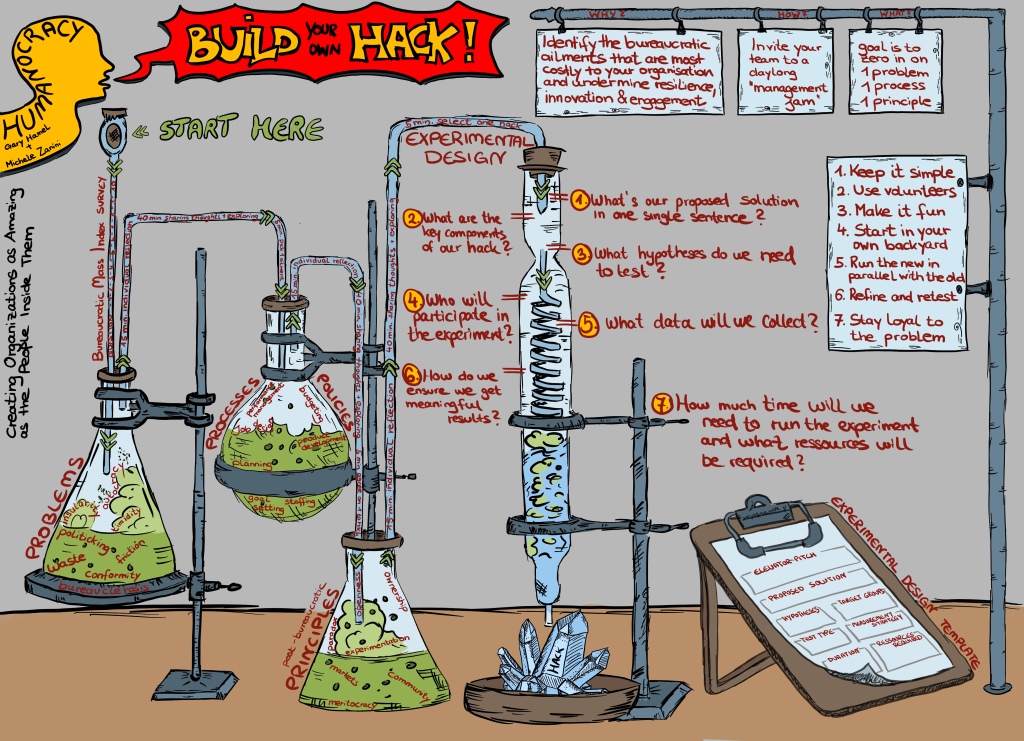
Humanocracy lays out seven tips for success in experimentation. I find they align nicely with Kotter’s 8 change accelerators.

Humanocracy’s TipKotter’s Accelerator
Keep it SimpleGenerate (and celebrate) short-term wins
Use VolunteersEnlist a volunteer army
Make it FunSustain Acceleration
Start in your own backyardForm a change vision and strategic initiatives
Run the new parallel with the oldEnable action by removing barriers
Refine and RetestSustain acceleration
Stay loyal to the problemCreate a Sense of Urgency around a
Big Opportunity
Comparison to Kotter’s Eight Accelerators for Change

Management’s Job

In episode 48 of the Deming Len’s podcast, the host refers back to Deming’s last interview, “Dr. Deming: ‘Management Today Does Not Know What Its Job Is‘”

Are You Learning or Just Staying Busy? In Their Own Words

If you've led an organization or a team for more than a few years, you've probably watched the same problems resurface again and again. Different initiatives. Different people. Same underlying issues.   In this episode, John Dues joins Andrew Stotz to dig into a puzzle Dr. Deming pointed to decades ago: "Experience without theory teaches nothing." John unpacks what Deming meant: experience doesn't come with its own explanation. It can answer a question, but only if you're asking one in the first place. Without a theory of why something works, all that hard-won experience just repeats itself. This episode is a great listen for anyone who has ever wondered why years of effort don't always add up to real improvement. TRANSCRIPT 0:00:02.2 Andrew Stotz: My name is Andrew Stotz, and I'll be your host as we dive deeper into the teachings of Dr. W. Edwards Deming. Today, I'm continuing my discussion with John Dues, who is part of the new generation of educators striving to apply Dr. Deming's principles to unleash student joy in learning. The topic for today is why experience isn't enough, and it leads to a pretty interesting puzzle. If experience is such a great teacher, shouldn't businesses and schools and school districts just keep getting better over time? John, take it away.   0:00:42.7 John Dues: Yeah, thanks for having me back, Andrew. Yeah, I think that's exactly the question that got me thinking about this. When I think about my own experience as a school leader and people I've worked with over the years, once you've been, let's say, a principal for 10 or 15 years or a teacher or superintendent, you're a school leader or a teacher leader, you've probably observed hundreds or maybe even thousands of lessons. You've dealt with all kinds of issues, discipline problems, staffing challenges, parent concerns. You've seen curriculum come and go, state assessments change, new initiatives, budget decisions, all kinds of unexpected problems. And yet, I think organizations, complex organizations like schools, you can spend years wrestling with essentially the same challenges year after year, even as the initiatives change and people sometimes change and terminology changes, but a lot of times the underlying problems can remain really, really consistent. And so I started thinking, if experience naturally produces learning, why doesn't all of this experience that gets accumulated reliably produce better organizations? And then I was thinking about something that I read from Deming, who more than 30 years ago said… Probably more than 40 years ago said now, "Experience without theory teaches nothing."   0:02:24.0 Andrew Stotz: This one… That statement always kind of got me when I first heard it. Sometimes I listen to that, "Experience without theory teaches nothing." and think to myself, I know what that means. And sometimes I listen and I think, I don't really know what that means. And so it is kind of a provocative statement because I'm thinking about, well, how did I learn? Did I learn in my past? Are we talking about individual learning or are we talking about learning within an organization? And also, isn't experience the best teacher? So what do you think Dr. Deming meant?   0:03:02.2 John Dues: Yeah, it's like a lot of things I think that he talked about, you sort of have to stop and think. And even after you've thought about it once or twice, you can come back to it and kind of question yourself, "Did I really understand that?" You might have to go talk to somebody. But when I first read it, truth be told, as I was learning this stuff, I thought he had to be exaggerating. I thought the same thing: how could experience teach us nothing? I mean, obviously, like you were saying, we learn things from experience. But I think my interpretation is that Deming's point is subtler than that. I don't think he's saying, or he wasn't saying, that experience has no value. I think what he was saying is that experience doesn't come with its own explanation. Something happens in our classroom or our school and we observe it, but what does that experience mean? What should we conclude from it? What should we do differently next time? I don't think that experience can answer those questions by itself. And in 'Out of the Crisis', Deming wrote, "Experience will answer a question, and a question comes from theory." And I think that's really the key. I think experience becomes useful when we're using it to answer a question about how we think the world works. Again, in our classroom, our school, our school district, that type of thing.   0:04:27.7 Andrew Stotz: Imagine that you're a kid walking down the street and a pit bull comes running at you and bites you on the arm. It's not too serious. The owner manages to get them off you. There's an experience. And it's experience tied with an emotion, which means it's memorable. You'll never forget that. What could you learn from that? Can you learn from that? Does what you learn from that apply to other dogs? It just, it opens up a Pandora's box that I like to think about in that particular case.   0:05:11.8 John Dues: Well, and I think in a case like that, you go through an experience like that, you're definitely gonna have a theory the next time you run into a dog, what you're gonna do, right? Especially if it looks like a…   0:05:23.4 Andrew Stotz: Yeah.   0:05:23.5 John Dues: Yeah. For sure.   0:05:24.4 Andrew Stotz: And this word theory, most of the time we don't really use that in our daily life, but we have words like theory, hypothesis, guess, hunch. So what exactly do you think he's talking about when he says theory?   0:05:45.9 John Dues: Yeah, I think that that can be, for if you're not in academia, I think that that can maybe be one of the biggest barriers to understanding this idea. I think, kind of like what you're saying, when people hear the word theory, you often are imagining something academic or something abstract. But if you think about it, we're using theories constantly, no matter what our work is. And when I'm saying theory, I'm just talking about an explanation for how and why something works. So, really every decision I'm making as a leader rests on some theory. I'm thinking about, if I'm a principal and I decide that something like weekly classroom observations will improve instruction, there's a theory behind that decision. I'm saying really, by putting weekly classroom observations into my practice, I'm saying if we increase the frequency of classroom observations and feedback, then teaching will improve. Right? That's my theory. If a superintendent who's leading his district and they have some issues with reading and they purchase a new reading curriculum, there's a theory, if teachers use this curriculum, student reading outcomes will improve. And this could apply to any number of things. The leadership team of a school district changes the schedule, they restructure what staffing looks like across their schools. You add an intervention period to your school building, the state changes the teacher evaluation system, or the state launches an attendance initiative in response to this chronic absenteeism problem we've been seeing. Every one of these decisions reflects a theory about cause and effect, basically.   0:07:46.5 Andrew Stotz: And there's two things about theory that I like to do when I'm teaching. I like to ask a question that we could prove what the answer is. And let's just say, how many companies in the world have a strong level of profitability and growth relative to peers sustained over a five-year period? That's a very specific question and I have very clear definitions of all of that. And out of… Then I ask the audience, my students, out of 8,500 companies in the sample that I have, how many companies do you think have sustained this outperformance over five years? And then they make guesses as to what they think the answer is, and then I walk them through, here's how I tried to prove it. Now, you could argue that my… You'd define something differently or you'd do the test differently over three years or seven years. One student said, "Why not 10 years?" All of that. But in the end, I say, "Okay, my answer to that question is 400."   0:08:59.9 John Dues: Interesting.   0:09:01.0 Andrew Stotz: And so then that leads me to another step in the process. And what I'm trying to teach my students in Valuation Masterclass Bootcamp is the idea of how do you think like an analyst? An analyst says they come up with a theory or an idea, like, "I think some stock, stock ABC, is gonna double in the next six months." Okay, that's a theory, and you're gonna put money down on that theory. You may try… You need to try to support it with evidence and all that, and then in six months, if you didn't write it down, you'll probably forget it or you'll misremember it.   0:09:37.7 John Dues: Yep.   0:09:38.3 Andrew Stotz: So the question isn't really whether leaders have theories. I think we all have theories, and we're acting on these theories. So where do we go from there?   0:09:49.9 John Dues: Yeah, I think what you just said is exactly right. The question is, I think, whether those theories are explicit enough to examine. So you talked about writing it down, that's a common misstep. We don't write our theories down. I think most of our theories are implicit. We don't say, "Here's my theory about how this system works. Here's my theory about how this classroom works. Here's my theory about why weekly classroom observation will work to improve instruction." We just sort of act, and then something happens. Sometimes the results improve, sometimes they get worse, sometimes nothing really changes. Probably a lot of the time it's that. And then typically what we do is tell ourselves a story about why that outcome happened, whichever one it is, right? And that's, I think, where experience becomes particularly dangerous, because two people can observe exactly the same event and draw completely different lessons from that.   0:10:52.2 Andrew Stotz: And my lesson is the correct one. So give me an example of when you've seen that?   0:11:01.9 John Dues: Yeah, I mean, I think, imagine a school that introduces a new instructional strategy and then test scores rise the following year. It'd be very easy for that principal to say, "The strategy worked. Now let's expand it." Another might say, "Well, wait a second. The tea… Or sorry, the students were simply a stronger cohort that particular year." Someone else might say, "Well, remember, we also changed how we staffed that particular school last year." Another might say, "Now, I just noticed that the state test that we were looking at actually was easier this year than in previous years." Everybody has access to that same, the same instructional change and then the same exact outcome, but they're interpreting that experience through different theories about what caused the results. So, in an example like that, experience doesn't settle the question. Theory determines what questions we ask of the experience.   0:12:16.1 Andrew Stotz: So once you start looking at organizations this way, you say you began seeing theory everywhere? So what do you mean by that?   0:12:25.5 John Dues: Yeah, I mean, I think once you start to think in this way or see in this way, you almost can't unsee it. It's like a lot of things with the Deming philosophy. For example, a strategic plan. We talked about that last time. A strategic plan, the whole plan in and of itself is a theory. It basically says, "We believe these priorities and these actions will move us toward this aim or outcome." A budget is a theory. In that case, we're saying, "We believe putting resources here rather than there will produce greater value." Our approach to professional development, it's a theory about how adults learn and how changes in adult knowledge will affect student outcomes. Another example would be teacher evaluation systems contain theories about motivation and improvement. Accountability systems contain theories about how performance changes. Hiring systems contain theories about what predicts effectiveness. The point here isn't that any particular theory is necessarily right or wrong. The important thing is that these theories already exist. They're guiding our behavior whether we've made them visible or not. And I think the main point here is that if the theory is invisible, then it's very, very difficult to improve it.   0:13:48.2 Andrew Stotz: And you connect this idea to your own experience with strategic planning, which we've talked about a lot at United Schools. So how did your theory change?   0:13:59.7 John Dues: Yeah, I think I kind of mentioned this in the last episode, but several years ago, my thinking about strategic planning really started to evolve and change quite a bit. We had written strategic plans a number of times before. We've often done it with an outside consultant. And we had done that about a decade ago, and it wasn't a bad plan. It had good priorities, useful ideas, and those types of things. But once it was kind of finalized, increasingly as we got away from the point where it was a new plan, it just kind of really quickly became disconnected from the way we actually manage the organization. But I think fundamentally the problem wasn't the plan itself. Our plan reflected our theory at the time about what strategic planning was supposed to do. And our basic theory was something like, you go through a planning process, you identify your priorities, you create the plan, and then you implement it. And basically over time, I've stopped believing that that's an effective approach basically.   0:15:10.1 Andrew Stotz: Yeah. I mean, one of the things that goes on in my head is the, what's the difference between strategy and planning? And now after doing a lot of work on strategy, strategy is some element that we think is something that could really… It's a pivotal point of what in our business we can change to be able to affect a significant outcome. The plan is kind of how we implement that. And that's where you see a lot of plans are very weak because they're just priorities and plans, but the clear vision of where you're going and the unique way that you're gonna break this down and implement it is something that I think a lot about. So you've talked about how your idea has changed over time. Tell me what's changed?   0:16:05.4 John Dues: I think what I eventually realized was that we didn't just need this document that we put a bunch of time and effort into. And it did describe where we wanted to go, but really what we needed to do was we needed the plan to make our thinking visible. We needed it connected to the way we actually manage the organization. And we needed it to be capable of changing as we learned. So that's a delicate balance there, right? And basically we were changing how we thought about what happened after the plan was implemented. We really needed a management system. It affected how we ran our leadership team meetings, it affected how we reviewed performance, it affected how we connected our long-term strategy to annual goals and smaller quarterly priorities and then down to the daily work. So the important learning wasn't that we finally figured out how to write a better strategic plan. It wasn't that. The deeper learning was we changed our theory about what strategic planning was for. And I think that's really the distinction that's most important here.   0:17:19.1 Andrew Stotz: So you're connecting planning with PDSA. So talk to me a little bit about that, because I think this may be the most important part of what you're talking about.   0:17:34.0 John Dues: Yeah, I think they're closely connected. So if organizations like a school system are gonna learn from experience, they need a disciplined way to do sort of three things. First, what we've already talked about, we got to make the theories explicit. The big theories or the main theories that are gonna guide our work, we got to write them down, make them explicit, let everybody in our organization know that they're there. And then second, we have to have a way to test those theories against reality. And then third, we have to revise the theories based on what they learn. And I think that's really where planning, something like the plan within the strategic plan and something like the Plan-Do-Study-Act cycle, really fit together. In either case, planning exists to make theory explicit. But when we create a plan, what we're really doing is putting our current thinking on the table. We're saying, "Here's our aim, here's what we believe matters, here's what we're gonna do, and here's what we expect will happen." And I think a good plan makes all of those assumptions visible to the entire team.   0:18:42.4 Andrew Stotz: So to the listeners out there, the viewers, ask yourself, "Am I making my theory explicit?" You know, that's one of the things I… We're in the process of testing a new strategic move for my coffee business. And we've pulled together a team of the best qualified people to start to test it. And we've definitely written out a lot, but now, just listening to you, I realize that I think we need to do more to make our theory very explicit so that we don't drift also into just doing the work, that we really are trying to make a strategic move that's gonna make an impact. So when we think about plan and making theories explicit, so tell me about how PDSA will test that?   0:19:38.8 John Dues: Yeah, I think that's how I'm kind of thinking about this. Your strategic plan has your priorities, your goals, and maybe even your quarterly actions. But then where your PDSA comes in, the PDSA cycle, it's basically there to then test and improve that theory. So you know PDSAs well, and probably a lot of the Deming community does as well. You make a prediction, we test a change, we observe what actually happens, and then we compare the prediction with the result. And the difference between those things is really where all the value lies, because that's where the learning occurs. So the goal of PDSA isn't merely to answer, did it work? That's often too simplistic. The better question is, what did this test teach us about our theory? Maybe the result matched the prediction, maybe it didn't, but either way, it generated new knowledge for us to then influence the next prediction, the next test, and eventually the plan itself.   0:20:40.7 Andrew Stotz: So what you're saying is that planning and PDSA are really parts of the same system. And what I'm thinking about myself is that I'm working with my accounting team on PDSAs. And you can say it's a very small and narrow part of our business that they're working on because they don't have the influence across the whole business. And they say that to me, and I understand that. So we focus in on what they can change and what testing out what that would mean. And then… But at the corporate level, at the senior level, it is this strategic planning. So maybe you can explain a little bit more.   0:21:17.6 John Dues: Yeah, the way I have started to think about it is that planning, strategic planning, and PDSA are really parts of the same system. So planning makes our current theory explicit, and then PDSA is what we do to improve that theory over time. So sort of put together, they form the learning system within an organization. So again, the plan sort of represents our best current understanding of how we're gonna achieve our aim. And then we actually meet reality. We start to act. We make predictions, we test the changes, we study what happens, we revise our understanding, and eventually that revised understanding gets reflected back in the plan. So you get into this sort of continual cycle, aim, current theory, action, PDSA, learning, revised theory, updated plan, and then that cycle just sort of continues on and on forever, right? And that's a very different conception of leadership from simply creating plans and implementing. Leadership becomes the work of continually improving the organization's understanding of how its system works, basically.   0:22:33.7 Andrew Stotz: Yeah, so I wanna repeat two things that you said. Planning makes our current theory explicit and PDSA improves that theory. That, those are the keys. And one of the things to think about is organizations accumulate activity, I believe is what you're saying, much faster than they accumulate knowledge. And that could be your explanation why they're not improving or improving at the pace that they could be.   0:23:04.2 John Dues: Yeah, I think this is probably true in the vast, vast majority of organizations. This idea of organizations accumulating activity much faster than they accumulate knowledge. And just think about the organization that you've been a part of or observed in. Think about everything that's going on day-to-day, the meetings, the initiatives, the training and professional development, assessments, planning sessions, data reviews, consultants, new programs, new technology, new policies. There is no shortage of activity. I know that's for sure true. This would resonate with 100% of educators, I am sure of that. But the thing is that activity and learning are definitely not… They're not the same thing, so… And that brings us sort of the point back to the intro. You can run the same process year after year without getting any better at it. You can hold hundreds of data meetings without improving your theory about what produces better outcomes. You can implement initiative after initiative, and this is what school systems do without learning very much about the underlying system. So I think the question for leaders isn't just "What did we do?", it's "What did we learn that changes what we believe about how the system works?" And if you can't answer that question, I think what you've done is accumulated experience without accumulating much knowledge. And again, I think this is probably the sort of typical way most school systems operate.   0:24:35.7 Andrew Stotz: Congratulations. You've run the same process year after year without substantially improving it in any way. So how does this change the way you think about what's the leader's job? Because everybody's doing all these things.   [overlapping conversation]   0:24:51.2 John Dues: Exactly. And I'm… Over time… Yeah, I mean, at different times, I've been just as guilty of this as the next leader. But it does completely sort of change how I think about the leader's job. Earlier in my career, I thought what leadership was was largely about knowing exactly what to do. You gain experience, you develop expertise, you get better at recognizing patterns, and then eventually you're in the leadership chair and you're the person who has all the answers. And I think a lot differently now. I think experience matters. Expertise matters, clearly. But I think the leader's job isn't simply to accumulate answers. The leader's responsibility is to build an organization capable of learning. And that, again, goes back to making those theories explicit. I think a big part of this is making predictions a part of how you operate every day. Testing and experimenting should be how you operate every day, studying the variation in your system, making it safe to discover that our assumptions were wrong, and then we sort of model revising our thinking. So the goal isn't to prove that leadership was right, which is sometimes what's happening in places. The goal is to continually improve the theory that's guiding the organization.   0:26:19.8 Andrew Stotz: That's quite a challenge. If someone listening remembers just one thing from this conversation, what would you say?   0:26:28.1 John Dues: Yeah, I mean, I think one, turning back to that original quote from Deming, "Experience without theory teaches nothing." And I'm sure people that have studied Deming will recognize that's the first part of a longer sort of section that goes on about this particular idea. But again, most organizations already have an enormous amount of experience. What they often lack is that disciplined system for turning that experience into knowledge. I think every important leadership decision rests on some theory about how the system works. So you have theories. You just do. That's just a fact. The question is whether you can make those theories visible enough to test them. And that's why I've come to believe that organizations don't improve simply by accumulating experience. They improve when they systematically improve the theories that guide their actions. And I think planning can help make the theories explicit and then PDSA can help us test and improve them. And so together, I think that that's the way organizations will then be able to continually learn towards… Learn their way towards their ultimate aim, their purpose.   0:27:42.8 Andrew Stotz: Yep, that's a great wrap-up. And I think if I had to say one thing, I've taken a lot of notes here and I would say what I like is that planning makes our current theory explicit and PDSA improves that theory. And that just, that loop to me is a big takeaway. So I appreciate that.   0:28:10.3 John Dues: Yeah, it was a great discussion.   0:28:12.3 Andrew Stotz: Yeah. So on behalf of everyone, of course, at The Deming Institute, I wanna thank you again for the discussion. And for listeners, remember to go to deming.org and jump into DemingNEXT to continue your journey. You can find John's book, 'Win-Win: W. Edwards Deming, the System of Profound Knowledge, and the Science of Improving Schools' on amazon.com. This is your host, Andrew Stotz, and I'll leave you with one of my favorite quotes from Dr. Deming, and that is, "People are entitled to joy in work."
  1. Are You Learning or Just Staying Busy?
  2. A New Lens with Balaji Reddie (Part 7)
  3. From Teacher to The Deming Institute Leader: Jake Rodgers' Story
  4. Why Strategic Plans Fail (And What Actually Works Instead)
  5. A New Lens with Balaji Reddie (Part 6)

I’ve written recently about driving fear out of the organization. Without a doubt I think this is the number one task for us. True North for the quality profession.

The source of innovation is freedom. All we have—new knowledge, invention—comes from freedom. Somebody responsible only to himself has the heaviest responsibility. “You cannot plan to make a discovery,” Irving Langmuir said. Discoveries and new knowledge come from freedom. When somebody is responsible only to himself, [has] only himself to satisfy, then you’ll have invention, new thought, now product, new design, new ideas.

Dr. W. Edwards Deming

Drive Out Fear on International Workers Day

Happy International Workers Day. Let’s celebrate by Driving Out Fear!

Thirty-five years ago Deming wrote that “no one can put in his best performance unless he feels secure.” Unfortunately, today we still live in a corporate world where fear and management by fear is ubiquitous. That fear is growing after more than a year of a global pandemic. As quality professionals we must deal with it at every opportunity.

Fear undermines quality, productivity, and innovation. The existence of fear leads to a vicious downward spiral.

Some sources of fear include:

  • Competition: Many managers use competition to instill fear. Competition is about winners and losers. Success cannot exist without failure. Managers deem the anxiety generated by competition between co-workers a good thing as they compete for scarce resources, power and status. Therefore, management encourage competition between individuals, between groups and departments and between business units.
  • “Us and Them” Culture: The “us and them” culture that predominates in so many organizations proliferated by silos. Includes barriers between staff and supervisors.
  • Blame Culture: Fear predominates in a blame culture. Blame culture can often center around enshrining the idea of human error.

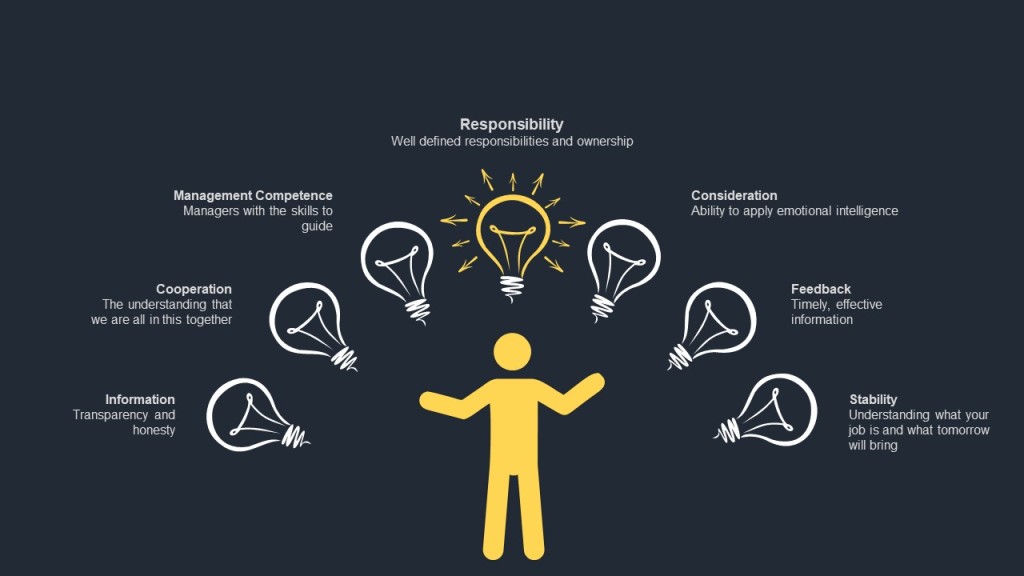
We drive out fear by building a culture centered on employee well-being. This is based on seven factors.

FactorMeansObtained by
ResponsibilityWell defined responsibilities and ownershipThe opportunity an employee has to provide input into decision making in his department
An individual employees’ own readiness to set high personal standards
An individual employee’s interest in challenging work assignments
The opportunity an employee has to improve skills and capabilities
Excellent career advancement opportunities
The organization’s encouragement of problem-solving and innovative thinking
Management CompetenceManagers trained with skills that lend themselves to contributing to the work of their team ensures that they will be looked to for help. Managers need to be able to guide.Direct Supervisor/Manager Leadership Abilities Management is engaged and leads by example (Gemba walks)
Management by Facts
ConsiderationWhen managers act as if employees have no feelings and just expect them to do their work as if they are robots, it can make employees uneasy. Such behavior makes them feel detached and merely a tool to carry out an end. In such environments, many times the only times employees hear from the manager is when something goes well or really bad. In either case, the perception could be that the manager has mood swings and that also adds to the employee’s insecurity. They may feel reluctant to talk to their manager for fear he is in one of his bad moods.Senior Management’s sincere interest in employee well-being
An individual employee’s relationship with their supervisor
Open and effective communication
Trust in management and co-workers
CooperationThe feeling that every person is on their own to look out for their interest is a sad state to be in. Yet when everyone has a fear that the other workers will take advantage of them or make them look bad at the first opportunity, a selfish and insecure environment will result. Employees should be able to work together for the benefit of the company. They should focus on group goals in addition to their personal goals, recognizing that individually there will be failures, but that the whole is more important than the individual parts.Trust Well trained employees Collaboration as a process Organizational culture (psychological safety) Hire and promote the right behaviors & traits to match the culture
FeedbackInformation that is given back to the employee regarding their performance on the job.Know what is expected of them (clear job descriptions)
Effective processes for timely feedback
Recognition
Know their opinion matters
InformationTransparency is critical. When employees know nothing about how a company is doing in terms of where they should be, it is a source of uneasiness. Without that knowledge, for all they know the company could be doing very poorly and that could be a bad thing for everyone. When they have a better sense of where the company is in the scheme of their objectives set by management, it helps them feel more secure. That is not to say it is the news being good or bad that affects their security, but rather the fact that they actually have the news.Strategy and Mission — especially the freedom and autonomy to succeed and contribute to an organization’s success
Organizational Culture and Core/Shared
Values
Feel that their job is important
StabilityEmployees feel more secure when their role does not change frequently and they understand what tomorrow will mean.Job Content — the ability to do what I do best
Availability of Resources to Perform the Job Effectively
Career development – opportunities to learn and grow
Photo by fauxels on Pexels.com

Driving out Fear

Norm Howe, a colleague in the ASQ and a great guy, wrote on his company’s blog “It Doesn’t Make Any Difference How Nice the Boss Is” and I want to strongly recommend that people read it.

Norm tells an engaging story where he shares a formative experience on the value of driving out fear. He then explains that we as managers grew up in these cultures and it requires work to build a new culture.

He hits on a great note, managers are part of the cultures they grew up in. We are like trees with many rings, and it can be very difficult just to change that.

I love story-sharing like this.

Photo by cottonbro on Pexels.com