Emergence in the Quality System

The concept of emergence—where complex behaviors arise unpredictably from interactions among simpler components—has haunted and inspired quality professionals since Aristotle first observed that “the whole is something besides the parts.” In modern quality systems, this ancient paradox takes new form: our meticulously engineered controls often birth unintended consequences, from phantom batch failures to self-reinforcing compliance gaps. Understanding emergence isn’t just an academic exercise—it’s a survival skill in an era where hyperconnected processes and globalized supply chains amplify systemic unpredictability.

The Spectrum of Emergence: From Predictable to Baffling

Emergence manifests across a continuum of complexity, each type demanding distinct management approaches:

1. Simple Emergence
Predictable patterns emerge from component interactions, observable even in abstracted models. Consider document control workflows: while individual steps like review or approval seem straightforward, their sequencing creates emergent properties like approval cycle times. These can be precisely modeled using flowcharts or digital twins, allowing proactive optimization.

2. Weak Emergence
Behaviors become explainable only after they occur, requiring detailed post-hoc analysis. A pharmaceutical company’s CAPA system might show seasonal trends in effectiveness—a pattern invisible in individual case reviews but emerging from interactions between manufacturing schedules, audit cycles, and supplier quality fluctuations. Weak emergence often reveals itself through advanced analytics like machine learning clustering.

3. Multiple Emergence
Here, system behaviors directly contradict component properties. A validated sterile filling line passing all IQ/OQ/PQ protocols might still produce unpredictable media fill failures when integrated with warehouse scheduling software. This “emergent invalidation” stems from hidden interaction vectors that only manifest at full operational scale.

4. Strong Emergence
Consistent with components but unpredictably manifested, strong emergence plagues culture-driven quality systems. A manufacturer might implement identical training programs across global sites, yet some facilities develop proactive quality innovation while others foster blame-avoidance rituals. The difference emerges from subtle interactions between local leadership styles and corporate KPIs.

5. Spooky Emergence
The most perplexing category, where system behaviors defy both component properties and simulation. A medical device company once faced identical cleanrooms producing statistically divergent particulate counts—despite matching designs, procedures, and personnel. Root cause analysis eventually traced the emergence to nanometer-level differences in HVAC duct machining, interacting with shift-change lighting schedules to alter airflow dynamics.

TypeCharacteristicsQuality System Example
SimplePredictable through component analysisDocument control workflows
WeakExplainable post-occurrence through detailed modelingCAPA effectiveness trends
MultipleContradicts component properties, defies simulationValidated processes failing at scale
StrongConsistent with components but unpredictably manifestedCulture-driven quality behaviors
SpookyDefies component properties and simulation entirelyPhantom batch failures in identical systems

The Modern Catalysts of Emergence

Three forces amplify emergence in contemporary quality systems:

Hyperconnected Processes

IoT-enabled manufacturing equipment generates real-time data avalanches. A biologics plant’s environmental monitoring system might integrate 5,000 sensors updating every 15 seconds. The emergent property? A “data tide” that overwhelms traditional statistical process control, requiring AI-driven anomaly detection to discern meaningful signals.

Compressed Innovation Cycles

Compressed innovation cycles are transforming the landscape of product development and quality management. In this new paradigm, the pressure to deliver products faster—whether due to market demands, technological advances, or public health emergencies—means that the traditional, sequential approach to development is replaced by a model where multiple phases run in parallel. Design, manufacturing, and validation activities that once followed a linear path now overlap, requiring organizations to verify quality in real time rather than relying on staged reviews and lengthy data collection.

One of the most significant consequences of this acceleration is the telescoping of validation windows. Where stability studies and shelf-life determinations once spanned years, they are now compressed into a matter of months or even weeks. This forces quality teams to make critical decisions based on limited data, often relying on predictive modeling and statistical extrapolation to fill in the gaps. The result is what some call “validation debt”—a situation where the pace of development outstrips the accumulation of empirical evidence, leaving organizations to manage risks that may not be fully understood until after product launch.

Regulatory frameworks are also evolving in response to compressed innovation cycles. Instead of the traditional, comprehensive submission and review process, regulators are increasingly open to iterative, rolling reviews and provisional specifications that can be adjusted as more data becomes available post-launch. This shift places greater emphasis on computational evidence, such as in silico modeling and digital twins, rather than solely on physical testing and historical precedent.

The acceleration of development timelines amplifies the risk of emergent behaviors within quality systems. Temporal compression means that components and subsystems are often scaled up and integrated before they have been fully characterized or validated in isolation. This can lead to unforeseen interactions and incompatibilities that only become apparent at the system level, sometimes after the product has reached the market. The sheer volume and velocity of data generated in these environments can overwhelm traditional quality monitoring tools, making it difficult to identify and respond to critical quality attributes in a timely manner.

Another challenge arises from the collision of different quality management protocols. As organizations attempt to blend frameworks such as GMP, Agile, and Lean to keep pace with rapid development, inconsistencies and gaps can emerge. Cross-functional teams may interpret standards differently, leading to confusion or conflicting priorities that undermine the integrity of the quality system.

The systemic consequences of compressed innovation cycles are profound. Cryptic interaction pathways can develop, where components that performed flawlessly in isolation begin to interact in unexpected ways at scale. Validation artifacts—such as artificial stability observed in accelerated testing—may fail to predict real-world performance, especially when environmental variables or logistics introduce new stressors. Regulatory uncertainty increases as control strategies become obsolete before they are fully implemented, and critical process parameters may shift unpredictably during technology transfer or scale-up.

To navigate these challenges, organizations are adopting adaptive quality strategies. Predictive quality modeling, using digital twins and machine learning, allows teams to simulate thousands of potential interaction scenarios and forecast failure modes even with incomplete data. Living control systems, powered by AI and continuous process verification, enable dynamic adjustment of specifications and risk priorities as new information emerges. Regulatory agencies are also experimenting with co-evolutionary approaches, such as shared industry databases for risk intelligence and regulatory sandboxes for testing novel quality controls.

Ultimately, compressed innovation cycles demand a fundamental rethinking of quality management. The focus shifts from simply ensuring compliance to actively navigating complexity and anticipating emergent risks. Success in this environment depends on building quality systems that are not only robust and compliant, but also agile and responsive—capable of detecting, understanding, and adapting to surprises as they arise in real time.

Supply Chain Entanglement

Globalization has fundamentally transformed supply chains, creating vast networks that span continents and industries. While this interconnectedness has brought about unprecedented efficiencies and access to resources, it has also introduced a web of hidden interaction vectors—complex, often opaque relationships and dependencies that can amplify both risk and opportunity in ways that are difficult to predict or control.

At the heart of this complexity is the fragmentation of production across multiple jurisdictions. This spatial and organizational dispersion means that disruptions—whether from geopolitical tensions, natural disasters, regulatory changes, or even cyberattacks—can propagate through the network in unexpected ways, sometimes surfacing as quality issues, delays, or compliance failures far from the original source of the problem.

Moreover, the rise of powerful transnational suppliers, sometimes referred to as “Big Suppliers,” has shifted the balance of power within global value chains. These entities do not merely manufacture goods; they orchestrate entire ecosystems of production, labor, and logistics across borders. Their decisions about sourcing, labor practices, and compliance can have ripple effects throughout the supply chain, influencing not just operational outcomes but also the diffusion of norms and standards. This reconsolidation at the supplier level complicates the traditional view that multinational brands are the primary drivers of supply chain governance, revealing instead a more distributed and dynamic landscape of influence.

The hidden interaction vectors created by globalization are further obscured by limited supply chain visibility. Many organizations have a clear understanding of their direct, or Tier 1, suppliers but lack insight into the lower tiers where critical risks often reside. This opacity can mask vulnerabilities such as overreliance on a single region, exposure to forced labor, or susceptibility to regulatory changes in distant markets. As a result, companies may find themselves blindsided by disruptions that originate deep within their supply networks, only becoming apparent when they manifest as operational or reputational crises.

In this environment, traditional risk management approaches are often insufficient. The sheer scale and complexity of global supply chains demand new strategies for mapping connections, monitoring dependencies, and anticipating how shocks in one part of the world might cascade through the system. Advanced analytics, digital tools, and collaborative relationships with suppliers are increasingly essential for uncovering and managing these hidden vectors. Ultimately, globalization has made supply chains more efficient but also more fragile, with hidden interaction points that require constant vigilance and adaptive management to ensure resilience and sustained performance.

Emergence and the Success/Failure Space: Navigating Complexity in System Design

The interplay between emergence and success/failure space reveals a fundamental tension in managing complex systems: our ability to anticipate outcomes is constrained by both the unpredictability of component interactions and the inherent asymmetry between defining success and preventing failure. Emergence is not merely a technical challenge, but a manifestation of how systems oscillate between latent potential and realized risk.

The Duality of Success and Failure Spaces

Systems exist in a continuum where:

  • Success space encompasses infinite potential pathways to desired outcomes, characterized by continuous variables like efficiency and adaptability.
  • Failure space contains discrete, identifiable modes of dysfunction, often easier to consensus-build around than nebulous success metrics.

Emergence complicates this duality. While traditional risk management focuses on cataloging failure modes, emergent behaviors—particularly strong emergence—defy this reductionist approach. Failures can arise not from component breakdowns, but from unexpected couplings between validated subsystems operating within design parameters. This creates a paradox: systems optimized for success space metrics (e.g., throughput, cost efficiency) may inadvertently amplify failure space risks through emergent interactions.

Emergence as a Boundary Phenomenon

Emergent behaviors manifest at the interface of success and failure spaces:

  1. Weak Emergence
    Predictable through detailed modeling, these behaviors align with traditional failure space analysis. For example, a pharmaceutical plant might anticipate temperature excursion risks in cold chain logistics through FMEA, implementing redundant monitoring systems.
  2. Strong Emergence
    Unpredictable interactions that bypass conventional risk controls. Consider a validated ERP system that unexpectedly generates phantom batch records when integrated with new MES modules—a failure emerging from software handshake protocols never modeled during individual system validation.

To return to a previous analogy of house purchasing to illustrate this dichotomy: while we can easily identify foundation cracks (failure space), defining the “perfect home” (success space) remains subjective. Similarly, strong emergence represents foundation cracks in system architectures that only become visible after integration.

Reconciling Spaces Through Emergence-Aware Design

To manage this complexity, organizations must:

1. Map Emergence Hotspots
Emergence hotspots represent critical junctures where localized interactions generate disproportionate system-wide impacts—whether beneficial innovations or cascading failures. Effectively mapping these zones requires integrating spatial, temporal, and contextual analytics to navigate the interplay between component behaviors and collective outcomes..

2. Implement Ambidextrous Monitoring
Combine failure space triggers (e.g., sterility breaches) with success space indicators (e.g., adaptive process capability) – pairing traditional deviation tracking with positive anomaly detection systems that flag beneficial emergent patterns.

3. Cultivate Graceful Success

Graceful success represents a paradigm shift from failure prevention to intelligent adaptation—creating systems that maintain core functionality even when components falter. Rooted in resilience engineering principles, this approach recognizes that perfect system reliability is unattainable, and instead focuses on designing architectures that fail into high-probability success states while preserving safety and quality.

  1. Controlled State Transitions: Systems default to reduced-but-safe operational modes during disruptions.
  2. Decoupled Subsystem Design: Modular architectures prevent cascading failures. This implements the four layers of protection philosophy through physical and procedural isolation.
  3. Dynamic Risk Reconfiguration: Continuously reassess risk priorities using real-time data brings the concept of fail forward into structured learning modes.

This paradigm shift from failure prevention to failure navigation represents the next evolution of quality systems. By designing for graceful success, organizations transform disruptions into structured learning opportunities while maintaining continuous value delivery—a critical capability in an era of compressed innovation cycles and hyperconnected supply chains.

The Emergence Literacy Imperative

This evolution demands rethinking Deming’s “profound knowledge” for the complexity age. Just as failure space analysis provides clearer boundaries, understanding emergence gives us lenses to see how those boundaries shift through system interactions. The organizations thriving in this landscape aren’t those eliminating surprises, but those building architectures where emergence more often reveals novel solutions than catastrophic failures—transforming the success/failure continuum into a discovery engine rather than a risk minefield.

Strategies for Emergence-Aware Quality Leadership

1. Cultivate Systemic Literacy
Move beyond component-level competence. Trains quality employees in basic complexity science..

2. Design for Graceful Failure
When emergence inevitably occurs, systems should fail into predictable states. For example, you can redesign batch records with:

  • Modular sections that remain valid if adjacent components fail
  • Context-aware checklists that adapt requirements based on real-time bioreactor data
  • Decoupled approvals allowing partial releases while investigating emergent anomalies

3. Harness Beneficial Emergence
The most advanced quality systems intentionally foster positive emergence.

The Emergence Imperative

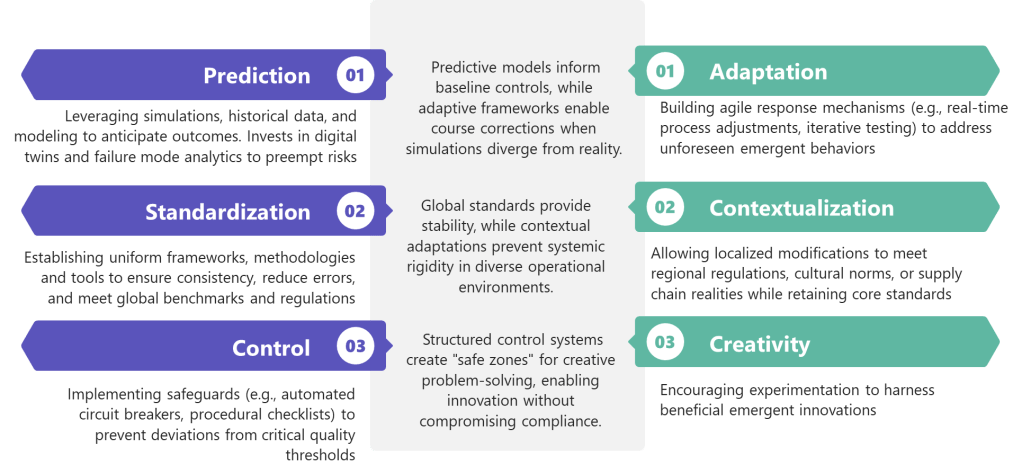
Future-ready quality professionals will balance three tensions:

  • Prediction AND Adaptation : Investing in simulation while building response agility
  • Standardization AND Contextualization : Maintaining global standards while allowing local adaptation
  • Control AND Creativity : Preventing harm while nurturing beneficial emergence

The organizations thriving in this new landscape aren’t those with perfect compliance records, but those that rapidly detect and adapt to emergent patterns. They understand that quality systems aren’t static fortresses, but living networks—constantly evolving, occasionally surprising, and always revealing new paths to excellence.

In this light, Aristotle’s ancient insight becomes a modern quality manifesto: Our systems will always be more than the sum of their parts. The challenge—and opportunity—lies in cultivating the wisdom to guide that “more” toward better outcomes.

Continuous Process Verification (CPV) Methodology and Tool Selection: A Framework Guided by FDA Process Validation

Continuous Process Verification (CPV) represents the final and most dynamic stage of the FDA’s process validation lifecycle, designed to ensure manufacturing processes remain validated during routine production. The methodology for CPV and the selection of appropriate tools are deeply rooted in the FDA’s 2011 guidance, Process Validation: General Principles and Practices, which emphasizes a science- and risk-based approach to quality assurance. This blog post examines how CPV methodologies align with regulatory frameworks and how tools are selected to meet compliance and operational objectives.

3 stages of process validation, with CPV in green as the 3rd stage

CPV Methodology: Anchored in the FDA’s Lifecycle Approach

The FDA’s process validation framework divides activities into three stages: Process Design (Stage 1), Process Qualification (Stage 2), and Continued Process Verification (Stage 3). CPV, as Stage 3, is not an isolated activity but a continuation of the knowledge gained in earlier stages. This lifecycle approach is our framework.

Stage 1: Process Design

During Stage 1, manufacturers define Critical Quality Attributes (CQAs) and Critical Process Parameters (CPPs) through risk assessments and experimental design. This phase establishes the scientific basis for monitoring and control strategies. For example, if a parameter’s variability is inherently low (e.g., clustering near the Limit of Quantification, or LOQ), this knowledge informs later decisions about CPV tools.

Stage 2: Process Qualification

Stage 2 confirms that the process, when operated within established parameters, consistently produces quality products. Data from this stage—such as process capability indices (Cpk/Ppk)—provide baseline metrics for CPV. For instance, a high Cpk (>2) for a parameter near LOQ signals that traditional control charts may be inappropriate due to limited variability.

Stage 3: Continued Process Verification

CPV methodology is defined by two pillars:

  1. Ongoing Monitoring: Continuous collection and analysis of CPP/CQA data.
  2. Adaptive Control: Adjustments to maintain process control, informed by statistical and risk-based insights.

Regulatory agencies require that CPV methodologies must be tailored to the process’s unique characteristics. For example, a parameter with data clustered near LOQ (as in the case study) demands a different approach than one with normal variability.

Selecting CPV Tools: Aligning with Data and Risk

The framework emphasizes that CPV tools must be scientifically justified, with selection criteria based on data suitability, risk criticality, and regulatory alignment.

Data Suitability Assessments

Data suitability assessments form the bedrock of effective Continuous Process Verification (CPV) programs, ensuring that monitoring tools align with the statistical and analytical realities of the process. These assessments are not merely technical exercises but strategic activities rooted in regulatory expectations, scientific rigor, and risk management. Below, we explore the three pillars of data suitability—distribution analysis, process capability evaluation, and analytical performance considerations—and their implications for CPV tool selection.

The foundation of any statistical monitoring system lies in understanding the distribution of the data being analyzed. Many traditional tools, such as control charts, assume that data follows a normal (Gaussian) distribution. This assumption underpins the calculation of control limits (e.g., ±3σ) and the interpretation of rule violations. To validate this assumption, manufacturers employ tests such as the Shapiro-Wilk test or Anderson-Darling test, which quantitatively assess normality. Visual tools like Q-Q plots or histograms complement these tests by providing intuitive insights into data skewness, kurtosis, or clustering.

When data deviates significantly from normality—common in parameters with values clustered near detection or quantification limits (e.g., LOQ)—the use of parametric tools like control charts becomes problematic. For instance, a parameter with 95% of its data below the LOQ may exhibit a left-skewed distribution, where the calculated mean and standard deviation are distorted by the analytical method’s noise rather than reflecting true process behavior. In such cases, traditional control charts generate misleading signals, such as Rule 1 violations (±3σ), which flag analytical variability rather than process shifts.

To address non-normal data, manufacturers must transition to non-parametric methods that do not rely on distributional assumptions. Tolerance intervals, which define ranges covering a specified proportion of the population with a given confidence level, are particularly useful for skewed datasets. For example, a 95/99 tolerance interval (95% of data within 99% confidence) can replace ±3σ limits for non-normal data, reducing false positives. Bootstrapping—a resampling technique—offers another alternative, enabling robust estimation of control limits without assuming normality.

Process Capability: Aligning Tools with Inherent Variability

Process capability indices, such as Cp and Cpk, quantify a parameter’s ability to meet specifications relative to its natural variability. A high Cp (>2) indicates that the process variability is small compared to the specification range, often resulting from tight manufacturing controls or robust product designs. While high capability is desirable for quality, it complicates CPV tool selection. For example, a parameter with a Cp of 3 and data clustered near the LOQ will exhibit minimal variability, rendering control charts ineffective. The narrow spread of data means that control limits shrink, increasing the likelihood of false alarms from minor analytical noise.

In such scenarios, traditional SPC tools like control charts lose their utility. Instead, manufacturers should adopt attribute-based monitoring or batch-wise trending. Attribute-based approaches classify results as pass/fail against predefined thresholds (e.g., LOQ breaches), simplifying signal interpretation. Batch-wise trending aggregates data across production lots, identifying shifts over time without overreacting to individual outliers. For instance, a manufacturer with a high-capability dissolution parameter might track the percentage of batches meeting dissolution criteria monthly, rather than plotting individual tablet results.

The FDA’s emphasis on risk-based monitoring further supports this shift. ICH Q9 guidelines encourage manufacturers to prioritize resources for high-risk parameters, allowing low-risk, high-capability parameters to be monitored with simpler tools. This approach reduces administrative burden while maintaining compliance.

Analytical Performance: Decoupling Noise from Process Signals

Parameters operating near analytical limits of detection (LOD) or quantification (LOQ) present unique challenges. At these extremes, measurement systems contribute significant variability, often overshadowing true process signals. For example, a purity assay with an LOQ of 0.1% may report values as “<0.1%” for 98% of batches, creating a dataset dominated by the analytical method’s imprecision. In such cases, failing to decouple analytical variability from process performance leads to misguided investigations and wasted resources.

To address this, manufacturers must isolate analytical variability through dedicated method monitoring programs. This involves:

  1. Analytical Method Validation: Rigorous characterization of precision, accuracy, and detection capabilities (e.g., determining the Practical Quantitation Limit, or PQL, which reflects real-world method performance).
  2. Separate Trending: Implementing control charts or capability analyses for the analytical method itself (e.g., monitoring LOQ stability across batches).
  3. Threshold-Based Alerts: Replacing statistical rules with binary triggers (e.g., investigating only results above LOQ).

For example, a manufacturer analyzing residual solvents near the LOQ might use detection capability indices to set action limits. If the analytical method’s variability (e.g., ±0.02% at LOQ) exceeds the process variability, threshold alerts focused on detecting values above 0.1% + 3σ_analytical would provide more meaningful signals than traditional control charts.

Integration with Regulatory Expectations

Regulatory agencies, including the FDA and EMA, mandate that CPV methodologies be “scientifically sound” and “statistically valid” (FDA 2011 Guidance). This requires documented justification for tool selection, including:

  • Normality Testing: Evidence that data distribution aligns with tool assumptions (e.g., Shapiro-Wilk test results).
  • Capability Analysis: Cp/Cpk values demonstrating the rationale for simplified monitoring.
  • Analytical Validation Data: Method performance metrics justifying decoupling strategies.

A 2024 FDA warning letter highlighted the consequences of neglecting these steps. A firm using control charts for non-normal dissolution data received a 483 observation for lacking statistical rationale, underscoring the need for rigor in data suitability assessments.

Case Study Application:
A manufacturer monitoring a CQA with 98% of data below LOQ initially used control charts, triggering frequent Rule 1 violations (±3σ). These violations reflected analytical noise, not process shifts. Transitioning to threshold-based alerts (investigating only LOQ breaches) reduced false positives by 72% while maintaining compliance.

Risk-Based Tool Selection

The ICH Q9 Quality Risk Management (QRM) framework provides a structured methodology for identifying, assessing, and controlling risks to pharmaceutical product quality, with a strong emphasis on aligning tool selection with the parameter’s impact on patient safety and product efficacy. Central to this approach is the principle that the rigor of risk management activities—including the selection of tools—should be proportionate to the criticality of the parameter under evaluation. This ensures resources are allocated efficiently, focusing on high-impact risks while avoiding overburdening low-risk areas.

Prioritizing Tools Through the Lens of Risk Impact

The ICH Q9 framework categorizes risks based on their potential to compromise product quality, guided by factors such as severity, detectability, and probability. Parameters with a direct impact on critical quality attributes (CQAs)—such as potency, purity, or sterility—are classified as high-risk and demand robust analytical tools. Conversely, parameters with minimal impact may require simpler methods. For example:

  • High-Impact Parameters: Use Failure Mode and Effects Analysis (FMEA) or Fault Tree Analysis (FTA) to dissect failure modes, root causes, and mitigation strategies.
  • Medium-Impact Parameters: Apply a tool such as a PHA.
  • Low-Impact Parameters: Utilize checklists or flowcharts for basic risk identification.

This tiered approach ensures that the complexity of the tool matches the parameter’s risk profile.

  1. Importance: The parameter’s criticality to patient safety or product efficacy.
  2. Complexity: The interdependencies of the system or process being assessed.
  3. Uncertainty: Gaps in knowledge about the parameter’s behavior or controls.

For instance, a high-purity active pharmaceutical ingredient (API) with narrow specification limits (high importance) and variable raw material inputs (high complexity) would necessitate FMEA to map failure modes across the supply chain. In contrast, a non-critical excipient with stable sourcing (low uncertainty) might only require a simplified risk ranking matrix.

Implementing a Risk-Based Approach

1. Assess Parameter Criticality

Begin by categorizing parameters based on their impact on CQAs, as defined during Stage 1 (Process Design) of the FDA’s validation lifecycle. Parameters are classified as:

  • Critical: Directly affecting safety/efficacy
  • Key: Influencing quality but not directly linked to safety
  • Non-Critical: No measurable impact on quality

This classification informs the depth of risk assessment and tool selection.

2. Select Tools Using the ICU Framework
  • Importance-Driven Tools: High-importance parameters warrant tools that quantify risk severity and detectability. FMEA is ideal for linking failure modes to patient harm, while Statistical Process Control (SPC) charts monitor real-time variability.
  • Complexity-Driven Tools: For multi-step processes (e.g., bioreactor operations), HACCP identifies critical control points, while Ishikawa diagrams map cause-effect relationships.
  • Uncertainty-Driven Tools: Parameters with limited historical data (e.g., novel drug formulations) benefit from Bayesian statistical models or Monte Carlo simulations to address knowledge gaps.
3. Document and Justify Tool Selection

Regulatory agencies require documented rationale for tool choices. For example, a firm using FMEA for a high-risk sterilization process must reference its ability to evaluate worst-case scenarios and prioritize mitigations. This documentation is typically embedded in Quality Risk Management (QRM) Plans or validation protocols.

Integration with Living Risk Assessments

Living risk assessments are dynamic, evolving documents that reflect real-time process knowledge and data. Unlike static, ad-hoc assessments, they are continually updated through:

1. Ongoing Data Integration

Data from Continual Process Verification (CPV)—such as trend analyses of CPPs/CQAs—feeds directly into living risk assessments. For example, shifts in fermentation yield detected via SPC charts trigger updates to bioreactor risk profiles, prompting tool adjustments (e.g., upgrading from checklists to FMEA).

2. Periodic Review Cycles

Living assessments undergo scheduled reviews (e.g., biannually) and event-driven updates (e.g., post-deviation). A QRM Master Plan, as outlined in ICH Q9(R1), orchestrates these reviews by mapping assessment frequencies to parameter criticality. High-impact parameters may be reviewed quarterly, while low-impact ones are assessed annually.

3. Cross-Functional Collaboration

Quality, manufacturing, and regulatory teams collaborate to interpret CPV data and update risk controls. For instance, a rise in particulate matter in vials (detected via CPV) prompts a joint review of filling line risk assessments, potentially revising tooling from HACCP to FMEA to address newly identified failure modes.

Regulatory Expectations and Compliance

Regulatory agencies requires documented justification for CPV tool selection, emphasizing:

  • Protocol Preapproval: CPV plans must be submitted during Stage 2, detailing tool selection criteria.
  • Change Control: Transitions between tools (e.g., SPC → thresholds) require risk assessments and documentation.
  • Training: Staff must be proficient in both traditional (e.g., Shewhart charts) and modern tools (e.g., AI).

A 2024 FDA warning letter cited a firm for using control charts on non-normal data without validation, underscoring the consequences of poor tool alignment.

A Framework for Adaptive Excellence

The FDA’s CPV framework is not prescriptive but principles-based, allowing flexibility in methodology and tool selection. Successful implementation hinges on:

  1. Science-Driven Decisions: Align tools with data characteristics and process capability.
  2. Risk-Based Prioritization: Focus resources on high-impact parameters.
  3. Regulatory Agility: Justify tool choices through documented risk assessments and lifecycle data.

CPV is a living system that must evolve alongside processes, leveraging tools that balance compliance with operational pragmatism. By anchoring decisions in the FDA’s lifecycle approach, manufacturers can transform CPV from a regulatory obligation into a strategic asset for quality excellence.

Quality Systems as Living Organizations: A Framework for Adaptive Excellence

The allure of shiny new tools in quality management is undeniable. Like magpies drawn to glittering objects, professionals often collect methodologies and technologies without a cohesive strategy. This “magpie syndrome” creates fragmented systems—FMEA here, 5S there, Six Sigma sprinkled in—that resemble disjointed toolkits rather than coherent ecosystems. The result? Confusion, wasted resources, and quality systems that look robust on paper but crumble under scrutiny. The antidote lies in reimagining quality systems not as static machines but as living organizations that evolve, adapt, and thrive.

The Shift from Machine Logic to Organic Design

Traditional quality systems mirror 20th-century industrial thinking: rigid hierarchies, linear processes, and documents that gather dust. These systems treat organizations as predictable machines, relying on policies to command and procedures to control. Yet living systems—forests, coral reefs, cities—operate differently. They self-organize around shared purpose, adapt through feedback, and balance structure with spontaneity. Deming foresaw this shift. His System of Profound Knowledge—emphasizing psychology, variation, and systems thinking—aligns with principles of living systems: coherence without control, stability with flexibility.

At the heart of this transformation is the recognition that quality emerges not from compliance checklists but from the invisible architecture of relationships, values, and purpose. Consider how a forest ecosystem thrives: trees communicate through fungal networks, species coexist through symbiotic relationships, and resilience comes from diversity, not uniformity. Similarly, effective quality systems depend on interconnected elements working in harmony, guided by a shared “DNA” of purpose.

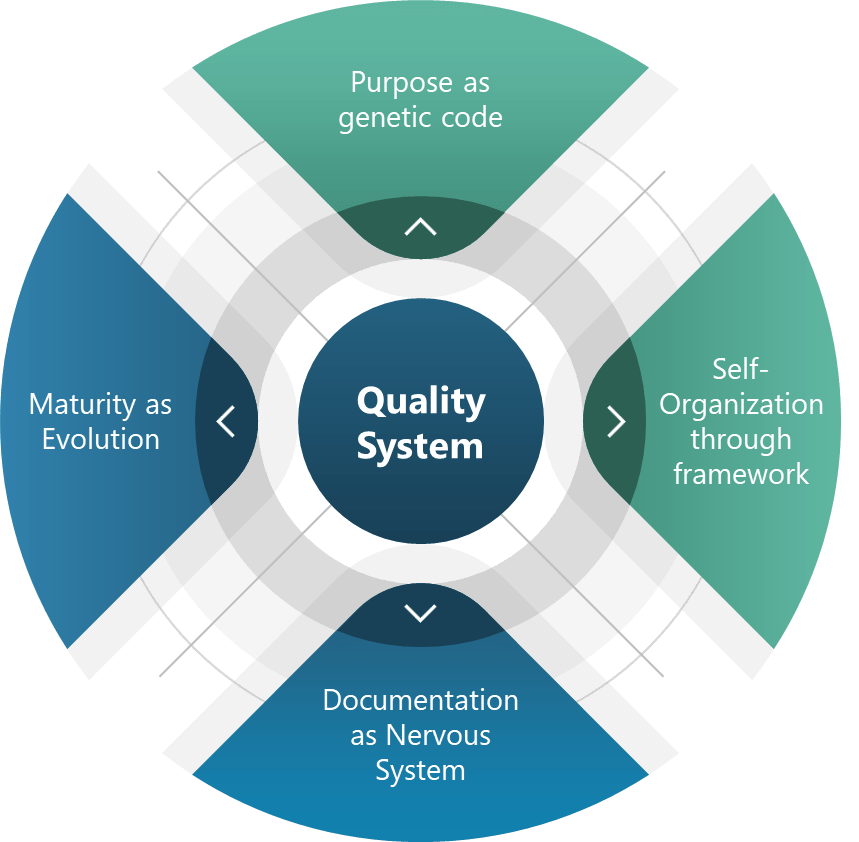
The Four Pillars of Living Quality Systems

  1. Purpose as Genetic Code
    Every living system has inherent telos—an aim that guides adaptation. For quality systems, this translates to policies that act as genetic non-negotiables. For pharmaceuticals and medical devices this is “patient safety above all.”. This “DNA” allowed teams to innovate while maintaining adherence to core requirements, much like genes express differently across environments without compromising core traits.
  2. Self-Organization Through Frameworks
    Complex systems achieve order through frameworks as guiding principles. Coherence emerges from shared intent. Deming’s PDSA cycles and emphasis on psychological safety create similar conditions for self-organization.
  3. Documentation as a Nervous System
    The enhanced document pyramid—policies, programs, procedures, work instructions, records—acts as an organizational nervous system. Adding a “program” level between policies and procedures bridges the gap between intent and action and can transform static documents into dynamic feedback loops.
  4. Maturity as Evolution
    Living systems evolve through natural selection. Maturity models serve as evolutionary markers:
    • Ad-hoc (Primordial): Tools collected like random mutations.
    • Managed (Organized): Basic processes stabilize.
    • Standardized (Complex): Methodologies cohere.
    • Predictable (Adaptive): Issues are anticipated.
    • Optimizing (Evolutionary): Improvement fuels innovation.

Cultivating Organizational Ecosystems: Eight Principles

Living quality systems thrive when guided by eight principles:

  • Balance: Serving patients, employees, and regulators equally.
  • Congruence: Aligning tools with culture.
  • Human-Centered: Designing for joy—automating drudgery, amplifying creativity.
  • Learning: Treating deviations as data, not failures.
  • Sustainability: Planning for decade-long impacts, not quarterly audits.
  • Elegance: Simplifying until it hurts, then relaxing slightly.
  • Coordination: Cross-pollinating across the organization
  • Convenience: Making compliance easier than non-compliance.

These principles operationalize Deming’s wisdom. Driving out fear (Point 8) fosters psychological safety, while breaking down barriers (Point 9) enables cross-functional symbiosis.

The Quality Professional’s New Role: Gardener, Not Auditor

Quality professionals must embrace a transformative shift in their roles. Instead of functioning as traditional enforcers or document controllers, we are now called to act as stewards of living systems. This evolution requires a mindset change from one of rigid oversight to one of nurturing growth and adaptability. The modern quality professional takes on new identities such as coach, data ecologist, and systems immunologist—roles that emphasize collaboration, learning, and resilience.

To thrive in this new capacity, practical steps must be taken. First, it is essential to prune toxic practices by eliminating fear-driven reporting mechanisms and redundant tools that stifle innovation and transparency. Quality professionals should focus on fostering trust and streamlining processes to create healthier organizational ecosystems. Next, they must plant feedback loops by embedding continuous learning into daily workflows. For instance, incorporating post-meeting retrospectives can help teams reflect on successes and challenges, ensuring ongoing improvement. Lastly, cross-pollination is key to cultivating diverse perspectives and skills. Rotating staff between quality assurance, operations, and research and development encourages knowledge sharing and breaks down silos, ultimately leading to more integrated and innovative solutions.

By adopting this gardener-like approach, quality professionals can nurture the growth of resilient systems that are better equipped to adapt to change and complexity. This shift not only enhances organizational performance but also fosters a culture of continuous improvement and collaboration.

Thriving, Not Just Surviving

Quality systems that mimic life—not machinery—turn crises into growth opportunities. As Deming noted, “Learning is not compulsory… neither is survival.” By embracing living system principles, we create environments where survival is the floor, and excellence is the emergent reward.

Start small: Audit one process using living system criteria. Replace one control mechanism with a self-organizing principle. Share learnings across your organizational “species.” The future of quality isn’t in thicker binders—it’s in cultivating systems that breathe, adapt, and evolve.

Building a Maturity Model for Pharmaceutical Change Control: Integrating ICH Q8-Q10

ICH Q8 (Pharmaceutical Development), Q9 (Quality Risk Management), and Q10 (Pharmaceutical Quality System) provide a comprehensive framework for transforming change management from a reactive compliance exercise into a strategic enabler of quality and innovation.

The ICH Q8-Q10 triad is my favorite framework pharmaceutical quality systems: Q8’s Quality by Design (QbD) principles establish proactive identification of critical quality attributes (CQAs) and design spaces, shifting the paradigm from retrospective testing to prospective control; Q9 provides the scaffolding for risk-based decision-making, enabling organizations to prioritize resources based on severity, occurrence, and detectability of risks; and, Q10 closes the loop by embedding these concepts into a lifecycle-oriented quality system, emphasizing knowledge management and continual improvement.

These guidelines create a robust foundation for change control. Q8 ensures changes align with product and process understanding, Q9 enables risk-informed evaluation, and Q10 mandates systemic integration across the product lifecycle. This triad rejects the notion of change control as a standalone procedure, instead positioning it as a manifestation of organizational quality culture.

The PIC/S Perspective: Risk-Based Change Management

The PIC/S guidance (PI 054-1) reinforces ICH principles by offering a methodology that emphasizes effectiveness as the cornerstone of change management. It outlines four pillars:

  1. Proposal and Impact Assessment: Systematic evaluation of cross-functional impacts, including regulatory filings, process interdependencies, and stakeholder needs.
  2. Risk Classification: Stratifying changes as critical/major/minor based on potential effects on product quality, patient safety, and data integrity.
  3. Implementation with Interim Controls: Bridging current and future states through mitigations like enhanced monitoring or temporary procedural adjustments.
  4. Effectiveness Verification: Post-implementation reviews using metrics aligned with change objectives, supported by tools like statistical process control (SPC) or continued process verification (CPV).

This guidance operationalizes ICH concepts by mandating traceability from change rationale to verified outcomes, creating accountability loops that prevent “paper compliance.”

A Five-Level Maturity Model for Change Control

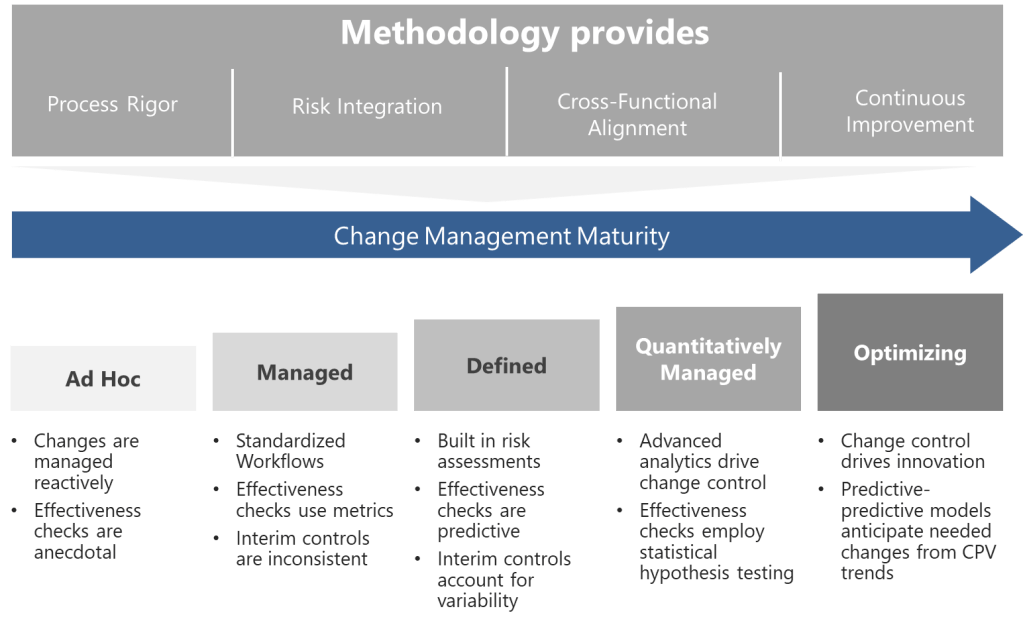
Building on these foundations, I propose a maturity model that evaluates organizational capability across four dimensions, each addressing critical aspects of pharmaceutical change control systems:

  1. Process Rigor
    • Assesses the standardization, documentation, and predictability of change control workflows.
    • Higher maturity levels incorporate design space utilization (ICH Q8), automated risk thresholds, and digital tools like Monte Carlo simulations for predictive impact modeling.
    • Progresses from ad hoc procedures to AI-driven, self-correcting systems that preemptively identify necessary changes via CPV trends.
  2. Risk Integration
    • Measures how effectively quality risk management (ICH Q9) is embedded into decision-making.
    • Includes risk-based classification (critical/major/minor), use of the right tool, and dynamic risk thresholds tied to process capability indices (CpK/PpK).
    • At advanced levels, machine learning models predict failure probabilities, enabling proactive mitigations.
  3. Cross-Functional Alignment
    • Evaluates collaboration between QA, regulatory, manufacturing, and supply chain teams during change evaluation.
    • Maturity is reflected in centralized review boards, real-time data integration (e.g., ERP/LIMS connectivity), and harmonized procedures across global sites.
  4. Continuous Improvement
    • Tracks the organization’s ability to learn from past changes and innovate.
    • Incorporates metrics like “first-time regulatory acceptance rate” and “change-related deviation reduction.”
    • Top-tier organizations use post-change data to refine design spaces and update control strategies.

Level 1: Ad Hoc (Chaotic)

At this initial stage, changes are managed reactively. Procedures exist but lack standardization—departments use disparate tools, and decisions rely on individual expertise rather than systematic risk assessment. Effectiveness checks are anecdotal, often reduced to checkbox exercises. Organizations here frequently experience regulatory citations related to undocumented changes or inadequate impact assessments.

Progression Strategy: Begin by mapping all change types and aligning them with ICH Q9 risk principles. Implement a centralized change control procedure with mandatory risk classification.

Level 2: Managed (Departmental)

Changes follow standardized workflows within functions, but silos persist. Risk assessments are performed but lack cross-functional input, leading to unanticipated impacts. Effectiveness checks use basic metrics (e.g., # of changes), yet data analysis remains superficial. Interim controls are applied inconsistently, often overcompensating with excessive conservatism or being their in name only.

Progression Strategy: Establish cross-functional change review boards. Introduce the right level of formality of risk for changes and integrate CPV data into effectiveness reviews.

Level 3: Defined (Integrated)

The organization achieves horizontal integration. Changes trigger automated risk assessments using predefined criteria from ICH Q8 design spaces. Effectiveness checks leverage predictive analytics, comparing post-change performance against historical baselines. Knowledge management systems capture lessons learned, enabling proactive risk identification. Interim controls are fully operational, with clear escalation paths for unexpected variability.

Progression Strategy: Develop a unified change control platform that connects to manufacturing execution systems (MES) and laboratory information management systems (LIMS). Implement real-time dashboards for change-related KPIs.

Level 4: Quantitatively Managed (Predictive)

Advanced analytics drive change control. Machine learning models predict change impacts using historical data, reducing assessment timelines. Risk thresholds dynamically adjust based on process capability indices (CpK/PpK). Effectiveness checks employ statistical hypothesis testing, with sample sizes calculated via power analysis. Regulatory submissions for post-approval changes are partially automated through ICH Q12-enabled platforms.

Progression Strategy: Pilot digital twins for high-complexity changes, simulating outcomes before implementation. Formalize partnerships with regulators for parallel review of major changes.

Level 5: Optimizing (Self-Correcting)

Change control becomes a source of innovation. Predictive-predictive models anticipate needed changes from CPV trends. Change histories provide immutable audit trails across the product. Autonomous effectiveness checks trigger corrective actions via integrated CAPA systems. The organization contributes to industry-wide maturity through participation in various consensus standard and professional associations.

Progression Strategy: Institutionalize a “change excellence” function focused on benchmarking against emerging technologies like AI-driven root cause analysis.

Methodological Pillars: From Framework to Practice

Translating this maturity model into practice requires three methodological pillars:

1. QbD-Driven Change Design
Leverage Q8’s design space concepts to predefine allowable change ranges. Changes outside the design space trigger Q9-based risk assessments, evaluating impacts on CQAs using tools like cause-effect matrices. Fully leverage Q12.

2. Risk-Based Resourcing
Apply Q9’s risk prioritization to allocate resources proportionally. A minor packaging change might require a 2-hour review by QA, while a novel drug product process change engages R&D, regulatory, and supply chain teams in a multi-week analysis. Remember, the “level of effort commensurate with risk” prevents over- or under-management.

3. Closed-Loop Verification
Align effectiveness checks with Q10’s lifecycle approach. Post-change monitoring periods are determined by statistical confidence levels rather than fixed durations. For instance, a formulation change might require 10 consecutive batches within CpK >1.33 before closure. PIC/S-mandated evaluations of unintended consequences are automated through anomaly detection algorithms.

Overcoming Implementation Barriers

Cultural and technical challenges abound in maturity progression. Common pitfalls include:

  • Overautomation: Implementing digital tools before standardizing processes, leading to “garbage in, gospel out” scenarios.
  • Risk Aversion: Misapplying Q9 to justify excessive controls, stifling continual improvement.
  • Siloed Metrics: Tracking change closure rates without assessing long-term quality impacts.

Mitigation strategies involve:

  • Co-developing procedures with frontline staff to ensure usability.
  • Training on “right-sized” QRM—using ICH Q9 to enable, not hinder, innovation.
  • Adopting balanced scorecards that link change metrics to business outcomes (e.g., time-to-market, cost of quality).

The Future State: Change Control as a Competitive Advantage

Change control maturity increasingly differentiates market leaders. Organizations reaching Level 5 capabilities can leverage:

  • Adaptive Regulatory Strategies: Real-time submission updates via ICH Q12’s Established Conditions framework.
  • AI-Enhanced Decision Making: Predictive analytics for change-related deviations, reducing downstream quality events.
  • Patient-Centric Changes: Direct integration of patient-reported outcomes (PROs) into change effectiveness criteria.

Maturity as a Journey, Not a Destination

The proposed model provides a roadmap—not a rigid prescription—for advancing change control. By grounding progression in ICH Q8-Q10 and PIC/S principles, organizations can systematically enhance their change agility while maintaining compliance. Success requires viewing maturity not as a compliance milestone but as a cultural commitment to excellence, where every change becomes an opportunity to strengthen quality and accelerate innovation.

In an era of personalized medicines and decentralized manufacturing, the ability to manage change effectively will separate thriving organizations from those merely surviving. The journey begins with honest self-assessment against this model and a willingness to invest in the systems, skills, and culture that make maturity possible.

The Deliberate Path: From Framework to Tool Selection in Quality Systems

Just as magpies are attracted to shiny objects, collecting them without purpose or pattern, professionals often find themselves drawn to the latest tools, techniques, or technologies that promise quick fixes or dramatic improvements. We attend conferences, read articles, participate in webinars, and invariably come away with new tools to add to our professional toolkit.

A picture of a magpie
https://commons.wikimedia.org/wiki/File:Common_magpie_(Pica_pica).jpg

This approach typically manifests in several recognizable patterns. You might see a quality professional enthusiastically implementing a fishbone diagram after attending a workshop, only to abandon it a month later for a new problem-solving methodology learned in a webinar. Or you’ve witnessed a manager who insists on using a particular project management tool simply because it worked well in their previous organization, regardless of its fit for current challenges. Even more common is the organization that accumulates a patchwork of disconnected tools over time – FMEA here, 5S there, with perhaps some Six Sigma tools sprinkled throughout – without a coherent strategy binding them together.

The consequences of this unsystematic approach are far-reaching. Teams become confused by constantly changing methodologies. Organizations waste resources on tools that don’t address fundamental needs and fail to build coherent quality systems that sustainably drive improvement. Instead, they create what might appear impressive on the surface but is fundamentally an incoherent collection of disconnected tools and techniques.

As I discussed in my recent post on methodologies, frameworks, and tools, this haphazard approach represents a fundamental misunderstanding of how effective quality systems function. The solution isn’t simply to stop acquiring new tools but to be deliberate and systematic in evaluating, selecting, and implementing them by starting with frameworks – the conceptual scaffolding that provides structure and guidance for our quality efforts – and working methodically toward appropriate tool selection.

I will outline a path from frameworks to tools in this post, utilizing the document pyramid as a structural guide. We’ll examine how the principles of sound systems design can inform this journey, how coherence emerges from thoughtful alignment of frameworks and tools, and how maturity models can help us track our progress. By the end, you’ll have a clear roadmap for transforming your organization’s approach to tool selection from random collection to strategic implementation.

Understanding the Hierarchy: Frameworks, Methodologies, and Tools

Here is a brief refresher:

  • A framework provides a flexible structure that organizes concepts, principles, and practices to guide decision-making. Unlike methodologies, frameworks are not rigidly sequential; they provide a mental model or lens through which problems can be analyzed. Frameworks emphasize what needs to be addressed rather than how to address it.
  • A methodology is a systematic, step-by-step approach to solving problems or achieving objectives. It provides a structured sequence of actions, often grounded in theoretical principles, and defines how tasks should be executed. Methodologies are prescriptive, offering clear guidelines to ensure consistency and repeatability.
  • A tool is a specific technique, model, or instrument used to execute tasks within a methodology or framework. Tools are action-oriented and often designed for a singular purpose, such as data collection, analysis, or visualization.

How They Interrelate: Building a Cohesive Strategy

The relationship between frameworks, methodologies, and tools is not merely hierarchical but interconnected and synergistic. A framework provides the conceptual structure for understanding a problem, the methodology defines the execution plan, and tools enable practical implementation.

To illustrate this integration, consider how these elements work together in various contexts:

In Systems Thinking:

  • Framework: Systems theory identifies inputs, processes, outputs, and feedback loops
  • Methodology: A 5-phase approach (problem structuring, dynamic modeling, scenario planning) guides analysis
  • Tools: Causal loop diagrams map relationships; simulation software models system behavior

In Quality by Design (QbD):

  • Framework: The ICH Q8 guideline outlines quality objectives
  • Methodology: Define QTPP → Identify Critical Quality Attributes → Design experiments
  • Tools: Design of Experiments (DoE) optimizes process parameters

Without frameworks, methodologies lack context and direction. Without methodologies, frameworks remain theoretical abstractions. Without tools, methodologies cannot be operationalized. The coherence and effectiveness of a quality management system depend on the proper alignment and integration of all three elements.

Understanding this hierarchy and interconnection is essential as we move toward establishing a deliberate path from frameworks to tools using the document pyramid structure.

The Document Pyramid: A Structure for Implementation

The document pyramid represents a hierarchical approach to organizing quality management documentation, which provides an excellent structure for mapping the path from frameworks to tools. In traditional quality systems, this pyramid typically consists of four levels: policies, procedures, work instructions, and records. However, I’ve found that adding an intermediate “program” level between policies and procedures creates a more effective bridge between high-level requirements and operational implementation.

Traditional Document Hierarchy in Quality Systems

Before examining the enhanced pyramid, let’s understand the traditional structure:

Policy Level: At the apex of the pyramid, policies establish the “what” – the requirements that must be met. They articulate the organization’s intentions, direction, and commitments regarding quality. Policies are typically broad, principle-based statements that apply across the organization.

Procedure Level: Procedures define the “who, what, when” of activities. They outline the sequence of steps, responsibilities, and timing for key processes. Procedures are more specific than policies but still focus on process flow rather than detailed execution.

Work Instruction Level: Work instructions provide the “how” – detailed steps for performing specific tasks. They offer step-by-step guidance for executing activities and are typically used by frontline staff directly performing the work.

Records Level: At the base of the pyramid, records provide evidence that work was performed according to requirements. They document the results of activities and serve as proof of compliance.

This structure establishes a logical flow from high-level requirements to detailed execution and documentation. However, in complex environments where requirements must be interpreted in various ways for different contexts, a gap often emerges between policies and procedures.

The Enhanced Pyramid: Adding the Program Level

To address this gap, I propose adding a “program” level between policies and procedures. The program level serves as a mapping requirement that shows the various ways to interpret high-level requirements for specific needs.

The beauty of the program document is that it helps translate from requirements (both internal and external) to processes and procedures. It explains how they interact and how they’re supported by technical assessments, risk management, and other control activities. Think of it as the design document and the connective tissue of your quality system.

With this enhanced structure, the document pyramid now consists of five levels:

  1. Policy Level (frameworks): Establishes what must be done
  2. Program Level (methodologies): Translates requirements into systems design
  3. Procedure Level: Defines who, what, when of activities
  4. Work Instruction Level (tools): Provides detailed how-to guidance
  5. Records Level: Evidences that activities were performed

This enhanced pyramid provides a clear structure for mapping our journey from frameworks to tools.

The image depicts a "Quality Management Pyramid," which is a hierarchical representation of quality management elements. The pyramid is divided into six levels from top to bottom, with corresponding labels:

Quality Manual (top tier, dark gray): Represents the "Vision" of quality management.

Policy (second tier, light blue): Represents "Strategy."

Program (third tier, teal): Represents "Strategy."

Process (fourth tier, orange-brown): Includes Standard Operating Procedures (SOPs) and Analytical Methods, representing "Tactics."

Procedure (fifth tier, dark blue): Includes Work Instructions, digital execution systems, and job aids as tools, representing "Tactics."

Reports and Records (bottom tier, yellow): Represents "Results."

Each level is accompanied by icons symbolizing its content and purpose. The pyramid visually organizes the hierarchy of documents and actions in quality management from high-level vision to actionable results.

Mapping Frameworks, Methodologies, and Tools to the Document Pyramid

When we overlay our hierarchy of frameworks, methodologies, and tools onto the document pyramid, we can see the natural alignment:

Frameworks operate at the Policy Level. They establish the conceptual structure and principles that guide the entire quality system. Policies articulate the “what” of quality management, just as frameworks define the “what” that needs to be addressed.

Methodologies align with the Program Level. They translate the conceptual guidance of frameworks into systematic approaches for implementation. The program level provides the connective tissue between high-level requirements and operational processes, similar to how methodologies bridge conceptual frameworks and practical tools.

Tools correspond to the Work Instruction Level. They provide specific techniques for executing tasks, just as work instructions detail exactly how to perform activities. Both are concerned with practical, hands-on implementation.

The Procedure Level sits between methodologies and tools, providing the organizational structure and process flow that guide tool selection and application. Procedures define who will use which tools, when they will be used, and in what sequence.

Finally, Records provide evidence of proper tool application and effectiveness. They document the results achieved through the application of tools within the context of methodologies and frameworks.

This mapping provides a structural framework for our journey from high-level concepts to practical implementation. It helps ensure that tool selection is not arbitrary but rather guided by and aligned with the organization’s overall quality framework and methodology.

Systems Thinking as a Meta-Framework

To guide our journey from frameworks to tools, we need a meta-framework that provides overarching principles for system design and evaluation. Systems thinking offers such a meta-framework, and I believe we can apply eight key principles that can be applied across the document pyramid to ensure coherence and effectiveness in our quality management system.

The Eight Principles of Good Systems

These eight principles form the foundation of effective system design, regardless of the specific framework, methodology, or tools employed:

Balance

Definition: The system creates value for multiple stakeholders. While the ideal is to develop a design that maximizes value for all key stakeholders, designers often must compromise and balance the needs of various stakeholders.

Application across the pyramid:

  • At the Policy/Framework level, balance ensures that quality objectives serve multiple organizational goals (compliance, customer satisfaction, operational efficiency)
  • At the Program/Methodology level, balance guides the design of systems that address diverse stakeholder needs
  • At the Work Instruction/Tool level, balance influences tool selection to ensure all stakeholder perspectives are considered

Congruence

Definition: The degree to which system components are aligned and consistent with each other and with other organizational systems, culture, plans, processes, information, resource decisions, and actions.

Application across the pyramid:

  • At the Policy/Framework level, congruence ensures alignment between quality frameworks and organizational strategy
  • At the Program/Methodology level, congruence guides the development of methodologies that integrate with existing systems
  • At the Work Instruction/Tool level, congruence ensures selected tools complement rather than contradict each other

Convenience

Definition: The system is designed to be as convenient as possible for participants to implement (a.k.a. user-friendly). The system includes specific processes, procedures, and controls only when necessary.

Application across the pyramid:

  • At the Policy/Framework level, convenience influences the selection of frameworks that suit organizational culture
  • At the Program/Methodology level, convenience shapes methodologies to be practical and accessible
  • At the Work Instruction/Tool level, convenience drives the selection of tools that users can easily adopt and apply

Coordination

Definition: System components are interconnected and harmonized with other (internal and external) components, systems, plans, processes, information, and resource decisions toward common action or effort. This goes beyond congruence and is achieved when individual components operate as a fully interconnected unit.

Application across the pyramid:

  • At the Policy/Framework level, coordination ensures frameworks complement each other
  • At the Program/Methodology level, coordination guides the development of methodologies that work together as an integrated system
  • At the Work Instruction/Tool level, coordination ensures tools are compatible and support each other

Elegance

Definition: Complexity vs. benefit — the system includes only enough complexity as necessary to meet stakeholders’ needs. In other words, keep the design as simple as possible but no simpler while delivering the desired benefits.

Application across the pyramid:

  • At the Policy/Framework level, elegance guides the selection of frameworks that provide sufficient but not excessive structure
  • At the Program/Methodology level, elegance shapes methodologies to include only necessary steps
  • At the Work Instruction/Tool level, elegance influences the selection of tools that solve problems without introducing unnecessary complexity

Human-Centered

Definition: Participants in the system are able to find joy, purpose, and meaning in their work.

Application across the pyramid:

  • At the Policy/Framework level, human-centeredness ensures frameworks consider human factors
  • At the Program/Methodology level, human-centeredness shapes methodologies to engage and empower participants
  • At the Work Instruction/Tool level, human-centeredness drives the selection of tools that enhance rather than diminish human capabilities

Learning

Definition: Knowledge management, with opportunities for reflection and learning (learning loops), is designed into the system. Reflection and learning are built into the system at key points to encourage single- and double-loop learning from experience.

Application across the pyramid:

  • At the Policy/Framework level, learning influences the selection of frameworks that promote improvement
  • At the Program/Methodology level, learning shapes methodologies to include feedback mechanisms
  • At the Work Instruction/Tool level, learning drives the selection of tools that generate insights and promote knowledge creation

Sustainability

Definition: The system effectively meets the near- and long-term needs of current stakeholders without compromising the ability of future generations of stakeholders to meet their own needs.

Application across the pyramid:

  • At the Policy/Framework level, sustainability ensures frameworks consider long-term viability
  • At the Program/Methodology level, sustainability shapes methodologies to create lasting value
  • At the Work Instruction/Tool level, sustainability influences the selection of tools that provide enduring benefits

These eight principles serve as evaluation criteria throughout our journey from frameworks to tools. They help ensure that each level of the document pyramid contributes to a coherent, effective, and sustainable quality system.

Systems Thinking and the Five Key Questions

In addition to these eight principles, systems thinking guides us to ask five key questions that apply across the document pyramid:

  1. What is the purpose of the system? What happens in the system?
  2. What is the system? What’s inside? What’s outside? Set the boundaries, the internal elements, and elements of the system’s environment.
  3. What are the internal structure and dependencies?
  4. How does the system behave? What are the system’s emergent behaviors, and do we understand their causes and dynamics?
  5. What is the context? Usually in terms of bigger systems and interacting systems.

Answering these questions at each level of the document pyramid helps ensure alignment and coherence. For example:

  • At the Policy/Framework level, we ask about the overall purpose of our quality system, its boundaries, and its context within the broader organization
  • At the Program/Methodology level, we define the internal structure and dependencies of specific quality initiatives
  • At the Work Instruction/Tool level, we examine how individual tools contribute to system behavior and objectives

By applying systems thinking principles and questions throughout our journey from frameworks to tools, we create a coherent quality system rather than a collection of disconnected elements.

Coherence in Quality Systems

Coherence goes beyond mere alignment or consistency. While alignment ensures that different elements point in the same direction, coherence creates a deeper harmony where components work together to produce emergent properties that transcend their individual contributions.

In quality systems, coherence means that our frameworks, methodologies, and tools don’t merely align on paper but actually work together organically to produce desired outcomes. The parts reinforce each other, creating a whole that is greater than the sum of its parts.

Building Coherence Through the Document Pyramid

The enhanced document pyramid provides an excellent structure for building coherence in quality systems. Each level must not only align with those above and below it but also contribute to the emergent properties of the whole system.

At the Policy/Framework level, coherence begins with selecting frameworks that complement each other and align with organizational context. For example, combining systems thinking with Quality by Design creates a more coherent foundation than either framework alone.

At the Program/Methodology level, coherence develops through methodologies that translate framework principles into practical approaches while maintaining their essential character. The program level is where we design systems that build order through their function rather than through rigid control.

At the Procedure level, coherence requires processes that flow naturally from methodologies while addressing practical organizational needs. Procedures should feel like natural expressions of higher-level principles rather than arbitrary rules.

At the Work Instruction/Tool level, coherence depends on selecting tools that embody the principles of chosen frameworks and methodologies. Tools should not merely execute tasks but reinforce the underlying philosophy of the quality system.

Throughout the pyramid, coherence is enhanced by using similar building blocks across systems. Risk management, data integrity, and knowledge management can serve as common elements that create consistency while allowing for adaptation to specific contexts.

The Framework-to-Tool Path: A Structured Approach

Building on the foundations we’ve established – the hierarchy of frameworks, methodologies, and tools; the enhanced document pyramid; systems thinking principles; and coherence concepts – we can now outline a structured approach for moving from frameworks to tools in a deliberate and coherent manner.

Step 1: Framework Selection Based on System Needs

The journey begins at the Policy level with the selection of appropriate frameworks. This selection should be guided by organizational context, strategic objectives, and the nature of the challenges being addressed.

Key considerations in framework selection include:

  • System Purpose: What are we trying to achieve? Different frameworks emphasize different aspects of quality (e.g., risk reduction, customer satisfaction, operational excellence).
  • System Context: What is our operating environment? Regulatory requirements, industry standards, and market conditions all influence framework selection.
  • Stakeholder Needs: Whose interests must be served? Frameworks should balance the needs of various stakeholders, from customers and employees to regulators and shareholders.
  • Organizational Culture: What approaches will resonate with our people? Frameworks should align with organizational values and ways of working.

Examples of quality frameworks include Systems Thinking, Quality by Design (QbD), Total Quality Management (TQM), and various ISO standards. Organizations often adopt multiple complementary frameworks to address different aspects of their quality system.

The output of this step is a clear articulation of the selected frameworks in policy documents that establish the conceptual foundation for all subsequent quality efforts.

Step 2: Translating Frameworks to Methodologies

At the Program level, we translate the selected frameworks into methodologies that provide systematic approaches for implementation. This translation occurs through program documents that serve as connective tissue between high-level principles and operational procedures.

Key activities in this step include:

  • Framework Interpretation: How do our chosen frameworks apply to our specific context? Program documents explain how framework principles translate into organizational approaches.
  • Methodology Selection: What systematic approaches will implement our frameworks? Examples include Six Sigma (DMAIC), 8D problem-solving, and various risk management methodologies.
  • System Design: How will our methodologies work together as a coherent system? Program documents outline the interconnections and dependencies between different methodologies.
  • Resource Allocation: What resources are needed to support these methodologies? Program documents identify the people, time, and tools required for successful implementation.

The output of this step is a set of program documents that define the methodologies to be employed across the organization, explaining how they embody the chosen frameworks and how they work together as a coherent system.

Step 3: The Document Pyramid as Implementation Structure

With frameworks translated into methodologies, we use the document pyramid to structure their implementation throughout the organization. This involves creating procedures, work instructions, and records that bring methodologies to life in day-to-day operations.

Key aspects of this step include:

  • Procedure Development: At the Procedure level, we define who does what, when, and in what sequence. Procedures establish the process flows that implement methodologies without specifying detailed steps.
  • Work Instruction Creation: At the Work Instruction level, we provide detailed guidance on how to perform specific tasks. Work instructions translate methodological steps into practical actions.
  • Record Definition: At the Records level, we establish what evidence will be collected to demonstrate that processes are working as intended. Records provide feedback for evaluation and improvement.

The document pyramid ensures that there’s a clear line of sight from high-level frameworks to day-to-day activities, with each level providing appropriate detail for its intended audience and purpose.

Step 4: Tool Selection Criteria Derived from Higher Levels

With the structure in place, we can now establish criteria for tool selection that ensure alignment with frameworks and methodologies. These criteria are derived from the higher levels of the document pyramid, ensuring that tool selection serves overall system objectives.

Key criteria for tool selection include:

  • Framework Alignment: Does the tool embody the principles of our chosen frameworks? Tools should reinforce rather than contradict the conceptual foundation of the quality system.
  • Methodological Fit: Does the tool support the systematic approach defined in our methodologies? Tools should be appropriate for the specific methodology they’re implementing.
  • System Integration: Does the tool integrate with other tools and systems? Tools should contribute to overall system coherence rather than creating silos.
  • User Needs: Does the tool address the needs and capabilities of its users? Tools should be accessible and valuable to the people who will use them.
  • Value Contribution: Does the tool provide value that justifies its cost and complexity? Tools should deliver benefits that outweigh their implementation and maintenance costs.

These criteria ensure that tool selection is guided by frameworks and methodologies rather than by trends or personal preferences.

Step 5: Evaluating Tools Against Framework Principles

Finally, we evaluate specific tools against our selection criteria and the principles of good systems design. This evaluation ensures that the tools we choose not only fulfill specific functions but also contribute to the coherence and effectiveness of the overall quality system.

For each tool under consideration, we ask:

  • Balance: Does this tool address the needs of multiple stakeholders, or does it serve only limited interests?
  • Congruence: Is this tool aligned with our frameworks, methodologies, and other tools?
  • Convenience: Is this tool user-friendly and practical for regular use?
  • Coordination: Does this tool work harmoniously with other components of our system?
  • Elegance: Does this tool provide sufficient functionality without unnecessary complexity?
  • Human-Centered: Does this tool enhance rather than diminish the human experience?
  • Learning: Does this tool provide opportunities for reflection and improvement?
  • Sustainability: Will this tool provide lasting value, or will it quickly become obsolete?

Tools that score well across these dimensions are more likely to contribute to a coherent and effective quality system than those that excel in only one or two areas.

The result of this structured approach is a deliberate path from frameworks to tools that ensures coherence, effectiveness, and sustainability in the quality system. Each tool is selected not in isolation but as part of a coherent whole, guided by frameworks and methodologies that provide context and direction.

Maturity Models: Tracking Implementation Progress

As organizations implement the framework-to-tool path, they need ways to assess their progress and identify areas for improvement. Maturity models provide structured frameworks for this assessment, helping organizations benchmark their current state and plan their development journey.

Understanding Maturity Models as Assessment Frameworks

Maturity models are structured frameworks used to assess the effectiveness, efficiency, and adaptability of an organization’s processes. They provide a systematic methodology for evaluating current capabilities and guiding continuous improvement efforts.

Key characteristics of maturity models include:

  • Assessment and Classification: Maturity models help organizations understand their current process maturity level and identify areas for improvement.
  • Guiding Principles: These models emphasize a process-centric approach focused on continuous improvement, aligning improvements with business goals, standardization, measurement, stakeholder involvement, documentation, training, technology enablement, and governance.
  • Incremental Levels: Maturity models typically define a progression through distinct levels, each building on the capabilities of previous levels.

The Business Process Maturity Model (BPMM)

The Business Process Maturity Model is a structured framework for assessing and improving the maturity of an organization’s business processes. It provides a systematic methodology to evaluate the effectiveness, efficiency, and adaptability of processes within an organization, guiding continuous improvement efforts.

The BPMM typically consists of five incremental levels, each building on the previous one:

Initial Level: Ad-hoc Tool Selection

At this level, tool selection is chaotic and unplanned. Organizations exhibit these characteristics:

  • Tools are selected arbitrarily without connection to frameworks or methodologies
  • Different departments use different tools for similar purposes
  • There’s limited understanding of the relationship between frameworks, methodologies, and tools
  • Documentation is inconsistent and often incomplete
  • The “magpie syndrome” is in full effect, with tools collected based on current trends or personal preferences

Managed Level: Consistent but Localized Selection

At this level, some structure emerges, but it remains limited in scope:

  • Basic processes for tool selection are established but may not fully align with organizational frameworks
  • Some risk assessment is used in tool selection, but not consistently
  • Subject matter experts are involved in selection, but their roles are unclear
  • There’s increased awareness of the need for justification in tool selection
  • Tools may be selected consistently within departments but vary across the organization

Standardized Level: Organization-wide Approach

At this level, a consistent approach to tool selection is implemented across the organization:

  • Tool selection processes are standardized and align with organizational frameworks
  • Risk-based approaches are consistently used to determine tool requirements and priorities
  • Subject matter experts are systematically involved in the selection process
  • The concept of the framework-to-tool path is understood and applied
  • The document pyramid is used to structure implementation
  • Quality management principles guide tool selection criteria

Predictable Level: Data-Driven Tool Selection

At this level, quantitative measures are used to guide and evaluate tool selection:

  • Key Performance Indicators (KPIs) for tool effectiveness are established and regularly monitored
  • Data-driven decision-making is used to continually improve tool selection processes
  • Advanced risk management techniques predict and mitigate potential issues with tool implementation
  • There’s a strong focus on leveraging supplier documentation and expertise to streamline tool selection
  • Engineering procedures for quality activities are formalized and consistently applied
  • Return on investment calculations guide tool selection decisions

Optimizing Level: Continuous Improvement in Selection Process

At the highest level, the organization continuously refines its approach to tool selection:

  • There’s a culture of continuous improvement in tool selection processes
  • Innovation in selection approaches is encouraged while maintaining alignment with frameworks
  • The organization actively contributes to developing industry best practices in tool selection
  • Tool selection activities are seamlessly integrated with other quality management systems
  • Advanced technologies may be leveraged to enhance selection strategies
  • The organization regularly reassesses its frameworks and methodologies, adjusting tool selection accordingly

Applying Maturity Models to Tool Selection Processes

To effectively apply these maturity models to the framework-to-tool path, organizations should:

  1. Assess Current State: Evaluate your current tool selection practices against the maturity model levels. Identify your organization’s position on each dimension.
  2. Identify Gaps: Determine the gap between your current state and desired future state. Prioritize areas for improvement based on strategic objectives and available resources.
  3. Develop Improvement Plan: Create a roadmap for advancing to higher maturity levels. Define specific actions, responsibilities, and timelines.
  4. Implement Changes: Execute the improvement plan, monitoring progress and adjusting as needed.
  5. Reassess Regularly: Periodically reassess maturity levels to track progress and identify new improvement opportunities.

By using maturity models to guide the evolution of their framework-to-tool path, organizations can move systematically from ad-hoc tool selection to a mature, deliberate approach that ensures coherence and effectiveness in their quality systems.

Practical Implementation Strategy

Translating the framework-to-tool path from theory to practice requires a structured implementation strategy. This section outlines a practical approach for organizations at any stage of maturity, from those just beginning their journey to those refining mature systems.

Assessing Current State of Tool Selection Practices

Before implementing changes, organizations must understand their current approach to tool selection. This assessment should examine:

Documentation Structure: Does your organization have a defined document pyramid? Are there clear policies, programs, procedures, work instructions, and records?

Framework Clarity: Have you explicitly defined the frameworks that guide your quality efforts? Are these frameworks documented and understood by key stakeholders?

Selection Processes: How are tools currently selected? Who makes these decisions, and what criteria do they use?

Coherence Evaluation: To what extent do your current tools work together as a coherent system rather than a collection of individual instruments?

Maturity Level: Sssess your organization’s current maturity in tool selection practices.

This assessment provides a baseline from which to measure progress and identify priority areas for improvement. It should involve stakeholders from across the organization to ensure a comprehensive understanding of current practices.

Identifying Framework Gaps and Misalignments

With a clear understanding of current state, the next step is to identify gaps and misalignments in your framework-to-tool path:

Framework Definition Gaps: Are there areas where frameworks are undefined or unclear? Do stakeholders have a shared understanding of guiding principles?

Translation Breaks: Are frameworks effectively translated into methodologies through program-level documents? Is there a clear connection between high-level principles and operational approaches?

Procedure Inconsistencies: Do procedures align with defined methodologies? Do they provide clear guidance on who, what, and when without overspecifying how?

Tool-Framework Misalignments: Do current tools align with and support organizational frameworks? Are there tools that contradict or undermine framework principles?

Document Hierarchy Gaps: Are there missing or inconsistent elements in your document pyramid? Are connections between levels clearly established?

These gaps and misalignments highlight areas where the framework-to-tool path needs strengthening. They become the focus of your implementation strategy.

Documenting the Selection Process Through the Document Pyramid

With gaps identified, the next step is to document a structured approach to tool selection using the document pyramid:

Policy Level: Develop policy documents that clearly articulate your chosen frameworks and their guiding principles. These documents should establish the “what” of your quality system without specifying the “how”.

Program Level: Create program documents that translate frameworks into methodologies. These documents should serve as connective tissue, showing how frameworks are implemented through systematic approaches.

Procedure Level: Establish procedures for tool selection that define roles, responsibilities, and process flow. These procedures should outline who is involved in selection decisions, what criteria they use, and when these decisions occur.

Work Instruction Level: Develop detailed work instructions for tool evaluation and implementation. These should provide step-by-step guidance for assessing tools against selection criteria and implementing them effectively.

Records Level: Define the records to be maintained throughout the tool selection process. These provide evidence that the process is being followed and create a knowledge base for future decisions.

This documentation creates a structured framework-to-tool path that guides all future tool selection decisions.

Creating Tool Selection Criteria Based on Framework Principles

With the process documented, the next step is to develop specific criteria for evaluating potential tools:

Framework Alignment: How well does the tool embody and support your chosen frameworks? Does it contradict any framework principles?

Methodological Fit: Is the tool appropriate for your defined methodologies? Does it support the systematic approaches outlined in your program documents?

Systems Principles Application: How does the tool perform against the eight principles of good systems (Balance, Congruence, Convenience, Coordination, Elegance, Human-Centered, Learning, Sustainability)?

Integration Capability: How well does the tool integrate with existing systems and other tools? Does it contribute to system coherence or create silos?

User Experience: Is the tool accessible and valuable to its intended users? Does it enhance rather than complicate their work?

Value Proposition: Does the tool provide value that justifies its cost and complexity? What specific benefits does it deliver, and how do these align with organizational objectives?

These criteria should be documented in your procedures and work instructions, providing a consistent framework for evaluating all potential tools.

Implementing Review Processes for Tool Efficacy

Once tools are selected and implemented, ongoing review ensures they continue to deliver value and remain aligned with frameworks:

Regular Assessments: Establish a schedule for reviewing existing tools against framework principles and selection criteria. This might occur annually or when significant changes in context occur.

Performance Metrics: Define and track metrics that measure each tool’s effectiveness and contribution to system objectives. These metrics should align with the specific value proposition identified during selection.

User Feedback Mechanisms: Create channels for users to provide feedback on tool effectiveness and usability. This feedback is invaluable for identifying improvement opportunities.

Improvement Planning: Develop processes for addressing identified issues, whether through tool modifications, additional training, or tool replacement.

These review processes ensure that the framework-to-tool path remains effective over time, adapting to changing needs and contexts.

Tracking Maturity Development Using Appropriate Models

Finally, organizations should track their progress in implementing the framework-to-tool path using maturity models:

Maturity Assessment: Regularly assess your organization’s maturity using the BPMM, PEMM, or similar models. Document current levels across all dimensions.

Gap Analysis: Identify gaps between current and desired maturity levels. Prioritize these gaps based on strategic importance and feasibility.

Improvement Roadmap: Develop a roadmap for advancing to higher maturity levels. This roadmap should include specific initiatives, timelines, and responsibilities.

Progress Tracking: Monitor implementation of the roadmap, tracking progress toward higher maturity levels. Adjust strategies as needed based on results and changing circumstances.

By systematically tracking maturity development, organizations can ensure continuous improvement in their framework-to-tool path, gradually moving from ad-hoc selection to a fully optimized approach.

This practical implementation strategy provides a structured approach to establishing and refining the framework-to-tool path. By following these steps, organizations at any maturity level can improve the coherence and effectiveness of their tool selection processes.

Common Pitfalls and How to Avoid Them

While implementing the framework-to-tool path, organizations often encounter several common pitfalls that can undermine their efforts. Understanding these challenges and how to address them is essential for successful implementation.

The Technology-First Trap

Pitfall: One of the most common errors is selecting tools based on technological appeal rather than alignment with frameworks and methodologies. This “technology-first” approach is the essence of the magpie syndrome, where organizations are attracted to shiny new tools without considering their fit within the broader system.

Signs you’ve fallen into this trap:

  • Tools are selected primarily based on features and capabilities
  • Framework and methodology considerations come after tool selection
  • Selection decisions are driven by technical teams without broader input
  • New tools are implemented because they’re trendy, not because they address specific needs

How to avoid it:

  • Always start with frameworks and methodologies, not tools
  • Establish clear selection criteria based on framework principles
  • Involve diverse stakeholders in selection decisions, not just technical experts
  • Require explicit alignment with frameworks for all tool selections
  • Use the five key questions of system design to evaluate any new technology

Ignoring the Human Element in Tool Selection

Pitfall: Tools are ultimately used by people, yet many organizations neglect the human element in selection decisions. Tools that are technically powerful but difficult to use or that undermine human capabilities often fail to deliver expected benefits.

Signs you’ve fallen into this trap:

  • User experience is considered secondary to technical capabilities
  • Training and change management are afterthoughts
  • Tools require extensive workarounds in practice
  • Users develop “shadow systems” to circumvent official tools
  • High resistance to adoption despite technical superiority

How to avoid it:

  • Include users in the selection process from the beginning
  • Evaluate tools against the “Human” principle of good systems
  • Consider the full user journey, not just isolated tasks
  • Prioritize adoption and usability alongside technical capabilities
  • Be empathetic with users, understanding their situation and feelings
  • Implement appropriate training and support mechanisms
  • Balance standardization with flexibility to accommodate user needs

Inconsistency Between Framework and Tools

Pitfall: Even when organizations start with frameworks, they often select tools that contradict framework principles or undermine methodological approaches. This inconsistency creates confusion and reduces effectiveness.

Signs you’ve fallen into this trap:

  • Tools enforce processes that conflict with stated methodologies
  • Multiple tools implement different approaches to the same task
  • Framework principles are not reflected in daily operations
  • Disconnection between policy statements and operational reality
  • Confusion among staff about “the right way” to approach tasks

How to avoid it:

  • Explicitly map tool capabilities to framework principles during selection
  • Use the program level of the document pyramid to ensure proper translation from frameworks to tools
  • Create clear traceability from frameworks to methodologies to tools
  • Regularly audit tools for alignment with frameworks
  • Address inconsistencies promptly through reconfiguration, replacement, or reconciliation
  • Ensure selection criteria prioritize framework alignment

Misalignment Between Different System Levels

Pitfall: Without proper coordination, different levels of the quality system can become misaligned. Policies may say one thing, procedures another, and tools may enforce yet a third approach.

Signs you’ve fallen into this trap:

  • Procedures don’t reflect policy requirements
  • Tools enforce processes different from documented procedures
  • Records don’t provide evidence of policy compliance
  • Different departments interpret frameworks differently
  • Audit findings frequently identify inconsistencies between levels

How to avoid it:

  • Use the enhanced document pyramid to create clear connections between levels
  • Ensure each level properly translates requirements from the level above
  • Review all system levels together when making changes
  • Establish governance mechanisms that ensure alignment
  • Create visual mappings that show relationships between levels
  • Implement regular cross-level reviews
  • Use the “Congruence” and “Coordination” principles to evaluate alignment

Lack of Documentation and Institutional Memory

Pitfall: Many organizations fail to document their framework-to-tool path adequately, leading to loss of institutional memory when key personnel leave. Without documentation, decisions seem arbitrary and inconsistent over time.

Signs you’ve fallen into this trap:

  • Selection decisions are not documented with clear rationales
  • Framework principles exist but are not formally recorded
  • Tool implementations vary based on who led the project
  • Tribal knowledge dominates over documented processes
  • New staff struggle to understand the logic behind existing systems

How to avoid it:

  • Document all elements of the framework-to-tool path in the document pyramid
  • Record selection decisions with explicit rationales
  • Create and maintain framework and methodology documentation
  • Establish knowledge management practices for preserving insights
  • Use the “Learning” principle to build reflection and documentation into processes
  • Implement succession planning for key roles
  • Create orientation materials that explain frameworks and their relationship to tools

Failure to Adapt: The Static System Problem

Pitfall: Some organizations successfully implement a framework-to-tool path but then treat it as static, failing to adapt to changing contexts and requirements. This rigidity eventually leads to irrelevance and bypassing of formal systems.

Signs you’ve fallen into this trap:

  • Frameworks haven’t been revisited in years despite changing context
  • Tools are maintained long after they’ve become obsolete
  • Increasing use of “exceptions” and workarounds
  • Growing gap between formal processes and actual work
  • Resistance to new approaches because “that’s not how we do things”

How to avoid it:

  • Schedule regular reviews of frameworks and methodologies
  • Use the “Learning” and “Sustainability” principles to build adaptation into systems2
  • Establish processes for evaluating and incorporating new approaches
  • Monitor external developments in frameworks, methodologies, and tools
  • Create feedback mechanisms that capture changing needs
  • Develop change management capabilities for system evolution
  • Use maturity models to guide continuous improvement

By recognizing and addressing these common pitfalls, organizations can increase the effectiveness of their framework-to-tool path implementation. The key is maintaining vigilance against these tendencies and establishing practices that reinforce the principles of good system design.

Case Studies: Success Through Deliberate Selection

To illustrate the practical application of the framework-to-tool path, let’s examine three case studies from different industries. These examples demonstrate how organizations have successfully implemented deliberate tool selection guided by frameworks, with measurable benefits to their quality systems.

Case Study 1: Pharmaceutical Manufacturing Quality System Redesign

Organization: A mid-sized pharmaceutical manufacturer facing increasing regulatory scrutiny and operational inefficiencies.

Initial Situation: The company had accumulated dozens of quality tools over the years, with minimal coordination between them. Documentation was extensive but inconsistent, and staff complained about “check-box compliance” that added little value. Different departments used different approaches to similar problems, and there was no clear alignment between high-level quality objectives and daily operations.

Framework-to-Tool Path Implementation:

  1. Framework Selection: The organization adopted a dual framework approach combining ICH Q10 (Pharmaceutical Quality System) with Systems Thinking principles. These frameworks were documented in updated quality policies that emphasized a holistic approach to quality.
  2. Methodology Translation: At the program level, they developed a Quality System Master Plan that translated these frameworks into specific methodologies, including risk-based decision-making, knowledge management, and continuous improvement. This document served as connective tissue between frameworks and operational procedures.
  3. Procedure Development: Procedures were redesigned to align with the selected methodologies, clearly defining roles, responsibilities, and processes. These procedures emphasized what needed to be done and by whom without overspecifying how tasks should be performed.
  4. Tool Selection: Tools were evaluated against criteria derived from the frameworks and methodologies. This evaluation led to the elimination of redundant tools, reconfiguration of others, and the addition of new tools where gaps existed. Each tool was documented in work instructions that connected it to higher-level requirements.
  5. Maturity Tracking: The organization used PEMM to assess their initial maturity and track progress over time, developing a roadmap for advancing from P-2 (basic standardization) to P-4 (optimization).

Results: Two years after implementation, the organization achieved:

  • 30% decrease in deviation investigations through improved root cause analysis
  • Successful regulatory inspections with zero findings
  • Improved staff engagement in quality activities
  • Advancement from P-2 to P-3 on the PEMM maturity scale

Key Lessons:

  • The program-level documentation was crucial for translating frameworks into operational practices
  • The deliberate evaluation of tools against framework principles eliminated many inefficiencies
  • Maturity modeling provided a structured approach to continuous improvement
  • Executive sponsorship and cross-functional involvement were essential for success

Case Study 2: Medical Device Design Transfer Process

Organization: A growing medical device company struggling with inconsistent design transfer from R&D to manufacturing.

Initial Situation: The design transfer process involved multiple departments using different tools and approaches, resulting in delays, quality issues, and frequent rework. Teams had independently selected tools based on familiarity rather than appropriateness, creating communication barriers and inconsistent outputs.

Framework-to-Tool Path Implementation:

  1. Framework Selection: The organization adopted the Quality by Design (QbD) framework integrated with Design Controls requirements from 21 CFR 820.30. These frameworks were documented in a new Design Transfer Policy that established principles for knowledge-based transfer.
  2. Methodology Translation: A Design Transfer Program document was created to translate these frameworks into methodologies, specifically Stage-Gate processes, Risk-Based Design Transfer, and Knowledge Management methodologies. This document mapped how different approaches would work together across the product lifecycle.
  3. Procedure Development: Cross-functional procedures defined responsibilities across departments and established standardized transfer points with clear entrance and exit criteria. These procedures created alignment without dictating specific technical approaches.
  4. Tool Selection: Tools were evaluated against framework principles and methodological requirements. This led to standardization on a core set of tools, including Design Failure Mode Effects Analysis (DFMEA), Process Failure Mode Effects Analysis (PFMEA), Design of Experiments (DoE), and Statistical Process Control (SPC). Each tool was documented with clear connections to higher-level requirements.
  5. Maturity Tracking: The organization used BPMM to assess and track their maturity in the design transfer process, initially identifying themselves at Level 2 (Managed) with a goal of reaching Level 4 (Predictable).

Results: 18 months after implementation, the organization achieved:

  • 50% reduction in design transfer cycle time
  • 60% reduction in manufacturing defects related to design transfer issues
  • Improved first-time-right performance in initial production runs
  • Better cross-functional collaboration and communication
  • Advancement from Level 2 to Level 3+ on the BPMM scale

Key Lessons:

  • The QbD framework provided a powerful foundation for selecting appropriate tools
  • Standardizing on a core toolset improved cross-functional communication
  • The program document was essential for creating a coherent approach
  • Regular maturity assessments helped maintain momentum for improvement

Lessons Learned from Successful Implementations

Across these diverse case studies, several common factors emerge as critical for successful implementation of the framework-to-tool path:

  1. Executive Sponsorship: In all cases, senior leadership commitment was essential for establishing frameworks and providing resources for implementation.
  2. Cross-Functional Involvement: Successful implementations involved stakeholders from multiple departments to ensure comprehensive perspective and buy-in.
  3. Program-Level Documentation: The program level of the document pyramid consistently proved crucial for translating frameworks into operational approaches.
  4. Deliberate Tool Evaluation: Taking the time to systematically evaluate tools against framework principles and methodological requirements led to more coherent and effective toolsets.
  5. Maturity Modeling: Using maturity models to assess current state, set targets, and track progress provided structure and momentum for continuous improvement.
  6. Balanced Standardization: Successful implementations balanced the need for standardization with appropriate flexibility for different contexts.
  7. Clear Documentation: Comprehensive documentation of the framework-to-tool path created transparency and institutional memory.
  8. Continuous Assessment: Regular evaluation of tool effectiveness against framework principles ensured ongoing alignment and adaptation.

These lessons provide valuable guidance for organizations embarking on their own journey from frameworks to tools. By following these principles and adapting them to their specific context, organizations can achieve similar benefits in quality, efficiency, and effectiveness.

Summary of Key Principles

Several fundamental principles emerge as essential for establishing an effective framework-to-tool path:

  1. Start with Frameworks: Begin with the conceptual foundations that provide structure and guidance for your quality system. Frameworks establish the “what” and “why” before addressing the “how”.
  2. Use the Document Pyramid: The enhanced document pyramid – with policies, programs, procedures, work instructions, and records – provides a coherent structure for implementing your framework-to-tool path.
  3. Apply Systems Thinking: The eight principles of good systems (Balance, Congruence, Convenience, Coordination, Elegance, Human-Centered, Learning, Sustainability) serve as evaluation criteria throughout the journey.
  4. Build Coherence: True coherence goes beyond alignment, creating systems that build order through their function rather than through rigid control.
  5. Think Before Implementing: Understand system purpose, structure, behavior, and context – rather than simply implementing technology.
  6. Follow a Structured Approach: The five-step approach (Framework Selection → Methodology Translation → Document Pyramid Implementation → Tool Selection Criteria → Tool Evaluation) provides a systematic path from concepts to implementation.
  7. Track Maturity: Maturity models help assess current state and guide continuous improvement in your framework-to-tool path.

These principles provide a foundation for transforming tool selection from a haphazard collection of shiny objects to a deliberate implementation of coherent strategy.

The Value of Deliberate Selection in Professional Practice

The deliberate selection of tools based on frameworks offers numerous benefits over the “magpie” approach:

Coherence: Tools work together as an integrated system rather than a collection of disconnected parts.

Effectiveness: Tools directly support strategic objectives and methodological approaches.

Efficiency: Redundancies are eliminated, and resources are focused on tools that provide the greatest value.

Sustainability: The system adapts and evolves while maintaining its essential character and purpose.

Engagement: Staff understand the “why” behind tools, increasing buy-in and proper utilization.

Learning: The system incorporates feedback and continuously improves based on experience.

These benefits translate into tangible outcomes: better quality, lower costs, improved regulatory compliance, enhanced customer satisfaction, and increased organizational capability.

Next Steps for Implementing in Your Organization

If you’re ready to implement the framework-to-tool path in your organization, consider these practical next steps:

  1. Assess Current State: Evaluate your current approach to tool selection using the maturity models described earlier. Identify your organization’s maturity level and key areas for improvement.
  2. Document Existing Frameworks: Identify and document the frameworks that currently guide your quality efforts, whether explicit or implicit. These form the foundation for your path.
  3. Enhance Your Document Pyramid: Review your documentation structure to ensure it includes all necessary levels, particularly the crucial program level that connects frameworks to operational practices.
  4. Develop Selection Criteria: Based on your frameworks and the principles of good systems, create explicit criteria for tool selection and document these criteria in your procedures.
  5. Evaluate Current Tools: Assess your existing toolset against these criteria, identifying gaps, redundancies, and misalignments. Based on this evaluation, develop an improvement plan.
  6. Create a Maturity Roadmap: Develop a roadmap for advancing your organization’s maturity in tool selection. Define specific initiatives, timelines, and responsibilities.
  7. Implement and Monitor: Execute your improvement plan, tracking progress against your maturity roadmap. Adjust strategies based on results and changing circumstances.

These steps will help you establish a deliberate path from frameworks to tools that enhances the coherence and effectiveness of your quality system.

The journey from frameworks to tools represents a fundamental shift from the “magpie syndrome” of haphazard tool collection to a deliberate approach that creates coherent, effective quality systems. Organizations can transform their tool selection processes by following the principles and techniques outlined here and significantly improve quality, efficiency, and effectiveness. The document pyramid provides the structure, maturity models track the progress, and systems thinking principles guide the journey. The result is better tool selection and a truly integrated quality system that delivers sustainable value.