To foster a culture of adaptability, engagement, and high performance on your team, you need to demonstrate consistent curiosity about your employees, yourself, and your organization. Here’s how:
Curiosity about employees. Organizations are a collection of the mindsets, attitudes, and values of the people that work within them. To shape your team’s culture, you need to understand people’s values and motivations. Talk to employees directly, formally survey them, or engage in focus groups about the team’s culture to tap into your collective wisdom.
Curiosity about yourself. As your culture evolves, you must too. Reflect with open-mindedness on your own role. Ask yourself: How have I evolved over time within this team and this organization? The better you understand your own position in the culture, the better suited you’ll be to lead and shape it.
Curiosity about the organization. Great leaders don’t just shape culture once—they stay curious about the changing nature of their companies and contexts over time. How have your organization’s mission, vision, and values changed? How has the personnel changed? And how have all of these factors affected the culture along the way? The more you understand your cultural context, the better equipped you’ll be to navigate it.
Curiosity about the domain: What are the changes in your field? What is current research? Regulatory shifts? Best practices? The more you understand the external landscape, the better equipped you are to establish a vision of excellence.
Happy little boy holding glass with soap foam by David Pereiras from Noun Project (CC BY-NC-ND 2.0)
I recently joined Just Evotec Biologics as the Senior Director of Global Quality Engineering and Validation. For a variety of reasons (just look at my past company on my LinkedIn bio and search the news to find one) it was a good time to move. I had decided that I wanted a position that was tied to an innovative manufacturing company and was deep in domain expertise. The combination of Just Evotec Biologics innovative technology aims and the ability to deep dive into one of my favorite topics was just too much to resist. Add to it the opportunity to work with a leader I deeply respected again and well, here I am. And feeling very good about it.
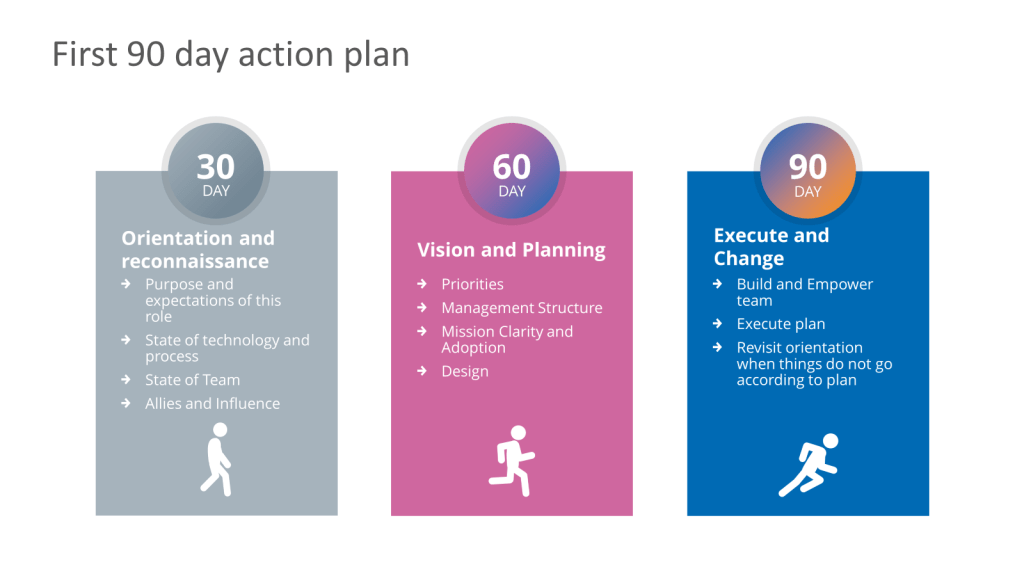
When I first started I met with the team and laid out my 30-60-90 day goals.
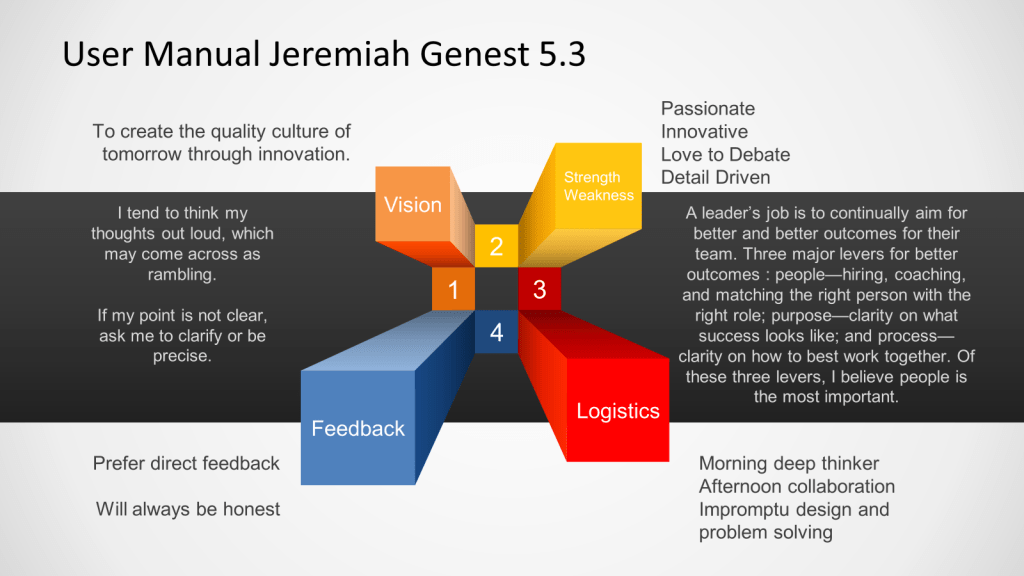
As well as talking a little about how I operate.
A big chunk of my time has been getting the lay-of-the-land institutionally. Setting some standards, doing gap assessments, figuring out what-is-what, and getting to know all my partners and stakeholders. For reasons of confidentiality, this post won’t be going deep on that.
What I do want to talk about is our team values and ways of working. I’ve been focused heavily on three areas with the team:
Team Values
Team Decision Making
Team Competencies
Team Values
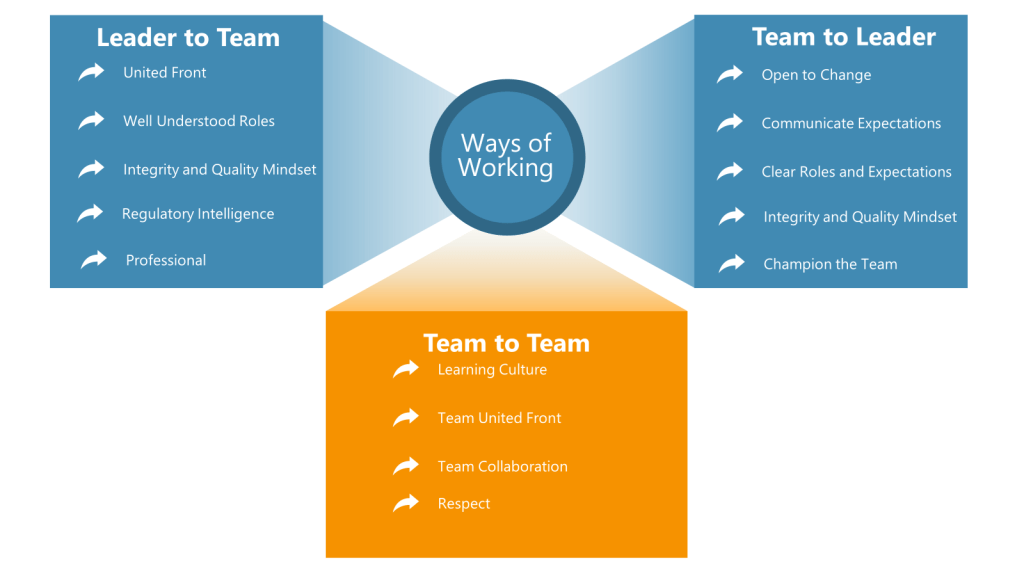
We did a few workshops where we identified a set of values:
Leader to Team: How I expect the team to perform
Team to Leader: How the Team expects me to perform
Team to Team: How we expect each other to perform
This exercise really helped me understand what was going on within the team and through it I really started to understand some priorities.
For each of these, we created a Value Statement. Here are some examples.
Value: United Front
Definition: Decisions are made and recorded honestly and transparently. Employees understand decisions and how to execute them. The entire team represents the decisions made, and the decision-making process with one voice.
Desired Behaviors:
I hold myself accountable for representing the decisions made by the team.
I work to anticipate and fend off the possibility of failures occurring.
I engage with decision making and respect the decisions that result.
Value: Open to Change
Definition: Willingness to listen to the team. Actively looking for feedback and input from the team before making decisions that impact the team. Open to changing established ways and revisiting previously made decisions.
I will create an environment where new ideas are welcome and challenging ideas are encouraged.
I will include the team in decision-making where applicable.
I will actively seek out individual and group feedback to enable continuous improvements.
Value: Learning Culture
Definition: Share lessons learned from projects so team can grow together and remain aligned. Engage in knowledge-sharing sessions.
Desired Behaviors:
I will share lessons learned from each project with the wider QEV team via teams channel &/or weekly team meetings.
I will encourage team members to openly share their experiences, successes, and challenges without fear of judgement.
I will update RAID log with decisions made by the team.
I will identify possible process improvements and update the process improvement tracker
Team Decision Making
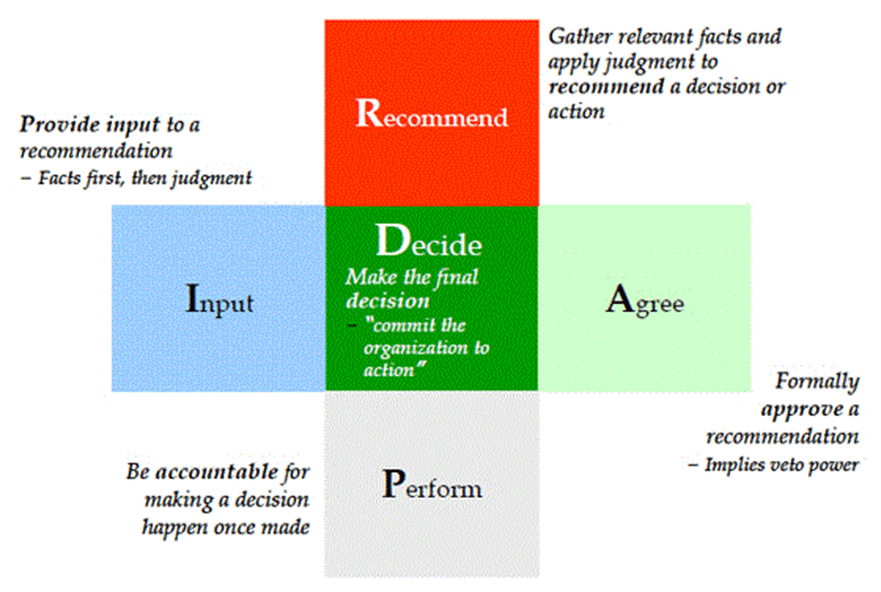
Currently working with the team to define decision-making, introducing the RAPID model and working on a matrix of decisions.
Team Competencies
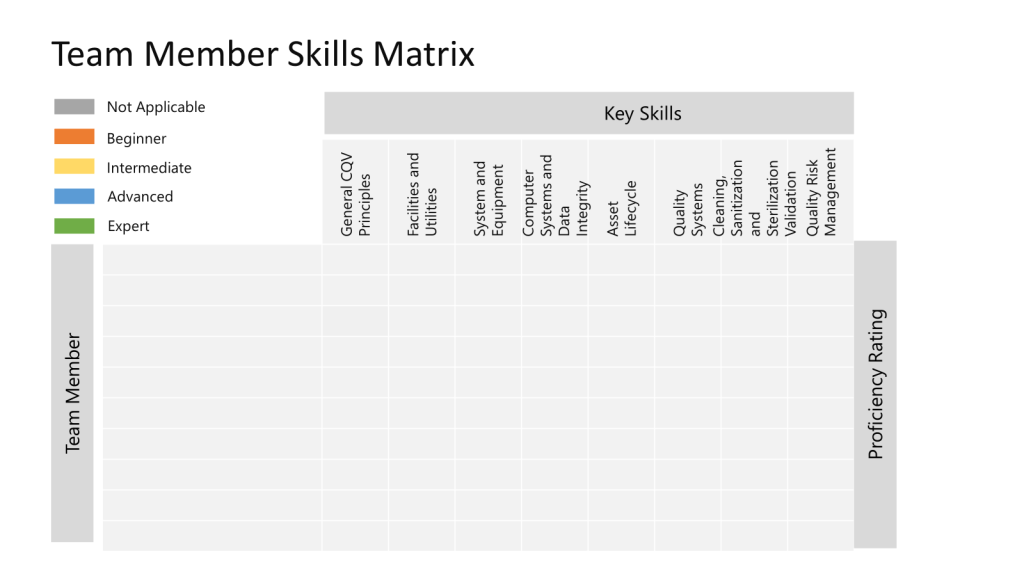
Starting with technical skills we are defining our core competencies. Next, we will tackle, with the larger quality organization, the soft skill side of the equation. This is definitely a work in progress.
Skill
Area
Key
Aspects
Proficiency
Levels
Beginner
Intermediate
Advanced
Expert
General
CQV Principles
�Modern
process validation and guidance
�Validation
design and how to reduce variability
�Able
to review a basic protocol
�Able
to review/approve Validation document deliverables.
�Understands
the importance of a well-defined URS.
�Able
to be QEV lead in a small project
�Able
to answer questions and guide others in QEV
�Participates
in process improvement
�Able
to review and approve RTM/SRs
�Able
to be QEV lead in a large project project
�Trains
and mentors others in QEV
�Leads
process improvement initiatives
�Able
to provide Quality oversight on the creation of Validation Plans for complex
systems and/or projects
�Sets
overall CQV strategy
�Recognized
as an expert outside of JEB
Facilities and Utilities
�Oversee
Facilities, HVAC and Controlled Environments
�Pharma
Water and WFI
�Pure
Steam, Compressed Air, Medical Gases
�Understands
the principles and GMP requirements
�Applies
the principles, activities, and deliverables that constitute an efficient and
acceptable approach to demonstrating facility fitness-for-use/qualification
�Guide
the Design to Qualification Process for new facilities/utilities or the
expansion of existing facilities/utilities
�Able
to establish best practices
Systems and Equipment
�Equipment,
including Lab equipment
�Understands
the principles and GMP requirements
�Principles,
activities, and deliverables that constitute an efficient and acceptable
approach to demonstrating equipment fitness-for-use/qualification
�Able
to provide overall strategy for large projects
�Able
to be QEV lead on complex systems and equipment.
�Able
to establish best practices
Computer Systems and Data Integrity
�Computer
lifecycle, including validation
�Understands
the principles and GMP requirements
�Able
to review CSV documents
�Apply
GAMP5 risk based approach
�Day-to-day
quality oversight
�Able
to provide overall strategy for a risk based GAMP5 approach to computer
system quality
�Able
to establish best practices
Asset Lifecycle
�Quality
oversight and decision making in the lifecycle asset lifecycle: Plan,
acquire, use, maintain, and dispose of assets
�Can
use CMMS to look up Calibrations, Cal schedules and PM schedules
�Quality
oversight of asset lifecycle decisions
�Able
to provide oversight on Cal/PM frequency
�Able
to assess impact to validated state for corrective WO’s.
�Able
to establish asset lifecycle for new equipment classes
�Establish
risk-based PM for new asset classes
�Establish
asset lifecycle approach
Quality Systems
�SOP/WI
and other GxP Documents
�Deviation
�Change
Control
�Able
to use the eQMS
�Deviation
reviewer (minor/major)
�Change
Control approver
�Document
author/approver
�Deviation
reviewer (critical)
�Manage
umbrella/Parent changes
�Able
to set strategic direction
Cleaning,
Sanitization and Sterilization Validation
�Evaluate
and execute cleaning practices, limit calculations, scientific rationales,
and validation documents
�Manage
the challenges of multi-product facilities in the establishment of limits,
determination of validation strategies, and maintaining the validated state
�Differentiate
the requirements for cleaning and sterilization validation when using manual,
semi-automatic, and automatic cleaning technologies
�Review
protocols
�Identify
and characterize potential residues including product, processing aids,
cleaning agents, and adventitious agents
�Understand
Sterilization principles and requirements
�Create,
review and approve scientifically sound rationales,
validation protocols, and reports
�Manage
and remediate the pitfalls inherent in cleaning after the production of
biopharmaceutical and pharmaceutical products
�Define
cleaning/sterilization validation strategy to meet GMP requirements
Quality Risk Management
�Apply
QRM principles according to Q9
�Participate
in a risk assessment
�Determine
appropriate tools
�Establish
risk-based decision-making tools
�Set
risk-based approaches
�Define
risk management program for CQV activities
I’d love feedback on this.
My Overall Philosophy
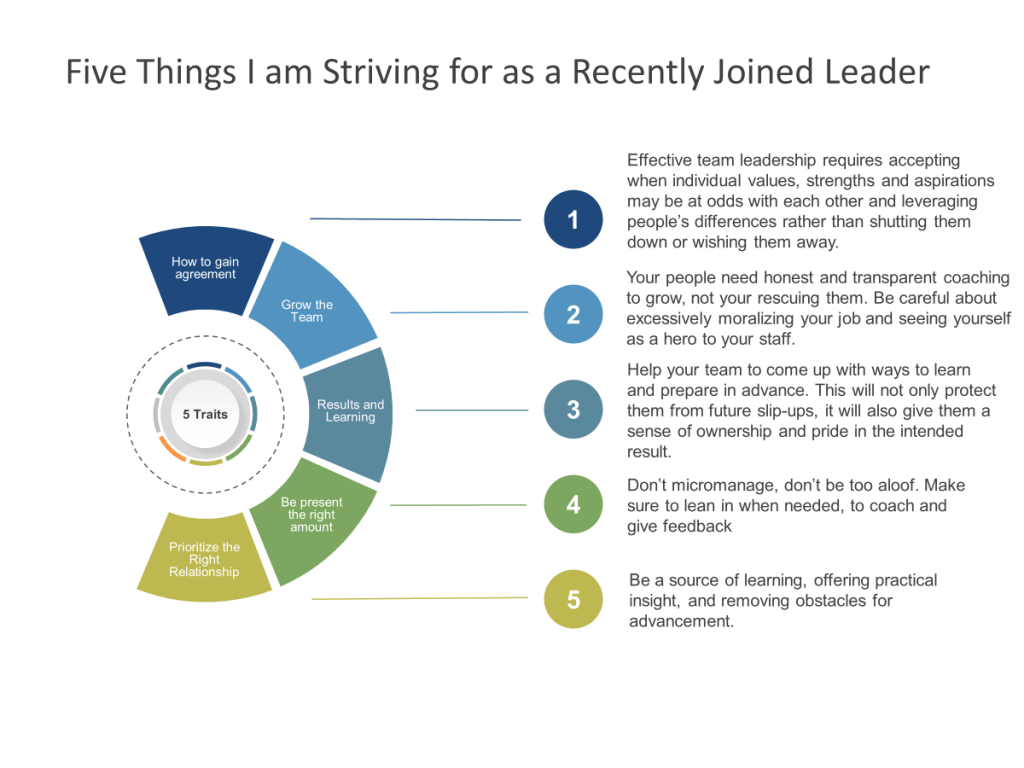
I’ve been focusing on five key tasks as a leader in this organization:
Quality as a profession is often put into the position of being the cop or gatekeeper. There are a set of regulations and standards that must be met, and it can be easy, especially early in one’s career and without proper mentoring, to start to see absolutes.
Compromise is not a weakness in a quality professional, it is a strength.
There are times when, instead of ramping up your argment fill fore to make a case, it is better to step back and think about where you can comprise and still convince the organization to implement most, if not all, of your ideas.
This is where the change accelerators come in. Articulate the vision, and then utilize compromise the build and evolve the guiding coalition and turn that into an army of the willing.
Pilot programs, soft launches, workshops. These tools will help you find your allies and facilitate a solution.
Part of comprise is knowing what you can and will settle for. These questions can help:
What is the first thing I am willing to cede? It may be the timeline or a small adoption of your solution, such as a pilot project.
What is my backup plan? If the stakeholders don’t adopt my plan but offer a counterproposal, what am I willing to accept and jump on board with?
What is fueling the stakeholders’ reluctance? Ask questions, engage in “yes…but…and” practice.
Can I rework my argument? Is there an opportunity to come back with a revised pitch? Can you simplify or emphasize specific parts of your argument? Can you break it down into smaller parts – such as building blocks – first gaining support for the concept, ten gaining support for the first step to test its success, and then building support for the next step or phase?
Compromise is negotiation, and it requires all your emotional intelligence skills – patience, active listening, respect for the stakeholders’ position.
Have a vision, a plan, can really help. You will never get to 100% of meeting a requirement but being able to articulate what great looks like and then showing a plan that builds at a good clip, that allows compromise, will allow you to make continued progress and adjust as you go. Your systems will be stronger as a result.
I’m on the record in believing that Quality as a process is an inherently progressive one and that when we stray from those progressive roots we become exactly what we strive to avoid. One only has to look at the history of Six Sigma, TQM, and even Lean to see that.
I’m a big proponent of Humanocracy for that very reason.
One cannot read much of business writing without coming across the great leader (or even worse great man) hypothesis, which serves to naturalize power and existing forms of authority. One cannot even escape the continued hagiography of Jack Welch, even though he’s been discredited in many ways for his toxic legacy.
We cannot drive out fear unless we unmask power by revealing its contradictions, hypocrisies, and reliance on violence and coercion. The way we work is a result of human decisions, and thus capable of being remade.
We all have a long way to go here. I, for example, catch myself all the time speaking of leadership in hierarchical ways. One of the current things I am working on is exorcising the term ‘leadership team’ from my vocabulary. It doesn’t serve any real purpose and it fundamentally puts the idea of leadership as a hierarchical entity.
Another thing I am working on is to tackle the thorn of positional authority, the idea that the higher the rank in the organization the more decision-making authority you have. Which is absurd. In every organization, I’ve been in people have positions of authority that cover areas they do not have the education, experience, and training to make decisions in. This is why we need to have clear decision matrixes, establish empowered process owners and drive democratic leadership throughout the organization.
I am speaking with the ASQ’s Human Developlement and Leadership Division on August 4th at 3 pm eastern on “Trust & Adaptability: Servant Leadership Lessons from Joining an Organization During a Pandemic” exploring from what Steven M. R. Covey wrote in Ken Blanchard and Renee’s Broadwell’s book Servant Leadership in Action that the key outcome for a servant leader is trust. Trust and servant leadership are both built on intent. The Trust built will allow your organization to be more adaptable. Adaptability builds resilience and allows innovation and transformation.
This talk will mostly focus on my continual learnings as I’ve worked, and usually struggled, to build trust during this pandemic in an environment where I’ve never met most of my co-workers.




 Investigations of a Dog