Worker’s Rights: The Bedrock of True Quality Management – A May Day Reflection

As we celebrate International Workers’ Day this May 1st, it is an opportune moment to reflect on the profound connection between workers’ rights and effective quality management. The pursuit of quality cannot be separated from how we treat, empower, and respect the rights of those who create that quality daily. Today’s post examines this critical relationship, drawing from the principles I’ve advocated throughout my blog, and challenges us to reimagine quality management as fundamentally worker-centered.

The Historical Connection Between Workers’ Rights and Quality

International Workers’ Day commemorates the historic struggles and gains made by workers and the labor movement. This celebration reminds us that the evolution of quality management has paralleled the fight for workers’ rights. Quality is inherently a progressive endeavor, fundamentally anti-Taylorist in nature. Frederick Taylor’s scientific management approach reduced workers to interchangeable parts in a machine, stripping them of autonomy and creativity – precisely the opposite of what modern quality management demands.

The quality movement, from Deming onwards, has recognized that treating workers as mere cogs undermines the very foundations of quality. When we champion human rights and center those whose rights are challenged, we’re not engaging in politics separate from quality – we’re acknowledging the fundamental truth that quality cannot exist without empowered, respected workers.

Driving Out Fear: The Essential Quality Right

“No one can put in his best performance unless he feels secure,” wrote Deming thirty-five years ago. Yet today, fear remains ubiquitous in corporate culture, undermining the very quality we seek to create. As quality professionals, we must confront this reality at every opportunity.

Fear in the workplace manifests in multiple ways, each destructive to quality:

Source of FearDescriptionImpact on Quality
CompetitionManagers often view anxiety generated by competition between co-workers as positive, encouraging competition for scarce resources, power, and statusUndermines collaboration necessary for system-wide quality improvements
“Us and Them” CultureSilos proliferate, creating barriers between staff and supervisorsPrevents holistic quality approaches that span departmental boundaries
Blame CultureFocus on finding fault rather than improving systems, often centered around the concept of “human error”Discourages reporting of issues, driving quality problems underground

When workers operate in fear, quality inevitably suffers. They hide mistakes rather than report them, avoid innovation for fear of failure, and focus on protecting themselves rather than improving systems. Driving out fear isn’t just humane – it’s essential for quality.

Key Worker Rights in Quality Management

Quality management systems that respect workers’ rights create environments where quality can flourish. Based on workplace investigation principles, these rights extend naturally to all quality processes.

The Right to Information

In any quality system, clarity is essential. Workers have the right to understand quality requirements, the rationale behind procedures, and how their work contributes to the overall quality system. Transparency sets the stage for collaboration, where everyone works toward a common quality goal with full understanding.

The Right to Confidentiality and Non-Retaliation

Workers must feel safe reporting quality issues without fear of punishment. This means protecting their confidentiality when appropriate and establishing clear non-retaliation policies. One of the pillars of workplace equity is ensuring that employees are shielded from retaliation when they raise concerns, reinforcing a commitment to a culture where individuals can voice quality issues without fear.

The Right to Participation and Representation

The Who-What Matrix is a powerful tool to ensure the right people are involved in quality processes. By including a wider set of people, this approach creates trust, commitment, and a sense of procedural justice-all essential for quality success. Workers deserve representation in decisions that affect their ability to produce quality work.

Worker Empowerment: The Foundation of Quality Culture

Empowerment is not just a nice-to-have; it’s a foundational element of any true quality culture. When workers are entrusted with authority to make decisions, initiate actions, and take responsibility for outcomes, both job satisfaction and quality improve. Unfortunately, empowerment rhetoric is sometimes misused within quality frameworks like TQM, Lean, and Six Sigma to justify increased work demands rather than genuinely empowering workers.

The concept of empowerment has its roots in social movements, including civil rights and women’s rights, where it described the process of gaining autonomy and self-determination for marginalized groups. In quality management, this translates to giving workers real authority to improve processes and address quality issues.

Mary Parker Follett’s Approach to Quality Through Autonomy

Follett emphasized giving workers autonomy to complete their jobs effectively, believing that when workers have freedom, they become happier, more productive, and more engaged. Her “power with” principle suggests that power should be shared broadly rather than concentrated, fostering a collaborative environment where quality can thrive.

Rejecting the Great Man Fallacy

Quality regulations often fall into the trap of the “Great Man Fallacy” – the misguided notion that one person through education, experience, and authority can ensure product safety, efficacy, and quality. This approach is fundamentally flawed.

People only perform successfully when they operate within well-built systems. Process drives success by leveraging the right people at the right time making the right decisions with the right information. No single person can ensure quality, and thinking otherwise sets up both individuals and systems for failure.

Instead, we need to build processes that leverage teams, democratize decisions, and drive reliable results. This approach aligns perfectly with respecting workers’ rights and empowering them as quality partners rather than subjects of quality control.

Quality Management as a Program: Centering Workers’ Rights

Quality needs to be managed as a program, walking a delicate line between long-term goals, short-term objectives, and day-to-day operations. As quality professionals, we must integrate workers’ rights into this program approach.

The challenges facing quality today-from hyperautomation to shifting customer expectations-can only be addressed through worker empowerment. Consider how these challenges demand a worker-centered approach:

ChallengeImpact on Quality ManagementWorker-Centered Approach
Advanced AnalyticsRequires holistic data analysis and applicationDevelop talent strategies that upskill workers rather than replacing them
Hyper-AutomationTasks previously done by humans being automatedInvolve workers in automation decisions; focus on how automation can enhance rather than replace human work
Virtualization of WorkRethinking how quality is executed in digital environmentsEnsure workers have input on how virtual quality processes are designed
Shift to Resilient OperationsNeed to adapt to changing risk levels in real-timeEnable employees to make faster decisions by building quality-informed judgment
Digitally Native WorkforceChanged expectations for how work is managedConnect quality to values employees care about: autonomy, innovation, social issues

To meet these challenges, we must shift from viewing quality as a function to quality as an interdisciplinary, participatory process. We need to break down silos and build autonomy, encouraging personal buy-in through participatory quality management.

May Day as a Reminder of Our Quality Mission

As International Workers’ Day approaches, I’m reminded that our quality mission is inseparable from our commitment to workers’ rights. This May Day, I encourage all quality professionals to:

  1. Evaluate how your quality systems either support or undermine workers’ rights
  2. Identify and eliminate sources of fear in your quality processes
  3. Create mechanisms for meaningful worker participation in quality decisions
  4. Reject hierarchical quality models in favor of democratic, empowering approaches
  5. Recognize that centering workers’ rights isn’t just ethical-it’s essential for quality

Quality management without respect for workers’ rights is not just morally questionable-it’s ineffective. The future of quality lies in approaches that are predictive, connected, flexible, and embedded. These can only be achieved when workers are treated as valued partners with protected rights and real authority.

This May Day, let’s renew our commitment to driving out fear, empowering workers, and building quality systems that respect the dignity and rights of every person who contributes to them. In doing so, we honor not just the historical struggles of workers, but also the true spirit of quality that puts people at its center.

What steps will you take this International Workers’ Day to strengthen the connection between workers’ rights and quality in your organization?
X-Matrix for Strategic Execution

Quality needs to be managed as a program, and as such, it must walk a delicate line between setting long-term goals, short-term goals, improvement priorities, and interacting with a suite of portfolios, programs, and KPIs. As quality professionals navigate increasingly complex regulatory landscapes, technological disruptions, and evolving customer expectations, the need for structured approaches to quality planning has never been greater.

At the heart of this activity, I use an x-matrix, a powerful tool at the intersection of strategic planning and quality management. The X-Matrix provides a comprehensive framework that clarifies the chaos, visually representing how long-term quality objectives cascade into actionable initiatives with clear ownership and metrics – connecting the dots between aspiration and execution in a single, coherent framework.

Understanding the X-Matrix: Structure and Purpose

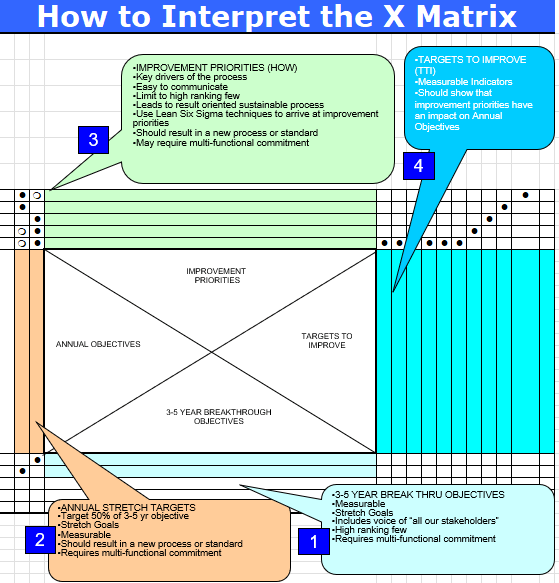
The X-Matrix is a strategic planning tool from Hoshin Kanri methodology that brings together multiple dimensions of organizational strategy onto a single page. Named for its distinctive X-shaped pattern of relationships, this tool enables us to visualize connections between long-term breakthroughs, annual objectives, improvement priorities, and measurable targets – all while clarifying ownership and resource allocation.

The X-Matrix is structured around four key quadrants that create its distinctive shape:

  1. South Quadrant (3-5 Year Breakthrough Objectives): These are the foundational, long-term quality goals that align with organizational vision and regulatory expectations. In quality contexts, these might include achieving specific quality maturity levels, establishing new quality paradigms, or fundamentally transforming quality systems.
  2. West Quadrant (Annual Objectives): These represent the quality priorities for the coming year that contribute directly to the longer-term breakthroughs. These objectives are specific enough to be actionable within a one-year timeframe.
  3. North Quadrant (Improvement Priorities): These are the specific initiatives, projects, and process improvements that will be undertaken to achieve the annual objectives. Each improvement priority should have clear ownership and resource allocation.
  4. East Quadrant (Targets/Metrics): These are the measurable indicators that will be used to track progress toward both annual objectives and breakthrough goals. In quality planning, these often include process capability indices, deviation rates, right-first-time metrics, and other key performance indicators.

The power of the X-Matrix lies in the correlation points where these quadrants intersect. These intersections show how initiatives support objectives and how objectives align with long-term goals. They create a clear line of sight from strategic quality vision to daily operations and improvement activities.

Why the X-Matrix Excels for Quality Planning

Traditional quality planning approaches often suffer from disconnection between strategic objectives and tactical activities. Quality initiatives may be undertaken in isolation, with limited understanding of how they contribute to broader organizational goals. The X-Matrix addresses this fragmentation through its integrated approach to planning.

The X-Matrix provides visibility into the interdependencies within your quality system. By mapping the relationships between long-term quality objectives, annual goals, improvement priorities, and key metrics, quality leaders can identify potential resource conflicts, capability gaps, and opportunities for synergy.

Developing an X-Matrix necessitates cross-functional input and alignment to ensure that quality objectives are not isolated but integrated with operations, regulatory, supply chain, and other critical functions. The development of an X-Matrix encourages the back-and-forth dialogue necessary to develop realistic, aligned goals.

Perhaps most importantly for quality organizations, the X-Matrix provides the structure and rigor to ensure quality planning is not left to chance. As the FDA and other regulatory bodies increasingly emphasize Quality Management Maturity (QMM) as a framework for evaluating pharmaceutical operations, the disciplined approach embodied in the X-Matrix becomes a competitive advantage. The matrix systematically considers resource constraints, capability requirements, and performance measures – all essential components of mature quality systems.

Mapping Modern Quality Challenges to the X-Matrix

The quality landscape is evolving rapidly, with several key challenges that must be addressed in any comprehensive quality planning effort. The X-Matrix provides an ideal framework for addressing these challenges systematically. Building on the post “The Challenges Ahead for Quality” we can start to build our an X-matrix.

Advanced Analytics and Digital Transformation

As data sources multiply and processing capabilities expand, quality organizations face increased expectations for data-driven insights and decision-making. An effective X-Matrix for quality planning couldinclude:

3-5 Year Breakthrough: Establish a predictive quality monitoring system that leverages advanced analytics to identify potential quality issues before they manifest.

Annual Objectives: Implement data visualization tools for key quality metrics; establish data governance framework for GxP data; develop predictive models for critical quality attributes.

Improvement Priorities: Create cross-functional data science capability; implement automated data capture for batch records; develop real-time dashboards for process parameters.

Metrics: Percentage of quality decisions made with data-driven insights; predictive model accuracy; reduction in quality investigation cycle time through analytics.

Operational Stability in Complex Supply Networks

As pharmaceutical manufacturing becomes increasingly globalized with complex supplier networks, operational stability emerges as a critical challenge. Operational stability represents the state where manufacturing and quality processes exhibit consistent, predictable performance over time with minimal unexpected variation. The X-Matrix can address this through:

3-5 Year Breakthrough: Achieve Level 4 (Proactive) operational stability across all manufacturing sites, networks and key suppliers.

Annual Objectives: Implement statistical process control for critical processes; establish supplier quality alignment program; develop operational stability metrics and monitoring system.

Improvement Priorities: Deploy SPC training and tools; conduct operational stability risk assessments; implement regular supplier quality reviews; establish cross-functional stability team.

Metrics: Process capability indices (Cp, Cpk); right-first-time batch rates; deviation frequency and severity patterns; supplier quality performance.

Using the X-Matrix to Address Validation Challenges

Validation presents unique challenges in modern pharmaceutical operations, particularly as data systems become more complex and interconnected. Handling complex data types and relationships can be time-consuming and difficult, while managing validation rules across large datasets becomes increasingly costly and challenging. The X-Matrix offers a structured approach to addressing these validation challenges:

3-5 Year Breakthrough: Establish a risk-based, continuous validation paradigm that accommodates rapidly evolving systems while maintaining compliance.

Annual Objectives: Implement risk-based validation approach for all GxP systems; establish automated testing capabilities for critical applications; develop validation strategy for AI/ML applications.

Improvement Priorities: Train validation team on risk-based approaches; implement validation tool for automated test execution; develop validation templates for different system types; establish validation center of excellence.

Metrics: Validation cycle time reduction; percentage of validation activities conducted via automated testing; validation resource efficiency; validation effectiveness (post-implementation defects).

This X-Matrix approach to validation challenges ensures that validation activities are not merely compliance exercises but strategic initiatives that support broader quality objectives. By connecting validation priorities to annual objectives and long-term breakthroughs, organizations can justify the necessary investments and resources while maintaining a clear focus on business value.

Connecting X-Matrix Planning to Quality Maturity Models

The FDA’s Quality Management Maturity (QMM) model provides a framework for assessing an organization’s progression from reactive quality management to optimized, continuous improvement. This model aligns perfectly with the X-Matrix planning approach, as both emphasize systematic progression toward excellence.

The X-Matrix can be structured to support advancement through quality maturity levels by targeting specific capabilities associated with each level:

Maturity LevelX-Matrix Breakthrough ObjectiveAnnual ObjectivesImprovement Priorities
Reactive (Level 1)Move from reactive to controlled quality operationsEstablish baseline quality metrics; implement basic SOPs; define critical quality attributesProcess mapping; basic training program; deviation management system
Controlled (Level 2)Transition from controlled to predictive quality systemsImplement statistical monitoring; establish proactive quality planning; develop quality risk managementSPC implementation; risk assessment training; preventive maintenance program
Predictive (Level 3)Advance from predictive to proactive quality operationsEstablish leading indicators; implement knowledge management; develop cross-functional quality ownershipPredictive analytics capability; knowledge database; quality circles
Proactive (Level 4)Progress from proactive to innovative quality systemsImplement continuous verification; establish quality innovation program; develop supplier quality maturityContinuous process verification; innovation workshops; supplier development program
Innovative (Level 5)Maintain and leverage innovative quality capabilitiesEstablish industry leading practices; develop quality thought leadership; implement next-generation quality approachesQuality research initiatives; external benchmarking; technology innovation pilots

This alignment between the X-Matrix and quality maturity models offers several advantages. First, it provides a clear roadmap for progression through maturity levels. Second, it helps organizations prioritize initiatives based on their current maturity level and desired trajectory. Finally, it creates a framework for measuring and communicating progress toward maturity goals.

Implementation Best Practices for Quality X-Matrix Planning

Implementing an X-Matrix approach to quality planning requires careful consideration of several key factors.

1. Start With Clear Strategic Quality Imperatives

The foundation of any effective X-Matrix is a clear set of strategic quality imperatives that align with broader organizational goals. These imperatives should be derived from:

  • Regulatory expectations and trends
  • Customer quality requirements
  • Competitive quality positioning
  • Organizational quality vision

These imperatives form the basis for the 3-5 year breakthrough objectives in the X-Matrix. Without this clarity, the remaining elements of the matrix will lack focus and alignment.

2. Leverage Cross-Functional Input

Quality does not exist in isolation; it intersects with every aspect of the organization. Effective X-Matrix planning requires input from operations, regulatory affairs, supply chain, R&D, and other functions. This cross-functional perspective ensures that quality objectives are realistic, supported by appropriate capabilities, and aligned with broader organizational priorities.

The catchball process from Hoshin Kanri provides an excellent framework for this cross-functional dialogue, allowing for iterative refinement of objectives, priorities, and metrics based on input from various stakeholders.

3. Focus on Critical Few Priorities

The power of the X-Matrix lies in its ability to focus organizational attention on the most critical priorities. Resist the temptation to include too many initiatives, objectives, or metrics. Instead, identify the vital few that will drive meaningful progress toward quality maturity and operational excellence.

This focus is particularly important in regulated environments where resource constraints are common and compliance demands can easily overwhelm improvement initiatives. A well-designed X-Matrix helps quality leaders maintain strategic focus amid the daily demands of compliance activities.

4. Establish Clear Ownership and Resource Allocation

The X-Matrix should clearly identify who is responsible for each improvement priority and what resources they will have available. This clarity is essential for execution and accountability. Without explicit ownership and resource allocation, even the most well-conceived quality initiatives may fail to deliver results.

The structure of the X-Matrix facilitates this clarity by explicitly mapping resources to initiatives and objectives. This mapping helps identify potential resource conflicts early and ensures that critical initiatives have the support they need.

Balancing Structure with Adaptability in Quality Planning

A potential criticism of highly structured planning approaches like the X-Matrix is that they may constrain adaptability and innovation. However, a well-designed X-Matrix actually enhances adaptability by providing a clear framework for evaluating and integrating new priorities. The structure of the matrix makes it apparent when new initiatives align with strategic objectives and when they represent potential distractions. This clarity helps quality leaders make informed decisions about where to focus limited resources when disruptions occur.

The key lies in building what might be called “bounded flexibility”—freedom to innovate within well-understood boundaries. By thoroughly understanding which process parameters truly impact critical quality attributes, organizations can focus stability efforts where they matter most while allowing flexibility elsewhere. The X-Matrix supports this balanced approach by clearly delineating strategic imperatives (where stability is essential) from tactical initiatives (where adaptation may be necessary).

Change management systems represent another critical mechanism for balancing stability with innovation. Well-designed change management ensures that innovations are implemented in a controlled manner that preserves operational stability. The X-Matrix can incorporate change management as a specific improvement priority, ensuring that the organization’s ability to adapt is explicitly addressed in quality planning.

The X-Matrix as the Engine of Quality Excellence

The X-Matrix represents a powerful approach to quality planning that addresses the complex challenges facing modern quality organizations. By providing a structured framework for aligning long-term quality objectives with annual goals, specific initiatives, and measurable targets, the X-Matrix helps quality leaders navigate complexity while maintaining strategic focus.

As regulatory bodies evolve toward Quality Management Maturity models, the systematic approach embodied in the X-Matrix will become increasingly valuable. Organizations that establish and maintain strong operational stability through structured planning will find themselves well-positioned for both compliance and competition in an increasingly demanding pharmaceutical landscape.

The journey toward quality excellence is not merely technical but cultural and organizational. It requires systematic approaches, appropriate metrics, and balanced objectives that recognize quality not as an end in itself but as a means to deliver value to patients, practitioners, and the business. The X-Matrix provides the framework needed to navigate this journey successfully, translating quality vision into tangible results that advance both organizational performance and patient outcomes.

By adopting the X-Matrix approach to quality planning, organizations can ensure that their quality initiatives are not isolated efforts but components of a coherent strategy that addresses current challenges while building the foundation for future excellence. In a world of increasing complexity and rising expectations, this structured yet flexible approach to quality planning may well be the difference between merely complying and truly excelling.

Quality Systems as Living Organizations: A Framework for Adaptive Excellence

The allure of shiny new tools in quality management is undeniable. Like magpies drawn to glittering objects, professionals often collect methodologies and technologies without a cohesive strategy. This “magpie syndrome” creates fragmented systems—FMEA here, 5S there, Six Sigma sprinkled in—that resemble disjointed toolkits rather than coherent ecosystems. The result? Confusion, wasted resources, and quality systems that look robust on paper but crumble under scrutiny. The antidote lies in reimagining quality systems not as static machines but as living organizations that evolve, adapt, and thrive.

The Shift from Machine Logic to Organic Design

Traditional quality systems mirror 20th-century industrial thinking: rigid hierarchies, linear processes, and documents that gather dust. These systems treat organizations as predictable machines, relying on policies to command and procedures to control. Yet living systems—forests, coral reefs, cities—operate differently. They self-organize around shared purpose, adapt through feedback, and balance structure with spontaneity. Deming foresaw this shift. His System of Profound Knowledge—emphasizing psychology, variation, and systems thinking—aligns with principles of living systems: coherence without control, stability with flexibility.

At the heart of this transformation is the recognition that quality emerges not from compliance checklists but from the invisible architecture of relationships, values, and purpose. Consider how a forest ecosystem thrives: trees communicate through fungal networks, species coexist through symbiotic relationships, and resilience comes from diversity, not uniformity. Similarly, effective quality systems depend on interconnected elements working in harmony, guided by a shared “DNA” of purpose.

The Four Pillars of Living Quality Systems

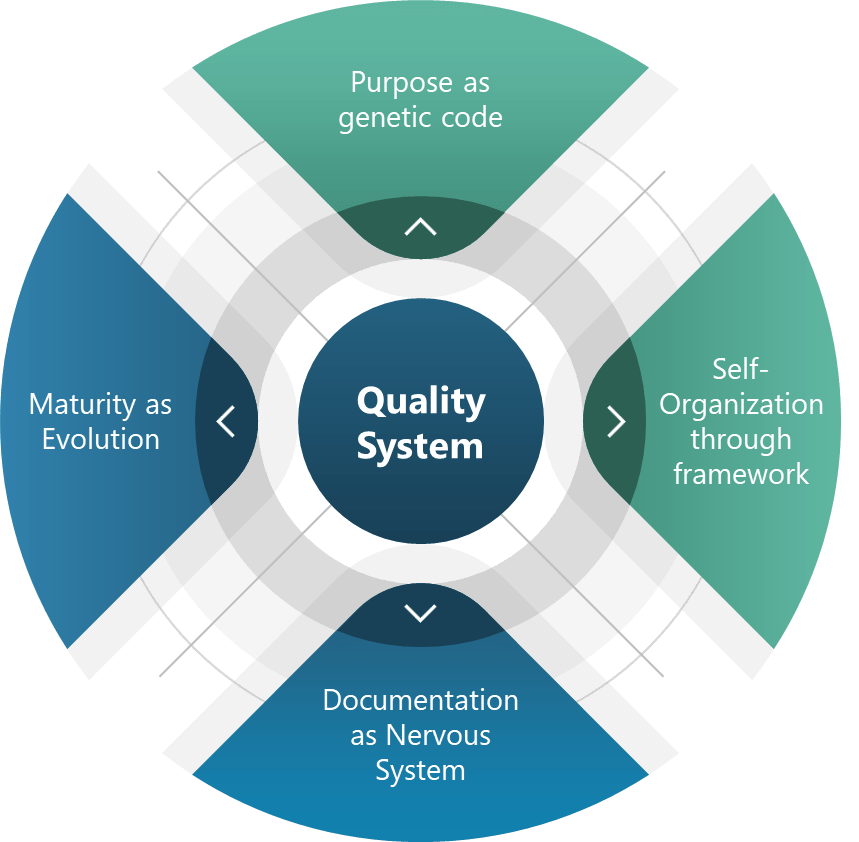
  1. Purpose as Genetic Code
    Every living system has inherent telos—an aim that guides adaptation. For quality systems, this translates to policies that act as genetic non-negotiables. For pharmaceuticals and medical devices this is “patient safety above all.”. This “DNA” allowed teams to innovate while maintaining adherence to core requirements, much like genes express differently across environments without compromising core traits.
  2. Self-Organization Through Frameworks
    Complex systems achieve order through frameworks as guiding principles. Coherence emerges from shared intent. Deming’s PDSA cycles and emphasis on psychological safety create similar conditions for self-organization.
  3. Documentation as a Nervous System
    The enhanced document pyramid—policies, programs, procedures, work instructions, records—acts as an organizational nervous system. Adding a “program” level between policies and procedures bridges the gap between intent and action and can transform static documents into dynamic feedback loops.
  4. Maturity as Evolution
    Living systems evolve through natural selection. Maturity models serve as evolutionary markers:
    • Ad-hoc (Primordial): Tools collected like random mutations.
    • Managed (Organized): Basic processes stabilize.
    • Standardized (Complex): Methodologies cohere.
    • Predictable (Adaptive): Issues are anticipated.
    • Optimizing (Evolutionary): Improvement fuels innovation.

Cultivating Organizational Ecosystems: Eight Principles

Living quality systems thrive when guided by eight principles:

  • Balance: Serving patients, employees, and regulators equally.
  • Congruence: Aligning tools with culture.
  • Human-Centered: Designing for joy—automating drudgery, amplifying creativity.
  • Learning: Treating deviations as data, not failures.
  • Sustainability: Planning for decade-long impacts, not quarterly audits.
  • Elegance: Simplifying until it hurts, then relaxing slightly.
  • Coordination: Cross-pollinating across the organization
  • Convenience: Making compliance easier than non-compliance.

These principles operationalize Deming’s wisdom. Driving out fear (Point 8) fosters psychological safety, while breaking down barriers (Point 9) enables cross-functional symbiosis.

The Quality Professional’s New Role: Gardener, Not Auditor

Quality professionals must embrace a transformative shift in their roles. Instead of functioning as traditional enforcers or document controllers, we are now called to act as stewards of living systems. This evolution requires a mindset change from one of rigid oversight to one of nurturing growth and adaptability. The modern quality professional takes on new identities such as coach, data ecologist, and systems immunologist—roles that emphasize collaboration, learning, and resilience.

To thrive in this new capacity, practical steps must be taken. First, it is essential to prune toxic practices by eliminating fear-driven reporting mechanisms and redundant tools that stifle innovation and transparency. Quality professionals should focus on fostering trust and streamlining processes to create healthier organizational ecosystems. Next, they must plant feedback loops by embedding continuous learning into daily workflows. For instance, incorporating post-meeting retrospectives can help teams reflect on successes and challenges, ensuring ongoing improvement. Lastly, cross-pollination is key to cultivating diverse perspectives and skills. Rotating staff between quality assurance, operations, and research and development encourages knowledge sharing and breaks down silos, ultimately leading to more integrated and innovative solutions.

By adopting this gardener-like approach, quality professionals can nurture the growth of resilient systems that are better equipped to adapt to change and complexity. This shift not only enhances organizational performance but also fosters a culture of continuous improvement and collaboration.

Thriving, Not Just Surviving

Quality systems that mimic life—not machinery—turn crises into growth opportunities. As Deming noted, “Learning is not compulsory… neither is survival.” By embracing living system principles, we create environments where survival is the floor, and excellence is the emergent reward.

Start small: Audit one process using living system criteria. Replace one control mechanism with a self-organizing principle. Share learnings across your organizational “species.” The future of quality isn’t in thicker binders—it’s in cultivating systems that breathe, adapt, and evolve.

Quality Management as a Program

Quality System Management should be viewed and governed as a program

Program management is commonly defined as “a group of projects that contribute to a common, higher order objective.” The projects in a program are related, and the intent of achieving benefits would not be realized if the projects were managed independently.

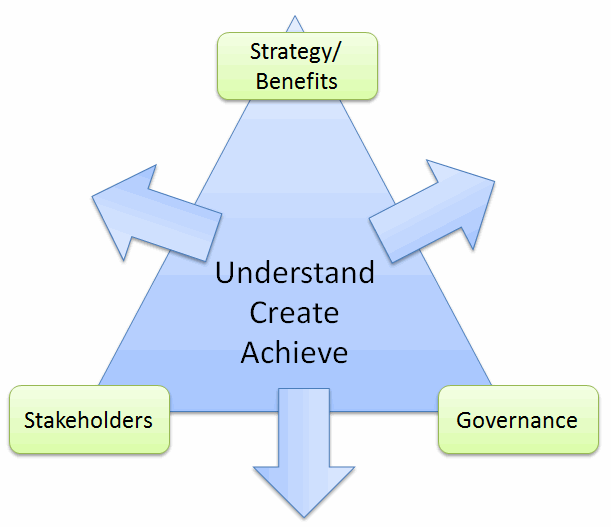
Program management includes the practices and processes of strategic alignment, benefits management, stakeholder management, governance, and lifecycle management. Program governance creates the control framework for delivering the programs’ change objectives and making benefit delivery visible to the organization’s control.

There are different styles of program management and what I am focusing on here is what is sometimes called “heartbeat”, which aims to achieve evolutionary improvement of existing systems and processes or organizational change. This program type creates value by reconciling contradicting views and demands for change from various organization actors in order to enhance existing systems and practices while sustaining operations.

Heartbeat program management is all about awareness of the contexts of the program and requires knowledge of strategy, competition, trends in the industry, and differences in management practices between the business units of the company. A good heartbeat program manager is highly concerned about their program’s long-term effects and implications for the company’s business.

Magic triangle of a program manager

Programs exist to create value by improving the management of projects and to create benefits through better organization of projects. The fundamental goals of program management are:

  • Efficiency and effectiveness: Aspects of management that a proficient project manager should address and benefit from coordination.
  • Business focus goal: The external alignment of projects with the requirements, goals, drivers and culture of the wider organization. These goals are associated with defining an appropriate direction for the constituent projects within a program as well as for the program as a whole.
GoalDescription
Efficiency and effectiveness goals
Improved co-ordinationAssist in identification and definition of project inter-dependencies and thereby reduce the incidence of work backlogs, rework and delays
Improved dependency managementReduce the amount of re-engineering required due to inadequate management of the interfaces between projects
More effective resource utilizationImprove the effectiveness and efficiency of the allocation of shared resources
Assist in providing justification for specialist resources that deliver an overall improvement to program delivery and/or business operations
More effective knowledge transferProvide a means to identify and improve upon transferable lessons.
Facilitate organizational learning
Greater senior management ‘visibility’Enable senior management to better monitor, direct and control the implementation process
Business focus goals
More coherent communicationImprove communication of overall goals and direction both internally and externally to the program
Target management attention clearly on the realization of benefits that are defined and understood at the outset and achieved through the lifetime of the program and beyond
Assist in keeping personal agendas in check
Improved project definitionEnsure that project definition is more systematic and objective, thereby reducing the prevalence of projects with a high risk of failure or obsolescence
Enable the unbundling of activities in a strategic project-set into specific projects
Enable the bundling of related projects together to create a greater leverage or achieve economies of scale
Better alignment with business drivers, goals and strategyImproves the linkage between the strategic direction of organizations and the management activities required to achieve these strategic objectives
Provide an enabling framework for the realization of strategic change and the ongoing alignment of strategy and projects in response to a changing business environment (via project addition/culling, etc.)

The Attributes of a Good Heartbeat Program Manager are the Attributes to a Good Quality Leader

As quality leaders we are often ambassadors to ensure that the quality program is progressing despite the conflicting requirements of the various stakeholders. We need to actively influence quality-related decisions of all stakeholders, including people holding superior positions. Having a well-developed personal network within the organization is particularly helpful.

It is critical to always be communicating about the quality program in a visionary way, to be seen as passionate ambassadors. Playing this role requires constant attention to differing expectations of the stakeholders and various ways to influence stakeholders for the benefit of the quality system. To always be striving to build quality, to advance quality.

As advocates for Quality, it is a core competency to be able to stand up and defend, or argue for, the quality program and team members. This ability to challenge others, including their superiors, in a productive way is a critical ability.

A key focus of the quality program should be on engagement with a conscious and sustained drive to secure buy-in from key stakeholders (including senior management) and win over the hearts and minds of those responsible for execution to make changes feel less painful and inflicted. As quality leaders our aim should always be to engender a climate of comprehension, inclusion and trust, and to draw upon expertise globally to create fit for purpose processes and systems

Effective quality leaders need to be “heavyweight” organizational players.

Core Competencies of the Heartbeat Manager

  • Contextual awareness
  • Scenario planning
  • Political skills
  • Courage
  • Networking

A note on program life

Many standard approaches perceive programs to have a finite life. This is constraining given that the strategies themselves, especially as applied to quality, have long lifetimes. I believe that program management has as much to learn from quality management,  and there is a lot of value in seeing an indefinite time horizon as beneficial.

Quality management is an evolutionary approach, and utilizing program management methodologies within it should be taken in the same light.