Managing Events Systematically

Being good at problem-solving is critical to success in an organization. I’ve written quite a bit on problem-solving, but here I want to tackle the amount of effort we should apply.

Not all problems should be treated the same. There are also levels of problems. And these two aspects can contribute to some poor problem-solving practices.

It helps to look at problems systematically across our organization. The iceberg analogy is a pretty popular way to break this done focusing on Events, Patterns, Underlying Structure, and Mental Model.

Iceberg analogy

Events

Events start with the observation or discovery of a situation that is different in some way. What is being observed is a symptom and we want to quickly identify the problem and then determine the effort needed to address it.

This is where Art Smalley’s Four Types of Problems comes in handy to help us take a risk-based approach to determining our level of effort.

Type 1 problems, Troubleshooting, allows us to set problems with a clear understanding of the issue and a clear pathway. Have a flat tire? Fix it. Have a document error, fix it using good documentation practices.

It is valuable to work the way through common troubleshooting and ensure the appropriate linkages between the different processes, to ensure a system-wide approach to problem solving.

Corrective maintenance is a great example of troubleshooting as it involved restoring the original state of an asset. It includes documentation, a return to service and analysis of data. From that analysis of data problems are identified which require going deeper into problem-solving. It should have appropriate tie-ins to evaluate when the impact of an asset breaking leads to other problems (for example, impact to product) which can also require additional problem-solving.

It can be helpful for the organization to build decision trees that can help folks decide if a given problem stays as troubleshooting or if it it also requires going to type 2, “gap from standard.”

Type 2 problems, gap from standard, means that the actual result does not meet the expected and there is a potential of not meeting the core requirements (objectives) of the process, product, or service. This is the place we start deeper problem-solving, including root cause analysis.

Please note that often troubleshooting is done in a type 2 problem. We often call that a correction. If the bioreactor cannot maintain temperature during a run, that is a type 2 problem but I am certainly going to immediately apply troubleshooting as well. This is called a correction.

Take documentation errors. There is a practice in place, part of good documentation practices, for addressing troubleshooting around documents (how to correct, how to record a comment, etc). By working through the various ways documentation can go wrong, applying which ones are solved through troubleshooting and don’t involve type 2 problems, we can create a lot of noise in our system.

Core to the quality system is trending, looking for possible signals that require additional effort. Trending can help determine where problems lay and can also drive up the level of effort necessary.

Underlying Structure

Root Cause Analysis is about finding the underlying structure of the problem that defines the work applied to a type 2 problem.

Not all problems require the same amount of effort, and type 2 problems really have a scale based on consequences, that can help drive the level of effort. This should be based on the impact to the organization’s ability to meet the quality objectives, the requirements behind the product or service.

For example, in the pharma world there are three major criteria:

  •  safety, rights, or well-being of patients (including subjects and participants human and non-human)
  • data integrity (includes confidence in the results, outcome, or decision dependent on the data)
  • ability to meet regulatory requirements (which stem from but can be a lot broader than the first two)

These three criteria can be sliced and diced a lot of ways, but serve our example well.

To these three criteria we add a scale of possible harm to derive our criticality, an example can look like this:

ClassificationDescription
CriticalThe event has resulted in, or is clearly likely to result in, any one of the following outcomes:   significant harm to the safety, rights, or well-being of subjects or participants (human or non-human), or patients; compromised data integrity to the extent that confidence in the results, outcome, or decision dependent on the data is significantly impacted; or regulatory action against the company.
MajorThe event(s), were they to persist over time or become more serious, could potentially, though not imminently, result in any one of the following outcomes:  
harm to the safety, rights, or well-being of subjects or participants (human or non-human), or patients; compromised data integrity to the extent that confidence in the results, outcome, or decision dependent on the data is significantly impacted.
MinorAn isolated or recurring triggering event that does not otherwise meet the definitions of Critical or Major quality impacts.
Example of Classification of Events in a Pharmaceutical Quality System

This level of classification will drive the level of effort on the investigation, as well as drive if the CAPA addresses underlying structures alone or drives to addressing the mental models and thus driving culture change.

Mental Model

Here is where we address building a quality culture. In CAPA lingo this is usually more a preventive action than a corrective action. In the simplest of terms, corrective actions is address the underlying structures of the problem in the process/asset where the event happened. Preventive actions deal with underlying structures in other (usually related) process/assets or get to the Mindsets that allowed the underlying structures to exist in the first place.

Solving Problems Systematically

By applying this system perspective to our problem solving, by realizing that not everything needs a complete rebuild of the foundation, by looking holistically across our systems, we can ensure that we are driving a level of effort to truly build the house of quality.

Hierarchy is not inevitable

I’m on the record in believing that Quality as a process is an inherently progressive one and that when we stray from those progressive roots we become exactly what we strive to avoid. One only has to look at the history of Six Sigma, TQM, and even Lean to see that.

I’m a big proponent of Humanocracy for that very reason.

One cannot read much of business writing without coming across the great leader (or even worse great man) hypothesis, which serves to naturalize power and existing forms of authority. One cannot even escape the continued hagiography of Jack Welch, even though he’s been discredited in many ways for his toxic legacy.

We cannot drive out fear unless we unmask power by revealing its contradictions, hypocrisies, and reliance on violence and coercion. The way we work is a result of human decisions, and thus capable of being remade.

We all have a long way to go here. I, for example, catch myself all the time speaking of leadership in hierarchical ways. One of the current things I am working on is exorcising the term ‘leadership team’ from my vocabulary. It doesn’t serve any real purpose and it fundamentally puts the idea of leadership as a hierarchical entity.

Another thing I am working on is to tackle the thorn of positional authority, the idea that the higher the rank in the organization the more decision-making authority you have. Which is absurd. In every organization, I’ve been in people have positions of authority that cover areas they do not have the education, experience, and training to make decisions in. This is why we need to have clear decision matrixes, establish empowered process owners and drive democratic leadership throughout the organization.

Quality Goes Way Beyond a Few Regulations

The quality profession in the pharmaceutical industry is wider than the overseeing regulations from health authorities. The GXPs are truly a starting point, not an ending point which is why we often use that little “c” for “current.”

The GXPs (and the regulations behind them) serve an important purpose. But they are the start of excellence and not the end.

The GXPs are an outline. When we start with these requirements and then fill in the details we build a robust and beautiful engine for quality.

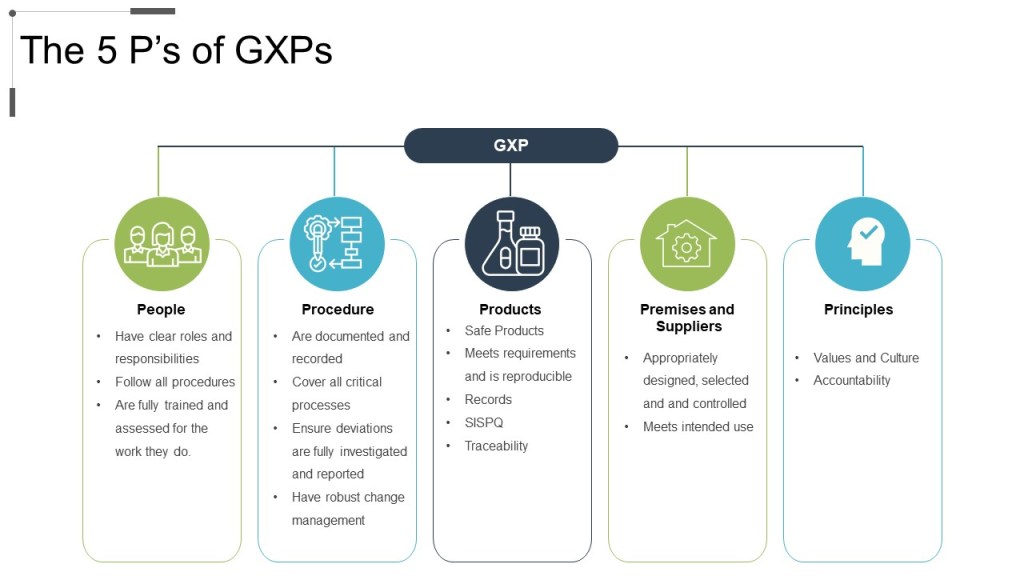
The 5Ps of GXPs: People, Procedure, Product, Premise, and Principles.

This is often why we talk about compliance being the start of quality, and not the end.

The stick is broken, regulatory agencies are toothless

Admit it, we’ve all been through GxP training that utilizes the stick. I’m assuming many of you have designed it. It might have looked like this:

Perhaps you have went over the hundred-and-fifty-plus years history of regulatory action, discussing Elixir Sulfanilamide, thalidomide, and a dozen other noteworthy cases that shared the modern regulatory environment.

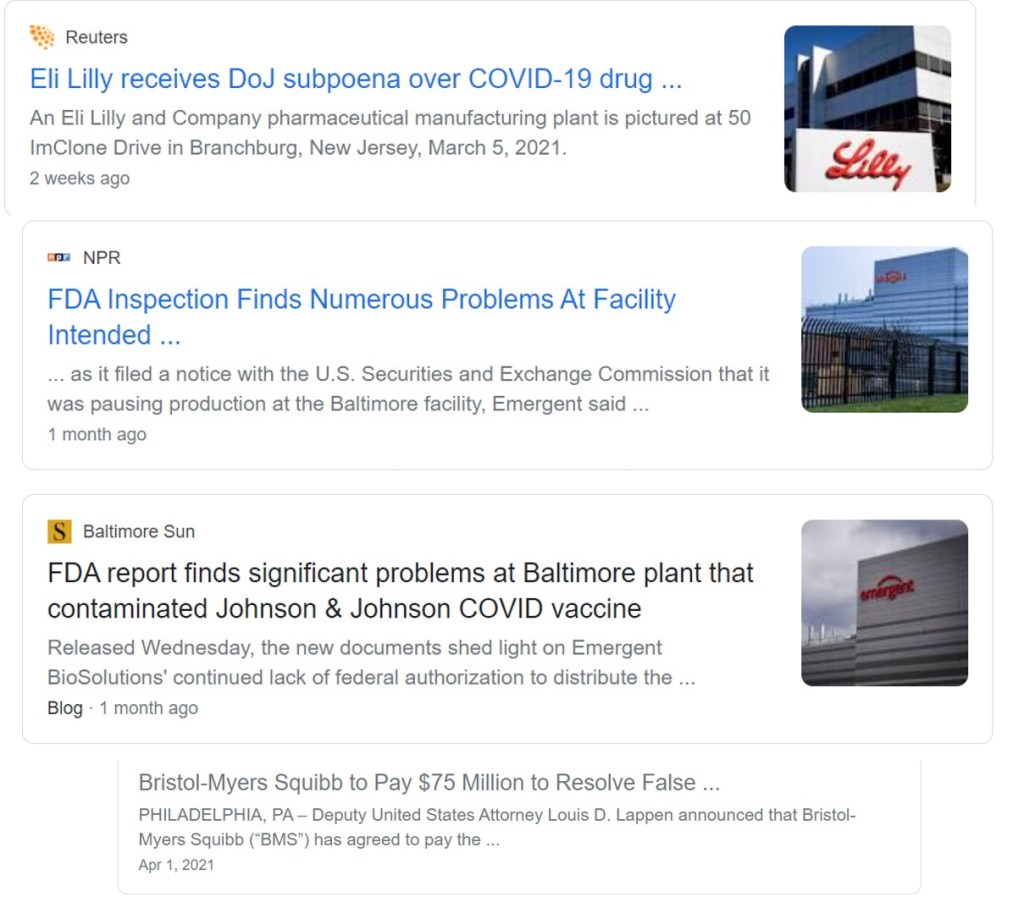
Or perhaps you just like to show a slide with recent headlines on it.

Let’s put aside all the excellent research about the power of positive messaging etc. Valid stuff but not the point I’m trying to make.

The point I want to make in this post is that the regulatory stick has long been broken. Companies suffer at most a slap on the wrist, fines that are weeks or months of profit. But real repercussions are absent.

The Sackler family walks away with billions, MacKenzie gets a slap on the wrist, and other companies are all protected from their deliberate actions in fueling the opioid epidemic.

J&J avoids all real accountability for knowingly causing cancer.

The list goes on.

Frankly, I think this is really bad for our industry. If the price of being caught is pennies to the dollar earned, it has become merely a cost of doing business.

This erodes trust in the safety of our drug supply. And if the last year hasn’t brought home the importance of that trust, you may be hiding under a rock.

We need more perp walks. We need a real system of deterrence that involves arrests and punishments that match the crimes. We can’t even count on the one form of deterrence left, liability lawsuits because companies are playing shenanigans with bankruptcy laws.

We talk about how quality culture starts at the top. But as we see again and again, the top only cares about profit.

That makes me fundamentally worry about the safety of our drugs and medical devices. And if I someone who has dear friends who work at large and small pharma worry, I must admit I can understand why people start to hold suspicions.

The Cost of Generics

Production of generics has shifted overseas, where it’s harder for the Food and Drug Administration to inspect factories. Major companies have been caught faking and manipulating the data that is supposed to prove that drugs are effective and safe. Probable carcinogens have been discovered in the drug supply. During the pandemic, which caused several countries to ban the export of medical supplies, a new fear has arisen: that faraway factories might one day cut Americans off from their drugs. Dozens of lifesaving medications are made with ingredients no longer manufactured in the United States.

Stockman,FarahOur Drug Supply Is Sick. How Can We Fix It?” The New York Times, 18 September 2021

Philip Runyan pointed out this article today, and it is worth reading. It has personal connection with me, as well as professional in that my wife takes Levothyroxine. I’m a huge fan of Katherine Eban’s Bottle of Lies, and this opinion piece fits excellently into that strand of reporting. We need more reporters on this beat.

I do not think the quality of drug manufacturers worldwide are rising to the level of the US and Europe. I think onshoring is one of those trends that is going to shake the pharmaceutical world over the next decade. Civica is ahead of the curve, but not by much.

Good shoutout to Redica, one of my favorite tools for regulatory intelligence (but expensive).

Notice that Viatris (Mylan) fails at driving out fear. Layoffs are one of the largest possible sources of fear.

We will eventually see a quality rating system. Whether it looks like the FDA’s current metric initiative remains to be seen.