I think a common challenge is how do we as a new quality professional joining an organization replicate the same success we have had in past roles
Quality requires a support structure, and I think it is easy to underestimate the impact of the absence, or the lack of, that structure. Just parachuting quality professionals into different organizations where they are left without the scaffolding they’ve implicitly grown to expect and depend on can lead to underperformance. Some adapt, of course, but others flounder, especially when hired with daunting short-term expectations, which can often be the case in organizations looking to remediate gaps in a fast way. I think this is only exacerbated as a result of the pandemic.
Culture can have a steep learning curve and being able to execute requires being very well-versed in the culture of an organization. You have to know how your organization works in order to get it to work diligently like a well-oiled machine to execute the higher-level quality vision.
Learning the culture doesn’t mean simply parroting the oft-repeated mantras received during orientation, but truly internalizing it to an extent where it informs every small decision and discussion. At the best of times, that’s difficult and takes time, particularly as there isn’t usually a single monolithic culture to learn, but myriad microcultures in various different parts of the organization. Doesn’t matter the size, this is a challenge.
In the worst case, where an organization has a culture diametrically opposite to that of the previous workplace, “learning the culture” also requires un-learning almost everything that led people to get to their current level in the first place. The humility to strive to turn themselves into the leader the organization truly needs, rather than the leader they’ve grown to be over the past years, is a hard one for many of us. Especially since we are usually brought on board to build and remediate and address deficiencies.
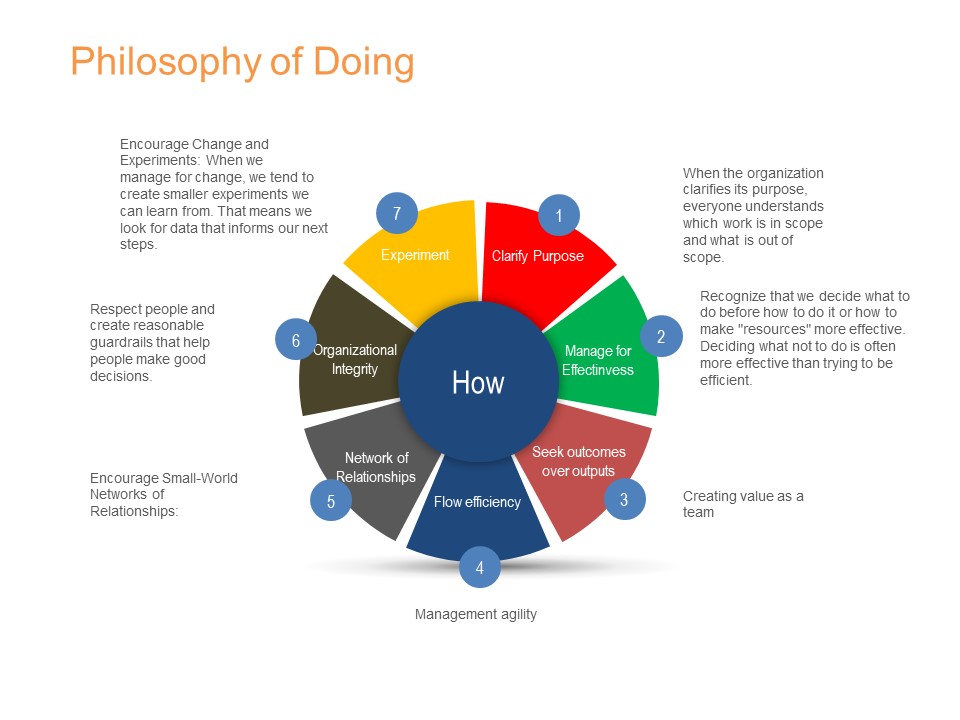
To be a successful agent of change one has to adapt to the current culture, try experiments to accelerate change, and do all the other aspects of our job.
This is hard stuff, and a part of the job I don’t think gets discussed enough.
Which espoused values and desired behaviors will best enable an organization to live its quality purpose? There’s been a lot of writing and thought on this, and for this post, I am going to start with ISO 10018-2020 “Quality management — Guidance for people engagement” and develop an example of a value to build in your organization.
ISO 10018-2020 gives 6 areas:
Context of the organization and quality culture
Leadership
Planning and Strategy
Knowledge and Awareness
Competence
Improvement
This list is pretty well aligned to other models, including the Malcolm Baldrige Excellence Framework (NIST), EFQM Excellence Model, SIQ Model for Performance Excellence, and such tools as the PDA Culture of Quality Assessment.
A concept that we find in ISO 10018-2020 (and everywhere else) is the handling of errors, mistakes, everyday problems and ‘niggles’, near misses, critical incidents, and failures; to ensure they are reported and recorded honestly and transparently. That the time is taken for these to be discussed openly and candidly, viewed as opportunities for learning how to prevent their recurrence by improving systems but also as potentially protective of potentially larger and more consequential failures or errors. The team takes the time and effort to engage in ‘second order’ problem-solving. ‘First order’ problem solving is the quick fixing of issues as they appear so as to stop them disrupting normal workflow. ‘Second order’ problem solving involves identifying the root causes of problems and taking action to address these rather than their signs and symptoms. The team takes ownership of mistakes instead of blaming, accusing, or scapegoating individual team members. The team proactively seeks to identify errors and problems it may have missed in its processes or outputs by seeking feedback and asking for help from external stakeholders, e.g. colleagues in other teams, and customers, and also by engaging in frequent experimentation and testing.
We can tackle this in two ways. The first is to define all the points above as a value. The second would be to look at themes for this and the other aspects of robust quality culture and come up with a set of standard values, for example:
Accountable
Ownership
Action Orientated
Speak up
Don’t be afraid to take a couple of approaches to get values that really sing in your organization.
Values can be easily written in the following format:
Value: A one or two-word title for each value
Definition: A two or three sentence description that clearly states what this value means in your organization
Desired Behaviors: “I statement” behaviors that simply state activities. The behaviors we choose reinforce the values’ definitions by describing exactly how you want members of the organization to interact.
Is this observable behavior? Can we assess someone’s demonstration of this behavior by watching and/or listening to their interactions? By seeing results?
Is this behavior measurable? Can we reliably “score” this behavior? Can we rank how individual models or demonstrates this behavior?
For the rest of this post, I am going to focus on how you would write a value statement for Speak Up.
First, ask two questions:
Specific to your organization’s work environment, how would youdefine “Speak Up.”
What phrase or sentences describe what you mean by “Speak Up.”
Then broaden by considering how fellow leaders and team members would act to demonstrate “Speak Up”, as you defined it.
How would leaders and team members act so that, when you observe them, you would see a demonstration of Speaking Up? Note three or four behaviors that would clearly demonstrate your definition.
Next, answer these questions exclusively from your team member’s perspective:
How would employees define Speaking Out?
How would their definition differ from yours? Why?
What behaviors would employees feel they must model to demonstrate Speaking Out properly?
How would their modeled behaviors differ from yours? Why?
This process allows us to create common alignment based on a shared purpose.
By going through this process we may end up with a Value that looks like this:
Value: Speaking Out
Definition: Problems are reported and recorded honestly and transparently. Employees are not afraid to speak up, identify quality issues, or challenge the status quo for improved quality; they believe management will act on their suggestions.
Desired Behaviors:
I hold myself accountable for raising problems and issues to my team promptly.
I attack process and problems, not people.
I work to anticipate and fend off the possibility of failures occurring.
I approach admissions of errors and lack of knowledge/skill with support.
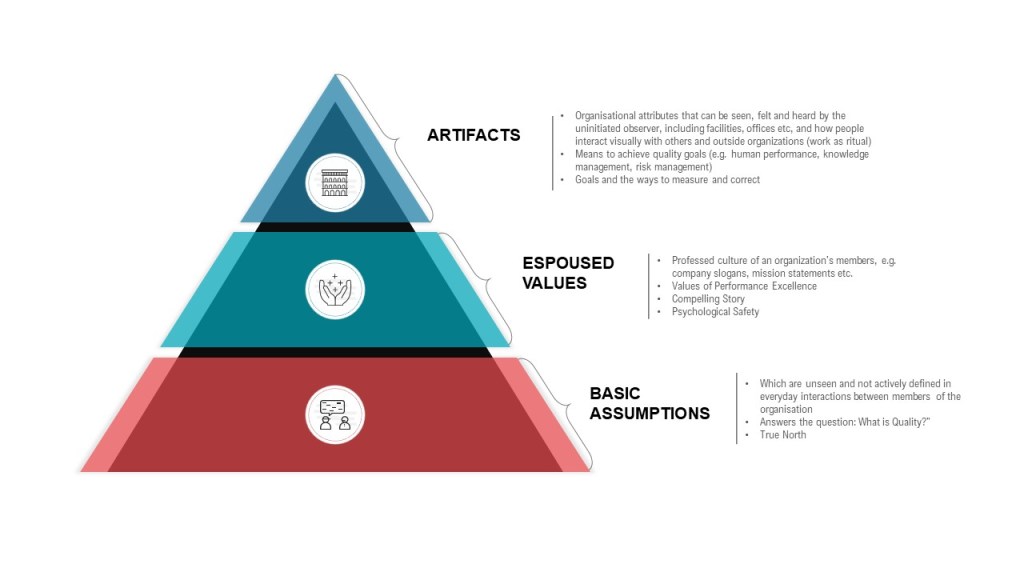
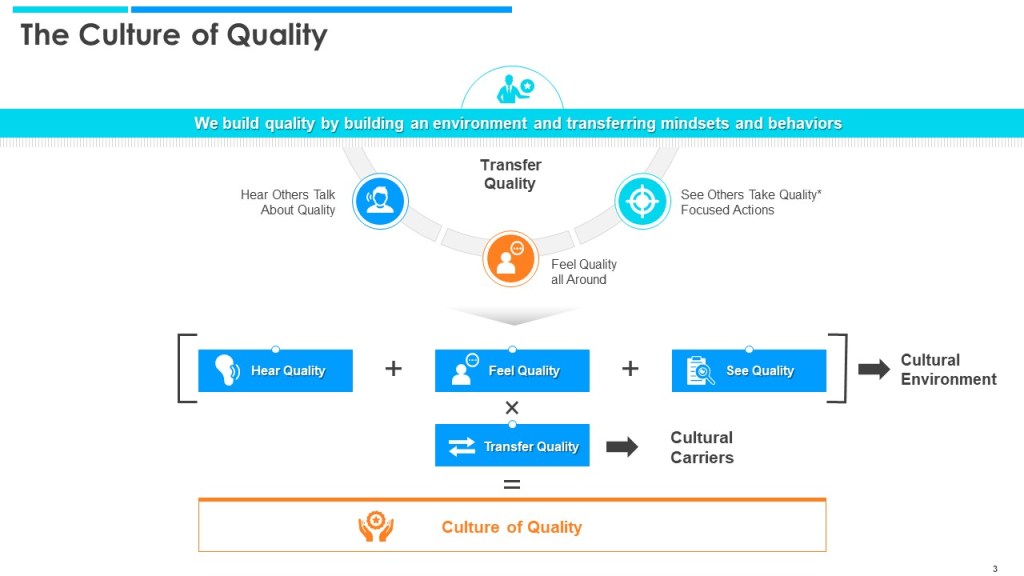
Culture is often the true reason for the behavior of people within an organization and it can often be deeply unconscious and not rationally recognized by most members. These ideas are so integrated that they can be difficult to confront or debate and thus difficult to change.
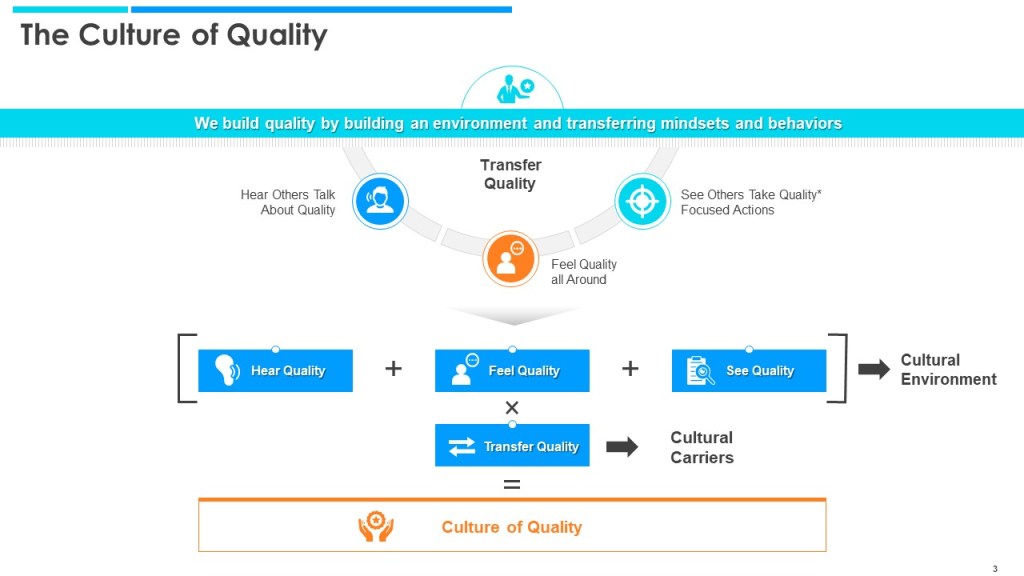
How we Build Quality
A critical part for improving culture is being able to measure the current situation. A great place to start is using a survey-based to gather input from employees on the current culture of quality. Some of the topic areas can include:
Teamwork, collaboration, and involvement are the norm
Emphasis on constant improvement and state-of-the-art knowledge and practices
Willingness to change, adapt, learn from successes and mistakes, take reasonable risk, and try new things
Attributes of a High Performing Culture
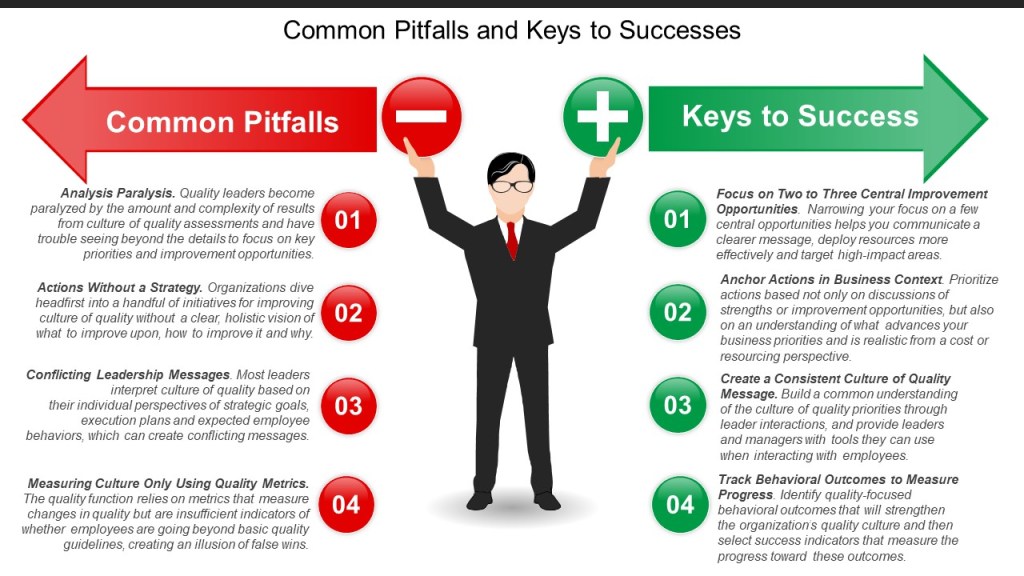
There is a dark underbelly to aspiring to this, leaders who either fail to meet these standards or demonstrate hypocrisy and “do-as-I-say-not-as-I-do” attitudes. Organizations that aspire, can easily be hoisted by their own petard, and there is an excellent term for this “Moral Injury.”
Moral injury is understood to be the strong cognitive and emotional response that can occur following events that violate a person’s moral or ethical code. Potentially morally injurious events include a person’s own or other people’s acts of omission or commission, or betrayal by a trusted person in a high-stakes situation. For example, look at healthcare staff working during the COVID-19 pandemic who experienced a moral injury because they perceive that they received inadequate protective equipment, or when their workload is such that they deliver care of a standard that falls well below what they would usually consider to be good enough. This is causing a mass exodus of employees.
Give some thought to how to resolve moral injuries when they happen. Include them in your change plan and make them sustainable. They can happen, and when they do they will cripple your organization.
People learn and solve problems when they are having fun, stress is low, and the environment encourages discovery. A core part of psychological safety.
I’ve talked before about bringing playfulness to work, about exuberance and excitement. These personal approaches can be turned to the wider organization.
Quality as a profession – not so known for fun. So we need to look for opportunities for fun, whether in our training programs, through initiatives like Quality Days, or any other place we can find it.
Here are some ideas for organizing fun to drive a quality message.
Activity
Name
Description
Cost
required
Effort
required
Impact/
Learning Opportunity
Learning
Outcome
Video
Competitions
Contest
of team videos with stories about how they transfer quality or outline
continuous improvement projects. Teams may also record a best practice
to be shared with the organization.
Medium
High
High
-Video and
poster viewership helps transfer quality behaviors and values to others.
-Employee-created
messages are more credible, giving them a stronger impact on transferring the
culture of quality throughout the organization.
Poster
Signing
Teams can
sign a poster to make a commitment to quality. They can hold a contest for
designing the best Quality Day poster.
Low
Low
Medium
Employee
Idea Demonstrations
Make peer
idea generation (quality ideas) visible to all employees through the use of
regularly refreshed public “progress boards” and idea showcases
where projects are publicly evaluated.
Low
Medium
High
-Shows
employees that quality focus is something that peers around them prioritize
and benefit from.
-Provides
employees a benchmark for what behaviors are expected from them and
encourages the ones whose ideas are recognized.
Quality
Awards and Recognition
Publicly
recognize individuals and teams with a trophy/certificate for consistently
embodying quality in their work. Awarding behaviors, not just outcomes,
increases employee engagement.
High
Medium
High
-Helps engage
employees in quality improvement efforts by demonstrating that despite other
objectives and priorities, quality remains important to leaders.
Client/
Customer Visit
Invite your
clients/customers to visit and talk about their experience with the
product/service and the importance of quality.
High
High
High
-Helps
employees understand how a high-quality mindset avoids customer-facing
mistakes and leads to greater customer satisfaction.
Games
Word-Play
Games: A group of employees can play games like Scrabble and Bingo with
quality terminology.
Low
Low
Medium
-Quick games
help employees become aware of quality terms, tests, standards in a fun way.
Trivia Games:
Employees can play games such as “Jeopardy” and beer pong with quality
standards, tests, tools to educate themselves.
Low
Low
Medium
Articles
on Quality
Share blogs
and articles on quality.
Low
Medium
Medium
-Increases
quality’s visibility across the organization and promotes awareness.
Quality
Quiz Competition
Employees can
take quizzes on quality-related concepts.
Low
Medium
High
-Tests
employees’ awareness and creates a healthy competition to know more.
Quality Merchandise
(swag)
Distribute
T-shirts, mugs, badges with quality quotes to employees. Reward contest
winners with goodies such as chocolates with quality phrases written on them.
High
High
Medium
-Provides
more visibility to quality and imparts a sense of pride in employees.
Leveraging fun is a good way to help build a culture of quality.
Building moments of planned fun is work, and should be part of the overall Quality Plan, with activities and milestones clearly marked and executed towards.