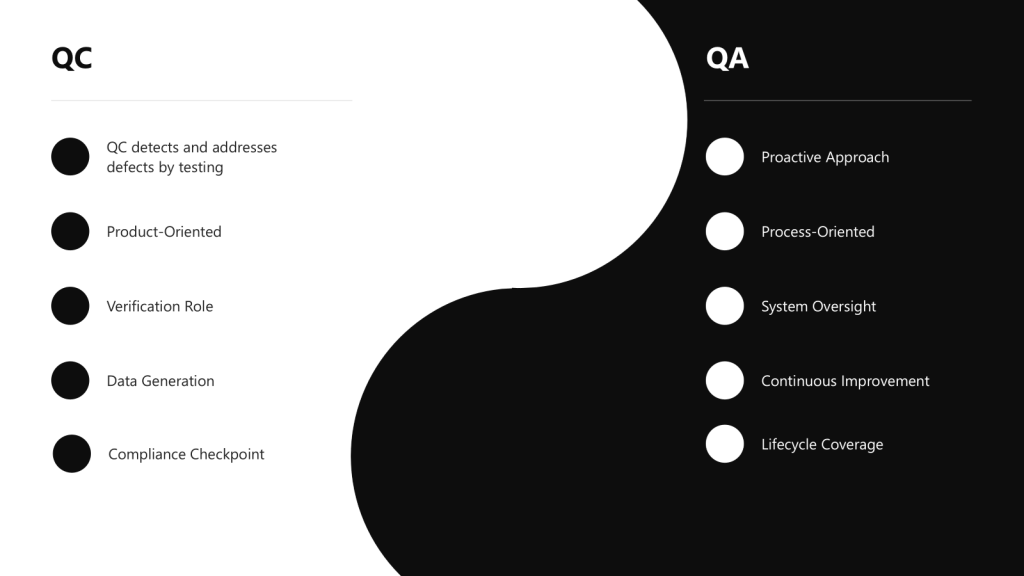
The Quality Continuum in Pharmaceutical Manufacturing

In the highly regulated pharmaceutical industry, ensuring the quality, safety, and efficacy of products is paramount. Two critical components of pharmaceutical quality management are Quality Assurance (QA) and Quality Control (QC). While these terms are sometimes used interchangeably, they represent distinct approaches with different focuses, methodologies, and objectives within pharmaceutical manufacturing. Understanding the differences between QA and QC is essential for pharmaceutical companies to effectively manage their quality processes and meet regulatory requirements.

Quality Assurance (QA) and Quality Control (QC) are both essential and complementary pillars of pharmaceutical quality management, each playing a distinct yet interconnected role in ensuring product safety, efficacy, and regulatory compliance. QA establishes the systems, procedures, and preventive measures that form the foundation for consistent quality throughout the manufacturing process, while QC verifies the effectiveness of these systems by testing and inspecting products to ensure they meet established standards. The synergy between QA and QC creates a robust feedback loop: QC identifies deviations or defects through analytical testing, and QA uses this information to drive process improvements, update protocols, and implement corrective and preventive actions. This collaboration not only helps prevent the release of substandard products but also fosters a culture of continuous improvement, risk mitigation, and regulatory compliance, making both QA and QC indispensable for maintaining the highest standards in pharmaceutical manufacturing.

Definition and Scope

Quality Assurance (QA) is a comprehensive, proactive approach focused on preventing defects by establishing robust systems and processes throughout the entire product lifecycle. It encompasses the totality of arrangements made to ensure pharmaceutical products meet the quality required for their intended use. QA is process-oriented and aims to build quality into every stage of development and manufacturing.

Quality Control (QC) is a reactive, product-oriented approach that involves testing, inspection, and verification of finished products to detect and address defects or deviations from established standards. QC serves as a checkpoint to identify any issues that may have slipped through the manufacturing process.

Approach: Proactive vs. Reactive

One of the most fundamental differences between QA and QC lies in their approach to quality management:

  • QA takes a proactive approach by focusing on preventing defects and deviations before they occur. It establishes robust quality management systems, procedures, and processes to minimize the risk of quality issues.
  • QC takes a reactive approach by focusing on detecting and addressing deviations and defects after they have occurred. It involves testing, sampling, and inspection activities to identify non-conformities and ensure products meet established quality standards.

Focus: Process vs. Product

  • QA is process-oriented, focusing on establishing and maintaining robust processes and procedures to ensure consistent product quality. It involves developing standard operating procedures (SOPs), documentation, and validation protocols.
  • QC is product-oriented, focusing on verifying the quality of finished products through testing and inspection. It ensures that the final product meets predetermined specifications before release to the market.

Comparison Table: QA vs. QC in Pharmaceutical Manufacturing

AspectQuality Assurance (QA)Quality Control (QC)
DefinitionA comprehensive, proactive approach focused on preventing defects by establishing robust systems and processesA reactive, product-oriented approach that involves testing and verification of finished products
FocusProcess-oriented, focusing on how products are madeProduct-oriented, focusing on what is produced
ApproachProactive – prevents defects before they occurReactive – detects defects after they occur
TimingBefore and during productionDuring and after production
ResponsibilityEstablishing systems, procedures, and documentationTesting, inspection, and verification of products

This includes the appropriate control of analytical methods.
ActivitiesSystem development, documentation, risk management, training, audits, supplier management, change control, validationRaw materials testing, in-process testing, finished product testing, dissolution testing, stability testing, microbiological testing
ObjectiveTo build quality into every stage of development and manufacturingTo identify non-conformities and ensure products meet specifications
MethodologyEstablishing SOPs, validation protocols, and quality management systemsSampling, testing, inspection, and verification activities
ScopeSpans the entire product lifecycle from development to discontinuationPrimarily focused on manufacturing and finished products
Relationship to GMPEnsures GMP implementation through systems and processesVerifies GMP compliance through testing and inspection

The Quality Continuum: QA and QC as Complementary Approaches

Rather than viewing QA and QC as separate entities, modern pharmaceutical quality systems recognize them as part of a continuous spectrum of quality management activities. This continuum spans the entire product lifecycle, from development through manufacturing to post-market surveillance.

The Integrated Quality Approach

QA and QC represent different points on the quality continuum but work together to ensure comprehensive quality management. The overlap between QA and QC creates an integrated quality approach where both preventive and detective measures work in harmony. This integration is essential for maintaining what regulators call a “state of control” – a condition in which the set of controls consistently provides assurance of continued process performance and product quality.

Quality Risk Management as a Bridge

Quality Risk Management (QRM) serves as a bridge between QA and QC activities, providing a systematic approach to quality decision-making. By identifying, assessing, and controlling risks throughout the product lifecycle, QRM helps determine where QA preventive measures and QC detective measures should be applied most effectively.

The concept of a “criticality continuum” further illustrates how QA and QC work together. Rather than categorizing quality attributes and process parameters as simply critical or non-critical, this approach recognizes varying degrees of criticality that require different levels of control and monitoring.

Organizational Models for QA and QC in Pharmaceutical Companies

Pharmaceutical companies employ various organizational structures to manage their quality functions. The choice of structure depends on factors such as company size, product portfolio complexity, regulatory requirements, and corporate culture.

Common Organizational Models

Integrated Quality Unit

In this model, QA and QC functions are combined under a single Quality Unit with shared leadership and resources. This approach promotes streamlined communication and a unified approach to quality management. However, it may present challenges related to potential conflicts of interest and lack of independent verification.

Separate QA and QC Departments

Many pharmaceutical companies maintain separate QA and QC departments, each with distinct leadership reporting to a higher-level quality executive. This structure provides clear separation of responsibilities and specialized focus but may create communication barriers and resource inefficiencies.

QA as a Standalone Department, QC Integrated with Operations

In this organizational model, the Quality Assurance (QA) function operates as an independent department, while Quality Control (QC) is grouped within the same department as other operations functions, such as manufacturing and production. This structure is designed to balance independent oversight with operational efficiency.

Centralized Quality Organization

Large pharmaceutical companies often adopt a centralized quality organization where quality functions are consolidated at the corporate level with standardized processes across all manufacturing sites. This model ensures consistent quality standards and efficient knowledge sharing but may be less adaptable to site-specific needs.

Decentralized Quality Organization

In contrast, some companies distribute quality functions across manufacturing sites with site-specific quality teams. This approach allows for site-specific quality focus and faster decision-making but may lead to inconsistent quality practices and regulatory compliance challenges.

Matrix Quality Organization

A matrix quality organization combines elements of both centralized and decentralized models. Quality personnel report to both functional quality leaders and operational/site leaders, providing a balance between standardization and site-specific needs. However, this structure can create complex reporting relationships and potential conflicts in priorities.

The Quality Unit: Overarching Responsibility for Pharmaceutical Quality

Concept and Definition of the Quality Unit

The Quality Unit is a fundamental concept in pharmaceutical manufacturing, representing the organizational entity responsible for overseeing all quality-related activities. According to FDA guidance, the Quality Unit is “any person or organizational element designated by the firm to be responsible for the duties relating to quality control”.

The concept of a Quality Unit was solidified in FDA’s 2006 guidance, “Quality Systems Approach to Pharmaceutical Current Good Manufacturing Practice Regulations,” which defined it as the entity responsible for creating, monitoring, and implementing a quality system.

Independence and Authority of the Quality Unit

Regulatory agencies emphasize that the Quality Unit must maintain independence from production operations to ensure objective quality oversight. This independence is critical for the Quality Unit to fulfill its responsibility of approving or rejecting materials, processes, and products without undue influence from production pressures.

The Quality Unit must have sufficient authority and resources to carry out its responsibilities effectively. This includes the authority to investigate quality issues, implement corrective actions, and make final decisions regarding product release.

How QA and QC Contribute to Environmental Monitoring and Contamination Control

Environmental monitoring (EM) and contamination control are critical pillars of pharmaceutical manufacturing quality systems, requiring the coordinated efforts of both Quality Assurance (QA) and Quality Control (QC) functions. While QA focuses on establishing preventive systems and procedures, QC provides the verification and testing that ensures these systems are effective. Together, they create a comprehensive framework for maintaining aseptic manufacturing environments and protecting product integrity. This also serves as a great example of the continuum in action.

QA Contributions to Environmental Monitoring and Contamination Control

System Design and Program Development

Quality Assurance takes the lead in establishing the foundational framework for environmental monitoring programs. QA is responsible for designing comprehensive EM programs that include sampling plans, alert and action limits, and risk-based monitoring locations. This involves developing a systematic approach that addresses all critical elements including types of monitoring methods, culture media and incubation conditions, frequency of environmental monitoring, and selection of sample sites.

For example, QA establishes the overall contamination control strategy (CCS) that defines and assesses the effectiveness of all critical control points, including design, procedural, technical, and organizational controls employed to manage contamination risks. This strategy encompasses the entire facility and provides a comprehensive framework for contamination prevention.

Risk Management and Assessment

QA implements quality risk management principles to provide a proactive means of identifying, scientifically evaluating, and controlling potential risks to quality. This involves conducting thorough risk assessments that cover all human interactions with clean room areas, equipment placement and ergonomics, and air quality considerations. The risk-based approach ensures that monitoring efforts are focused on the most critical areas and processes where contamination could have the greatest impact on product quality.

QA also establishes risk-based environmental monitoring programs that are re-evaluated at defined intervals to confirm effectiveness, considering factors such as facility aging, barrier and cleanroom design optimization, and personnel changes. This ongoing assessment ensures that the monitoring program remains relevant and effective as conditions change over time.

Procedural Oversight and Documentation

QA ensures the development and maintenance of standardized operating procedures (SOPs) for all aspects of environmental monitoring, including air sampling, surface sampling, and personnel sampling protocols. These procedures ensure consistency in monitoring activities and provide clear guidance for personnel conducting environmental monitoring tasks.

The documentation responsibilities of QA extend to creating comprehensive quality management plans that clearly define responsibilities and duties to ensure that environmental monitoring data generated are of the required type, quality, and quantity. This includes establishing procedures for data analysis, trending, investigative responses to action level excursions, and appropriate corrective and preventative actions.

Compliance Assurance and Regulatory Alignment

QA ensures that environmental monitoring protocols meet Good Manufacturing Practice (GMP) requirements and align with current regulatory expectations such as the EU Annex 1 guidelines.

QA also manages the overall quality system to ensure that environmental monitoring activities support regulatory compliance and facilitate successful inspections and audits. This involves maintaining proper documentation, training records, and quality improvement processes that demonstrate ongoing commitment to contamination control.

QC Contributions to Environmental Monitoring and Contamination Control

Execution of Testing and Sampling

Quality Control is responsible for the hands-on execution of environmental monitoring testing protocols. QC personnel conduct microbiological testing including bioburden and endotoxin testing, as well as particle counting for non-viable particulate monitoring. This includes performing microbial air sampling using techniques such as active air sampling and settle plates, along with surface and personnel sampling using swabbing and contact plates.

For example, QC technicians perform routine environmental monitoring of classified manufacturing and filling areas, conducting both routine and investigational sampling to assess environmental conditions. They utilize calibrated active air samplers and strategically placed settle plates throughout cleanrooms, while also conducting surface and personnel sampling periodically, especially after critical interventions.

Data Analysis and Trend Monitoring

QC plays a crucial role in analyzing environmental monitoring data and identifying trends that may indicate potential contamination issues. When alert or action limits are exceeded, QC personnel initiate immediate investigations and document findings according to established protocols. This includes performing regular trend analysis on collected data to understand the state of control in cleanrooms and identify potential contamination risks before they lead to significant problems.

QC also maintains environmental monitoring programs and ensures all data is properly logged into Laboratory Information Management Systems (LIMS) for comprehensive tracking and analysis . This systematic approach to data management enables effective trending and supports decision-making processes related to contamination control.

Validation and Verification Activities

QC conducts critical validation activities to simulate aseptic processes and verify the effectiveness of contamination control measures. These activities provide direct evidence that manufacturing processes maintain sterility and/or bioburden control and that environmental controls are functioning as intended.

QC also performs specific testing protocols including dissolution testing, stability testing, and comprehensive analysis of finished products to ensure they meet quality specifications and are free from contamination. This testing provides the verification that QA-established systems are effectively preventing contamination.

Real-Time Monitoring and Response

QC supports continuous monitoring efforts through the implementation of Process Analytical Technology (PAT) for real-time quality verification. This includes continuous monitoring of non-viable particulates, which helps detect events that could potentially increase contamination risk and enables immediate corrective measures.

When deviations occur, QC personnel immediately report findings and place products on hold for further evaluation, providing documented reports and track-and-trend data to support decision-making processes. This rapid response capability is essential for preventing contaminated products from reaching the market.

Conclusion

While Quality Assurance and Quality Control in pharmaceutical manufacturing represent distinct processes with different focuses and approaches, they form a complementary continuum that ensures product quality throughout the lifecycle. QA is proactive, process-oriented, and focused on preventing quality issues through robust systems and procedures. QC is reactive, product-oriented, and focused on detecting and addressing quality issues through testing and inspection.

The organizational structure of quality functions in pharmaceutical companies varies, with models ranging from integrated quality units to separate departments, centralized or decentralized organizations, and matrix structures. Regardless of the organizational model, the Quality Unit plays a critical role in overseeing all quality-related activities and ensuring compliance with regulatory requirements.

The Pharmaceutical Quality System provides an overarching framework that integrates QA and QC activities within a comprehensive approach to quality management. By implementing effective quality systems and fostering a culture of quality, pharmaceutical companies can ensure the safety, efficacy, and quality of their products while meeting regulatory requirements and continuously improving their processes.


Quality Unit Oversight Failures: A Critical Analysis of Recent FDA Warning Letters

The continued trend in FDA warning letters citing Quality Unit (QU) deficiencies highlights a concerning reality across pharmaceutical manufacturing operations worldwide. Three warning letters recently issued to pharmaceutical companies in China, India, and Malaysia reveal fundamental weaknesses in Quality Unit oversight that extend beyond isolated procedural failures to indicate systemic quality management deficiencies. These regulatory actions demonstrate the FDA’s continued emphasis on the Quality Unit as the cornerstone of pharmaceutical quality systems, with expectations that these units function as independent guardians of product quality with sufficient authority, resources, and expertise. This analysis examines the specific deficiencies identified across recent warning letters, identifies patterns of Quality Unit organizational failures, explores regulatory expectations, and provides strategic guidance for building robust quality oversight capabilities that meet evolving compliance standards.

Recent FDA Warning Letters Highlighting Critical Quality Unit Deficiencies

Multiple Geographic Regions Under Scrutiny

The FDA has continues to provide an intense focus on Quality Unit oversight through a series of warning letters targeting pharmaceutical operations across Asia. As highlighted in a May 19, 2025 GMP Compliance article, three notable warning letters targeted specific Quality Unit failures across multiple regions. The Chinese manufacturer failed to establish an adequate Quality Unit with proper authority to oversee manufacturing operations, particularly in implementing change control procedures and conducting required periodic product reviews. Similarly, the Indian manufacturer’s Quality Unit failed to implement controls ensuring data integrity, resulting in unacceptable documentation practices including torn batch records, damaged testing chromatograms, and improperly completed forms. The Malaysian facility, producing OTC products, showed failures in establishing adequate training programs and performing appropriate product reviews, further demonstrating systemic quality oversight weaknesses. These geographically diverse cases indicate that Quality Unit deficiencies represent a global challenge rather than isolated regional issues.

Historical Context of Regulatory Concerns

FDA’s focus on Quality Unit responsibilities isn’t new. A warning letter to a Thai pharmaceutical company earlier in 2024 cited Quality Unit deficiencies including lack of control over manufacturing operations, inadequate documentation of laboratory preparation, and insufficient review of raw analytical data. These issues allowed concerning practices such as production staff altering master batch records and using erasable markers on laminated sheets for production records. Another notable case involved Henan Kangdi Medical Devices, where in January 2020 the FDA stated explicitly that “significant findings in this letter indicate that your quality unit is not fully exercising its authority and/or responsibilities”. The consistent regulatory focus across multiple years suggests pharmaceutical manufacturers continue to struggle with properly empowering and positioning Quality Units within their organizational structures.

Geographic Analysis of Quality Unit Failures: Emerging vs. Mature Regulatory Markets

These FDA warning letters highlighting Quality Unit (QU) deficiencies reveal significant disparities between pharmaceutical manufacturing practices in emerging markets (e.g., China, India, Malaysia, Thailand) and mature regulatory jurisdictions (e.g., the U.S., EU, Japan). These geographic differences reflect systemic challenges tied to regulatory infrastructure, economic priorities, and technological adoption.

In emerging markets, structural weaknesses in regulatory oversight and quality culture dominate QU failures. For example, Chinese manufacturers like Linghai ZhanWang Biotechnology (2025) and Henan Kangdi (2019) faced FDA action because their Quality Units lacked the authority to enforce CGMP standards, with production teams frequently overriding quality decisions. Similarly, Indian facilities cited in 2025 warnings struggled with basic data integrity controls, including torn paper records and unreviewed raw data—issues exacerbated by domestic regulatory bodies like India’s CDSCO, which inspects fewer than 2% of facilities annually. These regions often prioritize production quotas over compliance, leading to under-resourced Quality Units and inadequate training programs, as seen in a 2025 warning letter to a Malaysian OTC manufacturer whose QU staff lacked GMP training. Supply chain fragmentation further complicates oversight, particularly in contract manufacturing hubs like Thailand, where a 2024 warning letter noted no QU review of outsourced laboratory testing.

By contrast, mature markets face more nuanced QU challenges tied to technological complexity and evolving regulatory expectations. In the U.S. and EU, recent warnings highlight gaps in Quality Units’ understanding of advanced manufacturing technologies, such as continuous manufacturing processes or AI-driven analytics. A 2024 EU warning letter to a German API manufacturer, for instance, cited cybersecurity vulnerabilities in electronic batch records—a stark contrast to emerging markets’ struggles with paper-based systems. While data integrity remains a global concern, mature markets grapple with sophisticated gaps like inadequate audit trails in cloud-based laboratory systems, whereas emerging economies face foundational issues like erased entries or unreviewed chromatograms. Regulatory scrutiny also differs: FDA inspection data from 2023 shows QU-related citations in just 6.2% of U.S. facilities versus 23.1% in Asian operations, reflecting stronger baseline compliance in mature jurisdictions.

Case comparisons illustrate these divergences. At an Indian facility warned in 2025, production staff routinely overruled QU decisions to meet output targets, while a 2024 U.S. warning letter described a Quality Unit delaying batch releases due to inadequate validation of a new AI-powered inventory system. Training gaps also differ qualitatively: emerging-market QUs often lack basic GMP knowledge, whereas mature-market teams may struggle with advanced tools like machine learning algorithms.

These geographic trends have strategic implications. Emerging markets require foundational investments in QU independence, such as direct reporting lines to executive leadership, and adoption of centralized digital systems to mitigate paper-record risks. Partnerships with mature-market firms could accelerate quality culture development. Meanwhile, mature jurisdictions must modernize QU training programs to address rapidly changing technologies and strengthen oversight of decentralized production models.

Data Integrity as a Critical Quality Unit Responsibility

Data integrity issues feature prominently in recent enforcement actions, reflecting the Quality Unit’s crucial role as guardian of trustworthy information. The FDA frequently requires manufacturers with data integrity deficiencies to engage third-party consultants to conduct comprehensive investigations into record inaccuracies across all laboratories, manufacturing operations, and relevant systems. These remediation efforts must identify numerous potential issues including omissions, alterations, deletions, record destruction, non-contemporaneous record completion, and other deficiencies that undermine data reliability. Thorough risk assessments must evaluate potential impacts on product quality, with companies required to implement both interim protective measures and comprehensive long-term corrective actions. These requirements underscore the fundamental importance of the Quality Unit in ensuring that product decisions are based on accurate, complete, and trustworthy data.

Patterns of Quality Unit Organizational Failures

Insufficient Authority and Resources

A recurring theme across warning letters is Quality Units lacking adequate authority or resources to fulfill their responsibilities effectively. The FDA’s warning letter to Linghai ZhanWang Biotechnology Co. in February 2025 cited violations that demonstrated the company’s Quality Unit couldn’t effectively ensure compliance with CGMP regulations. Similarly, Lex Inc. faced regulatory action when its “quality system was inadequate” because the Quality Unit “did not provide adequate oversight for the manufacture of over-the-counter (OTC) drug products”.

These cases reflect a fundamental organizational failure to empower Quality Units with sufficient authority and resources to perform their essential functions. Without proper positioning within the organizational hierarchy, Quality Units cannot effectively challenge manufacturing decisions that might compromise product quality or regulatory compliance, creating systemic vulnerabilities.

Documentation and Data Management Deficiencies

Quality Units frequently demonstrate inadequate oversight of documentation and data management processes, allowing significant compliance risks to emerge. According to FDA warning letters, these issues include torn batch records, incompletely documented laboratory preparation, inadequate retention of weight printouts, and insufficient review of raw analytical data. One particularly concerning practice involved “production records on laminated sheets using erasable markers that could be easily altered or lost,” representing a fundamental breakdown of documentation control. These examples demonstrate how Quality Unit failures in documentation oversight directly enable data integrity issues that can undermine the reliability of manufacturing records, ultimately calling product quality into question. Effective Quality Units must establish robust systems for ensuring complete, accurate, and contemporaneous documentation throughout the manufacturing process.

Inadequate Change Control and Risk Assessment

Change control deficiencies represent another significant pattern in Quality Unit failures. Warning letters frequently cite the Quality Unit’s failure to ensure appropriate change control procedures, highlighting inadequate risk assessments as a particular area of concern. FDA inspectors have found that inadequate change control practices present significant compliance risks, with change control appearing among the top ten FDA 483 violations. These deficiencies often involve failure to evaluate the potential impact of changes on product quality, incomplete documentation of changes, and improper execution of change implementation. Effective Quality Units must establish robust change control processes that include thorough risk assessments, appropriate approvals, and verification that changes have not adversely affected product quality.

Insufficient Batch Release and Production Record Review

Quality Units regularly fail to conduct adequate reviews of production records and properly execute batch release procedures. A frequent citation in warning letters involves the Quality Unit’s failure to “review production records to assure that no errors have occurred or, if errors have occurred, that they have been fully investigated”. In several cases, the Quality Unit reviewed only analytical results entered into enterprise systems without examining the underlying raw analytical data, creating significant blind spots in quality oversight. This pattern demonstrates a superficial approach to batch review and release decisions that fails to fulfill the Quality Unit’s fundamental responsibility to ensure each batch meets all established specifications before distribution. Comprehensive batch record review is essential for detecting anomalies that might indicate quality or compliance issues requiring investigation.

Regulatory Expectations for Effective Quality Units

Core Quality Unit Responsibilities

The FDA has clearly defined the essential responsibilities of the Quality Unit through regulations, guidance documents, and enforcement actions. According to 21 CFR 211.22, the Quality Unit must “have the responsibility and authority to approve or reject all components, drug product containers, closures, in-process materials, packaging material, labeling, and drug products”. Additionally, the unit must “review production records to assure that no errors have occurred or, if errors have occurred, that they have been fully investigated”. FDA guidance elaborates that the Quality Unit’s duties include “ensuring that controls are implemented and completed satisfactorily during manufacturing operations” and “ensuring that developed procedures and specifications are appropriate and followed”. These expectations establish the Quality Unit as both guardian and arbiter of quality throughout the manufacturing process, with authority to make critical decisions regarding product acceptability.

Independence and Organizational Structure

Regulatory authorities expect Quality Units to maintain appropriate independence from production units to prevent conflicts of interest. FDA guidance specifically states that “under a quality system, it is normally expected that the product and process development units, the manufacturing units, and the QU will remain independent”. This separation ensures that quality decisions remain objective and focused on product quality rather than production metrics or efficiency considerations. While the FDA acknowledges that “in very limited circumstances, a single individual can perform both production and quality functions,” such arrangements require additional safeguards including “another qualified individual, not involved in the production operation, conduct[ing] an additional, periodic review of QU activities”. This guidance underscores the critical importance of maintaining appropriate separation between quality and production responsibilities.

Quality System Integration

Regulatory authorities increasingly view the Quality Unit as the central coordinator of a comprehensive quality system. The FDA’s guidance document “Quality Systems Approach to Pharmaceutical CGMP Regulations” positions the Quality Unit as responsible for creating, monitoring, and implementing the entire quality system. This expanded view recognizes that while the Quality Unit doesn’t assume responsibilities belonging to other organizational units, it plays a crucial role in ensuring that all departments understand and fulfill their quality-related responsibilities. The Quality Unit must therefore establish appropriate communication channels and collaborative mechanisms with other functional areas while maintaining the independence necessary to make objective quality decisions. This integrated approach recognizes that quality management extends beyond a single department to encompass all activities affecting product quality.

Strategic Approaches to Strengthening Quality Unit Effectiveness

Comprehensive Quality System Assessment

Organizations facing Quality Unit deficiencies should begin remediation with a thorough assessment of their entire pharmaceutical quality system. Warning letters frequently require companies to conduct “a comprehensive assessment and remediation plan to ensure your QU is given the authority and resources to effectively function”. This assessment should examine whether procedures are “robust and appropriate,” how the Quality Unit provides oversight “throughout operations to evaluate adherence to appropriate practices,” the effectiveness of batch review processes, and the Quality Unit’s investigational capabilities. A thorough gap analysis should compare current practices against regulatory requirements and industry best practices to identify specific areas requiring improvement. This comprehensive assessment provides the foundation for developing targeted remediation strategies that address the root causes of Quality Unit deficiencies.

Establishing Clear Roles and Adequate Resources

Effective remediation requires clearly defining Quality Unit roles and ensuring adequate resources to fulfill regulatory responsibilities. FDA warning letters frequently cite the absence of “written procedures for QU roles and responsibilities” as a significant deficiency. Organizations must develop detailed written procedures that clearly articulate the Quality Unit’s authority and responsibilities, including approval or rejection authority for components and drug products, review of production records, and oversight of quality-impacting procedures and specifications. Additionally, companies must assess whether Quality Units have sufficient staffing with appropriate qualifications and training to effectively execute these responsibilities. This assessment should consider both the number of personnel and their technical capabilities relative to the complexity of manufacturing operations and product portfolio.

Implementing Robust Data Integrity Controls

Data integrity represents a critical area requiring focused attention from Quality Units. Companies must implement comprehensive data governance systems that ensure records are attributable, legible, contemporaneous, original, and accurate (ALCOA principles). Quality Units should establish oversight mechanisms for all quality-critical data, including laboratory results, manufacturing records, and investigation documentation. These systems must include appropriate controls for paper records and electronic data, with verification processes to ensure consistency between different data sources. Quality Units should also implement risk-based audit programs that regularly evaluate data integrity practices across all manufacturing and laboratory operations. These controls provide the foundation for trustworthy data that supports sound quality decisions and regulatory compliance.

Developing Management Support and Quality Culture

Sustainable improvements in Quality Unit effectiveness require strong management support and a positive quality culture throughout the organization. FDA warning letters specifically call for “demonstration of top management support for quality assurance and reliable operations, including timely provision of resources to address emerging manufacturing and quality issues”. Executive leadership must visibly champion quality as an organizational priority and empower the Quality Unit with appropriate authority to fulfill its responsibilities effectively. Organizations should implement programs that promote quality awareness at all levels, with particular emphasis on the shared responsibility for quality across all departments. Performance metrics and incentive structures should align with quality objectives to reinforce desired behaviors and decision-making patterns. This culture change requires consistent messaging, appropriate resource allocation, and leadership accountability for quality outcomes.

Conclusion

FDA warning letters reveal persistent Quality Unit deficiencies across global pharmaceutical operations, with significant implications for product quality and regulatory compliance. The patterns identified—including insufficient authority and resources, documentation and data management weaknesses, inadequate change control, and ineffective batch review processes—highlight the need for fundamental improvements in how Quality Units are structured, resourced, and empowered within pharmaceutical organizations. Regulatory expectations clearly position the Quality Unit as the cornerstone of effective pharmaceutical quality systems, with responsibility for ensuring that all operations meet established quality standards through appropriate oversight, review, and decision-making processes.

Addressing these challenges requires a strategic approach that begins with comprehensive assessment of current practices, establishment of clear roles and responsibilities, implementation of robust data governance systems, and development of a supportive quality culture. Organizations that successfully strengthen their Quality Units can not only avoid regulatory action but also realize significant operational benefits through more consistent product quality, reduced manufacturing deviations, and more efficient operations. As regulatory scrutiny of Quality Unit effectiveness continues to intensify, pharmaceutical manufacturers must prioritize these improvements to ensure sustainable compliance and protect patient safety in an increasingly complex manufacturing environment.

Key Warning Letters Discussed

  • Linghai ZhanWang Biotechnology Co., Ltd. (China) — February 25, 2025
    • (For the original FDA letter, search the FDA Warning Letters database for “Linghai ZhanWang Biotechnology Co” and the date “02/25/2025”)
  • Henan Kangdi Medical Devices Co. Ltd. (China) — December 3, 2019
    • (For the original FDA letter, search the FDA Warning Letters database for “Henan Kangdi Medical Devices” and the date “12/03/2019”)
  • Drug Manufacturing Facility in Thailand — February 27, 2024
    • (For the original FDA letter, search the FDA Warning Letters database for “Thailand” and the date “02/27/2024”)
  • BioAsia Worldwide (Malaysia) — February 2025
    • (For the original FDA letter, search the FDA Warning Letters database for “BioAsia Worldwide” and the date “02/2025”)

For the most authoritative and up-to-date versions, always use the FDA Warning Letters database and search by company name and date.

Know When and How to Compromise

Quality as a profession is often put into the position of being the cop or gatekeeper. There are a set of regulations and standards that must be met, and it can be easy, especially early in one’s career and without proper mentoring, to start to see absolutes.

It is important to always have a vision of what good and great look like. But the road to that will be filled with compromise, so get good at it.

Compromise is not a weakness in a quality professional, it is a strength.

There are times when, instead of ramping up your argment fill fore to make a case, it is better to step back and think about where you can comprise and still convince the organization to implement most, if not all, of your ideas.

This is where the change accelerators come in. Articulate the vision, and then utilize compromise the build and evolve the guiding coalition and turn that into an army of the willing.

Pilot programs, soft launches, workshops. These tools will help you find your allies and facilitate a solution.

Part of comprise is knowing what you can and will settle for. These questions can help:

  • What is the first thing I am willing to cede? It may be the timeline or a small adoption of your solution, such as a pilot project.
  • What is my backup plan? If the stakeholders don’t adopt my plan but offer a counterproposal, what am I willing to accept and jump on board with?
  • What is fueling the stakeholders’ reluctance? Ask questions, engage in “yes…but…and” practice.
  • Can I rework my argument? Is there an opportunity to come back with a revised pitch? Can you simplify or emphasize specific parts of your argument? Can you break it down into smaller parts – such as building blocks – first gaining support for the concept, ten gaining support for the first step to test its success, and then building support for the next step or phase?

Compromise is negotiation, and it requires all your emotional intelligence skills – patience, active listening, respect for the stakeholders’ position.

Have a vision, a plan, can really help. You will never get to 100% of meeting a requirement but being able to articulate what great looks like and then showing a plan that builds at a good clip, that allows compromise, will allow you to make continued progress and adjust as you go. Your systems will be stronger as a result.

Quality Management as a Program

Quality System Management should be viewed and governed as a program

Program management is commonly defined as “a group of projects that contribute to a common, higher order objective.” The projects in a program are related, and the intent of achieving benefits would not be realized if the projects were managed independently.

Program management includes the practices and processes of strategic alignment, benefits management, stakeholder management, governance, and lifecycle management. Program governance creates the control framework for delivering the programs’ change objectives and making benefit delivery visible to the organization’s control.

There are different styles of program management and what I am focusing on here is what is sometimes called “heartbeat”, which aims to achieve evolutionary improvement of existing systems and processes or organizational change. This program type creates value by reconciling contradicting views and demands for change from various organization actors in order to enhance existing systems and practices while sustaining operations.

Heartbeat program management is all about awareness of the contexts of the program and requires knowledge of strategy, competition, trends in the industry, and differences in management practices between the business units of the company. A good heartbeat program manager is highly concerned about their program’s long-term effects and implications for the company’s business.

Magic triangle of a program manager

Programs exist to create value by improving the management of projects and to create benefits through better organization of projects. The fundamental goals of program management are:

  • Efficiency and effectiveness: Aspects of management that a proficient project manager should address and benefit from coordination.
  • Business focus goal: The external alignment of projects with the requirements, goals, drivers and culture of the wider organization. These goals are associated with defining an appropriate direction for the constituent projects within a program as well as for the program as a whole.
GoalDescription
Efficiency and effectiveness goals
Improved co-ordinationAssist in identification and definition of project inter-dependencies and thereby reduce the incidence of work backlogs, rework and delays
Improved dependency managementReduce the amount of re-engineering required due to inadequate management of the interfaces between projects
More effective resource utilizationImprove the effectiveness and efficiency of the allocation of shared resources
Assist in providing justification for specialist resources that deliver an overall improvement to program delivery and/or business operations
More effective knowledge transferProvide a means to identify and improve upon transferable lessons.
Facilitate organizational learning
Greater senior management ‘visibility’Enable senior management to better monitor, direct and control the implementation process
Business focus goals
More coherent communicationImprove communication of overall goals and direction both internally and externally to the program
Target management attention clearly on the realization of benefits that are defined and understood at the outset and achieved through the lifetime of the program and beyond
Assist in keeping personal agendas in check
Improved project definitionEnsure that project definition is more systematic and objective, thereby reducing the prevalence of projects with a high risk of failure or obsolescence
Enable the unbundling of activities in a strategic project-set into specific projects
Enable the bundling of related projects together to create a greater leverage or achieve economies of scale
Better alignment with business drivers, goals and strategyImproves the linkage between the strategic direction of organizations and the management activities required to achieve these strategic objectives
Provide an enabling framework for the realization of strategic change and the ongoing alignment of strategy and projects in response to a changing business environment (via project addition/culling, etc.)

The Attributes of a Good Heartbeat Program Manager are the Attributes to a Good Quality Leader

As quality leaders we are often ambassadors to ensure that the quality program is progressing despite the conflicting requirements of the various stakeholders. We need to actively influence quality-related decisions of all stakeholders, including people holding superior positions. Having a well-developed personal network within the organization is particularly helpful.

It is critical to always be communicating about the quality program in a visionary way, to be seen as passionate ambassadors. Playing this role requires constant attention to differing expectations of the stakeholders and various ways to influence stakeholders for the benefit of the quality system. To always be striving to build quality, to advance quality.

As advocates for Quality, it is a core competency to be able to stand up and defend, or argue for, the quality program and team members. This ability to challenge others, including their superiors, in a productive way is a critical ability.

A key focus of the quality program should be on engagement with a conscious and sustained drive to secure buy-in from key stakeholders (including senior management) and win over the hearts and minds of those responsible for execution to make changes feel less painful and inflicted. As quality leaders our aim should always be to engender a climate of comprehension, inclusion and trust, and to draw upon expertise globally to create fit for purpose processes and systems

Effective quality leaders need to be “heavyweight” organizational players.

Core Competencies of the Heartbeat Manager

  • Contextual awareness
  • Scenario planning
  • Political skills
  • Courage
  • Networking

A note on program life

Many standard approaches perceive programs to have a finite life. This is constraining given that the strategies themselves, especially as applied to quality, have long lifetimes. I believe that program management has as much to learn from quality management,  and there is a lot of value in seeing an indefinite time horizon as beneficial.

Quality management is an evolutionary approach, and utilizing program management methodologies within it should be taken in the same light.

What does a quality reviewer do?

ICH Q10 states , “Leadership is essential to establish and maintain a company-wide commitment to quality and for the performance of the pharmaceutical quality system.” One of the central roles of the Quality reviewer/approver is to provide leadership, driving each event/record/etc, and the system as a whole, to continually improve. Quality does this in three ways:

  1. Ensuring the process is followed
  2. Validating the decisions made
  3. Creating a good history

Ensuring the process is followed

The quality review provides a coaching/mentoring opportunity to build and/or enhance capabilities and behaviors and recognize and reinforce desired behaviors.

Questions to Ask

1.       What is the process? What process and steps apply?

2.       What is expected? Look for: Standard work, expected state, variation to the expected state

3.       What is working well? Look for: process being followed, ideas being generated, lessons shared

4.       What is not being followed? Look for: variation to procedural requirements, poor technical writing

Validating the decisions made

Quality is ultimately responsible for the decisions made. For each decision we do the following:

  1. Identify alternatives. Once you have a clear understanding of the record from ensuring the process was followed, it’s time to identify the various options for each decision.
  2. Weigh the evidence. In this step, you’ll need to “evaluate for feasibility, acceptability and desirability” to know which alternative is best. It may be helpful to seek out a trusted second opinion to gain a new perspective on the issue at hand.
  3. Choose among alternatives. When it’s time to make your decision, be sure that you understand the risks involved with your chosen route. You may also choose a combination of alternatives now that you fully grasp all relevant information and potential risks.
  4. Take action. Ensure the quality system/process reflects the action.
  5. Review your decision. An often-overlooked but important step in the decision making process is evaluating your decision for effectiveness. Ask yourself what you did well and what can be improved next time.

Creating a good history

If it Isn’t Written Down, then it Didn’t Happen” is a guiding principle of the quality profession.

There are four major types of writing in quality: instructional, informational, persuasive and transactional. A well written event is both instructional and transactional.

Our quality systems record what happened, finalize recommendations and action plans, and to act as an archive. A well written report allows the reader to easily grasp the content and, if applicable, make informed decision. Report writing is a cornerstone of an Event/CAPA system (from incident identification to root cause through CAPA completion and effectiveness review), validation, risk management and so much more.

In short, reports are our stories, they form the narrative. And how we tell that narrative determines how we think of an issue, and how we will continue to think of it in the future.