The Means Justify the Ends

A central premise of the Quality mindset is that the means justify the ends and that how we work produces a better result.

At its core, a Quality mindset values the journey as much as the destination. It’s an understanding that the path taken to achieve results is integral to the quality of those results. This mindset shifts the focus from merely meeting targets to how those targets are met, emphasizing continuous improvement, attention to detail, and a commitment to excellence at every step of the process.

The Means Define the Culture

One of the most profound impacts of adopting a Quality mindset is on organizational culture. When a company prioritizes the means as much as the ends, it fosters a culture of integrity, responsibility, and continuous learning. Employees are encouraged to take ownership of their work, innovate, and find better ways to achieve objectives. This enhances the quality of work and boosts morale and engagement among team members.

Process Improvement as a Habit

Incorporating a Quality mindset means viewing process improvement as not a one-time initiative but an ongoing habit. It’s about making small, continuous adjustments that cumulatively lead to significant improvements.

Building Resilience through Quality

Another critical aspect of the Quality mindset is its role in building organizational resilience. Companies can create flexible and robust processes that withstand external pressures and disruptions by concentrating on the means. This resilience is crucial in today’s fast-paced and ever-changing business environment, where adaptability and agility are key to survival and success.

The Role of Leadership

Leadership plays a pivotal role in cultivating a Quality mindset within an organization. Leaders must set the tone by demonstrating a commitment to quality in their actions and decisions. They should encourage open communication, foster a culture of feedback and learning, and recognize and reward quality improvements. By leading by example, leaders can inspire their teams to adopt a Quality mindset and contribute to a culture of excellence.

Conclusion

Adopting a Quality mindset is a strategic choice that can lead to superior outcomes for organizations. By focusing on the means—how work is done—companies can improve processes, foster a positive culture, build resilience, and ultimately achieve higher-quality results. Embedding this mindset into the fabric of the company’s operations requires a commitment from all levels of the organization, especially leadership. In the end, a Quality mindset is not just about achieving better results; it’s about building a better organization.

Risk Based Thinking

Risk-based thinking is a crucial component of modern quality management systems and consists of four key aspects: anticipate, monitor, respond, and learn. Each aspect ensures an organization can effectively manage and mitigate risks, enhancing overall performance and reliability.

Anticipate

Anticipating risks involves proactively identifying and analyzing potential risks that could impact the organization’s operations or objectives. This step is about foreseeing problems before they occur and planning how to address them. It requires a thorough understanding of the organization’s processes, the external and internal factors that could affect these processes, and the potential consequences of various risks. By anticipating risks, organizations can prepare more effectively and prevent many issues from occurring.

Monitor

Monitoring involves continuously observing and tracking the operational environment to detect risk indicators early. This ongoing process helps catch deviations from expected outcomes or standards, which could indicate the emergence of a risk. Effective monitoring relies on establishing metrics that help to quickly and accurately identify when things are starting to veer off course. This real-time data collection is crucial for enabling timely responses to potential threats.

Respond

Responding to risks is about taking appropriate actions to manage or mitigate identified risks based on their severity and potential impact. This step involves implementing the planned risk responses that were developed during the anticipation phase. The effectiveness of these responses often depends on the speed and decisiveness of the actions taken. Responses can include adjusting processes, reallocating resources, or activating contingency plans. The goal is to minimize the organization’s and its stakeholders’ negative impact.

Learn

Learning from the management of risks is a critical component that closes the loop of risk-based thinking. This aspect involves analyzing the outcomes of risk responses and understanding what worked well and what did not. Learning from these experiences is essential for continuous improvement. It helps organizations refine risk management processes, improve response strategies, and better prepare for future risks. This iterative learning process ensures that risk management efforts are increasingly effective over time.

The four aspects of risk-based thinking—anticipate, monitor, respond, and learn—form a continuous cycle that helps organizations manage uncertainties proactively. This approach protects the organization from potential downsides and enables it to seize opportunities that arise from a well-understood risk landscape. Organizations can enhance their resilience and adaptability by embedding these practices into everyday operations.

Implementing Risk-Based Thinking

1. Understand the Concept of Risk-Based Thinking

Risk-based thinking involves a proactive approach to identifying, analyzing, and addressing risks. This mindset should be ingrained in the organization’s culture and used as a basis for decision-making.

2. Identify Risks and Opportunities

Identify potential risks and opportunities. This can be achieved through various methods such as SWOT analysis, brainstorming sessions, and process mapping. It’s crucial to involve people at all levels of the organization since they can provide diverse perspectives on potential risks and opportunities.

3. Analyze and Prioritize Risks

Once risks and opportunities are identified, they should be analyzed to understand their potential impact and likelihood. This analysis will help prioritize which risks need immediate attention and which opportunities should be pursued.

4. Plan and Implement Responses

After prioritizing, develop strategies to address these risks and opportunities. Plans should include preventive measures for risks and proactive steps to seize opportunities. Integrating these plans into the organization’s overall strategy and daily operations is important to ensure they are effective.

5. Monitor and Review

Implementing risk-based thinking is not a one-time activity but an ongoing process. Regular monitoring and reviewing of risks, opportunities, and the effectiveness of responses are crucial. This can be done through regular audits, performance evaluations, and feedback mechanisms. Adjustments should be made based on these reviews to improve the risk management process.

6. Learn and Improve

Organizations should learn from their experiences in managing risks and opportunities. This involves analyzing what worked well and what didn’t and using this information to improve future risk management efforts. Continuous improvement should be a key goal, aligning with the Plan-Do-Check-Act (PDCA) cycle.

7. Documentation and Compliance

Maintaining proper documentation is essential for tracking and managing risk-based thinking activities. Documents such as risk registers, action plans, and review reports should be updated and readily available.

8. Training and Culture

Training and cultural adaptation are necessary to implement risk-based thinking effectively. All employees should be trained on the principles of risk-based thinking and how to apply them in their roles. Creating a culture encouraging open communication about risks and supporting risk-taking within defined limits is also vital.

State of the Organization

Even a criminal organization like McKinsey can be occasionally right. So ocasionally I’ll read their stuff for free, but any organization that pays them is basically just paying the mob and should be ashamed of themselves and stop it.

In the McKinsey report The State of Organizations 2023: Ten shifts transforming organizations (April 2023) the authors Patrick GuggenbergerDana MaorMichael Park, and Patrick Simon (all of which we can assume would probably be liable for some RICO charges if the Justice Department had any courage) lay out 10 key shifts:

  • Increasing speed, strengthening resilience
  • ‘True hybrid’: The new balance of in-person and remote work
  • Making way for applied AI
  • New rules of attraction, retention, and attrition
  • Closing the capability chasm
  • Walking the talent tightrope
  • Leadership that is self-aware and inspiring
  • Making meaningful progress on diversity, equity, and inclusion
  • Mental health: Investing in a portfolio of interventions
  • Efficiency reloaded

This closely aligns with the key challenges facing Quality.

A few thoughts.

Resiliency takes time and effort to build. I discussed how Business Continuity Planning is critical to an organization (and a regulatory requirement in Pharma). Building resilience deliberately, and leveraging it as part of change management, allows us to ensure our organizations can meet the challenges ahead of them and continue to transform. The conditions for building resilience and scaling up an organization’s change capacity are speed, learning, and integration. These three conditions are the principles of transformation. When organizations build around these first principles, they can enable the understanding, engagement, adoption, and endorsement needed for successful organizations. They can also simultaneously lay the foundation to achieve the speed, learning and integration needed to evolve.

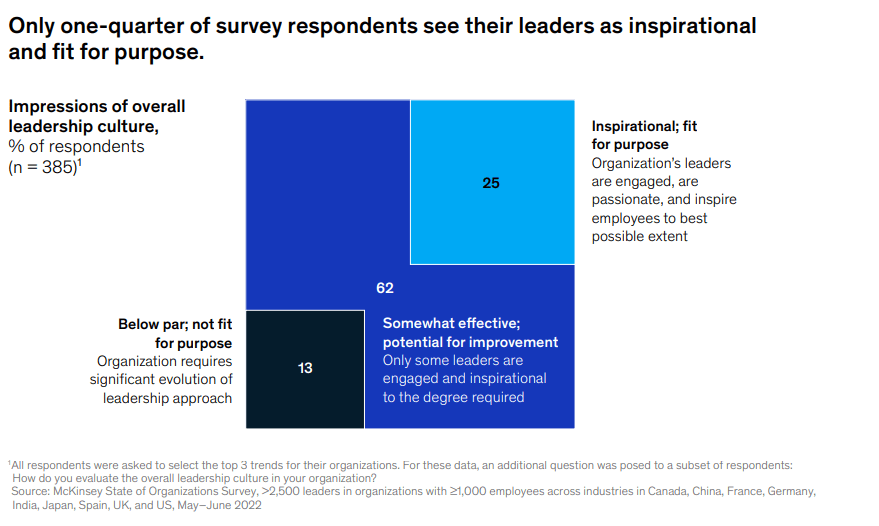
I assume the majority of the quarter of respondents seeing their leaders as inspirational and fit-for-purpose were in fact the leaders in their respective organizations.

We shouldn’t talk about organization efficency without talking about effectiveness and excellence. I relly wish folks would widely adapt the principles of organizational excellence.

As usual, interesting information with some poor or impartial takes published by an organization that should be RICO’ed out of existence and join the Arthur Anderson graveyard of consulting companies.

Resilience

In the current world scenario, which is marked by high volatility, uncertainty, complexity, and ambiguity (VUCA), threats are increasingly unforeseen. As organizations, we are striving for this concept of Resilience.

Resilience is one of those hot words, and like many hot business terms it can mean a few different things depending on who is using it, and that can lead to confusion. I tend to see the following uses, which are similar in theme.

Where usedMeaning
PhysicsThe property of a material to absorb energy when deformed and not fracture nor break; in other words, the material’s elasticity.
EcologyThe capacity of an ecosystem to absorb and respond to disturbances without permanent damage to the relationships between species.
PsychologyAn individual’s coping mechanisms and strategies.
Organizational and Management studiesThe ability to maintain an acceptable level of service in the face of periodic or catastrophic systemic and singular faults and disruptions (e.g. natural disasters, cyber or terrorist attacks, supply chain disturbances).

For our purposes, resilience can be viewed as the ability of an organization to maintain quality over time, in the face of faults and disruptions. Given we live in a time of disruption, resilience is obviously of great interest to us.

In my post “Principles behind a good system” I lay out eight principles for good system development. Resilience is not a principle, it is an outcome. It is through applying our principles we gain resilience. However, like any outcome we need to design for it deliberately.

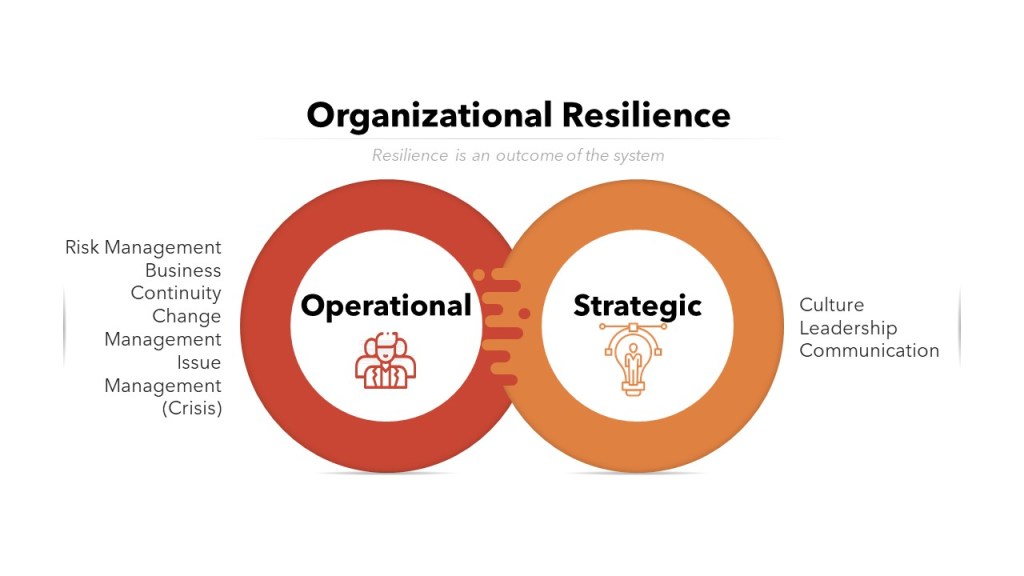
We gain resilience in the organization through levers that can be lumped together as operational and organizational.

The attributes that give resilience are the same that we build as part of our quality culture:

On the operational side, we have processes to drive risk management, business continuity, and issue management. A set of activities that we engage in.

Like many activities they key is to think of these as holistic endeavors proactively building resiliency into the organizaiton.

Increasing Transparency in Drug/Medical Device Manufacturers

The National Academies of Science, Engineering and Medicine (NASEM) has published a report on resiliency in the medical supply chain that calls for the US Food and Drug Administration (FDA) to publicly disclose the location of all manufacturing facilities that supply ingredients and parts for pharmaceuticals and medical devices approved in the US.

The report recommends FDA publicly disclose information on drug sourcing, manufacturing quality and volume, and capacity for medical products approved for sale in the US.
 
“The manufacturer for a pharmaceutical drug should be required to publicly disclose the manufacturing location, in particular the FDA Establishment Identifier (FEI), the city, and the country for the finished dosage form (FDF), active pharmaceutical ingredient (API, major excipients, and major packaging and delivery devices for all pharmaceutical drugs sold in the United States,” said a report summary.
 
The same recommendation also applies to devices; device manufacturers should publicly disclose the manufacturing location in the FEI, the city, and the country involved in the device’s manufacturing and final assembly.
 
The report also recommends FDA make its risk-based site selection model scores publicly available. Wow, not only would that be good for consumers, I’d love to know where my sites fall in on that scoring.

Hurry up and put this recommendation in place!

Transparency is a good thing and it is shown to increase consumer safety. It is a problem that even a fairly knowledgeable industry professional like myself cannot figure out where generics are manufactured without making a few phone calls and shaking down my friend network. And even then, I’m never positive that I understand where my family’s medicine is coming from and the status of the sites involved in manufacturing and distributing the product.