
Quality Culture is Fundamental to Actually Providing Quality

For all I love the hard dimensions of quality (i.e. process, training, validation, management review, auditing, measurement of KPI) I also stress in my practice how the soft dimension of communication and employee participation, and teamwork are critical to bringing about a culture of excellence. Without a strong quality culture, people will not be ready to commit and involve themselves fully in building and supporting a robust quality management system. The goal is to align top management behavior and the emergent culture to be consistent over time with the quality system philosophy or people will become cynical. In short, organizational culture should be compatible with quality values.

Quality culture is justifiably the rage and it is not going anywhere. If you are not actively engaging with it you are losing one of your mechanisms for success.

Quality Culture really serves as a way to categorize an organizational culture that intends to enhance quality permanently. There are two distinct elements characterizing this culture:

  • A cultural/psychological element of shared values, beliefs, expectations, and commitment toward quality
  • A structural/managerial element with defined processes that enhance quality and aim at coordinating individual efforts.
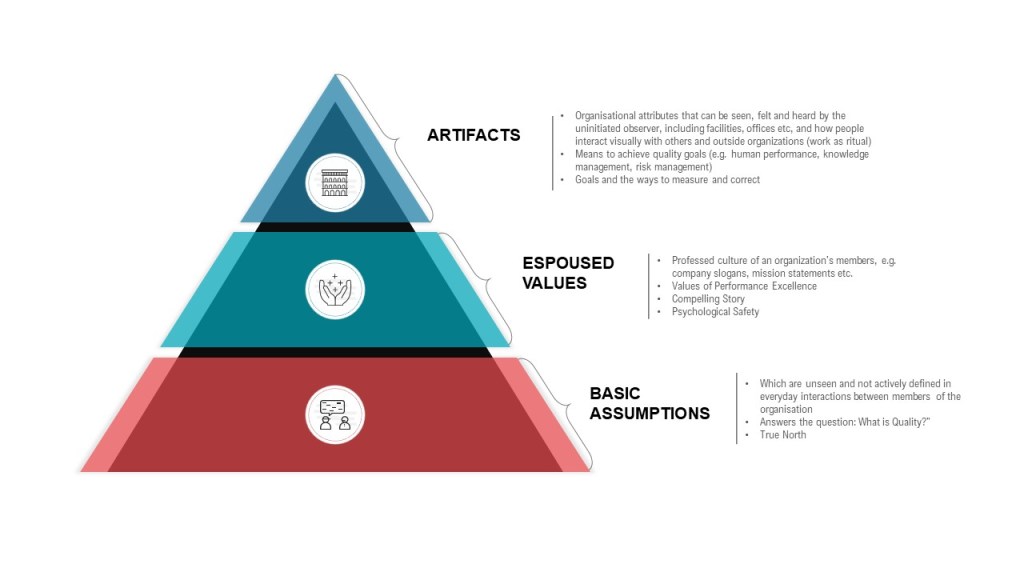
Edgar Schein’s Organizaitonal Culture Model

Schein’s model of organizational culture provides a valuable place to start in assessing quality culture:

  • Visible quality artifacts (e.g. quality assessment tools)
  • Espoused quality values (e.g. mission statement)
  • Shared basic quality assumptions (e.g. quality commitment)

The first basic quality assumption to tackle is to answer what do you mean by Quality?

Even amongst quality professionals, we do not all seem to be in agreement on what we mean by Quality. Hence all the presentations at conferences and part of the focus on Quality 4.0 (the other part of the focus is mistaken worship of technology – go back to Deming people!)

Route out the ambiguity that results in:

  • Uncontrollable fragmentation of quality thinking, discussion, and practices
  • Superficiality of quality-related information and communication
  • Conceptual confusion between the quality results and quality enablers, and between quality and many other related factors
  • Disintegration of the foundation of quality

I like to place front and center the definition of quality from ISO 9000: “degree to which a set of inherent characteristics of an object fulfils requirements.” This definition emphasizes the relative nature of quality (“degree”) that also highlights the subjective perception of quality. The object of quality is defined more generally than for the goods or service products only. The object has its inherent characteristics that consist of all of its features or attributes. “Requirement” means here needs and expectations, which may be related to all interested parties of the object and the interaction. This definition of quality is also compatible the prevailing understanding of quality in everyday language.

For an organization, the definition of quality relates to the organization’s stakeholders. With the definition, we can consider both the quality of the organization as a whole and the quality of the entities being exchanged between the organization and its stakeholders. Products produced and delivered to the organization’s customers are especially significant entities in this context.

Following through with ISO9000’s definition of Quality management implying how the personal, organizational, or societal resources and activities or processes are managed with regard to quality, we are able to the framework for basic quality assumptions in an organization.

Herein usually lies your True North, a term used a lot, that recognizes that quality is a journey: there is no absolute destination point and we will never achieve perfection. Think of True North not as a destination, but as a term used to describe the ideal state of perfection that your organization should be continually striving for.

In espoused quality values we take the shared concept of quality and expand it to performance excellence as an integrated approach to the organizational performance management that results in:

  • the delivery of ever-improving value to customers and stakeholders, contributing to organizational sustainability
  • the improvement of overall organizational effectiveness and capabilities
  • Organizational and personal learning.

We need to have a compelling story around these values.

A compelling story is a narrative that charts a change over time, showing how potential solutions fit into the espoused values. This story can generate more engagement from listeners than any burning platform ever will. By telling a compelling story, you clarify the motivation to develop discontent with the status quo. Let the story show the organization where you have come from and where you might go. The story must be consistent and adopted by all leaders in the organization. The leadership team should weave in the compelling story at all opportunities. They should ask their teams constantly, “What’s next?” “How can we make that even better?” “How did you improve your area today?”

Compelling stories often build on dissatisfaction by positioning against competitors. In the life science sector, it can be more effective to enshrine the patient in the center of the compelling story. People will support change when they see and experience a purposeful connection to an organization’s mission. The compelling story drives that.

Espoused values require strong and constant communication.

Espoused values have more levers for change than basic assumptions. While I placed True North down in assumptions, in all honestly it will for a central part of that compelling story and drive the adoption of the espoused values.

It is here we need to build and reaffirm psychological safety.

In the post “Driving towards a Culture of Excellence” I provided elements of a high-performing culture that count as artifacts of quality, stemming from the values.
Teaching Quality People to Listen

Been thinking a lot on what a training program around teaching people to listen and not to talk might look like and how it fits into a development program for quality professionals.

People in quality think a lot on how to make a reasoned argument, a good decision, to provide guidance, get their point across in meetings, persuade or coerce people to follow standards. This is understandable, but it has a cost. There is a fair amount of research out there that indicates that all too often when others are talking, we are getting ready to speak instead of listening.

I think we fail to listen because we are anxious about our own performance, concerned about being viewed as an expert, convinced that our ideas are better than others, comfortable in our expertise, or probably all of the above. As a result we get into conflicts that could be avoided, miss opportunities to advance the conversation, alienate people and diminish our teams’ effectiveness.

When we really listen we create the spaces to make quality decisions. Listening can be improved by these practices:

Ask expansive questions. Stay curious, build on other’s ideas are mantras I think most of us are familiar with. Suppress the urge to interrupt or dominate a conversation and concentrate on the implications of other people’s words. It is very easy for a quality professional to instantly leap to solving the problem, and we need to be able to give space. Focus on open-ended “what” and “how” questions, which encourage people to provide more information, reflect on the situation and feel more heard. Avoid yes-and-no questions which can kill dialogue.

Engage in “self-checks”. Be aware of one’s own tendencies and prepare with ways to identify they are happening and head them off. Doing this will surprisingly allow you to focus on the listener and not yourself moving beyond the words that are being said and being able to take in the speaker’s tone, body language, emotions and perspective, and the energy in the conversation.

Become comfortable with silence. This means communicating attentiveness and respect while you are silent.

Listening needs to be part of our core competencies, and unless we work on it, we don’t get better.

Decision Quality helps overcome bad outcomes

We gather for a meeting, usually around a table, place our collective attention on the problem, and let, most likely let our automatic processes take over. But, all too often, this turns out to be a mistake. From this stems poor meetings, bad decisions, and a general feeling of malaise that we are wasting time.

Problem-solving has stages, it is a process, and in order for groups to collaborate effectively and avoid talking past one another, members must all be in the same problem-solving stage. In order to make this happen our meetings must be methodical.

In a methodical meeting, for each issue that needs to be discussed, members deliberately and explicitly choose just one problem-solving stage to complete.

To convert an intuitive meeting into a methodical one take your meeting agenda, and to the right of each agenda item, write down a problem-solving stage that will help move you closer to a solution, as well as the corresponding measurable outcome for that stage. Then, during that part of the meeting, focus only on achieving that outcome. Once you do, move on.

A Template for Conducting a Methodical Meeting

Pair each agenda item with a problem solving stage and a measurable outcome.

Agenda ItemProblem Solving StageMeasurable Outcome
Select a venue for the offsiteDevelop alternativesList of potential venues
Discuss ERP usage problemsFrameProblem statement
Implement new batch record strategyPlan for ImplementationList of actions / owners / due dates
Review proposed projectsEvaluate AlternativesList of strengths and weaknesses
Choose a vendorMake DecisionWritten decision

If you don’t know which problem-solving stage to choose, consider the following:

Do you genuinely understand the problem you’re trying to solve? If you can’t clearly articulate the problem to someone else, chances are you don’t understand it as well as you might think. If that’s the case, before you start generating solutions, consider dedicating this part of the meeting to framing and ending it with a succinctly written problem statement.

Do you have an ample list of potential solutions? If the group understands the problem, but hasn’t yet produced a set of potential solutions, that’s the next order of business. Concentrate on generating as many quality options as possible (set the alternatives).

Do you know the strengths and weaknesses of the various alternatives? Suppose you have already generated potential solutions. If so, this time will be best spent letting the group evaluate them. Free attendees from the obligation of reaching a final decision—for which they may not yet be ready—and let them focus exclusively on developing a list of pros and cons for the various alternatives.

Has the group already spent time debating various alternatives? If the answer is yes, use this part of the meeting to do the often difficult work of choosing. Make sure, of course, that the final choice is in writing.

Has a decision been made? Then focus on developing an implementation plan. If you’re able to leave the conversation with a comprehensive list of actions, assigned owners, and due dates, you can celebrate a remarkably profitable outcome.

Topics of concern for collaboration

More a collection of topics for things I am currently exploring. Please add additional ones and/or resources in the comments.

Trends Concerns
Increasing collaborative modes of working, specifically more:
Matrix structures (Cross et al. 2013, 2016; Cross and Gray 2013)
(Distributed) Teamwork (Cross et al. 2015) 
(Multi-) Project work (Zika-Viktorsson et al. 2006) and multiple team membership (O`Leary et al. 2011)
Interruptions, which are ‘normal’ or even as a necessary part of knowledge workers’ workday (Wajcman and Rose 2011)
Collaboration, which is seen as an end (Breu et al. 2005; Dewar et al. 2009; Gardner 2017; Randle 2017)
Collaborative work is highly demanding (Barley et al. 2011; Dewar et al. 2009; Eppler and Mengis 2004)
Perils of multitasking (Atchley 2010; Ophir et al. 2009; Turkle 2015)
Too many structurally unproductive and inefficient teams (Duhigg 2016)
Lack of accountability for meeting and conference call time (Fried 2016)
Overall, lack of structural protection of employee’s productive time (Fried 2016)
Impacts of collaborative technology
Growing share of social technologies in the workplace (Bughin et al. 2017)
‘Always on’ mentality, cycle of responsiveness (Perlow 2012)
Platforms are designed to prime and nudge users to spend more time using them (Stewart 2017)
Unclear organizational expectations how to use collaborative technology and limited individual knowledge (Griffith 2014; Maruping and Magni 2015)
Technology exacerbates organizational issues (Mankins 2017)
Inability to ‘turn off’ (Perlow 2012)
Technology creates more complexity than productivity gains (Stephens et al. 2017)
Increasing complex media repertoires: highly differentiated, vanishing common denominator (Greene 2017; Mankins 2017)
Social technology specific Increased visibility (Treem and Leonardi 2013) and thus the ability to monitor behaviour Impression management and frustration (Farzan et al. 2008)
Overall, overload scenarios and fragmentation of work (Cross et al. 2015; Wajcman and Rose 2011)
Increasing ratio of collaborative activities for managers (Mankins and Garton 2017; Mintzberg 1990) and employees (CEB 2013; Cross and Gray 2013)

Workdays are primarily characterized by communication and collaboration.
Managers at intersections of matrix structures get overloaded (Feintzeig 2016; Mankins and Garton 2017)
Limited knowledge how to shape collaboration on the managerial level (Cross and Gray 2013; Maruping and Magni 2015)
Experts and structurally exposed individuals (e.g. boundary spanners) easily get overburdened with requests (Cross et al. 2016; Cross and Gray 2013).

Behavioral traits (‘givers’) may push employees close burn-outs (Grant 2013; Grant and Rebele 2017)
Diminishing ‘perceived control’ over one’s own schedule (Cross and Gray 2013)

Overall, managers and employees do not have enough uninterrupted time (Cross et al. 2016; Mankins and Garton 2017)

Resources

  • Atchley, P. 2010. “You Can’t Multitask, So Stop Trying,” Harvard Business Review
  • Barley, S. R., Meyerson, D. E., and Grodal, S. 2011. “E-mail as a Source and Symbol of Stress,” Organization Science (22:4), pp. 887–906.
  • Breu, K., Hemingway, C., and Ashurst, C. 2005. “The impact of mobile and wireless technology on knowledge workers: An exploratory study,” in Proceedings of the 13th European Conference on Information Systems, Regensburg, Germany.
  • Bughin, J., Chui, M., Harrysson, M., and Lijek, S. 2017. “Advanced social technologies and the future of collaboration,” McKinsey Global Institute.
  • CEB. 2013. “Driving the Strategic Agenda in the New Work Environment
  • Cross, R., Ernst, C., Assimakopoulos, D., and Ranta, D. 2015. “Investing in boundary-spanning collaboration to drive efficiency and innovation,” Organizational Dynamics (44:3), pp. 204–216.
  • Cross, R., and Gray, P. 2013. “Where Has the Time Gone? Addressing Collaboration Overload in a Networked Economy,” California Management Review (56:1), pp. 1–17.
  • Cross, R., Kase, R., Kilduff, M., and King, Z. 2013. “Bridging the gap between research and practice in organizational network analysis: A conversation between Rob Cross and Martin Kilduff,” Human Resource Management (52:4), pp. 627–644.
  • Cross, R., Rebele, R., and Grant, A. 2016. “Collaborative Overload,” Harvard Business Review (94:1), pp. 74–79.
  • Cross, R., Taylor, S.N., Zehner, D. 2018. “Collaboration without burnout“. Harvard Business Review. (96:4), pp. 134-137.
  • Dewar, C., Keller, S., Lavoie, J., and Weiss, L. M. 2009. “How do I drive effective collaboration to deliver real business impact?,” McKinsey & Company.
  • Duhigg, C. 2016. Smarter, Faster, Better – The Secrets of Being Productive in Life and Business, New York, USA: Penguin Random House.
  • Eppler, M. J., and Mengis, J. 2004. “The Concept of Information Overload: A Review of Literature from Organization Science, Accounting, Marketing, MIS, and Related Disciplines,” The Information Society (20:5), pp. 325–344.
  • Farzan, R., DiMicco, J. M., Millen, D. R., Brownholtz, B., Geyer, W., and Dugan, C. 2008. “Results from Deploying a Participation Incentive Mechanism within the Enterprise,” in Proceedings of the 26th SIGCHI Conference on Human Factors in Computing Systems, Florence, Italy.
  • Feintzeig, R. 2016. “So Busy at Work, No Time to Do the Job,” The Wall Street Journal
  • Fried, J. 2016. “Restoring Sanity to the Office,” Harvard Business Review .
  • Gardner, H. K. 2017. Smart Collaboration: How Professionals and Their Firms Succeed by Breaking Down Silos, Boston, USA: Harvard Business Review Press.
  • Grant, A. 2013. Give and Take: A Revolutionary Approach to Success, New York, USA: Penguin Group.
  • Grant, A., and Rebele, R. 2017. “Generosity Burnout,” Harvard Business Review
  • Greene, J. 2017. “Beware Collaboration-Tool Overload,” The Wall Street Journal
  • Griffith, T. L. 2014. “Are Companies Ready to Finally Kill Email?,” MIT Sloan Management Review
  • Lock Lee, L. 2017. “Enterprise Social Networking Benchmarking Report 2017,” SWOOP Analytics
  • Mankins, M. 2017. “Collaboration Overload Is a Symptom of a Deeper Organizational Problem,” Harvard Business Review
  • Mankins, M., and Garton, E. 2017. Time, Talent, Energy, Boston, USA: Harvard Business Review Press
  • Maruping, L. M., and Magni, M. 2015. “Motivating Employees to Explore Collaboration Technology in Team Contexts,” MIS Quarterly (39:1), pp. 1–16.
  • O’Leary, M. B., Mortensen, M., and Woolley, A. W. 2011. “Multiple Team Membership: a Theoretical Model of Its Effects on Productivity and,” Academy of Management Review (36:3), pp. 461–478.
  • Ophir, E., Nass, C., and Wagner, A. D. 2009. “Cognitive control in media multitaskers,” Proceedings of the National Academy of Sciences of the United States of America (106:37), pp. 15583–15587.
  • Perlow, L. A. 1999. “The time famine: Toward a sociology of work time,” Administrative Science Quarterly (44:1), pp. 57–81.
  • Perlow, L. A. 2012. Sleeping With Your Smartphone, Boston, USA: Harvard Business Review Press.
  • Perlow, L. A. 2014. “Manage Your Team’s Collective Time,” Harvard Business Review (92:6), pp. 23–25.
  • Perlow, L. A., and Porter, J. L. 2009. “Making time off predictable–and required,” Harvard Business Review (87:10), pp. 102–109.
  • Randle, C. 2017. “24/7: Managing Constant Connectivity,” in Work Pressures: New Agendas in Communication, D. I. Ballard and M. S. McGlone (eds.), New York, USA: Routledge, pp. 20–26.
  • Stephens, K. K. 2017. “Understanding Overload in a Contemporary World,” in Work Pressures: New Agendas in Communication, D. I. Ballard and M. S. McGlone (eds.), New York, USA: Routledge.
  • Stephens, K. K., Mandhana, D. M., Kim, J. J., and Li, X. 2017. “Reconceptualizing Communication Overload and Building a Theoretical Foundation,” Communication Theory (27:3), pp. 269–289.
  • Stewart, J. B. 2017. “Facebook Has 50 Minutes of Your Time Each Day. It Wants More.” The New York Times
  • Treem, J. W., and Leonardi, P. M. 2013. “Social Media Use in Organizations: Exploring the Affordances of Visibility, Editability, Persistence, and Association,” Annals of the International Communication Association (36:1), pp. 143–189.
  • Turkle, S. 2015. Reclaiming Conversation: The Power of Talk in a Digital Age, New York, USA: Pinguin Press.
  • Wajcman, J., and Rose, E. 2011. “Constant Connectivity: Rethinking Interruptions at Work,” Organization Studies (32:7), pp. 941–961.
  • Zika-Viktorsson, A., Sundström, P., and Engwall, M. 2006. “Project overload: An exploratory study of work and management in multi-project settings,” International Journal of Project Management (24:5), pp. 385–394.

Team Effectiveness

With much of the work in organizations accomplished through teams it is important to determine the factors that lead to effective as well as ineffective team processes and to better specify how, why, and when they contribute. It doesn’t matter if the team is brought together for a specific project and then disbands, or if it is a fairly permanent part of the organization, similar principles are at work.

Input-Process-Output model

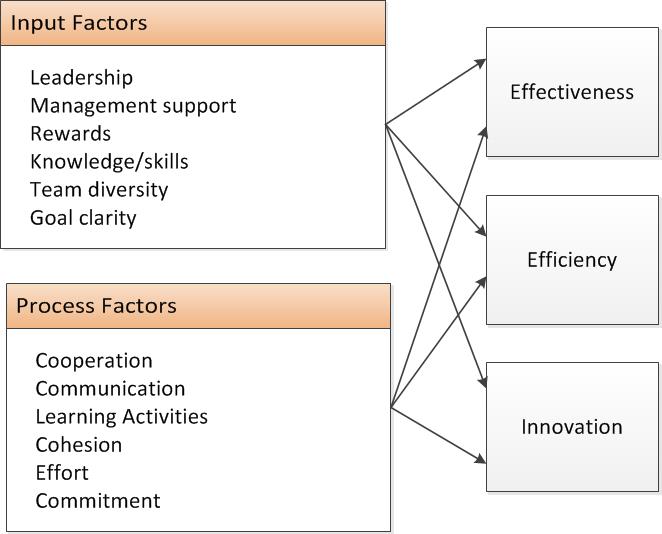
The input-process-output model of teams is a great place to start. While simplistic, it can offer a good model of what makes teams works and is applicable to the different types of teams.

Input factors are the organizational context, team composition, task design that influence the team. Process factors are what mediates between the inputs and desired outputs.

  • Leadership:  The leadership style(s) (participative, facilitative, transformational, directive, etc) of the team leader influences the team toward the achievement of goals.
  • Management support refers to the help or effort provided by senior management to assist the project team, including managerial involvement and resource support.
  • Rewards are the recompense that the organization gives in return for good work.
  • Knowledge/skills are the knowledge, experience and capability of team members to process, interpret, manipulate and use information.
  • Team diversity includes functional diversity as well as overall diversity.
  • Goal clarity is the degree to which the goals of the project are well defined and the importance of the goals to the organization is clearly communicated to all team members.
  • Cooperation is the measure of how well team members work with each other and with other groups.
  • Communication is the exchange of knowledge and information related to tasks with the team (internal) or between team members and external stakeholders (external).
  • Learning activities are the process by which a team takes action, contains feedback and makes changes to improve. Under this fits the PDCA lifecycle, including Lean, SixSigma and similar problem solving methodologies..
  • Cohesion is the spirit of togetherness and support for other team members that helps team members quickly resolve conflicts without residual hard feelings, also referred to as team trust, team spirit, team member support or team member involvement.
  • Effort includes the amount of time that team members devote to the project.
  • Commitment refers to the condition where team members are bound emotionally or intellectually to the project and to each other during the team process.

Process Factors are usually the focus on team excellence frameworks, such as the ASQ or the PMI.

Outputs, or outcomes, are the consequences of the team’s actions or activities:

  • Effectiveness is the extent a project achieves the performance expectations of key project stakeholders. Expectations are usually different for different projects and across different stake-holders; thus, various measures have been used to evaluate effectiveness, usually quality, functionality, or reliability. Effectiveness can be meeting customer/user requirements, meeting project goals or some other related set of measures.
  • Efficiency is the ability of the project team to meet its budget and schedule goals and utilize resources within constraints Measures include: adherence to budget, adherence to schedule, resource utilization within constraints, etc.
  • Innovation is the creative accomplishment of teams in generating new ideas, methods, approaches, inventions, or applications and the degree to which the project outputs were novel.

Under this model we can find a various levers to improve out outcomes and enhance the culture of our teams.