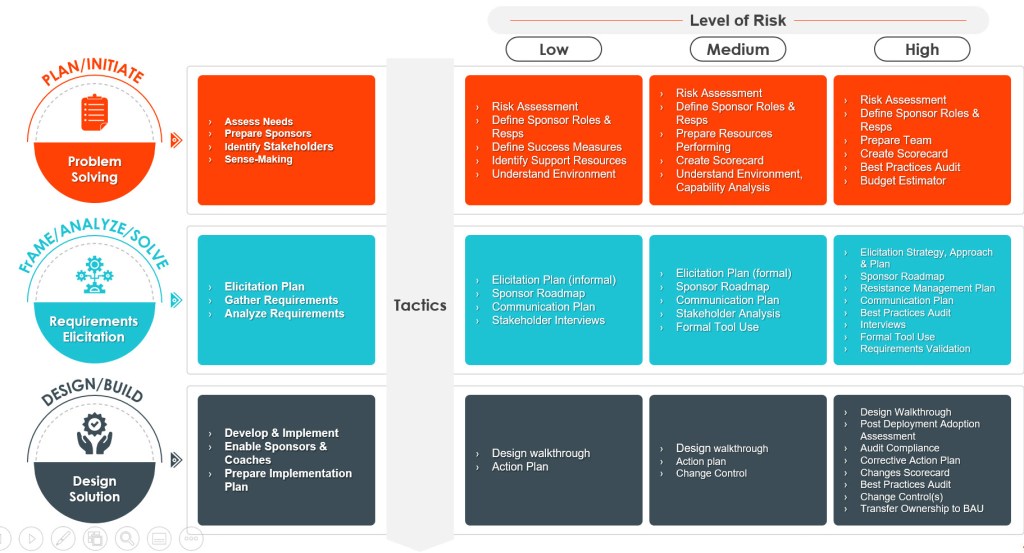
Like most activities, the level of effort is commensurate with the level of risk. Above I provide some different activities that can happen based on the risk inherent in the process and problem being evaluated.
In the post “Review of Process/Procedure” I mentioned how the document draft and review cycle can be seen as an iterative design cycle. In this post I want to expand on the design lifecycle as a fundamental expression of PDCA that sits at the heart of all we do.
PDCA, a refresher
PDCA (and it’s variants) are a pretty tried and true model for process improvement. In the PDCA model a plan is structured in four steps: P (plan) D (do) C (check) A (act). The intention is create a structured cycle that allows the process to flow in accordance with the objectives to be achieved (P), execute what was planned (D), check whether the objectives were achieved with emphasis on the verification of what went right and what went wrong (C) and identify factors of success or failure to feed a new process of planning (A).
Conceptually, the organization will be a fast turning wheel of endlessly learning from mistakes and seeking to maximize processes in order to remain forever in pursuit of strategic objectives, endlessly searching for the maximum efficiency and effectiveness of the system.
PDCA cycle driving continuous improvement
Design Lifecycle
This design lifecycle just takes the PDCA spiral and spreads it across time. At the same time it breaks down a standard set of activities and recognizes the stage gates from moving between startup (or experiment) and continuous improvement.
Design Lifecycle
Identifying the Problem (Plan)
At it’s heart problem-solving requires understanding a set of requirements and building for success.
I always go back to the IEEE definition of “A requirement is a condition or capability needed by a user to solve a problem or achieve an objective; a condition or capability that must be met or possessed by a system or system component to satisfy a contract ,standard, specification , or other formally imposed document; a document representation of condition or capability “
A requirement can be explicitly stated, implicit, inherited or derived from other requirements.
The first place to look for requirements is the organization itself.
Understanding the needs of the organization
The cultural needs of the organization drives the whole problem-solving and requirement gathering activity and it starts by being clear on Strategy and understanding the goals and objectives and how these goals percolate to the different business processes that we are improving. This gives a good starting point to focus on what opportunities to be explored and what problems to be solved.
It is not uncommon in the problem-solving phase that the objectives/needs are not known, so we must work our way through figuring out what the initial need is. Go back to the fundamentals of understanding the business processes “as-is” and review existing regulations, standards, guidelines and other internal sources of requirements followed currently. This is the time to interview stakeholders and go the GEMBA.
We state the problem, and re-frame it. And now we can move on to Requirement Elicitation.
Identifying the Problem
Requirement Elicitation
Requirement Elicitation is the process of probing and facilitating the stakeholders to provide more clarity and granular details pertaining to the (usual) high-level requirement gathered so far. This is a discovery process, exploratory in nature, focusing on finding enough details so that a solution can be envisioned and developed. Elicitation is not an isolated activity, and has been happening throughout the process by all the discussion, interaction, analysis, verification and validation up to now.
You should be engaging with knowledge management throughout the cycle, but ensure there is specific engagement here.
It is a progressive process where the requirement clarity ushers in increments and may need multiple rounds of probing/discussions. As the new details are uncovered the requirements are further elaborated and detailed. There are a whole toolbox of elicitation techniques and like any engagement it is important to properly prepare.
Requirement Elicitation
Requirement Analysis
Requirement Analysis pertains to extracting the requirement out of the heaps of information acquired from various stakeholders and communicated and turned into documentation in a form that is easily understood by the stakeholders, including the project team. Here we are engaging in requirement refinement, modification, clarification, validation & finalization and engaging in extensive communication.
In this design process, we address and use empathy to acquire insight into users’ (stakeholders) needs and inform the design process and create a relevant solution. Using an approach informed by cognitive empathy, we apply different methods to build up that competence and insight, enabling us to prioritize the needs of the users and make the results of the process more desirable.
It is pretty standard advice that relevant references to other documents should be listed in a separate section of the procedure. The reasoning is that when some standard operating procedures are intimately linked to others – the information contained in more than one document is necessary to complete a task – it is useful to include a cross-reference section in each document. Many also say that this section reinforces the SOP’s authority.
Another fairly common piece of advice is to have this, or another, section in the procedure identify the documents used in the development of the procedure, such as regulatory documents or technical/validation reports.
My take is that neither belongs in a process/procedure (SOP/WI). We should be looking to streamline requirements documents, and these sections are just cruft.
If you have electronic document control systems then cross-references should be handled trough hyperlink. Users are quite comfortable with hyperlinks and will easily navigate between documents.
Listing of regulations and other requirements belongs in a separate design document (ideally part of the document control system), and again add little value to the execution of the document.
There are a lot of so-called “best practices” about documents that stem from the days where everything is paper, and it is okay to move beyond them.
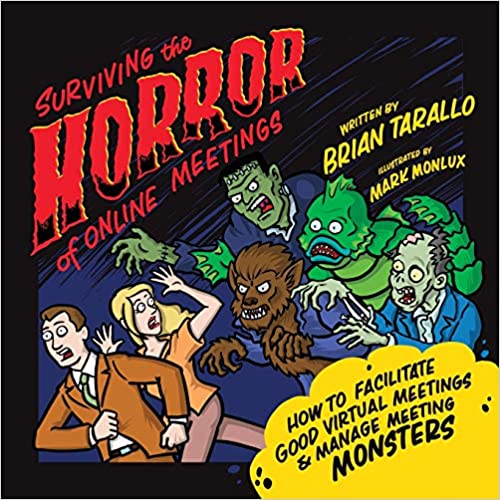
A fun read this week has been Surviving the Horror of Online Meetings, which brings a great deal of fun to a very pertinent topic in a pretty short page count (70 pages). As a fan of classic monster movies I can’t recommend the art enough.
Tons of good survival tips. Some of my favorite were:
Plan five minute sprints – for every 5 minutes of slide presentations or briefings include something that will engage participants – for example a poll or a breakout session.
“I Like, I wish, what if” – participants type feedback into chat about idea share
Hide self-view – I instantly did this and it makes such a difference
And then each of the silver bullets was worth the price of admission.
We are all fatigued from constant online meetings, and they are not going anywhere. This book is a fun bit of medicine and I definitely recommend giving it a read.



 Investigations of a Dog