
Tacit and Explicit Knowledge

Nonaka classified knowledge as explicit and tacit. This concept has become the center piece of knowledge management and fundamental concept in process improvement.

Explicit knowledge is documented and accepted knowledge. Tacit knowledge stems more from experience and is more undocumented in nature. In spite of being difficult to interpret and transfer, tacit knowledge is regarded as the root of all organizational knowledge.

Tacit knowledge, unlike its explicit counterpart, mostly consists of perceptions and is often unstructured and non-documented in nature. Therefore, mental models, justification of beliefs, heuristics, judgments, “gut feelings” and the communication skills of the individual can influence the quality of tacit knowledge.

The process of creation of knowledge begins with the creation and sharing of tacit knowledge, which stems from socialization, facilitation of experience and interactive capacity of individuals with their coworkers.

Creation and Sharing of Knowledge

Knowledge creation involved organizations and it’s individual transcending the boundaries of the old to the new by acquiring new knowledge, which is considered to be mostly tacit in nature. The key to tacit knowledge sharing lies in the willingness and capacity of individuals to share what they know (knowledge donation) and to use what they learn (knowledge collection).

Knowledge quality is the acquisition of useful and innovative knowledge and is the degree to which people are satisfied with the quality of the shared knowledge and find it useful in accomplishing their activities. The quality of knowledge can be measured by frequency, usefulness and innovativeness, and can be innovative or new for the system or organization. However, if the knowledge is not beneficial to achieving the objective of the objective of the organization then it does not fulfill the criteria of knowledge quality. There are six attributes to knowledge quality: adaptability, innovativeness, applicability, expandability, justifiability and authenticity,

Sources

  • Kaser, P.A. and Miles, R.E. (2002), “Understanding knowledge activists’ successes and failures”, Long Range Planning, Vol. 35 No. 1, pp. 9-28.
  • Kucharska, W. and Dabrowski, J. (2016), “Tacit knowledge sharing and personal branding: how to derive innovation from project teams”, in Proceedings of the11th European Conference on Innovation and Entrepreneurship ECIE, pp. 435-443.
  • Nonaka, I. (1994), “A dynamic theory of organizational knowledge creation”, Organizational Science, Vol. 5 No. 1, pp. 14-37.
  • Nonaka, I. and Takeuchi, H. (1995), The Knowledge-Creating Company, Oxford University Press, New York, NY.
  • Nonaka, I. and Toyama, R. (2003), “The knowledge-creating theory revisited: knowledge creation as a synthesizing process”, Knowledge Management Research and Practice, Vol. 1 No. 1, pp. 2-10.
  • Nonaka, I. and Von Krogh, G. (2009), “Perspective—tacit knowledge and knowledge conversion: controversy and advancement in organizational knowledge creation theory”, Organization Science, Vol. 20 No. 3, pp. 635-652
  • Riege, A. (2005), “Three-dozen knowledge-sharing barriers managers must consider”, Journal of Knowledge Management, Vol. 9 No. 3, pp. 18-35.
  • Smedlund, A. (2008), “The knowledge system of a firm: social capital for explicit, tacit and potential knowledge”, Journal of Knowledge Management, Vol. 12 No. 1, pp. 63-77.
  • Spender, J.C. (1996), “Making knowledge the basis of a dynamic theory of the firm”, Strategic Management Journal, Vol. 17 No. S2, pp. 45-62.
  • Soo, C.W., Devinney, T.M. and Midgley, D.F. (2004), “The role of knowledge quality in firm performance”, In Tsoukas, H. and Mylonopoulus, N. (Eds), Organizations as Knowledge Systems. Knowledge, Learning and Dynamic Capabilities, Palgrave Macmillan, London, pp. 252-275.
  • Sorenson, O., Rivkin, J.W. and Fleming, L. (2006), “Complexity, networks and knowledge flow”, Research Policy, Vol. 35 No. 7, pp. 994-1017.
  • Waheed, M. and Kaur, K. (2016), “Knowledge quality: a review and a revised conceptual model”, Information Development, Vol. 32 No. 3, pp. 271-284.
  • Wang, Z. and Wang, N. (2012), “Knowledge sharing, innovation and firm performance”, Expert Systems with Applications, Vol. 39 No. 10, pp. 8899-8908.

Experts think differently

Research on expertise has identified the following differences between expert performers and beginners

  • Experts have larger and more integrative knowledge units, and their represen­tations of information are more functional and abstract than those of novices, whose knowledge base is more fragmentary. For example, a beginning piano player reads sheet music note by note, whereas a concert pianist is able to see the whole row or even several rows of music notation at the same time.
  • When solving problems, experts may spend more time on the initial prob­lem evaluation and planning than novices. This enables them to form a holistic and in-depth understanding of the task and usually to reach a solution more swiftly than beginners.
  • Basic functions related to tasks or the job are automated in experts, whereas beginners need to pay attention to these functions. For instance, in a driving Basic functions related to tasks or the job are automated in experts, whereas beginners need to pay attention to these functions. For instance, in a driving school, a young driver focuses his or her attention on controlling devices and pedals, while an experienced driver performs basic strokes automatically. For this reason, an expert driver can observe and anticipate traffic situations better than a beginning driver.
  • Experts outperform novices in their metacognitive and reflective thinking. In other words, they make sharp observations of their own ways of think­ing, acting, and working, especially in non-routine situations when auto­ mated activities are challenged. Beginners’ knowledge is mainly explicit and they are dependent on learned rules. In addition to explicit knowledge, experts have tacit or implicit knowledge that accumulates with experience. This kind of knowledge makes it possible to make fast decisions on the basis of what is often called intuition.
  • In situations where something has gone wrong or when experts face totally new problems but are not required to make fast decisions, they critically reflect on their actions. Unlike beginners, experienced professionals focus their thinking not only on details but rather on the totality consisting of the details.
  • Experts’ thinking is more holistic than the thinking of novices. It seems that the quality of thinking is associated with the quality and amount of knowledge. With a fragmentary knowledge base, a novice in any field may remain on lower levels of thinking: things are seen as black and white, without any nuances. In contrast, more experienced colleagues with a more organized and holistic know­ledge base can access more material for their thinking, and, thus, may begin to explore different perspectives on matters and develop more relativistic views concerning certain problems. At the highest levels of thinking, an individual is able to reconcile different perspectives, either by forming a synthesis or by inte­grating different approaches or views.
LevelPerformance
BeginnerFollows simple directions
NovicePerforms using memory of facts and simple rules
CompetentMakes simple judgmentsfor typical tasksMay need help withcomplex or unusual tasksMay lack speed andflexibility
ProficientPerformance guided by deeper experience Able to figure out the most critical aspects of a situation Sees nuances missed by less-skilled performers Flexible performance
ExpertPerformance guided by extensive practice and easily retrievable knowledge and skillsNotices nuances, connections, and patterns Intuitive understanding based on extensive practice Able to solve difficult problems, learn quickly, and find needed resources
Levels of Performance

Sources

  • Clark, R. 2003. Building Expertise: Cognitive Methods for Training and Performance Improvement, 2nd ed. Silver Spring, MD: International Society for Performance Improvement.
  • Ericsson, K.A. 2016. Peak: Secrets From the New Science of Expertise. Boston: Houghton Mifflin Harcourt
  • Kallio, E, ed. Development of Adult Thinking : Interdisciplinary Perspectives on Cognitive Development and Adult Learning. Taylor & Francis Group, 2020.

.

Emotional Intelligence and Critical Thinking

Research from Tony Anderson and David James Robertson, outlined in The Conversation, suggests people with higher emotional intelligence can recognize misinformation better. 

There is growing evidence, including outlined above, that emotional intelligence has a huge impact of critical thinking. Emotional intelligence is the capacity for recognizing our own feelings and those of others, for motivating ourselves, and for managing emotions well in ourselves and in our relationships.

The evidence indicates that emotional intelligence helps us navigate uncertainty by regulating the emotional turmoil from a decision and the stress around it and reduce tendency to fall to biases.

Emotional Intelligence aspects of social awareness and empathy further enlighten the decision maker’s situational awareness.

Photo by Marta Wave on Pexels.com

Sources

  • Carmeli, A., & Josman, Z. E. (2006). The relationship among emotional intelligence, task performance, and organizational citizenship behaviors. Human Performance, 19, 403–419. doi:10.1207/s15327043hup1904_5
  • Miao, C., Humphrey, R. H., & Qian, S. (2017). A meta-analysis of emotional intelligence effects on job satisfaction mediated by job resources, and a test of moderators. Personality and Individual Differences, 116, 281–288. doi:10.1016/j.paid.2017.04.031
  • Mount, M., Ilies, R., & Johnson, E. (2006). Relationship of personality traits and counterproductive work behaviors: The mediating effects of job satisfaction. Personnel Psychology, 59, 591–622. doi:10.1111/peps.2006.59.issue-3
  • Spector, P. E., & Fox, S. (2002). An emotion-centered model of voluntary work behavior: Some parallels between counterproductive work behavior and organizational citizenship behavior. Human Resource Management Review, 12(2002), 269–292. doi:10.1016/S1053-4822(02)00049-9

Whiteboards as Artifacts

In “An Ode to the Whiteboard, Corporate America’s Least Appreciated Office Tool” Rob Walker says “And even for more workaday whiteboards, there’s an additional factor that the pandemic era has actually underscored: the value and appeal of whiteboarding as an analog, tactile experience.”

He then goes on to compare the whiteboard to a campfire, a gathering place that drives collaboration and creativity.

Whiteboards are a great visual artifact of quality culture.

Whiteboard are shared spaces for problem-solving and innovation.

They form an important part of visual management.

Share your thoughts on whiteboards in the comments!

Visual Management

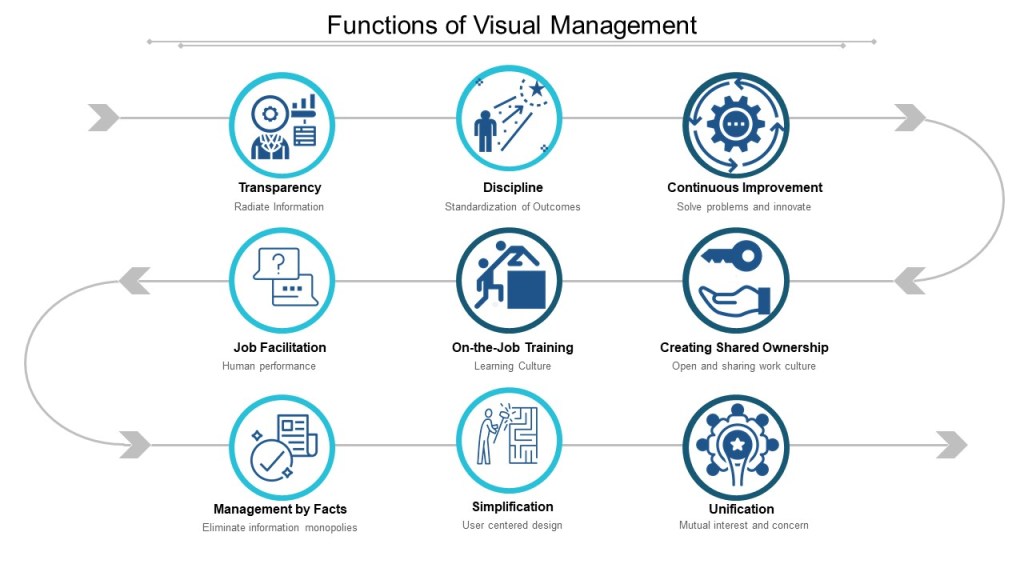
In the organizational world Visual Management is a management system that attempts to improve organizational performance through connecting and aligning organizational vision, core values, goals and culture with other management systems, work processes, workplace elements, and stakeholders, by means of stimuli, which directly address one or more of the five human senses (sight, hearing, feeling, smell and taste). These stimuli communicate quality information (necessary, relevant, correct, immediate, easy to-understand and stimulating), which helps people make sense of the organizational context at a glance by merely looking around. It is a management approach that utilizes either one or more of information giving, signaling, limiting or guaranteeing (mistake-proofing/ poka-yoke) visual devices to communicate with “doers”, so that places become self-explanatory, self-ordering, self-regulating and self-improving.

FunctionDefinitionReplaces the Practice of
TransparencyThe ability of a process (or its parts) to communicate with people through organizational and physical means, measurements, and public display of information

Transparency stimulates people to move outside the confines of particular job responsibilities and to see the larger scale of their work
Information held in people‟s minds and on the shelves.
DisciplineMaking a habit of properly maintaining correct procedures by transforming the abstract concept of discipline into directly observable concrete practices

Address the six basic questions (the what, the where, the who, the how, the how many and the when)
Warning, scolding, inflicting punishments, dismissing etc.
Continuous ImprovementFocused and sustained incremental innovation

Makes organizational learning visual with high ability to respond to people’s ideas
Static organizations or big improvement leaps through considerable investment.
Job FacilitationConscious attempt to physically and/or mentally ease people’s efforts on routine, already known tasks, by offering various visual aidsExpecting people to perform well at their jobs without providing them any aids.
On-the-Job TrainingLearning from experience or integrating working with learning.Conventional training practices or offering no training.
Creating Shared OwnershipA feeling of possessiveness and being psychologically tied to the objectivesManagement dictation for change efforts, vision and culture creation.
Management by FactsUse of facts and data based on statisticsManagement by subjective judgement or vague terms.
SimplificationConstant efforts on monitoring, processing, visualizing and distributing system wide information for individuals and teamsExpecting people to monitor, process and understand the complex system wide information on their own.
UnificationPartly removing the boundaries and creating empathy within an organization through effective information sharingFragmentation or “this is not my job” behavior
The functions of Visual Management