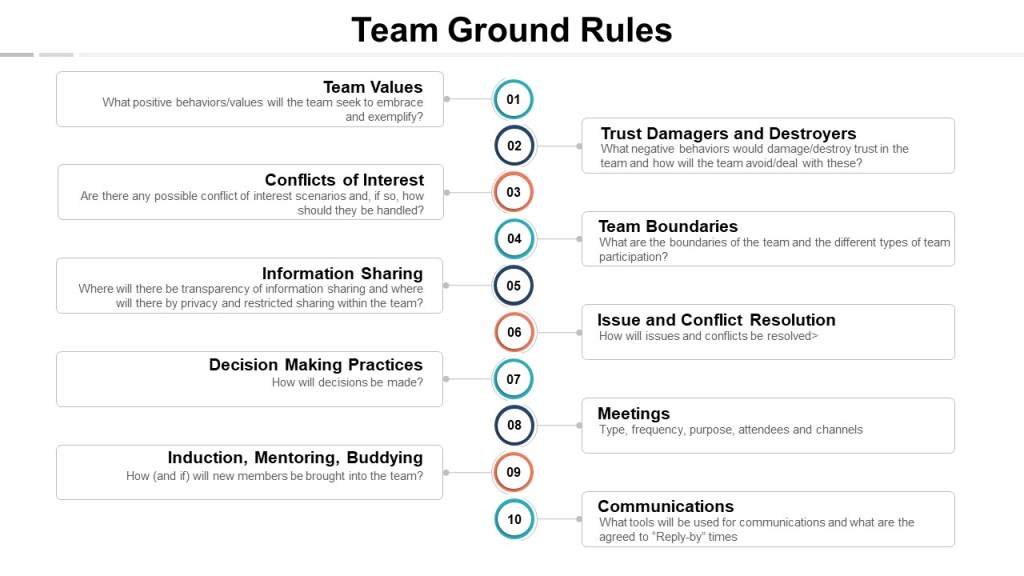
All teams need ground rules. Ground rules, the agreed behaviors of the team, should be short, sharp, unambiguous, and unanimous. The best ground rules follow the goldilocks-principle – they exist but are not unrealistic.
Ground rules are worthless unless implemented. A light set of ground rules which have been fully implemented is always better than a heavy set of ground rules not implemented or observed.
This means that any violations must be dealt with early on, or else the ground rules are not worth the paper they are written on.
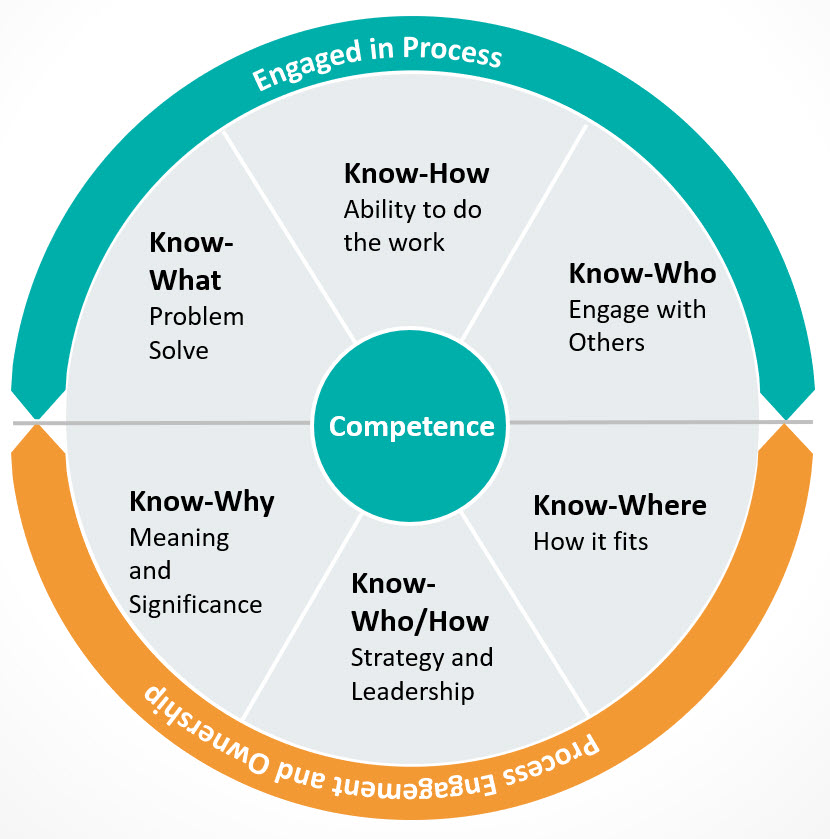
When developing training programs and cultural initiative sit is useful to break down what we really want people to know. I find it useful to think in terms of the following:
know-how: The technical skills to do the work
know-what: The ability to perform functional problem-solving, to adapt the process and innovate
know-who: networking and interpersonal skills, with social/emotional intelligence, for empathy or social network capacities
know-where: institutional and system knowledge of how the work fits into a larger ecosystem
know-who/how: strategic and leadership skills, for political ‘ nous’ in setting agendas, managing institutions, mobilizing resources;
know-why: creation of meaning, significance, identity, morality, with practical intuition for creative arts, sports, everyday social exchange.
To build all six elements requires a learning culture and a recognition that knowledge and awareness do not start and end at initial training on a process. We need to build the mechanisms to:
Communicate in a way to continually facilitate the assimilation of knowledge
Incorporate ongoing uses of tools such as coaching and mentoring in our processes and systems
Playfulness can soften difficult decisions, conversations and actions that require courage. Having the ability to bring a level of lightheartedness to even the most difficult situations can take the edge of circumstances that might otherwise scare you. Playfulness has the incredible power to disarm even the darkest of circumstances.
Play is a fundamental part of the human experience. We should never forget to bring it to our work. A playful attitude keeps your mind curious. It makes us better problem-solvers.
Play involves an enthusiastic and in-the-moment attitude. When we play, we detach from outside stressors and become completely absorbed in the activity. Play is the ultimate mindfulness.
Do not let play be the first thing that gets lost when stress overrides our lives.
Playfulness is a subtle art. It is bordered by silliness on one side and rudeness on the other side. Be careful to ensure you never are in either of those territories. Men, this is especially critical to us as our culture lets too many sexist, racist and homophobic attitudes slide as humor. Always remember that playfulness is not the same as being funny. I’m not a very funny person, I try to avoid making people laugh. what I strive to do is make people feel included in my curiosity and exploration.
Good playfulness should always connect, never divide.
Take your play seriously! But don’t take yourself too seriously. Point out your own flaws and imperfections in a humorous, confident way. Sincere self-deprecation can be powerful.
People will strive for your success when you show up with playful energy. Make the other person genuinely feel special and watch the magic happen. Playfulness is a gentle invitation for others to follow you if they want to.
Playfulness will reflect in your body language. This is very inviting, and a whole lot of what folks mean as charisma stems from this spark.
By practicing playfulness you will develop an attitude of irreverence where you are in touch with yourself and avoid negativity and drama.
So reflect and ask yourself these questions:
How can you approach life with more playfulness? What would happen if you were more playful in your daily life?
Where are you lacking playfulness?
Who is someone playful you admire? What makes them playful?
If you approached life in a more playful way, what brave decisions would you make?
How would you show up differently if you were to embrace playfulness?
Ambiguity is present in virtually all real-life situations and are those ‘situations in which we do not have sufficient information to quantify the stochastic nature of the problem. It is a lack of knowledge as to the ‘basic rules of the game’ where cause-and-effect are not understood and there is no precedent for making predictions as to what to expect
Ambiguity is often used, especially in the context of VUCA, to cover situations in situations that have:
Doubt about the nature of cause and effect
Little to no historical information to predict the outcome
Difficult to forecast or plan for
It is important to answer whether there are risks of lack of experience and predictability that might affect the situation, and interrogate our unknown unknowns.
People are ambiguity averse in that they prefer situations in which probabilities are perfectly known to situations in which they are unknown.
Walker et al. (2010) developed a taxonomy of “levels of uncertainty”, ranging from Level 1 to Level 4, which is useful in problem-solving:
Level 1uncertainties are defined as relatively minor – as representing “a clear enough future” set within a “single system model” whereby outcomes can be estimated with reasonable accuracy;
Level 2 uncertainties display “alternative futures” but, again, within a single system in which probability estimates can be applied with confidence.
Levels 3 and 4 uncertainties are described as representing “deep uncertainty”.
Level 3 uncertainties are described as “a multiplicity of plausible futures”, in which multiple systems interact, but in which we can identify “a known range of outcomes”
Level 4 uncertainties lead us to an “unknown future” in which we don’t understand the system: we know only that there is something, or are some things, that we know we don’t know.
This hierarchy can be useful to help us think carefully about whether the uncertainty behind a problem can be defined in terms of a Level 1 prediction, with parameters for variation. Or, can it be resolved as group of Level 2 possibilities with probability estimates for each? Can the issue only be understood as a set of different Level 3 futures, each with a clear set of defined outcomes, or only by means of a Level 4 statement to the effect that we know only that there is something crucial that we don’t yet know?
There is often no clear or unanimous view of whether a particular uncertainty is set at a specific level. Uncertainty should always be considered at the deepest proposed level, unless or until those that propose this level can be convinced by an evidence-based argument that it should be otherwise.
Sources
Walker, W.E., Marchau, V.A.W.J. and Swanson, D. (2010) “Addressing Deep Uncertainty using Adaptive Policies: Introduction to Section 2”, Technological Forecasting & Social Change, 77: 917–23.


 Investigations of a Dog