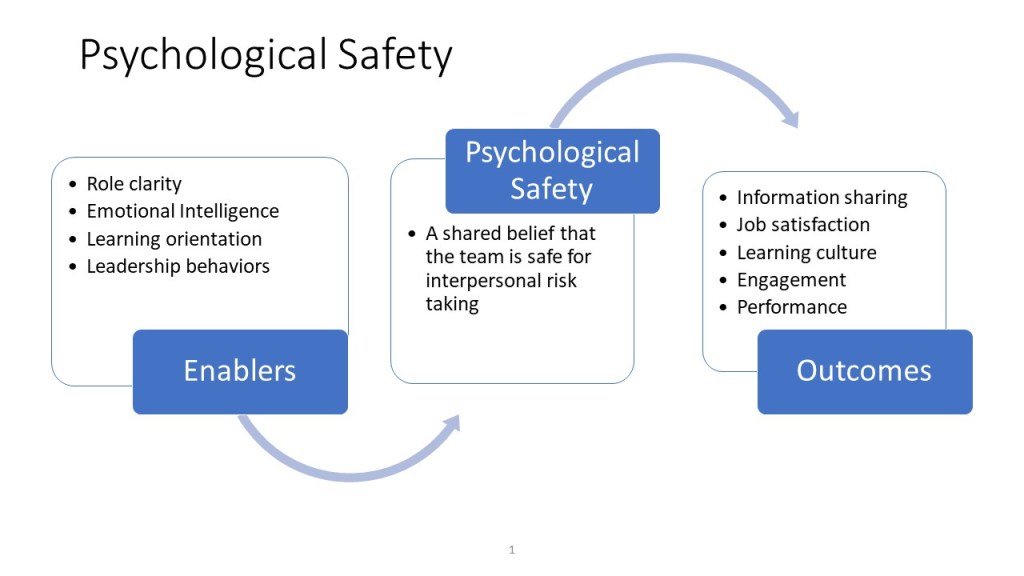
Psychological safety enables individuals to behave authentically, take risks and express themselves candidly. In the workplace, psychological safety captures how comfortable employees feel as team members. Timothy Clark gives four elements of psychological safety:
Psychological safety, Reflexivity and a Learning Culture
Reflexivity is the extent employees reflect upon the work tasks they have completed and identify ways of improving performance – it is the information-processing activity. Using reflexivity, employees develop a better sense of what is done, why and how, and can adjust their behaviors and actions accordingly. Reflexivity is a powerful process that can drive performance in a learning culture that requires psychological safety to flourish. When employees reflect upon their work tasks, they need to have a deeper and better understanding of what they have done, what was done well and not as well, why they engaged in these behaviors, and changes and adaptations needed to result in better performance. People are not likely to engage in reflexivity unless they feel psychologically safe to take interpersonal risks, speak up, and admit failures without feeling uncomfortable or fearful of status and image loss.
Psychological Safety is the magic glue that makes transformative learning possible. Psychological Safety and reflexivity enables a problem solving culture.
Bibliography
Clark, T.R. 2020. The 4 Stages of Psychological Safety. Oakland, CA: Barrett-Koehler
Edmondson, A. 2018. The Fearless Organization: Creating Psychological Safety in the Workplace for Learning, Innovation and Growth. Hoboken, NJ: John Wiley and Sons
West, M.A. 1996. Reflexivity and work group effectiveness: A conceptual integration. In M.A. West (Ed.), Handbook of work group psychology. Chichester, UK: Wiley.
Zak, P.J. 2018. “The Neuroscience of High-Trust Organizations.” Consulting Psychology Journal: Practice and Research 70(1): 45-48
Our organizations are either growing or they’re dying. The key thing that drives growth in organizations is when their employees are learning. To strengthen our organizations, our teams, ourselves we need to ensure our culture allows people to be exposed to new and challenging opportunities to learn.
We learn constantly. Most of that learning, however, is incremental, improvements that build on what we already know and do. We expand our knowledge and refine our skills in ways that strengthen our identities and commitments. This process sharpens competence and broadens expertise, and is key in building subject matter experts.
Incremental learning can allow people to grow in a workplace until they reach the limit on their resources for new learning – think of it as an S-curve. Eventually, there isn’t enough opportunities to learn. Furthermore, learning that broadens our expertise is valuable, but it is not enough. Incremental learning does not alter the way we see others, the world, and ourselves.
The second type of learning is called transformative, it changes our perspectives laying the foundations for growth and innovative leaps.
Both kinds of learning are necessary. Incremental learning helps us deliver, while transformative learning helps us develop. Both are necessary, but too often we allow incremental learning to be haphazard and make no space for transformative learning.
In both cases we need to build spaces to drive learning.
We often see incremental in our training programs, while transformative is critical for culture building.
Boyatzis E., & Akrivou, K. (2006). The ideal self as the driver of intentional change. Journal of Management Development,25(7), 624-642. doi:10.1108/02621710610678454
Brown D., & Starkey, K. (2000). Organizational identity and learning: A psychodynamic perspective. The Academy of Management Review,25(1), 102. doi:10.2307/259265
Mezirow, J. (1991). Transformative dimensions of adult learning. San Francisco, CA: Jossey-Bass.
Petriglieri, G., Petriglieri, J. L., & Wood, J. D. (2017). Fast tracks and Inner Journeys: Crafting Portable selves for contemporary careers. Administrative Science Quarterly,63(3), 479-525. doi:10.1177/0001839217720930
Gemba, as a term, is here to stay. We’re told that gemba comes from the Japanese for “the actual place”, and people who know more than me say it probably should translate as “Genba” but phonetically it uses an “m” instead and as a result, it’s commonly referred to as gemba – so that’s how it is used. Someday I’ll see a good linguistic study of loan words in quality circles, and I have been known to fight against some of the “buzz-terminess” of adopting words from Japanese. But gemba is a term that seems to have settled in, and heck, English is a borrowing language.
Just don’t subject me to any more hour-long talks about how we’re all doing lean wrong because we misunderstood a Japanese written character (I can assure you I don’t know any Japanese written characters). The Lean practitioner community sometimes reminds me of 80s Ninja movies, and can be problematic in all the same ways – you start with “Enter the Ninja” and before long it’s Remo Williams baby!
So let’s pretend that gemba is an English word now, we’ve borrowed it and it means “where the work happens.” It also seems to be a noun and a verb.
And if you know any good studies on the heady blend of Japanophobia mixed with Japanophilia from the 80s and 90s that saturated quality and management thinking, send them my way.
I think we can draw from ethnography more in our methodology.
The Importance of the Gemba Walk
Gemba is a principle from the lean methodology that says “go and see” something happening for real – you need to go and see how the process really works. This principle rightly belongs as one of the center points of quality thinking. This may be fighting words but I think it is the strongest of the principles from Lean because of the straightforward “no duh” of the concept. Any quality idea that feels so straightforward and radical at the same time is powerful.
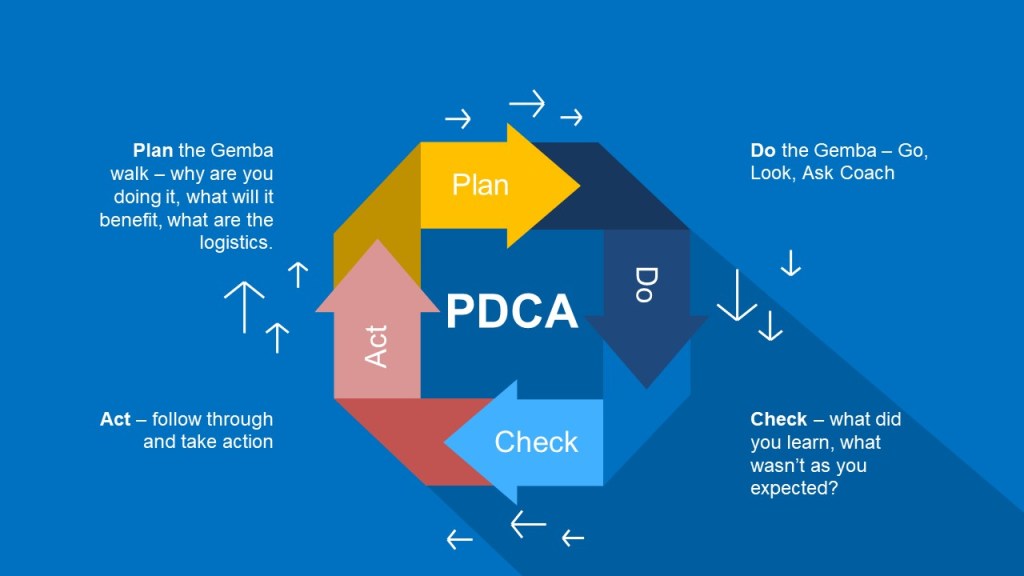
You can think of a gemba through the PDCA lifecycle -You plan, you do it, you decide on the learnings, you follow through.
Gemba seen through the PDCA lense
This is all about building a shared understanding of problems we all face together by:
Observation of specific issues where things don’t go as intended, listening to the people who do the work.
Discussion of what those issues mean both in the details of operations but also on a wider strategic level.
Commitment to problem solving in order to investigate further – not to fix the issue but to have the time to delve deeper. The assumption is that if people understand better what they do, they perform better at every aspects of their job
Gemba walks demonstrate visible commitment from the leadership to all members of the organization. They allow leadership to spread clear messages using open and honest dialogue and get a real indication of the progress of behavioral change at all levels. They empower employees because their contributions to site results are recognized and their ideas for continuous improvements heard.
Conducting a Successful Gemba Walk
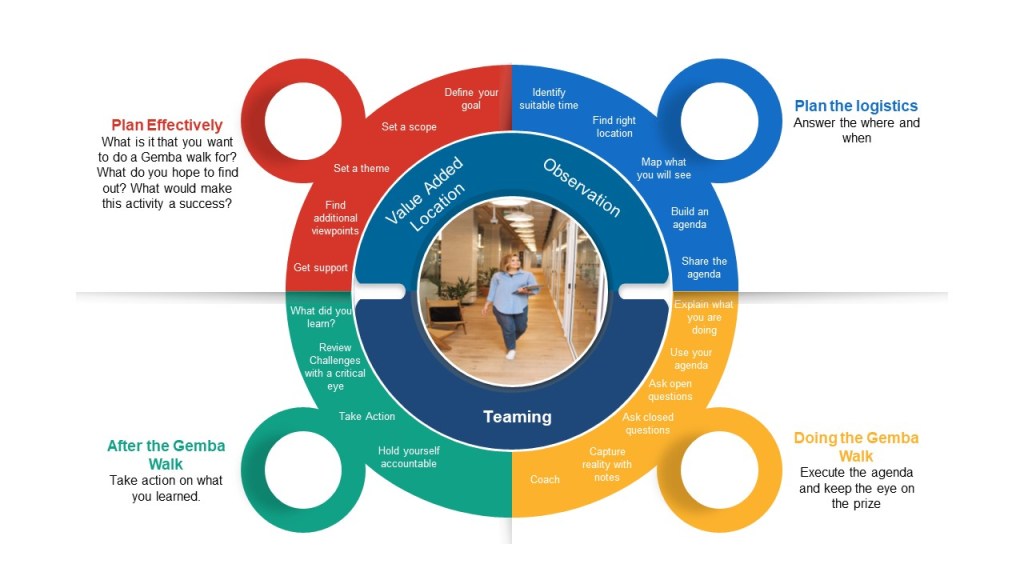
Elements of a Successful Gemba
Plan Effectively
Define your goal
What is it that you want to do a gemba walk for? What do you hope to find out? What would make this activity a success? A successful walk stresses discovery.
Set a scope
Which areas will you observe? A specific process? Team? This will allow you to zoom into more detail and get the most out of the activity.
Set a theme
What challenges or topics will you focus on? Specific and targeted gemba walks are the most effective. For example, having a emba focusing on Data Integrity, or area clearance or error reduction.
Picking the right challenge is critical. Workplaces are complex and confusing, a gemba walk can help find concrete problems and drive improvement linked to strategy.
Find additional viewpoints
Who else can help you? Who could add a “fresh pair of eyes” to see the big questions that are left un-asked. Finding additional people to support will result in a richer output and can get buy in from your stakeholders.
Get support
Bring visibility and sponsorship for your gemba. Ensure all stakeholders are aware and on board.
Plan the Logistics
Identify Suitable Time
Find a suitable time from the process’ perspective. Be sure to also consider times of day, days of the week and any other time-based variations that occur in the process.
Find right location
Where should you see the process? Also, do you need to consider visiting multiple sites or areas?
Map what you’ll see
Define the process steps that you expect to see.
Build an agenda
What parts of the process will you see in what order? Are there any time sensitive processes to observe?
Share that agenda
Sharing your agenda to get help from the operational owner and other subject matter experts.
Doing the Gemba Walk
Explain what you are doing
Put people at ease when you’re observing the process.
When you are on the walk you need to challenge in a productive yet safe manner to create a place where everyone feels they’ve learned something useful and problems can be resolved. It pays to communicate both the purpose and overall approach by explaining the why, the who, and the when.
Use your agenda
Keep some flexibility but also make sure to cover everything.
Open discussion and explore the process challenges.
Ask closed questions
Use this to check your understanding of the process.
Capture reality with notes
Take notes as soon as possible to make sure you recall the reality of the situation.
Coach
As a coach, your objective is not to obtain results – that’s the person you’re coaching’s role – but to keep them striving to improve. Take a step back and focus on dismantling barriers.
What did you learn
What did you expect to see but didn’t? Also, what did you not expect to happen?
The ask questions, coach, learn aspect can be summarized as:
Visualize the ideal performance with your inner eye
Spot the specific difficulty the person is having (they’ll tell you – just listen)
Explain that (though sometimes they won’t want to hear it)
Spell out a simple exercise to practice overcoming the difficulty.
After the Gemba Walk
What did you learn?
Were challenges widespread or just one offs? Review challenges with a critical eye. The best way I’ve heard this explained is “helicopter” thinking – start n a very detailed operational point and ascend to the big picture and then return to the ground.
Resolve challenges with a critical eye
Define next steps and agree which are highest priority. It is a good outcome when what is observed on the gemba walk leads to a project that can transform the organization.
Take action
Follow-through on the agreed upon actions. Make them visible. In order to avoid being seen only as a critic you need to contribute firsthand.
Hold yourself to account
Share your recommendations with others. Engage in knowledge management and ensure actions are complete and effective.
Key points for executing a successful GEMBA
Gemba Walks as Standard Work
You can standardize a lot of the preparation of a gemba walk by creating standard work. I’ve seen this successfully done for data integrity, safety, material management, and other topics.
Build a frequency, and make sure they are often, and then hold leaders accountable.
Who
Best Practice Frequency
Minimum Recommended Frequency
First line supervisors
Each shift, multiple times
Each shift
Team leaders in individual units
Daily covering different shifts
2 per week
Unit/Department heads
1 per day
1 per week
Leadership team
1 per day
1 per month
Internal customers and support (e.g. purchasing, finance, HR)
1 per month
1 per quarter
Frequency recommendation example
Going to the Gemba for a Deviation and Root Cause Analysis
These same principles can apply to golden-hour deviation triage and root cause analysis. This form of gemba means bringing together a cross-functional team meeting that is assembled where a potential deviation event occurred. Going to the gemba and “freezing the scene” as close as possible to the time the event occurred will yield valuable clues about the environment that existed at the time – and fresher memories will provide higher quality interviews. This gemba has specific objectives:
Obtain a common understanding of the event: what happened, when and where it happened, who observed it, who was involved – all the facts surrounding the event. Is it a deviation?
Clearly describe actions taken, or that need to be taken, to contain impact from the event: product quarantine, physical or mechanical interventions, management or regulatory notifications, etc.
Interview involved operators: ask open-ended questions, like how the event unfolded or was discovered, from their perspective, or how the event could have been prevented, in their opinion – insights from personnel experienced with the process can prove invaluable during an investigation.
You will gain plenty of investigational leads from your observations and interviews at the gemba – which documents to review, which personnel to interview, which equipment history to inspect, and more. The gemba is such an invaluable experience that, for many minor events, root cause and CAPA can be determined fairly easily from information gathered solely at the gemba.
The biggest thing I am working on is situational humility. How do I successfully balance the subject matter expertise my organization needs with the humility to truly lead? It is clear that such humility is critical to building psychological safety, and psychological safety is critical to building innovative teams.
Amy Edmondson’s powerful talk on psychological safety and teams
For most of my career I’ve been prized for my subject matter expertise, but there are huge limits, no one can know everything, so I am cultivating the following behaviors in my practices.
To build Humility do this
Which means
And I do this
Know what you don’t know
Resist “master of the universe” impulses. You may yourself excel in an area, but as a leader you are, by definition, a generalist. Rely on those who have relevant qualification and expertise. Know when to defer and delegate.
I have a list of key topics that are both in my space and overlap and individuals who involving in the discussion is critical.
I’ve created a “swear jar” for every time I say something like “I have an answer” and at this rate I’ll be taking a lot of people out for drinks by the time this pandemic is over. It is all IOUs right now because I don’t remember the last time I used cash and I don’t think I’ve seen a dollar bill in 11 months.
Resist falling for your own publicity
We all put the best spin on our success — and then conveniently forget that the reality wasn’t as flawless.
This is an interesting one for me. Having joined a new company 10 months ago it has been important to avoid the spin on my joining, and to not exacerbate it.
I’ve taken to keeping a list of problems and who is the right people who are not me that can solve them.
Never underestimateothers
The world is filled with other hard-working, knowledgable, and creative professionals
I purposely look for opportunities to meet with folks at all levels and ask them to collaborate.
Embrace and promote a spirit of service
Focus on finding ways to help others to succeed
I’m all about the development. Crucial for me here is stepping back and letting others lead, even if its more work for me as I spend more time coaching and mentoring than would actually take to do the job. But lets be honest, can’t and shouldn’t do anything.
Listen, even (no, especially) to the weird ideas
Only when you are not convinced that your idea is or will be better than someone else’s do you really open your ears to what they are saying. But there is ample evidence that you should: the most imaginative and valuable ideas tend to come from left field, from some associate who seems a little offbeat, and may not hold an exalted position in the organization.
I love the weird, though maybe most when they are my weird ideas. Been working to strengthen idea management as a concept and practice in my organization.
Be passionately curious
Constantly welcome and seek out new knowledge, and insist on curiosity from those around you. Research has found linkages between curiosity and many positive leadership attributes (including emotional and social intelligence). Take it from Einstein. “I have no special talent,” he claimed. “I am only passionately curious.”
I’m a voracious reading machine, its always been a central skill.
How I am trying to teach others to be curious and turn it to their advantage.



 Investigations of a Dog