ASQ 2022 WCQI Day 3 (second half)

Making a Quality Leader: From Theory to Practice

Always a pleasure to hear from the Human Development and Leadership (HDL) technical community. Their competency framework is a great tool that can help many a quality leader as they struggle to build the leadership competencies necessary to strive towards excellence.
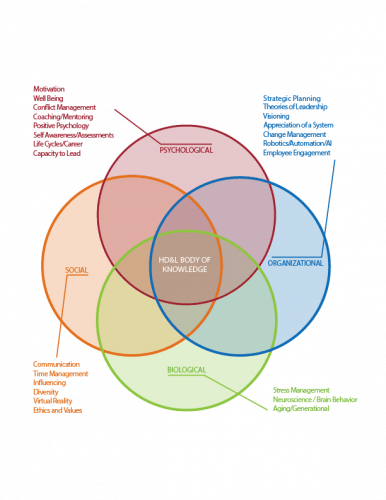
Human Development & Leadership Body of Knowledge Model

Having done a lot of comptency frameworks I think the HDL has done a good job building theirs out as a progressive framework. I think a challenge is how do we make it easy to scale up to this more detailed HD&LBok from the QBok, and occasionally the same concept can be discussed a few different ways across different technical community boks and this lack of consistency is a detriment.

Stressing practice as the core part of a competency framework. A good conversation at my table was how often these competencies move back a little as we change roles and organizations.

No competency framework is valuable without a good development plan and the workshop did a great job at introducing how to use one.

Honor Deming’s 14 Points Through Modular Kaizen by Grace Duffy

Grace has always been a mentor who always brings thought provoking topics to the society.
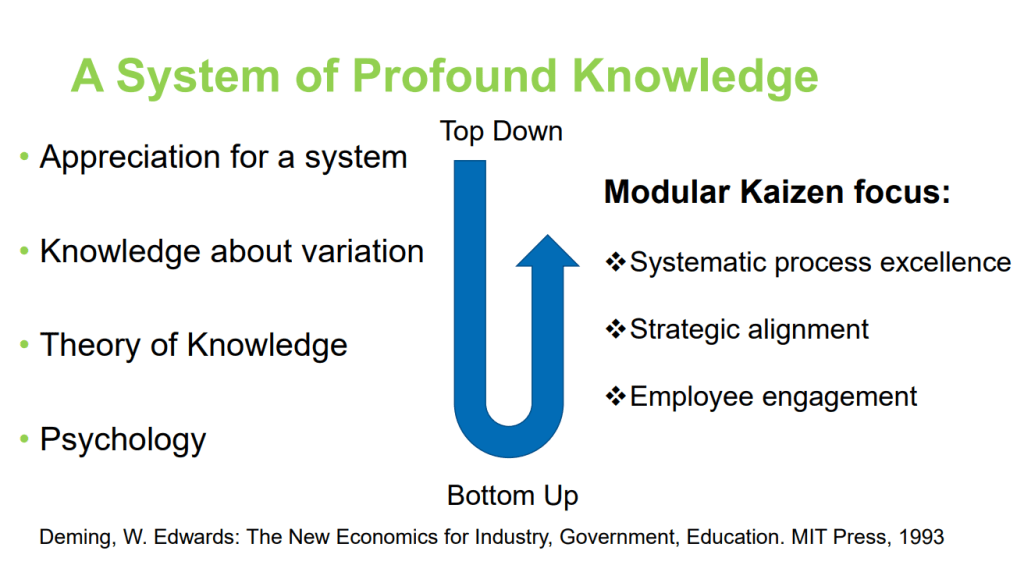
Goes without saying that I’m a fan of the 14 points and the System of Profound Knowledge. I’ve written a lot about Driving out Fear. It ties in a lot of my thoughts about how much of what is happening now in organizational excellence is the evolution from these 14 points.

Looking to the past is an important part of building the future. I think Grace did a great job of respecting the past to drive innovation and new ideas within the quality practice. I loved the care for our past, and the urge to challenge the future in the audience. She really avoided the tendency in some quality circles to obsess about the past (Toyota nuts I am thinking of you) and thus trap the present and stifle the future.

Grace does an amazing job being a pillar of the quality community while still being an iconcolast. When you see her name on the conference session list I always recommend taking the time to attend.

Quality Past & Present

I found most of the videos to be a little personality driven instead of insightful pieces of history. I would hope this session would draw from our history in exciting ways, that was not realized. However the ending charge to create solutions instead of just solving problems is a pivotal one.

2022 Business Meeting

This business meeting drives home the struggle the ASQ has on figuring out what comes next.

As an organization we do not understand what a digital organization looks like. Only 2000 users of the app in the US is embarrassing. Teens can create apps with 100 times more users.

It is nice to admit that actively listening to the members is crucial. I look forward to that consistently happening. We don’t always do a good job of using the tools at the heart of the QBok.

Finances are still rocky, though the Federal Stimulus has left the ASQ in an okay place.

I was actually shocked to hear the chair of the ASQ say it is hard to have metrics for meeting strategic goals. We have entire methodologies dedicated to that.

There are a lot of challenges ahead of us.
WCQI 2022 Day 3 (first half)

Heather McGowan

I am a huge fan of The Adaptation Advantage: Let Go, Learn Fast, and Thrive in the Future of Work by Heather E. McGowan and Chris Shipley. So I was thrilled when I heard Heather was going to speak. I could write for ever, but you are much better off listening to her yourself.

One of the things I think the quality community is bad about is forming connections with researchers who are basically researching topics at the heart of quality. Heather is a great example of this, she should see herself as a fellow traveler, but I do not think she does. Feels like another post.

Anticipating Disruption in the Supply Chain: Rethinking Business Continuity by Russell Snyder

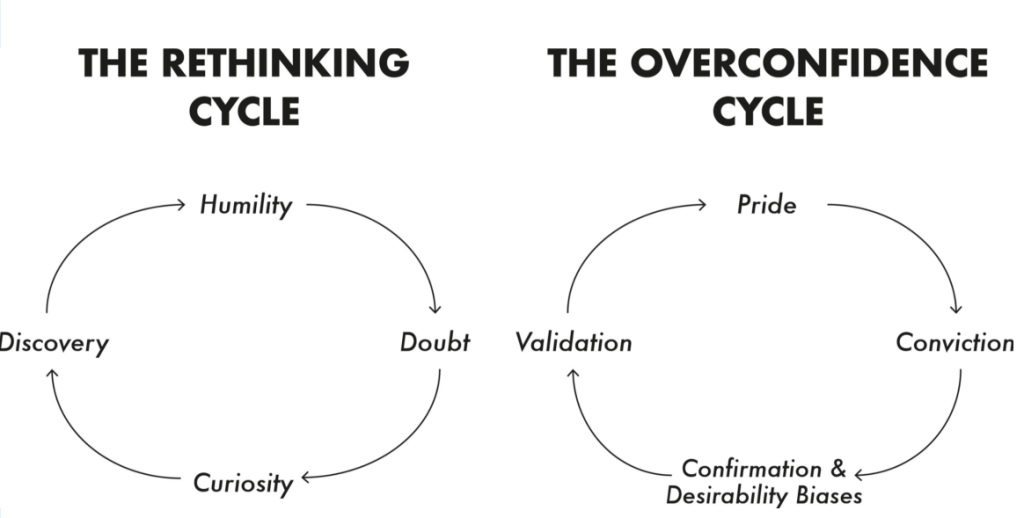
I chose to come to this session because I was really curious about a practical application of Adam Grant’s model from Think Again.

And my bingo card quickly gets another spot marked off by the speaker extolling Steve Jobs as some sort of good role model.

The central point that in times of constraint everything is a quality issue is an important one for us all to ponder.

Does a good job discussing the rethinking cycle vs the overconfidence cycle, and other parts of Grant’s rethinking model.

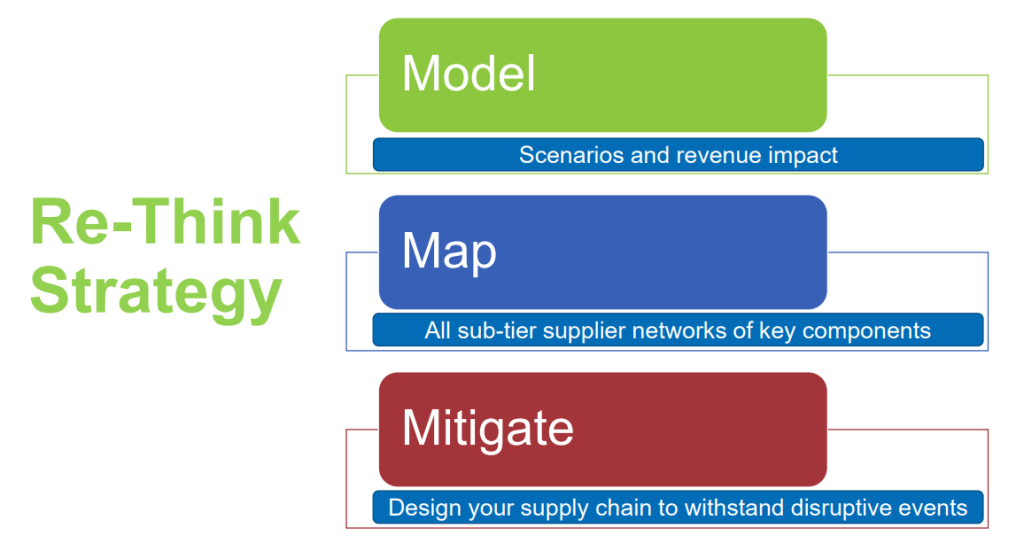
The rethink approach is Model (scenarios and revenue impact); Map (all sub-tier supplier networks of key components); and, Mitigate (design your supply chain to withstand disruptive effects).

Very much aligned with a risk-based approach. The examples he discusses were pretty valuable shares relevant across many industries. I am already adapting several of his slides to an ongoing project I have.

I love seeing Grant’s work percolate into quality thinking. Applying it to supply chain disruptions was as fascinating as I was hoping it would be.

Bingo Card at Half-day

My pessimistic self is surprised I’m not complete yet. Well, one more day to go!

Design & Construction Technical Community Body of Knowledge

Based on the member leaders day on Sunday (I need to finish that post, so may thoughts) I was really curious how a body of knowledge was developed recently by a technical community.

A body of knowledge for a broad area like construction is interesting. You need to make it specific enough to be relevant to construction but broad enough to avoid niches. The speakers spoke passionately about this balancing act.

I wish this had gone deeper. I’m really fascinating to understand how we talk about commonalities likerisk based auditing or knowledge management differently in this body-of-knowledge. It is really that quesiton of application.

ASQ Insights on Excellence Tool

I am so excited to see this tool out in the world. I had the priviledge of providing a few ideas to it a while back, so seeing it in use, at the conference was just amazing.

WCQI 2022 Day 2

Ugwem Eneyo’s keynote this morning was interesting and the type of inspiring keynote about the importance of quality that I love to hear.

QMS for Data-Driven Decision-Making

Charles Cox starts up being a little by blurring the differences between a Quality Management System (QMS) and an electronic Quality Management System (eQMS), but quickly solidified his topic of how to foundational build digital data into the QMS in an iterative approach for decision data decision-marking and growth.

I appreciate a quality-function-deployment (QFD) approach, a tool-set that I feel folks take a little for granted and don’t utilize enough. Charles co-wrote a useful text on QFD back in the 90s, but I really haven’t read a lot from him in recent years, so this presentation is an excellent example of a practical application, updated for today.

The focus on thinking today about the needs of the future is one that we cannot stress enough. Future sense-making is a core competency for quality professionals and one we do not spend enough time discussing and performing deliberative practice on.

Aligning Organizational Structure with Quality 4.0 by Jane Keathley

Jane co-wrote a thought provoking book on organizational design – Structuring Your Organization For Innovation.

I’m always surprised when folks refer to open office plans in a positive light. The research is pretty definitive on the destructive aspects here.

Thinking about the various organization chart structures is key. In pharma, the regulations are pretty clear on the need to do this, I think a lot of organizations struggle on how to build their organizations for quality. Color me a bit pessimistic here, but I want to see network structures work but have not had the experience.

The four criteria or organizational structures influence on performance: formality, hierarchy, complexity, technology.

Provides three perspectives for organization design: Strategic, Operational, Tactical.

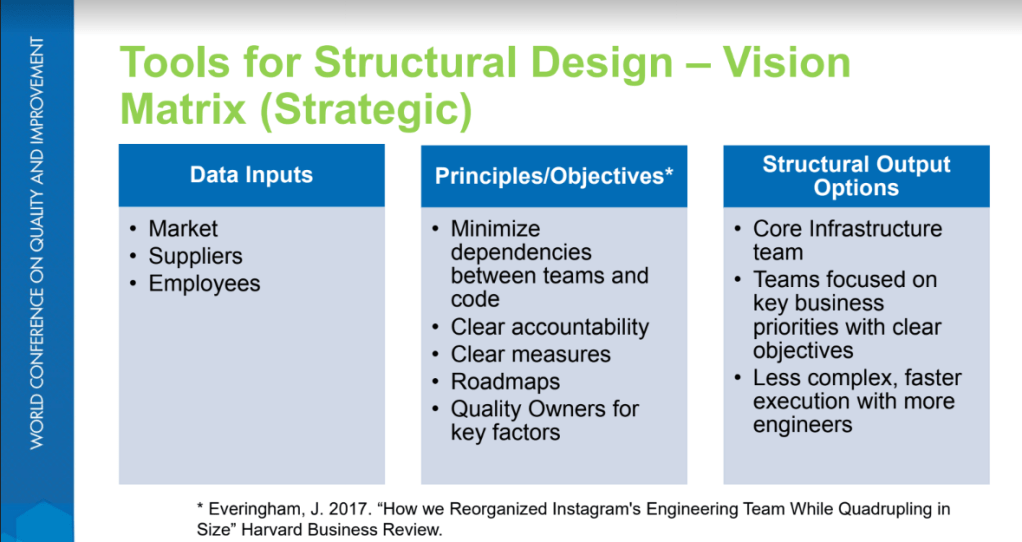
I think there could have been a whole session just on the vision matrix. Same for organizational network analysis. Both of these are tools I do not think enough quality folks are comfortable with. Would make a good workshop.

tratVision Matrix – the Strategic Perspetive

And I got a free book for being a know-it-all about holacracy, which means I now have 2. I’ll keep this copy because I’ll get it signed, and pass off the copy at home.

I should put McKinsey on my junk science bingo card. Support for a criminal enterprise seems to be pretty garbage.

Key message – push decision making and autonomy down as low as possible.

And then I spoke

Good turn out. I was happy with the volume of questions.

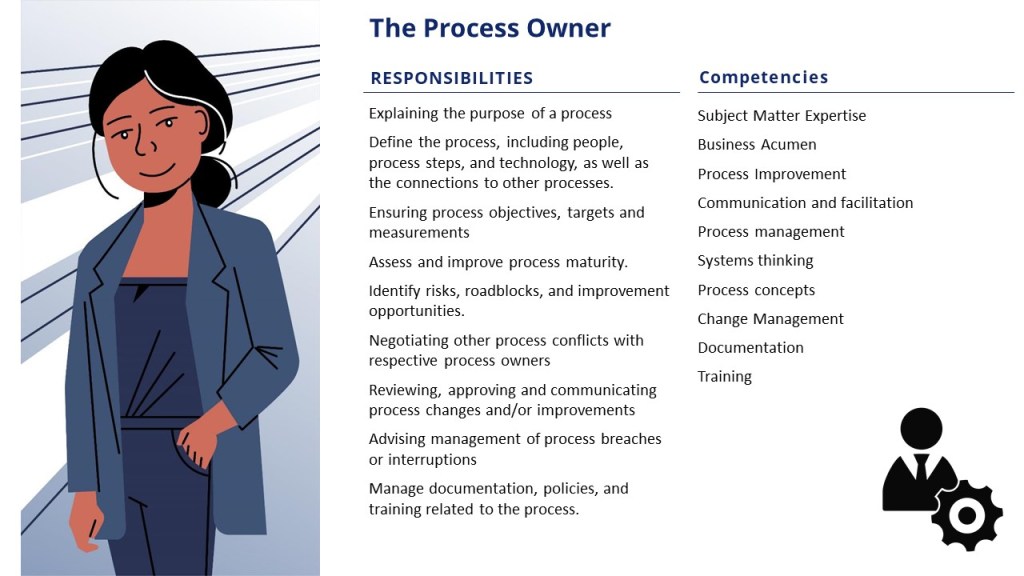
Enabling the Process Owner to Drive Improvement

The process owner is a central part of business process management yet is often the one we take for granted. In this session, the speaker will share through case study how organizations can build strong process owners and leverage them to drive improvement in a highly regulated environment. Participants in this session will learn: ~how to identify process owners and competencies for success, ~how to build a change management program that leverages process owners as the guiding coalition, and ~how to create and execute a training program for process owners

2022 ASQ WORLD CONFERENCE ON QUALITY & IMPROVEMENT

The presentation I gave at the 2022 World Conference on Quality & Improvement.

Is There Equity in Out of Office?

I think many of us are considering what work looks like, grappling with a return to offices, hybrid situations, and being fully remote. I think the media focuses rather extensively on companies like Apple, where a good chunk of the workforce seems to be up-in-arms about a mandatory return to the office.

In the pharma world, things are a little more complicated, especially as it applies to the quality profession.

At the heart sits the question, what sort of labs and manufacturing facilities do you have on site? This physical presence requires that certain employees be on-site. Which in most pharmas makes a bundle of those who must be on-site, and those who do not need to be on-site.

I understand the desire for those who can work remotely to want to work remotely. There are a lot of good reasons for working remotely, and I personally chose a company that was purely remote for a chunk of those.

But, and this is a big but, what does equity look like?

Take for example an average quality department. It is broken down into those who support labs, manufacturing, clinical trials and post-marketing surveillance (for simplicity). You thus have in the same department individuals who must be always on-site; who need to show up a few days a week; and those who can do their job perfectly well remotely. To complicate matters you might even have a big chunk of your partners (all those clinical trial, medical affairs, pharmacovigilance folks) that have no attention of coming back to the office.

So, what does equity look like? How do you treat these three camps? How to you compensate those who come into the office, that have commutes on top of their days that co-workers do not? How do you ensure everyone has equal opportunity to be seen, heard and participate? What does this organization look like?

I thnk this is one of the major challenges for quality organizations moving forward. I do not think there is one size fits all, and there is no easy answer.