Accountability does not go away to be Psychologically Safe

A common and distorted application of psychological safety is that it is somehow a shield from accountability. Non-performing employees tend to invoke it as an excuse for poor performance, insisting that a focus on psychological safety means valuing people and building relationships. That’s true, but stretching the premise, they claim that we should give them a pass when they don’t perform.

The flawed logic seems to be along the lines of because we may have used fear and intimidation, command and control, and manipulative and coercive tactics with people in the past, in an attempt to hold folks accountable, we must shed the artifacts that drive accountability in order to have an environment of psychological safety.

In my experience, this is especially prevalent when discussing metrics around overdue quality systems records and training. How to discuss what is late, can you even publish a list of folks with overdue training?

I want to be very clear, psychological safety is not a kind of diplomatic immunity from having to deliver results. It is not a shield from accountability.

Being held accountable can be looked at as transparency in progress. Psychological safety allows us to be vulnerable and to trust that the organization will take the problems seriously and address them.

Culture of Quality Initiatives

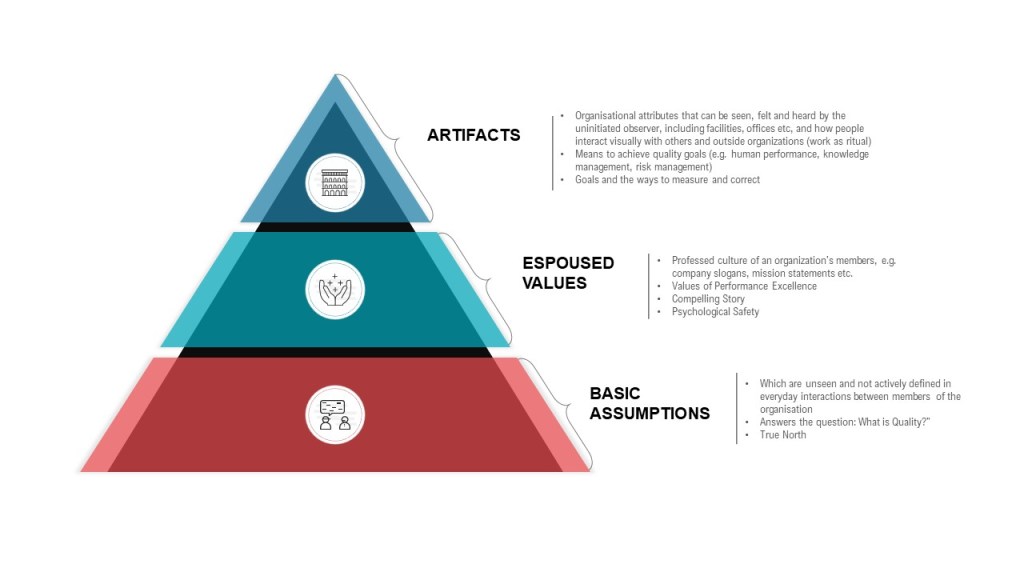
At the heart of culture is a set of behaviors and beliefs, that indicate what is important to the organization and drive all decision-making. Culture, and weaknesses within it, drive the root cause of many problems, and improving quality culture is an essential part of continuous improvement.

Culture is often the true reason for the behavior of people within an organization and it can often be deeply unconscious and not rationally recognized by most members. These ideas are so integrated that they can be difficult to confront or debate and thus difficult to change.

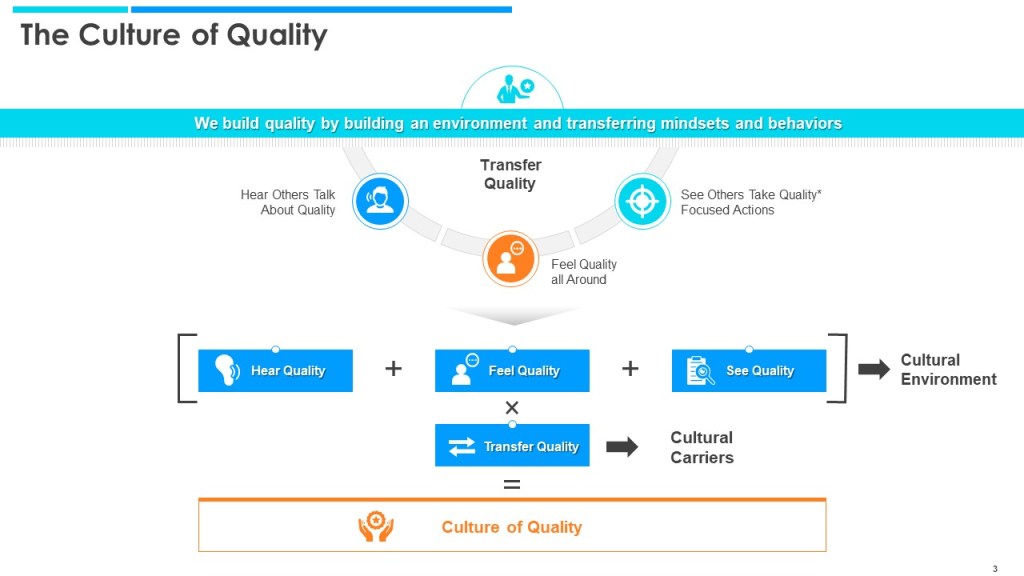
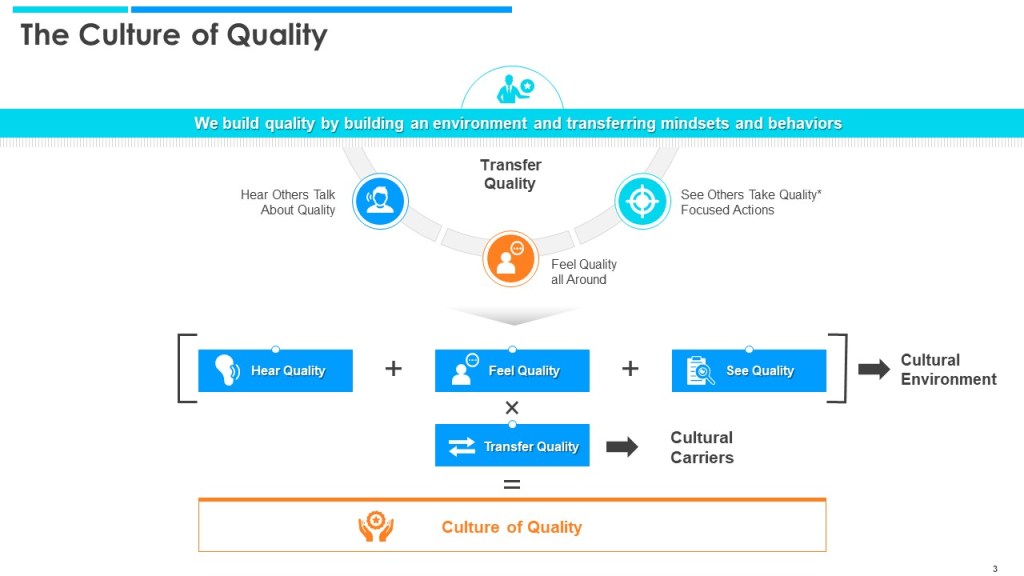
How we Build Quality

A critical part for improving culture is being able to measure the current situation. A great place to start is using a survey-based to gather input from employees on the current culture of quality. Some of the topic areas can include:

Some of the feedback methods to utilize once you have a baseline can include:

Feedback MethodWhen to use
Focus GroupsYou want detailed feedback on a number if issues AND employees are generally willing to speak on the record
Short, targeted surveysYou have a number of close-ended findings to test AND your organization is not suffering survey fatigue
Informal conversationsYou want to gain context of a few data points AND you have a trusted circle

As you build improvements, you will introduce better metrics of success.

Once you a good set of findings select 2-3 key ones and design experiments.

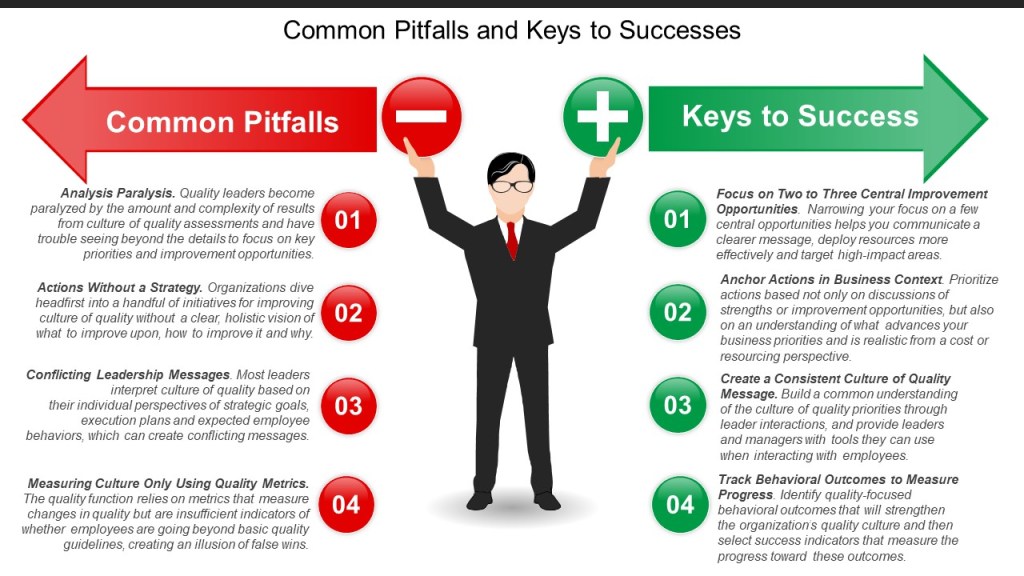
Pitfalls and Keys to Success for Experiments in Quality Culture
Experiment for Success

Failing the Culture We Build is a Moral Injury

We as organization leaders are striving to build a high performing organization that might look like this:

High-Performance Cultures
Leaders are skilled, admired, and build organizations that excel at results and at taking excellent care of their people and their customers
Clear and compelling vision, mission, goals, and strategy
Core values drive the culture and are used in decision making
Committed to excellence, ethics, and doing things right
Clear roles, responsibilities, and success criteria, and strong commitment to engaging, empowering, and developing people
Positive, can-do work environment
Open, candid, straightforward, and transparent communication
Teamwork, collaboration, and involvement are the norm
Emphasis on constant improvement and state-of-the-art knowledge and practices
Willingness to change, adapt, learn from successes and mistakes, take reasonable risk, and try new things
Attributes of a High Performing Culture

There is a dark underbelly to aspiring to this, leaders who either fail to meet these standards or demonstrate hypocrisy and “do-as-I-say-not-as-I-do” attitudes. Organizations that aspire, can easily be hoisted by their own petard, and there is an excellent term for this “Moral Injury.”

Moral injury is understood to be the strong cognitive and emotional response that can occur following events that violate a person’s moral or ethical code. Potentially morally injurious events include a person’s own or other people’s acts of omission or commission, or betrayal by a trusted person in a high-stakes situation. For example, look at healthcare staff working during the COVID-19 pandemic who experienced a moral injury because they perceive that they received inadequate protective equipment, or when their workload is such that they deliver care of a standard that falls well below what they would usually consider to be good enough. This is causing a mass exodus of employees.

Give some thought to how to resolve moral injuries when they happen. Include them in your change plan and make them sustainable. They can happen, and when they do they will cripple your organization.

Pump up the Fun!

People learn and solve problems when they are having fun, stress is low, and the environment encourages discovery. A core part of psychological safety.

I’ve talked before about bringing playfulness to work, about exuberance and excitement. These personal approaches can be turned to the wider organization.

Quality as a profession – not so known for fun. So we need to look for opportunities for fun, whether in our training programs, through initiatives like Quality Days, or any other place we can find it.

Here are some ideas for organizing fun to drive a quality message.

Activity Name

Description

Cost required

Effort required

Impact/ Learning Opportunity

Learning Outcome

Video Competitions

Contest of team videos with stories about how they transfer quality or outline continuous improvement projects. Teams may also record a best practice to be shared with the organization.

Medium

High

High

-Video and poster viewership helps transfer quality behaviors and values to others.

-Employee-created messages are more credible, giving them a stronger impact on transferring the culture of quality throughout the organization.

Poster Signing

Teams can sign a poster to make a commitment to quality. They can hold a contest for designing the best Quality Day poster.

Low

Low

Medium

Employee Idea Demonstrations

Make peer idea generation (quality ideas) visible to all employees through the use of regularly refreshed public “progress boards” and idea showcases where projects are publicly evaluated.

Low

Medium

High

-Shows employees that quality focus is something that peers around them prioritize and benefit from.

-Provides employees a benchmark for what behaviors are expected from them and encourages the ones whose ideas are recognized.

Quality Awards and Recognition

Publicly recognize individuals and teams with a trophy/certificate for consistently embodying quality in their work. Awarding behaviors, not just outcomes, increases employee engagement.

High

Medium

High

-Helps engage employees in quality improvement efforts by demonstrating that despite other objectives and priorities, quality remains important to leaders.

Client/ Customer Visit

Invite your clients/customers to visit and talk about their experience with the product/service and the importance of quality.

High

High

High

-Helps employees understand how a high-quality mindset avoids customer-facing mistakes and leads to greater customer satisfaction.

Games

Word-Play Games: A group of employees can play games like Scrabble and Bingo with quality terminology.

Low

Low

Medium

-Quick games help employees become aware of quality terms, tests, standards in a fun way.

Trivia Games: Employees can play games such as “Jeopardy” and beer pong with quality standards, tests, tools to educate themselves.

Low

Low

Medium

Articles on Quality

Share blogs and articles on quality.

Low

Medium

Medium

-Increases quality’s visibility across the organization and promotes awareness.

Quality Quiz Competition

Employees can take quizzes on quality-related concepts.

Low

Medium

High

-Tests employees’ awareness and creates a healthy competition to know more.

Quality Merchandise (swag)

Distribute T-shirts, mugs, badges with quality quotes to employees. Reward contest winners with goodies such as chocolates with quality phrases written on them.

High

High

Medium

-Provides more visibility to quality and imparts a sense of pride in employees.


Leveraging fun is a good way to help build a culture of quality.

Building moments of planned fun is work, and should be part of the overall Quality Plan, with activities and milestones clearly marked and executed towards.

Biotech Employees in Short Supply, a rant

The Boston Globe reported this past weekend “In the region’s booming biotech industry, workers are in short supply“, which is both good news and bad for me.

Good news is that my career prospects are always good.

Bad news is that I am hiring and building teams within quality.

also affect the quality of work as key positions become harder to fill and lower-level workers jump from company to company in search of a better compensation package.

For compensation package, read total cash. Sure there can be a difference on how good other benefits can be, but they all kind of get blurred together and I don’t think I noticed any difference between benefits packages until I went to a small startup, and I definitely knew what I was getting into there. The article later goes on to say some biotech is starting to offer some of the benefits seen in more computer-driven fields, but maybe folks should pay attention to how that is usually a trad to entice people into longer hours.

Notice the emphasis on lower level workers. Read that for “We don’t really offer good development programs and the only way to get promoted in this title-obsessed field is go to another company.”

According to the latest report from industry association MassBio, nearly 85,000 people work in the state’s life sciences sector, up 55 percent from 2008.

And sometimes you feel like you know all 85k, and have worked with most of them.

“You can’t walk two blocks around Kendall Square without receiving a job offer,” said Jeanne Gray, chief people officer at Relay Therapeutics in Cambridge, only half-kiddingly. “I get the sense that a lot of candidates know the market is hot.”

And she only made it 2 blocks because of the pandemic. Seriously, this joke has existed for over a decade.

About 16.5 percent of life sciences employees in Massachusetts voluntarily quit their jobs last year

Wouldn’t you if you keep getting better offers, often unsolicited from other companies and your current company gave you a measly 2-4% raise? Companies want folks to stay, start giving real raises commensurate with the market increase. As a manager, looking someone in the eyes (or vaguely at their eyes because we are both on camera) and telling the best the company can do is a 3% raise is pretty damn problematic. Especially if the employee knows how to read a SEC filing (if your company is public make sure you read these at every update).

There’s also a sense that employees are easily swayed by “title inflation,” a phenomenon that occurs when people climb the corporate ladder faster by bouncing around.

This is a problem in a field where title is everything. Where people where their MDs and PhDs as holy vestments. Where title is tied to autonomy and with ability to influence. This is a complex systematic problem, and few companies are even thinking of how to fix it, and probably can’t because the problem starts at the C-suite. No the problem starts with the regulators. See it’s complex, it starts in a lot of places.

I’m doing my little experiment here, I went to a company started by two incredibly earnest guys who had just graduated from Brown. Is everything perfect? Never is. But the experiment itself is fascinating to participate in.

the talent pool has not matured enough to fill key areas from the C-suite and clinical development, all the way through to the commercial launch of products.

Yes, expertise matters. However, we prize years-in-seat more than we should sometimes, and we do not spend enough time building talent. And let’s be honest, that leads to a lot of director levels who do not know how to actually do the thing they are supposed to do beyond the last time they did it.

This is definitely a ranty post.