Quality Profession Needs to Stand for Quality in Public Practices

The Quality profession either stays true to its’ principles and ideals, or it is useless. We either support transparency and driving out fear or we don’t. Then we become the shallow, and dangerous crutch of demagogues and tyrants. One of the reasons Six Sigma has immense problems it still has not successfully grappled stems from how it is centered on the tyranny of Jack Welch.

The ASQ’s Government Division has taken a great step recently by endorsing the adoption of ISO/TS 54001:2019 “Quality management systems — Particular requirements for the application of ISO 9001:2015 for electoral organizations at all levels of government”.

We should be demanding elections built on the foundations of good quality. This should be part of electoral reform requirements at the Federal level. We need to oppose attempts to restrict voting. We need to drive fear out of our electoral system.

The United States is a signatory of international standards of policing. And yet no state follows those standards. Federal law needs to respect our treaty obligations and impose these standards, and we need to hold states and localities accountable.

As a quality professional I spend the day figuring out how to truthfully measure results. Yet an entire party has gleefully adopted lies and disinformation. I strive to democratize leadership, to build a culture of psychological safety. And yet all around us we see demagoguery.

Our workplace cultures are influenced greatly by external factors. We cannot hope to drive lies and fraud out of our systems, to create cultures of safety, to build excellence when all around us is a disregard for those standards. For this reason the quality profession must be political. It must standard for truth, for fair standards applied equitably. For driving out fear.
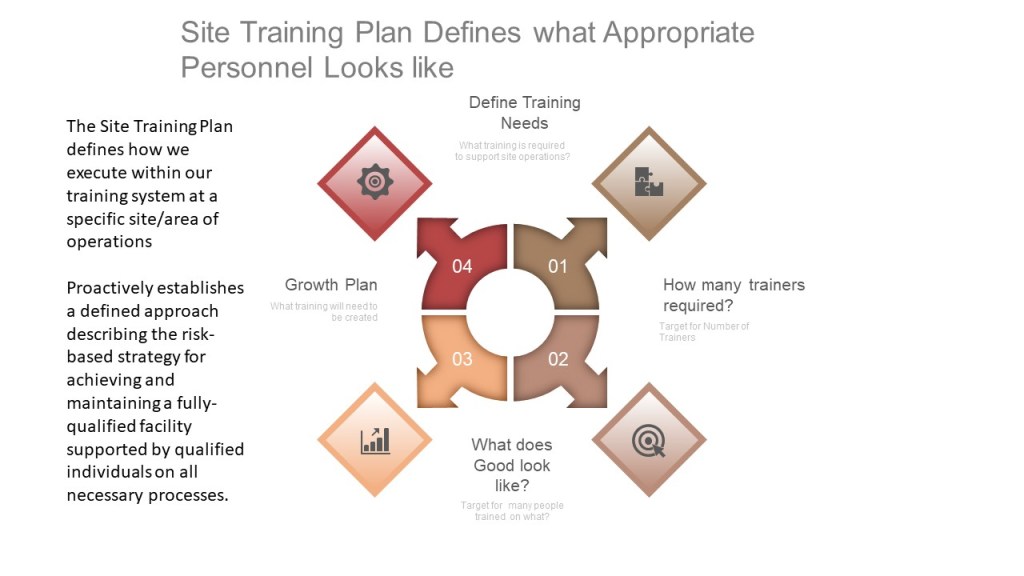
Site Training Needs

Institute training on the job.

Principle 6, W. Edwards Deming

(a) Each person engaged in the manufacture, processing, packing, or holding of a drug product shall have education, training, and experience, or any combination thereof, to enable that person to perform the assigned functions. Training shall be in the particular operations that the employee performs and in current good manufacturing practice (including the current good manufacturing practice regulations in this chapter and written procedures required by these regulations) as they relate to the employee’s functions. Training in current good manufacturing practice shall be conducted by qualified individuals on a continuing basis and with sufficient frequency to assure that employees remain familiar with CGMP requirements applicable to them.

(b) Each person responsible for supervising the manufacture, processing, packing, or holding of a drug product shall have the education, training, and experience, or any combination thereof, to perform assigned functions in such a manner as to provide assurance that the drug product has the safety, identity, strength, quality, and purity that it purports or is represented to possess.

(c) There shall be an adequate number of qualified personnel to perform and supervise the manufacture, processing, packing, or holding of each drug product.

US FDA 21CFR 210.25

All parts of the Pharmaceutical Quality system should be adequately resourced with competent personnel, and suitable and sufficient premises, equipment and facilities.

EU EMA/INS/GMP/735037/201 2.1

The organization shall determine and provide the resources needed for the establishment,
implementation, maintenance and continual improvement of the quality management system. The organization shall consider:

a) the capabilities of, and constraints on, existing internal resources;
b) what needs to be obtained from external providers.

ISO 9001:2015 requirement 7.1.1

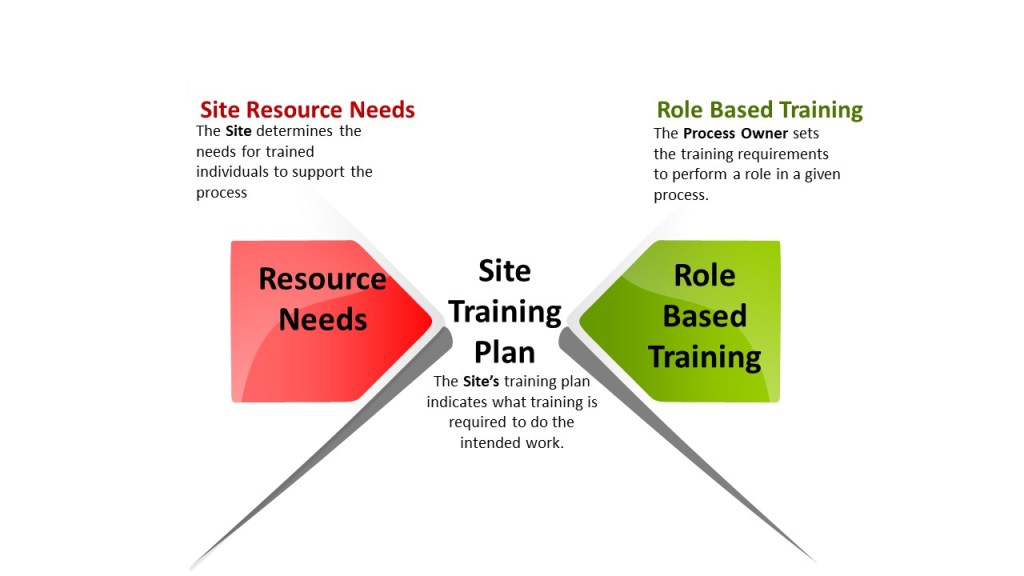
It is critical to have enough people with the appropriate level of training to execute their tasks.

It is fairly easy to define the individual training plan, stemming from the job description and the process training requirements. In the aggregate we get the ability to track overdue training, and a forward look at what training is coming due. Quite frankly, lagging indicators that show success at completing assigned training but give no insight to the central question – do we have enough qualified individuals to do the work?

To get this proactive, we start with the resource plan. What operations need to happen in a time frame and what are the resources needed. We then compare that to the training requirements for those operations.

We can then evaluate current training status and retention levels and determine how many instructors we will need to ensure adequate training.

We perform a gap assessment to determine what new training needs exist

We then take a forward look at what new improvements are planned and ensure appropriate training is forecasted.

Now we have a good picture of what an “adequate number” is. We can now set a leading KPI to ensure that training is truly proactive.

Teams Need Vision Too

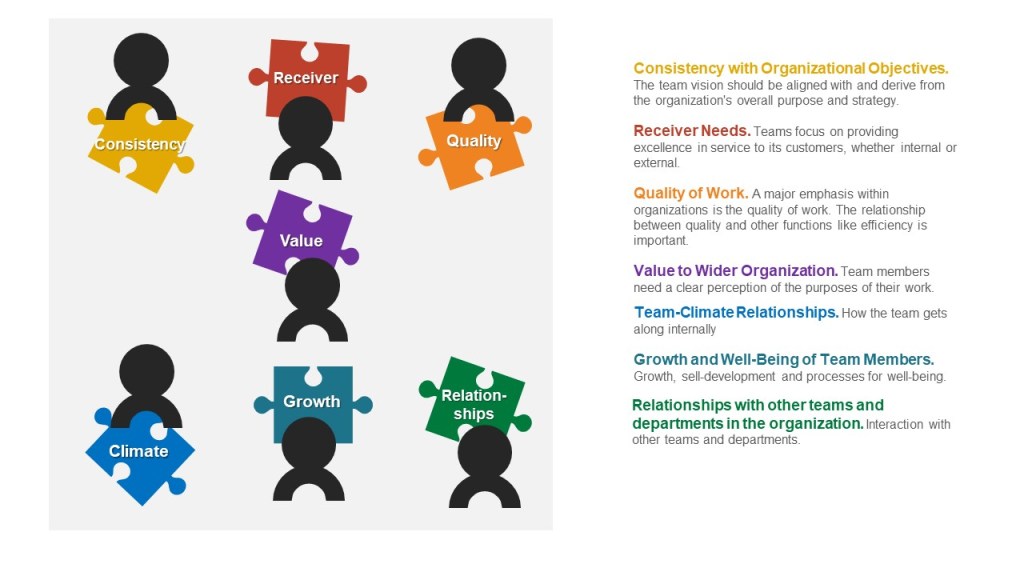
Teams exist to execute to organization objectives. In order to meet these objectives, a team needs a vision of itself. There are eight major elements to a team’s vision:

  1. Consistency with organizational objectives: The team vision should be aligned with and derive from the organization’s overall purpose and strategy. Teams are sub-elements in a wider organization structure and their success will be judged on the extent to which they make valuable contributions to the overall purpose of the organization. In some circumstances a team may decide that it is important for its own values, purposes and orientations to act as a minority group which aims to bring about change in organization objectives – perhaps like a red team.
  2. Receiver needs: Teams focus on providing excellence in service to its customers, whether internal or external.
  3. Quality of work: A major emphasis within organizations is the quality of work. The relationship between quality and other functions like efficiency is important.
  4. Value to the wider organization: Understanding the importance of the team just not for the wider organization but beyond, leads to team cohesion and greater team effectiveness. Team members need a clear perception of the purposes of their work.
  5. Team-climate relationships: Team climate refers to aspects such as the warmth, humor, amount of conflict, mutual support, sharing, backbiting, emphasis on status, participation, information sharing, level of criticism of each other’s work and support for new ideas.
  6. Growth and well-being of team members: Growth, skill development and challenge are central elements of work life and teams can be a major source of support. Teams provide opportunities for skill sharing and support for new training. Teams need to be concerned for the well-being of its members, including things like burnout.
  7. Relationships with other teams and departments in the organization: Teams rarely operate in isolation. They interact with other team and departments within the organization. Teams must be committed to working effectively and supporting other teams. Avoid silo thinking.
Criteria for Team Vision

Management’s Job

In episode 48 of the Deming Len’s podcast, the host refers back to Deming’s last interview, “Dr. Deming: ‘Management Today Does Not Know What Its Job Is‘”

A New Lens with Balaji Reddie (Part 9) – In Their Own Words

What if the way you measure performance is actually making your organization worse? Balaji Reddie and Andrew Stotz dig into Points 7 through 9 of Deming's 14 Points: leadership as a Socratic act of asking rather than answering, why 'drive out fear' is really about removing the fear of telling the truth, and how breaking down departmental silos sometimes means one team taking a loss for the good of the whole. Along the way: KPIs, internal competition, and why they so often undermine the system they're meant to improve. The episode closes with Dr. Deming's own words: leadership carries a responsibility to make a difference. TRANSCRIPT 0:00:02.4 Andrew Stotz: My name is Andrew Stotz, and I'll be your host as we dive deeper into the teachings of Dr. W. Edwards Deming. Today, I'm continuing my discussion with Balaji Reddie, an educator and trainer in the teachings of Dr. Deming and quality management more broadly. Balaji, how are you?   0:00:17.3 Balaji Reddie: Oh, I'm fine this morning. How are you, Andrew?   0:00:19.8 Andrew Stotz: I'm excited. Last time we talked, we talked about points four, five, and six. We packed a lot into that one.   0:00:25.5 Balaji Reddie: Oh, yeah.   0:00:25.8 Andrew Stotz: I'm interested in what we'll get through today.   0:00:28.9 Balaji Reddie: Yeah, right. And as we logged off the last time, of course, I had a hard stop to be made because I had another engagement at the end of the hour that we had. But it occurred to me later on that I should have mentioned something more. So I thought I'll just do a quick recap about what we did the last time we met, and then we proceed from there on.   0:00:54.4 Andrew Stotz: Oh, that's neat.   0:00:54.8 Balaji Reddie: Best part about doing this is there is no time limit, right? So we're taking it easy to finish whatever we have. But here we go. So points number four, five, and six is what we discussed the last time. And point number four, working very closely with your suppliers, don't go for the cheapest, go for the best, and calculate life cycle cost and things like that. So, I should have mentioned a particular person at that time. This was the lady who was working on behalf of MIT CAES, Center for Advanced Engineering Study, they are the people who originally published Out of the Crisis and The New Economics. And if you know, The New Economics second edition came out in '94, March '94, after Dr. Deming had passed away. And that's when in my early days in the Deming world, and I was when the internet came in and I was sending out emails to people I knew, might've seen… Whose pictures I saw on the net, including Henry. Henry was… We started a correspondence first by what you call snail mail, if I may call it. And then when the internet came a year after we were corresponding, that's when we started corresponding on email. And that too, he was not very conversant with it initially. He had a secretary, and so she would send me the mail and I would send her the mail, and then… It was on her ID. And then slowly she, I think, left the British Deming Association, and then Henry was all on his own. And that's when email, then one after the other started sending. So I needed to cite some portions of the book, and then I got in touch with the Deming Institute, and Dave Nave used to look into the emails in those days. Dave Nave and, bless his soul, Bill Ratcliff, if you know, Dr. Deming's son-in-law. So, they guided me. They said that you need to speak to Elizabeth Dorenzo, the lady who edited the second edition of The New Economics, which came out in March '94. So…   0:03:10.7 Andrew Stotz: It's the one I have right here, second edition.   0:03:13.5 Balaji Reddie: Yeah. That's the one. Yeah. It had a different cover, by the way, but this is an, I think, the 2000 print. This is a 2000 print.   0:03:22.1 Andrew Stotz: Right.   0:03:22.9 Balaji Reddie: Yeah, they changed the cover in the year 2000. In 1994 to 2000, the cover was quite different. I have that. I don't have it with me right now. But she told me something very interesting. First of all, she said she was expecting twins at that time. And the joke was, what will come out first, the book or the twins?   [laughter]   0:03:46.7 Balaji Reddie: Because she was racing against the clock and trying to get that book published. And the one point she said that he kept working on, because she kept getting notes from Joyce and Cecelia Kilian, his secretary, typed out notes, handwritten notes, which he wanted to be put into the book, was on point number four. So he was working on that till the day he passed away, about different worlds, different scenarios of working with suppliers, especially the point which we spoke of, work towards a single source. And he said it cannot happen overnight. However, he said in certain scenarios, if all of them are offering the same quality, then you'd be a fool not to go for the cheapest among those, right? And he was giving his… Trying to be… So there were many… There's World 1, World 2. So if you have the book The New Economics, these appear in the appendix: World 1, World 2, World 3, World 4, et cetera. And later on I found that he also gave them these as handouts during his four days… The four worlds in which you work with your suppliers and so on and so forth. So, being very, very practical in the application of what he meant. So that was one. And point number five, of course, we spoke about that you need to constantly improve. But he also cautioned what he meant by improvement, because he said here that improvement is of course taking the performance to another level, but these were in a different sense. He said when people come to you with problems. And remember, a problem is something that you did not anticipate that could happen. So, be welcoming of problems, and you need to look at it as a ways and means of understanding your process better. So the spirit was more of that. That was point number five.   0:05:37.0 Balaji Reddie: And then point number six we looked at, training should be reconstructed from ground up. And he meant in both ways, training on the job and off the job training. But the main thing is, he said that you need to help a person as a part of the training understand how they're contributing to the entire system. Because when a person knows why, they always perform the job better. I think he gave some examples of what that meant. So that was the point number six. Now we get to point number seven, which gets really interesting. So let me just pull up what he had to say in the text of point number seven. So here we go. Right, this is four, five, six, and now we come to seven. Now he says here, "Adopt and institute leadership." And interestingly, in the mimeographed book, the word was "supervision." And then he replaced it. In fact, I have that copy of that book where his handwriting is there, he's scratched out "supervision" and written "leadership." So he had it in mind. The 1982 edition of the 14 points, he wrote "supervision" there. But let's understand why he wrote that word, because I saw that word even in Dr. Juran's book, the 1964 edition of his book called 'Managerial Breakthrough.' And both he and Deming came from the same era, right? And so obviously their understanding of the word "supervisor" was a person with "super vision." In other words, the person who would see things that the people inside the process or system could not see. He actually meant manager, leader, call it what you will, right?   0:07:31.1 Andrew Stotz: Right.   0:07:31.3 Balaji Reddie: And so later on, I think it was Bill Latzko who told Deming to use the word "leadership." And so in the 1986 edition, in Out of the Crisis, he brought in "Adopt and institute leadership." And he said the aim of leadership should be to help people and machines do a better job. And he elaborated this a bit more in the 1990 edition, saying, "Adopt and institute leadership for the management of people, recognizing their different abilities, capabilities, and aspirations." And then he adds, "The aim of leadership should be to help people, machines, and gadgets do a better job. Leadership of management is in need of overhaul, as well as leadership of production workers." So that's what he wrote in 1990. Then he says here, "Transformation in any organization will take place under a leader." Now, this is profound knowledge, when he reworded it. And we started with this, and that's why when we started this series, this podcast series, I started with 14 principles of leadership, if you remember.   0:08:33.8 Andrew Stotz: Yeah. We're back to leadership.   0:08:37.6 Balaji Reddie: Yeah. So what I had to say actually for point number seven is in that podcast, because he actually elaborated 14 principles of leadership as an elaboration of this point. And he says here, "The transformation in any organization will take place under a leader. It will not be spontaneous. How may he accomplish transformation? First, he has a theory. He understands why the transformation would bring gains to his organization and to all the people that his organization deal with. Second, he feels compelled to accomplish the transformation as an obligation to himself and to his organization. Third, he is a practical man. He has a plan step-by-step, and he can explain it in simple terms. But what is in his own head is not enough. He must convince and change enough people in power to make it happen. He possesses persuasive power. He understands people." So, in other words, profound knowledge. You saw people, you saw theory, right? And of course, the variation in the sense that when you're making this transformation, don't expect the system to behave in a predictable manner. Sometimes it'll behave unpredictably. So if you understand that and you know what to do in such circumstances, you need to be prepared. And when you get prepared, you can manage. As he used to often say, "Management is prediction," right? And even if we are faced with unpredictability, if there is a predictability in the unpredictability, you can still manage it if you know the extent of unpredictability. So Walter Shewhart, when he invented the control chart, if you look at it that way, that the control limits, talk about the extent of unpredictability in the process which are predictable. And then you have the unpredictability in the process which is unpredictable, right? And so we tend to work on those, the unpredictable things first, and then the predictability which is unpredictable, we try to reduce the unpredictability in the process. I hope I'm making sense. [laughter]   0:10:44.1 Andrew Stotz: Yeah.   0:10:46.0 Balaji Reddie: So, this is what he meant. Now, when I was speaking to, I think I got this from Bill Latzko, and I think I even spoke to Bill Bellows once about this. So this is what I heard Bill Latzko say. He said that point number seven, he said leadership, he said, "The job of a leader is to create more leaders," he says. And he says managers are no longer just planners or instruction givers, they must be leaders. And then came this input from Myron Tribus. I think I mentioned him once here, the director of MIT, he was at the National Productivity Council in the United States. And he once used to have a lot of discussions and, may I be permitted to use the word, argument with Deming. They used to have it going back and forth. A brilliant man. So, during one of the discussions, I believe Myron Tribus went like this and said, "Okay, okay, Dr. D, I've understood all your 14 points and I've understood Profound Knowledge. What is it I need to do different starting tomorrow morning?" And as usual, Deming answers his question with a question, leans forward and speaks to him and says, "Do you want me to define your job for you?"   [laughter]   0:12:15.7 Andrew Stotz: Clash of the Titans.   0:12:17.0 Balaji Reddie: Oh, yeah, yeah, yeah. I was reminded so much of Bill Scherkenbach. Bill Scherkenbach mentioned this in a video where he says, "He does what he does because he wants you to think." He said he's very Socratic. He never answers a question. He answers a question with a question.   0:12:32.0 Andrew Stotz: Yeah.   0:12:37.6 Balaji Reddie: Right? And I think once I mentioned on one of the podcasts here about what the word guru really means. The person is unlocking the knowledge you actually have inside of you. And when I heard Bill Scherkenbach say that in the video, I said, "Wow, this is exactly what we in our culture define as a guru." The guru does not give answers. He only keeps asking questions. The theme, the logic, and the philosophy is that people know the answers, but they do not know they know the answers. And I think Deming was right like that. He pushed you. He provoked you into thinking. And he wanted you to think for yourself. And I think he always believed that every person has that, and it's just that they need to be shown the right direction. Even my boss, whom I worked for so many years, that gentleman, I often saw much of Deming in him when he used to answer a question with a question. And at times when he used to get angry, I realized that even when he got angry and he was yelling, he was not yelling because he was angry with me. He was angry at himself for having expected too much of me. [laughter] And so I used to always… When he used to give any certain instructions, I used to sit down and discuss at threadbare what exactly he wanted, and then I would get to my job. Because I used to find he was well-meaning, and he never wanted to cause any kind of harm to anybody. But when he used to get really upset, then obviously it was upsetting to see him like that. So I saw that he'd never answer questions. "Go find out. Go find out." So the managers are no longer instruction givers, they must be leaders. And then this comes from Myron Tribus. Hear what he said when Dr. Deming said, "Do you want me to describe your job? What's the job of a leader?" So he says here, "People are the most important part of a system. They work in a system to create value for the customer. The leader's job is to work on the system and continually improve it with help from the people in the system and the customer by leading the people, coaching and counseling them in a non-judgmental manner." So he often said, "Coach and counsel, but do not judge." Right? And he said, "If you judge people, they shut up." So point number seven, if you want an elaboration, I've already covered this in our very first podcast on 14 principles of leadership. In fact, there were 17. For anyone who is following this could go back and check the very first, the first or the second one, I can't remember, but we went through these. And in The New Economics, also, the second chapter on this.   0:15:33.2 Andrew Stotz: By the way, I want to show you something.   0:15:34.7 Balaji Reddie: Yeah, sure.   0:15:38.1 Andrew Stotz: This is something I have on my wall, and it's called the 14 Obligations of Top Management.   0:15:45.7 Balaji Reddie: Okay.   0:15:47.0 Andrew Stotz: And it's signed by Dr. Deming in March of 1992. In fact, on the certificate, it doesn't have the date, but now I realize the last seminar I did with him was March in 1992.   0:15:58.4 Balaji Reddie: Okay.   0:15:58.8 Andrew Stotz: These are the 14 points. He called on it, it says the 14 Obligations of Top Management. But just a prized possession I have that I have on my wall with his signature on it.   0:16:08.3 Balaji Reddie: Wow. You guys are so lucky you met him. [chuckle]   0:16:12.5 Andrew Stotz: Yeah, that's just… Anyways, that was just something that just popped up in my head, and so I asked someone on my team to go get it, and then I just want to show you.   0:16:21.8 Balaji Reddie: Absolutely. Wonderful. Wonderful to see that.   0:16:24.7 Andrew Stotz: Yep. So that's good. That's leadership.   0:16:26.8 Balaji Reddie: Yes, that's leadership.   0:16:27.6 Andrew Stotz: Yep.   0:16:28.3 Balaji Reddie: So, we already did a podcast on that, so people can go back and just listen to that because there were a lot of, kind of a to-do that he gave. People often confuse that. I think in one of the last papers he wrote too, there was a compilation made by, I believe Accenture was the company. I can't remember. They were known as Arthur Andersen. Am I right?   0:16:55.8 Andrew Stotz: I don't know how Accenture… Where they came from actually.   0:16:59.4 Balaji Reddie: Oh, okay. Because there was a publication that was released titled Total Quality Management, TQM. And then it contained papers by who's who. You had just about everyone, Feigenbaum and Crosby and Juran, and then Deming was of course right in front. And in that he spoke about 14 principles of leadership. Everybody thought 14 Points, but when you read, he actually wrote about the chapter what he wrote in The New Economics, the principles that we discussed the other day. I of course felt that instead of 14, there should have been 17 because there were three principles which he wrote down in Out of the Crisis which went missing in The New Economics. And so I just added them on and it became 17. So if anyone's interested, they can go back and listen to that podcast, also read both Out of the Crisis and The New Economics about managing people, and you'll find these points there in a very raw form in Out of the Crisis, but more refined in The New Economics. So that was point number seven. So without elaborating much on that, I said just go back and just check that podcast.   0:18:10.4 Balaji Reddie: Now we come to point number eight, one of his most misunderstood points. Right? And let's read. It's incredible what he wrote. He said, "Drive out fear so that everyone can work effectively for the company." This is what he wrote in 1986, and in 1990 he changed it. But I want to talk about this 1986 version because there were many people who misunderstood and misquoted this. When he meant fear, he meant fear of reporting a problem, fear of making a mistake, right?   0:18:57.0 Andrew Stotz: Yeah.   0:18:57.6 Balaji Reddie: Reporting things going wrong. And we just discussed in point number five that you need to be told about problems because a problem is something that you did not anticipate that can go wrong. And so if someone comes to you with that problem, you should be more than happy and instead look at it as a better way of understanding your process. No matter how much, what precautions you take, and there's so many tools available right now to get into this and try anticipation, blah, blah. Yes, it does work to a certain extent and in fact very effective. But there are always cases where things can go wrong. And you can't do everything. You're not the all-knowing person, and you don't have to be. So this was what he meant, that when people come to you with their problems, when they come to you with that we made a mistake and we need to correct it and things like that, then you don't need to steamroll them. It's like what happened, I think I shared over here in one of the podcasts, what happened with my father when he made a mistake. I think I shared this. Right? So, and he was told that if you make a defective product, you have to pull the cord. And when he pulled the cord, the red lamp went on and there was a little siren. So the entire shop floor would know that there was a mistake that was committed here in the process.   0:20:34.0 Balaji Reddie: And he was told to just do that and that you should not make defective pieces, but if you do, do not hesitate to pull this cord. And so they had removed that fear even then. I told you what my father felt that, what if they feel this about me, that here's a guy from India and look how the people from India work. And that did cross his mind. And he said, "Should I? Should I not?" And he said, "No, but they've put such a lot of faith in me." And so he decided to pull the cord. So that's that fear that people have that we need to remove, and that's the fear that Dr. Deming was talking about. But people misinterpreted this. They confused it with another emotion called anxiety. It's like I'm sitting in the evening, working my backside off because there's a deadline and the customer needs the product tomorrow, and I said, "Damn, if I don't finish this today, we are done." Now that's not fear. That's anxiousness. And very often anxiousness can lead to something positive, right? When you have the butterflies in your stomach bit, for those who are stage artists, before they go on stage, they have this butterflies in your stomach, and that drives you somehow to do something good, right? You just want to go out there and just finish it. But fear is different. It almost always is negative. And so that's what he meant because Andrew Grove, the CEO of Intel…   0:22:06.3 Andrew Stotz: Intel.   0:22:07.8 Balaji Reddie: Yeah, he wrote that famous book, 'Only the Paranoid Survive.'   0:22:12.5 Andrew Stotz: Survive.   0:22:13.1 Balaji Reddie: Yeah. And in that, in one of the chapters or some of the paragraphs, he writes there that Deming writes in his part of the 14 points that drive out fear. He said that's too simplistic a statement. You need some kind of fear to survive. Now, he also confused this with anxiousness. Are you getting it?   0:22:30.8 Andrew Stotz: Well, no, this is his other book, 'High Output Management,' that Andy Grove wrote, which was great.   0:22:35.5 Balaji Reddie: Oh, okay.   0:22:36.2 Andrew Stotz: Yeah.   0:22:36.6 Balaji Reddie: Okay. Yeah. So this was, I think in Paranoid Survive, he did write about Deming. There's a reference to him.   0:22:43.1 Andrew Stotz: Okay.   0:22:44.6 Balaji Reddie: And yeah, so this is just that misconception about the word fear. Also, in our part of the world, I'm talking about Orient, that is Asia. I think you being in Thailand, you must have experienced this, that we in India, we confuse fear and respect. Because respect is something else here. In the Western world, you address each other by first names and things like that, but here in India, there is still the thing about a person who's older than you, we think 10 times before addressing them.   0:23:28.7 Andrew Stotz: Honorific language throughout all of Asia.   0:23:30.8 Balaji Reddie: Yes, that's right. Exactly. We have that. And somehow we feel that, yes, we know it doesn't change anything, but I think we still have that thing in our culture that calling someone by their first name, especially if the person is older to me, we think 15 or 20 times for doing that. In fact, for the longest time, I would address Henry Neave as sir.   0:24:02.3 Andrew Stotz: Until he finally stopped you from doing it.   0:24:05.6 Balaji Reddie: And he said, "Hmm. When will you change?" [laughter] And it's only when I met him in person for the first time I gathered that much courage to address him as Henry. But today, when I even refer to him in conversations, I still refer to him as Henry sir when I talk about him. But when I talk to him, okay, that's different.   0:24:31.8 Andrew Stotz: Yeah, well, when I talk to my aunt and my uncle these days, still, after all these years, I never would call them by their first name. I would always call them Aunt Virginia or Uncle Ham.   0:24:42.0 Balaji Reddie: Oh yeah, that's how it is.   0:24:43.6 Andrew Stotz: So… Yep.   0:24:45.2 Balaji Reddie: Right? So we do have that here. And so that bit, we've confused these two things, the fear and respect. And yeah, so that's one of those things that… Because people here then start thinking that where there's no fear, then people become indisciplined. Now, that is a crazy equation, right? Discipline very simply, very simply means doing the right thing at the right time in the right manner, right? And if you want to really get my version of this, I believe that when people know their purpose, when they understand why they're doing what they're doing, then they automatically become disciplined, you don't have to impose anything on them. The fear, this… It had nothing to do… This fear is much to do with a fear of reporting the truth. In fact, there is a school here in India that kind of works on Deming's principles, right? It used to be known as the Modern School. A gentleman, Mr. Rakesh Kapoor, I don't know, I met him more than 20 years ago and we had a wonderful, wonderful discussion, I think it's now known as Vidya Tree. That's a very interesting name for the school because Vidya is the Sanskrit word for knowledge. So Vidya Tree, that's the school. And there are four pillars on which that school stands. That's what the gentleman told me. And the very first one was discipline without fear. Second one is excellence without distress, right? Third is learning without cramming. And the fourth is relationships without expectation. [laughter]   0:26:53.2 Andrew Stotz: If you can do that, you got a pretty good life ahead.   0:26:56.0 Balaji Reddie: Oh yeah. So, when he said discipline without fear, and then I said, "What is it?" he said that he used to attend these programs in America, American Society for Koality for children. It's called Koality Kid, if you know. A koala bear is the mascot and they spell quality as K-O-A, koala bear, Koality. Are you getting me?   0:27:21.5 Andrew Stotz: Yeah.   0:27:22.4 Balaji Reddie: Koality Kid and how to imbibe quality in education. So he used to attend those seminars and that's where he read something written which was attributed to Dr. Deming, though I never precisely heard him say these words, but I would take it because he said this is what he said. He said that what is the job of a teacher? What Dr. Deming said, he said the job of a teacher is to make the student fall in love with the subject that he or she is teaching. And all else is just academic.   0:28:04.7 Andrew Stotz: That's great.   0:28:04.8 Balaji Reddie: I mean, that's great. And he said that because that's the real job. And then he said, of course, he should have something to teach and then he should understand the learning process of the children or the students so that he can present and explain the subject to them in their terms, right? Because everyone learns differently, correct? So these were the three things. But falling in love with the subject. So he said that children should love the subject. They shouldn't be studying it, it should just flow, right? And that is why he said, "I've kept cameras inside my classroom." Not to monitor the students, but to monitor the teachers. And he says, "I watch how they teach and then I give them a feedback." Right? And sometimes if I feel that they're doing their own thing and things are being effective, because he says if the students like it, then that's enough for me. When I find that the students are being a little edgy and things like that, then he would want to sit down and talk to the teachers. But otherwise he says, "I would rather that things happen in this way." So the first point in his first pillar is discipline without fear. That was amazing. So, now coming to how Dr. Deming worded it later on, 1990, he says here, "Encourage two-way communication." And that's where I think he meant that people should not have that fear of communication. They should be able to communicate to you or tell you what is wrong. And he said, "Create trust, create a climate of innovation," right? And now comes the commentary where he says, "Fear invites wrong figures." So, obviously when you have that blame culture, then people tend to fudge numbers so that they don't get… There's a fear, right?   0:30:02.9 Andrew Stotz: Yep.   0:30:03.4 Balaji Reddie: They don't get yelled at. And "Bearers of bad news fare badly," that's what he says. "To keep his job, anyone may present to his boss only good news. A committee appointed by the president of a company will report what the president wishes to hear. Would they dare report otherwise? Statistical calculations and predictions based on warped figures may lead to confusion, frustration, and wrong decisions. Accounting-based measures of performance drive employees to achieve targets of sales, revenue, and cost by manipulation of processes and by flattery or delusive promises to cajole a customer into purchase of what he does not need."   0:30:45.1 Andrew Stotz: You gotta reread that.   0:30:46.1 Balaji Reddie: Oh yeah, I'll say it again.   0:30:46.9 Andrew Stotz: Please reread that. And where are you getting that from?   0:30:49.8 Balaji Reddie: This is The New Economics.   0:30:51.5 Andrew Stotz: Okay. Okay.   0:30:53.0 Balaji Reddie: So, "Accounting-based measures of performance drive employees to achieve targets of sales, revenue, and cost by manipulation of processes and by flattery or delusive promises to cajole a customer into purchase of what he does not need." And then he says, "Encourage communication, make physical arrangements for informal dialogue between people in the various components of the company regardless of level of position. Encourage continual learning and advancement." So this is what he meant by drive out fear, right?   0:31:28.2 Andrew Stotz: The reason why I asked you to repeat that was because I feel like that's probably one of the biggest things going on right now in management these days is the KPI madness…   0:31:35.0 Balaji Reddie: Oh, yeah. Oh, yeah.   0:31:36.4 Andrew Stotz: And just really thumping on people that, "Hit your KPIs or you're not gonna get this or that." And I had a debate in my class, a formal debate in my Ethics in Finance class where I asked them, the proposition was that KPIs are the best method to get the most out of a company. Which of course, I taught them about the System of Profound Knowledge afterwards, but the debate was excellent with two sides, one arguing for and one arguing against. But yeah, it's just such a powder keg right now.   0:32:17.0 Balaji Reddie: Yeah. In fact, the other day I saw a presentation or an infographic on LinkedIn. You had three acronyms there: KPI, KRA, OKR… Or ORK, I don't know what it was.   0:32:31.2 Andrew Stotz: OKR.   0:32:31.3 Balaji Reddie: OKR, yeah. And I was reminded of something very funny. I will not take the name of the company. It's a very well-known company and quite frankly, it's one of the best I've seen, and let me be fair to them, they're a very good company. But I saw this funny thing way back in '96, alright?   0:32:49.2 Balaji Reddie: They had three-letter acronyms for all the systems in their company. Got it? So I'm not taking the name. So even if I utter the acronym, I think many will pick on this. Those who worked in the company will know what I'm talking about. So I'll use another alphabet. So let's say there was XPS and XCS and XQS and X-this-S. And I was just saying, goddamn it, for everything they had a three-letter acronym. And you won't believe what I saw. A department there called the TLA department. And I said, "What the hell is that?" Somebody said, "Three-letter acronym department." There was a department! [laughter]   0:33:27.7 Andrew Stotz: We're the department of three-letter acronyms.   0:33:30.1 Balaji Reddie: Yes.   0:33:30.5 Andrew Stotz: You'll have to get approval before you issue a new three-letter acronym from us.   0:33:36.7 Balaji Reddie: Yeah, that was hilarious. I couldn't believe what I was seeing there. I said, "Okay, that's how the world is." They love three-letter acronyms. Nevertheless.   0:33:46.3 Andrew Stotz: Yeah.   0:33:47.0 Balaji Reddie: So that's your point number eight.   0:33:49.7 Andrew Stotz: Yeah.   0:33:50.8 Balaji Reddie: Now we get to point number nine. Now if you wanna ask me, nine, ten, eleven are all linked. And one leads to the other. And yes, of course he had a lot to say. Towards the end of his life, he found the right terms and he was much more clear. Rather, he used to be much more elaborate when he first wrote this. So point number nine, let's get to this, is: "Break down barriers between departments," right? And "people in research, design, sales, and production must work as a team to foresee problems of production and in use that may be encountered with the product or service." Right? And so here you go. He's actually elaborated this. Okay? Now, in the 1990 version of the 14 Points, by the time he was professing profound knowledge, so here he goes. He says, "Optimize towards the aims and purposes of the company the efforts of teams, groups, and staff areas." So I think he found the right term then. He put it in a nutshell that we need to optimize the aims and purposes. So all their efforts should be directed towards the aim and purpose. Purpose is why we exist, I think we discussed that, and aim is what do we do because we exist. So if they know both, they would definitely work in that direction.   0:35:21.1 Balaji Reddie: Now, in Out of the Crisis, when he wrote about break down barriers between departments, of course, the functional silos, and it was I think a little more rampant at that time. It's not that it's gone away. It still exists. We still have people working in silos. So this commentary is more for that. So he says here, "Everybody in a company was doing a superb job and had been doing so for years. Nobody had any problems. Yet somehow or other, the company was going down the tube. Why? The answer was simple. Each staff area was sub-optimizing its own work, but not working as a team for the company. Teams composed of people in design, engineering, production, and sales could contribute to designs for the future and could accomplish important improvements in product, service, and quality of today." So this is what he wrote in 1986. But in 1990, when he was talking about optimization, well, then his commentary changed. "The obligation of any component is to contribute its best to the system, not to maximize its own production, profit, or sales, or any other competitive measure. Some components…" Now this is very important, Andrew. It's amazing, "Some components may operate at a loss to themselves in order to optimize the whole system, including the components that take a loss." Right? And then he says "best for everyone concerned should be the basis for negotiation between people, between divisions, between union and management, between companies, between components, between countries. Everybody would gain." Right? So this what I put together, in fact, I think I forgot to read out what I wrote about point number eight based on all this commentary and what I wrote down from one with Latzko, Tony, so I'll just come back here. "Create a climate of openness, trust, and two-way communication. People must not be afraid to voice their problems and constraints they are facing to do a better job." Okay, that's it. But now let's come back here, nine. So he says breakdown barriers, optimize, and he says the obligation of any component should be optimization of the entire system and sometimes may operate at a loss to themselves in order to optimize the whole. I think that's an amazing point he's made.   0:37:47.0 Andrew Stotz: There's two parts to that that I was thinking about. The first one is occasionally you'll hear a manager of a company or a leader say, "I want to figure out how we can be revenue generating in our loss-making divisions," like let's say human resource department. "How can we start making revenue out of this?" And then all of a sudden you really, really mess up the objective of the whole system. Number one, you mess up what is the objective of the overall company. So that's one thing that I've seen in relation to this. And there was another one, but I can't remember it now, but it just made me think about this idea of everything doesn't operate at full pitch, otherwise it all falls apart. It's like a symphony getting up and everybody standing up and playing all at the same time doing their best. That doesn't necessarily generate the best outcome of the whole.   0:38:46.8 Balaji Reddie: Right. So that's basically… I mean, you were just saying that optimize, don't maximize. Right? And people tend to work on maximizing their own part. Now coming to this, in The New Economics there is, and I forget the page number, but there is a fantastic exercise which you will find, and he attributes that exercise to Henry Neave, of Department A, Department B, Department C. And each one is given a separate target to achieve or they're supposed to choose projects. You have the book in front of you?   0:39:35.7 Andrew Stotz: I do, and I'm looking for that. Hold on, I'm just looking for…   0:39:37.9 Balaji Reddie: That table, A, B, C, and plus, plus, plus, minus, minus.   0:39:42.5 Andrew Stotz: Yes, yeah, I see that. That's on page 84.   0:39:45.9 Balaji Reddie: Right.   0:39:46.6 Andrew Stotz: Yeah.   0:39:47.6 Balaji Reddie: So he starts with the first table where he says that the companies have been told that they're gonna be judged by how well… The departments have been told, I'm sorry, that they're gonna be judged by how well they individually perform. And so they're free to choose… They're given a host of projects, right? And they're free to choose the projects in which they are gonna benefit. So if you see in the table, it says Department A takes projects one, two, three, where a plus sign shows a positive outcome for them. Right.   0:40:27.1 Andrew Stotz: Yep.   0:40:27.8 Balaji Reddie: And B chooses two projects, one and two, which they show plus sign under B, that is they are benefiting. And then C chooses again three projects where again they are benefiting C. So now if you say that each one is… If you take a plus sign as a million dollars of revenue or whatever, so A is generating $3 million and B has taken projects of two and then suppose they're pitted against each other and then somehow, let's say for argument's sake, A is declared as the winner because for whatever reason, right? Now they're given some extra information that because of these projects that they've taken up, one, two, and three, now they're given some extra information as to how their work is impacting the other departments, right? So if you see there, A, there's a minus sign for B and a minus sign for C for A for all the three projects. For B, likewise. I think there's one in A which is a plus, if I'm not mistaken.   0:41:30.7 Andrew Stotz: Yeah.   0:41:30.8 Balaji Reddie: Right? And there's in C also which there is a plus, and in B there's both minus. So when you add it all up, the company, it comes to zero. The company does not gain anything and you still got a prize for being the best. Now, now they're given some extra information, right? They're given this extra information saying that, "Look, this is what's happening to the company." And so they say, "What's the best solution then?" Now, Andrew, I have actually conducted this experiment.   0:42:05.3 Andrew Stotz: Right.   0:42:06.0 Balaji Reddie: All right? I ran up certain projects. I used to divide the audience into groups, there used to be 25 people in the room, so break them up into four or five groups of five people each, and each was a department. And I used to write down certain projects. Department A, I used to call them, one is production, one is this, one is that. You're getting the drift here, right? And I would say, "Now you're gonna be judged by how you do." And then invariably they would follow this table, if you know what I'm saying. I've seen this table. And then I would say, "Look, but now I'm gonna show you what effect it is having on other departments." And then I used to reveal the minus signs, that this is actually harming. And I said, "Okay, I'm giving you guys 10 to 15 minutes of discussion and I'm going out of the room. You call me when you're ready." I kid you not, Andrew, in five minutes they used to call me back. "We found a solution." What? A would say, "I'll take the only one project where all of us are gaining and I'm scrapping the other two." And B would do something likewise, and C would do one. And we would take only those projects where the company is gaining, not just them. And now everyone does well. But then I say, "What's the next step?" Because there was some other projects. And they would say, "Wait, there are other projects which has a minus sign for us but a plus sign for the company."   0:43:41.0 Andrew Stotz: Yes.   0:43:41.1 Balaji Reddie: So what came out of this exercise is that we've often said that competition is natural, but I've not seen this once, I've seen this a couple of times, more than once, where they actually say it's for the good of everyone because if everyone gains, we gain, right? And sometimes we have to take up some projects. It's only apparent. See, that's the fear. Now you're getting me?   0:44:06.6 Andrew Stotz: Yeah.   0:44:09.0 Balaji Reddie: We need to remove that…   0:44:09.5 Andrew Stotz: And in real life, people understand that there's compromises and trade-offs, but when you add in pressure and incentives and all that, it just complicates it. And then all of a sudden people just say, "Well, I'm gonna do what's best for me."   0:44:26.0 Balaji Reddie: Yeah. Because, "Show me the way you can measure me and I'll show you what I can do." Right?   0:44:34.2 Andrew Stotz: Yeah.   0:44:34.8 Balaji Reddie: If you remember the gentleman who wrote the very famous book 'The Goal,' Eliyahu Goldratt, I don't know if I'm pronouncing his name correctly, he speaks about that. Theory of Constraints, right? Oh, there he is.   0:44:48.4 Andrew Stotz: Goldratt.   0:44:49.7 Balaji Reddie: Goldratt, yes. He wrote that. He said, "Show me how you're measuring me and I'll tell you what I'm gonna do."   0:44:53.8 Andrew Stotz: Yeah.   0:44:55.8 Balaji Reddie: And whether it's Alfie Kohn or everybody else… If you remember, Alfie Kohn wrote that wonderful paper about… the essay, remember that? About, "I put a block of cheese, the rat comes out and takes the cheese and goes back inside the hole." And this is called motivation. We motivate by dangling a carrot in front of…   0:45:20.7 Andrew Stotz: Carrot and stick.   0:45:21.7 Balaji Reddie: Yeah, carrot and stick. And he wrote in the form of rat and the cheese. And then came the fantastic paper which Alfie Kohn wrote, "The Autobiography of That Rat." And then he writes out how crazy this human is that every time I go dancing on that, he puts a block of cheese for me. So who's actually manipulating whom? Right?   0:45:45.8 Andrew Stotz: Great.   0:45:46.3 Balaji Reddie: So yeah, this of course is an out… As I said, this comes into 10 and 11, but here we are, we're discussing nine.   0:45:52.5 Andrew Stotz: Yes. Breakdown barriers between staff.   0:45:54.0 Balaji Reddie: Breakdown barriers.   0:45:55.5 Andrew Stotz: It's amazing that that still is happening all the time.   0:45:57.8 Balaji Reddie: Oh, yes.   0:45:58.4 Andrew Stotz: And people are always talking about silos and we've got to break down these silos, we've got to work together. But then they're saying, "Okay, here's your KPIs."   0:46:06.6 Balaji Reddie: Yeah, that's funny, right? So if you say then people are really not focused on quality, they're still focused on quantity.   0:46:14.8 Andrew Stotz: Yeah, yeah.   0:46:15.0 Balaji Reddie: There are no measures for quality, right? So if you say here now, he says, "Encourage systems thinking." That's point number nine. "Encourage systems thinking in the organization where everybody focuses on creating value for the customer and not just meeting departmental or sectional objectives. Optimize the efforts of everyone, do not maximize individual or departmental efforts." And if you look at the arrow diagram that he actually drew, the famous Production Viewed as a System, organization viewed as a system diagram. Well, if you are working on KPI and KRA, you're actually trying to please your boss, and that's a vertical kind of a thing rather than horizontal towards the customer. And focus on the customer is incidental and not by design.   0:47:05.9 Andrew Stotz: Yeah.   0:47:06.5 Balaji Reddie: And that's what he was trying to say here, that no, we need to bring back that kind of thinking. And that's why encourage systems thinking, break down barriers, optimize towards the aims and purposes of the company. So that has to be made clear to everyone.   0:47:22.2 Andrew Stotz: Yeah.   0:47:23.2 Balaji Reddie: So yeah, I think that's about what we had time for right now. It's almost…   0:47:29.6 Andrew Stotz: Yes. And I'd say in my own company, Coffee Works, we got rid of KPIs in 2016 and never looked back because we saw that it was an internal process of pleasing the boss and a lot of games being played, and we realized there's just no value from that. And so we were happy to drop it. And these chapters about driving out fear and also breaking down barriers, if you've got any chance of people really, truly working together, it's got to be…   0:48:00.9 Balaji Reddie: You see magic.   0:48:02.9 Andrew Stotz: Yeah. And that's where things happen. So yeah. Wonderful.   0:48:06.4 Balaji Reddie: Yeah. I'd like to quote, Gallery Furniture, Jim McIngvale. Have you heard of him?   0:48:15.2 Andrew Stotz: No, but go ahead. Tell me.   0:48:16.3 Balaji Reddie: Oh, you must. You must watch the video. You must… There's a huge, big section written on him by Henry Neave in his 12 Days to Deming course.   0:48:29.2 Andrew Stotz: Okay.   0:48:29.8 Balaji Reddie: And I know for a fact that Kevin has been very… He's been persuasive. He's trying to get in touch with him, has sent him tweets, emails. I don't know whether he's really replied, but at least I've not seen any reply in the public domain. But I know Kevin is very keen to interact with him because he was a true, true Deming man. He wrote this book called 'Always Thinking Big' on how he turned Gallery Furniture around. And he's known right now in America, in Texas, he has his store there, which is very famous. I think two years ago when there was that horrible storm, I don't know, was it where there was a power outage and there were homeless people on the streets, and he opened up his store and told the people, "Just come here and park yourselves." And he turned up the generator set.   0:49:27.5 Andrew Stotz: What was his name, by the way?   0:49:29.5 Balaji Reddie: Jim McIngvale. He's called Mack.   0:49:32.9 Andrew Stotz: Okay, yeah, I've seen him on Instagram now.   0:49:35.7 Balaji Reddie: Right.. Gallery Furniture.   0:49:37.5 Andrew Stotz: Right.   0:49:38.4 Balaji Reddie: He's still alive. And I hope someday he responds to Kevin because he appeared in so many videos with Dr. Deming. And in fact, there is a beautiful, beautiful speech he made in the last time when he saw Deming. And I often quote this in my program. Let me just pull it up. I have to bring it up because I'd like to end today's episode with that. This is, I mean, I hope I find it quickly. But okay, so… Right, this is… Yeah, I think I found it. Okay. This happened in 1999 at the, what they called as the British Deming Association, one of the last programs that they held. And he was the main speaker there. And he talks very, very quickly. Right. He speaks very fast. So let me see if I have this here. Oh, I think I've… Yeah, okay. And here he is. And he says, "The Last Time." Alright? And I don't know if people listening to this, especially from the Deming family, if they listen to this, I don't know what they're gonna feel. He says, "In finishing, I'd like to talk about the last time I saw Dr. Deming. My son James was very young back then in 1993, and he went to that seminar with me. It was a four-day seminar. At that time, Dr. Deming was 93 years old. He weighed less than 100 pounds, and disease had pretty much ravaged his body. He had a big oxygen tank on his belt, and they were pumping oxygen into his nose. And he did this seminar all day Tuesday, all day Wednesday, and all day Thursday. Friday was the fourth and final day there in Houston. We were sitting up towards the right of the front row. He did the first hour and a half's lecture that Friday morning. He was coughing and wheezing, having a hard time getting through his notes and shaking. And came time for the first break there at 9:30 in the morning. One of the seminar participants came up to him and said, 'Dr. Deming, you're old, you're tired, you're ill, you're coughing and wheezing.' He said, 'Why don't you cancel the next six hours of the seminar and go home and get some rest?' He said, 'Nobody will get upset. Everybody here will understand.' Why, why, why are you doing this? Why are you punishing yourself?' I'll never forget. Dr. Deming looked at him in the eye and said, 'I'm doing this because I have a responsibility to make a difference.'"   0:52:51.5 Andrew Stotz: Amazing. So inspiring.   0:52:53.0 Balaji Reddie: And this is Mack's last big program in England, 1999. I think Diana Deming was there…   0:53:02.2 Andrew Stotz: Yeah.   0:53:02.8 Balaji Reddie: At the same program. It had a galaxy of stars. Nita Bacaitis was there, Barbara Lawton was there, and I don't know, I think Gipsie Ranney was there. The Who's Who were right there. I don't know whether Henry managed to take a photograph of people or him, but he's forgotten everything, so I don't know whom to contact. But I know that the proceeds of that seminar… Because Henry sent this to me the instant it happened. We used to correspond right at that time. And in 1999, when we celebrated Deming Day, October 14th, we always celebrate Deming Day here in India, so I read this out at…   0:53:43.0 Andrew Stotz: Yeah, that's wonderful. Wonderful. So let's all make a difference. I think we're gonna wrap it up there. Any final words you want to give or?   0:53:52.7 Balaji Reddie: This is final, Andrew.   0:53:53.4 Andrew Stotz: Yeah. I don't think it gets better than that. That's so inspiring.   0:53:56.7 Balaji Reddie: You can't say anything other than that.   0:53:58.9 Andrew Stotz: 1993, I was just getting ready to come to Thailand. I had also had my last seminar with Dr. Deming, and he inspired me to the point that I always feel now that I want to contribute and I want to do it all my life until the last days, because I saw him with an oxygen tank right behind him and a nurse right behind him, and yet he brought all of his energy. And every time I get up and speak and have had a long day, I just think how much he put into that. So it's very inspiring. So, on behalf of everyone listening, I know we all enjoyed it. I want to thank you again for the discussion. And for listeners, remember to go to deming.org and jump into DemingNext to continue your journey. This is your host, Andrew Stotz, and I'll leave you with one of my favorite quotes from Dr. Deming: "People are entitled to joy in work."   0:54:55.7 Balaji Reddie: Joy in work.
  1. A New Lens with Balaji Reddie (Part 9)
  2. John Willis: Why AI's Biggest Problem Isn't Technology
  3. A New Lens with Balaji Reddie (Part 8)
  4. Are You Learning or Just Staying Busy?
  5. A New Lens with Balaji Reddie (Part 7)

I’ve written recently about driving fear out of the organization. Without a doubt I think this is the number one task for us. True North for the quality profession.

The source of innovation is freedom. All we have—new knowledge, invention—comes from freedom. Somebody responsible only to himself has the heaviest responsibility. “You cannot plan to make a discovery,” Irving Langmuir said. Discoveries and new knowledge come from freedom. When somebody is responsible only to himself, [has] only himself to satisfy, then you’ll have invention, new thought, now product, new design, new ideas.

Dr. W. Edwards Deming

Structured What-If Technique as a Risk Assessment Tool

The structured what-if technique, SWIFT, is a high-level and less formal risk identification technique that can be used independently, or as part of a staged approach to make bottom-up methods such as FMEA more efficient. SWIFT uses structured brainstorming in a facilitated workshop where a predetermined set of guidewords (timing, amount, etc.) are combined with prompts elicited from participants that often begin with phrases such as “what if?” or “how could?”.

At the heart of a SWIFT is a list of guidewords to enable a comprehensive review of risks or sources of risk. At the start of the workshop the context, scope and purpose of the SWIFT is discussed and criteria for success articulated. Using the guidewords and “what if?” prompts, the facilitator asks the participants to raise and discuss issues such as:

  • known risks
  • risk sources and drivers
  • previous experience, successes and incidents
  • known and existing controls
  • regulatory requirements and constraints

The list of guidewords is utilized by the facilitator to monitor the discussion and to suggest additional issues and scenarios for the team to discuss. The team considers whether controls are adequate and if not considers potential treatments. During this discussion, further “what if?” questions are posed.

Often the list of risks generated can be used to fuel a qualitative or semi-quantitative risk assessment method, such as an FMEA is.

A SWIFT Analysis allows participants to look at the system response to problems rather than just examining the consequences of component failure. As such, it can be used to identify opportunities for improvement of processes and systems and generally can be used to identify actions that lead to and enhance their probabilities of success.

What-If Analysis

What–If Analysis is a structured brainstorming method of determining what things can go wrong and judging the likelihood and consequences of those situations occurring.  The answers to these questions form the basis for making judgments regarding the acceptability of those risks and determining a recommended course of action for those risks judged to be unacceptable.  An experienced review team can effectively and productively discern major issues concerning a process or system.  Lead by an energetic and focused facilitator, each member of the review team participates in assessing what can go wrong based on their past experiences and knowledge of similar situations.

What If?AnswerLikelihoodSeverityRecommendations
What could go wrong?What would happen if it did?How likely?ConsequencesWhat will we do about them Again – prevent and monitor
What-If Analysis

Steps in a SWIFT Analysis

SWIFT Risk Assessment
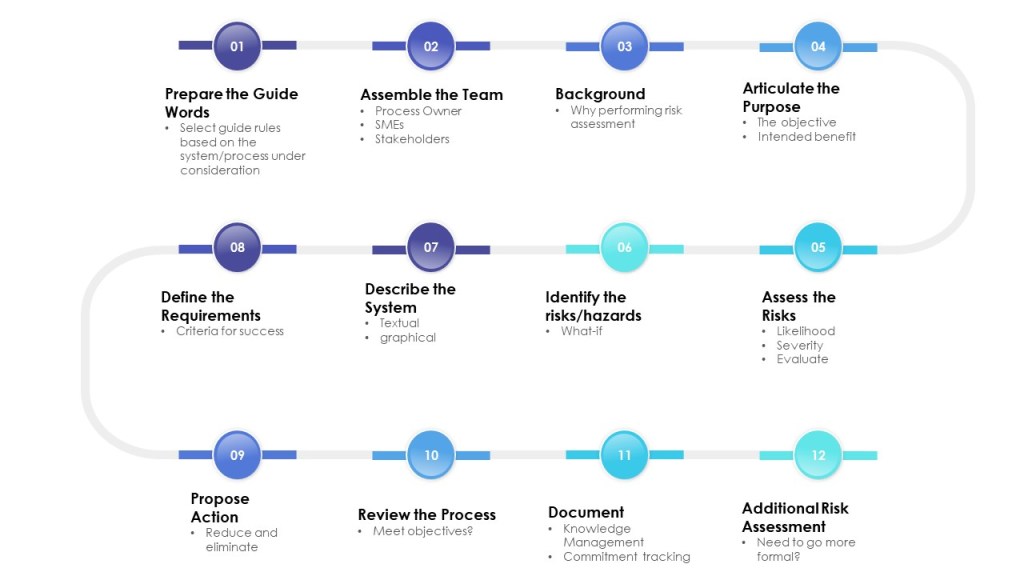
  1. Prepare the guide words: The facilitator should select a set of guide words to be used in the SWIFT.
  2. Assemble the team: Select participants for the SWIFT workshop based on their knowledge of the system/process being assessed and the degree to which they represent the full range of stakeholder groups.
  3. Background: Describe the trigger for the SWIFT (e.g., a regulatory change, an adverse event, etc.).
  4. Articulate the purpose: Clearly explain the purpose to be served by the SWIFT (e.g., to improve effectiveness of the process).
  5. Define the requirements: Articulate the criteria for success
  6. Describe the system: Provide appropriate-level textual and graphical descriptions of the system or process to be risk assessed. A clear understanding is necessary and can be is established through interviews, gathering a multifunctional team and through the study of documents, plans and other records. Normally the
  7. Identify the risks/hazards: This is where the structured what-if technique is applied. Use the guide words/headings with each system, high-level subsystem, or process step in turn. Participants should use prompts starting with the phrases like “What if…” or “How could…” to elicit potential risks/hazards associated with the guide word. For instance, if the process is “Receipt of samples,” and the guide word is “time, timing or speed,” prompts might include: “What if the sample is delivered at a shift change” (wrong time) or “How could the sample be left waiting too long in ambient conditions?” (wrong timing).
  8. Assess the risks: With the use of either a generic approach or a supporting risk analysis technique, estimate the risk associated with the identified hazards. In light of existing controls, assess the likelihood that they could lead to harm and the severity of harm they might cause. Evaluate the acceptability of these risk levels, and identify any aspects of the system that may require more detailed risk identification and analysis.
  9. Propose actions: Propose risk control action plans to reduce the identified risks to an acceptable level.
  10. Review the process: Determine whether the SWIFT met its objectives, or whether a more detailed risk assessment is required for some parts of the system.
  11. Document: Produce an overview document to communicate the results of the SWIFT.
  12. Additional risk assessment: Conduct additional risk assessments using more detailed or quantitative techniques, if required. The SWIFT Analysis is really effective as a filtering mechanism to focus effort on the most valuable areas.

Guideword Examples

The facilitator and process owner can choose any guide words that seem appropriate. Guidewords usually stem around:

  • Wrong: Person or people
  • Wrong: Place, location, site, or environment
  • Wrong: Thing or things
  • Wrong: Idea, information, or understanding
  • Wrong: Time, timing, or speed
  • Wrong: Process
  • Wrong: Amount
  • Failure: Control or Detection
  • Failure: Equipment

If your organization has invested time to create root cause categories and sub-categories, the guidewords can easily start there.