Dear all, regarding question 20 “Is the effective date of the change (completion date) recorded and when appropriate the first batch manufactured recorded?” we are not sure how to handle it for multi-product changes. At our site we manufacture products of different customers. Sometimes we have changes, where f.e. documents of several products need to be adapted. How are the requirements defined in such cases? Do we need to report the first batch only once or for each product
At heart, this requirement is to help meet the regulatory requirement that “After implementation, an evaluation of the change should be undertaken to confirm the change objectives were achieved and that there was no deleterious impact on product quality.” (ICH Q9 part IV.B.3.d)
In order to perform an evaluation, you must be able to know when to start. This evaluation must be able to be performed on each and every product. It is from here we can settle on 1st batch. There are lots of ways to do this. The requirement is, for each and every product, to be able to state definitively when the change was first applied to the product.
Changes are monitored via ongoing monitoring systems to ensure maintenance of a state of control, and lessons learned are captured and shared/communicated. (Note: Activities such as Management Review, Annual Product Quality Review, Continuous Process Verification, Deviation Management and Complaint Monitoring can be useful in this regard.)
Having that definitive point allow all these activities to be effective.
The requirement is clear. We need to be able for any given change identify when it started impacting product.
All of the various Annual Product Review/Product Quality Review requirements also require the ability to evaluate all changes to the product in a given time frame.
Like many such requirements, there are multiple ways to do this. I think the requirement to capture first batch in a change control really stems from it, in many ways, being the easiest to do as you only have to manage it in the change control workflow. Though, in all honesty, it is also darn annoying with changes potentially being open more than a year to capture all possible products.
Based on our core requirement, there are several factors to consider:
There must be a way for a user to easily determine when a given change impacted a given product and to determine if a given batch was impacted by the changes
The user must be able to link any batch to all the changes that impacted it
The user must be able to run a report of all changes that impacted a product in a time frame
There are multiple ways of solving for this from the put a field in the change control to set of interfaces between the ERP and eQMS (and maybe MES).
As a pharmaceutical GXP professional with one foot in the GXP Quality camp and another in the organizational change management camp, I have a few pet peeves. And one of my biggest is whenever someone uses a phrase like “Change management may be known by different terminologies (e.g., change control, change requests, change orders).” That’s a reductionist statement that can really lead to a lot of confusion in an organization.
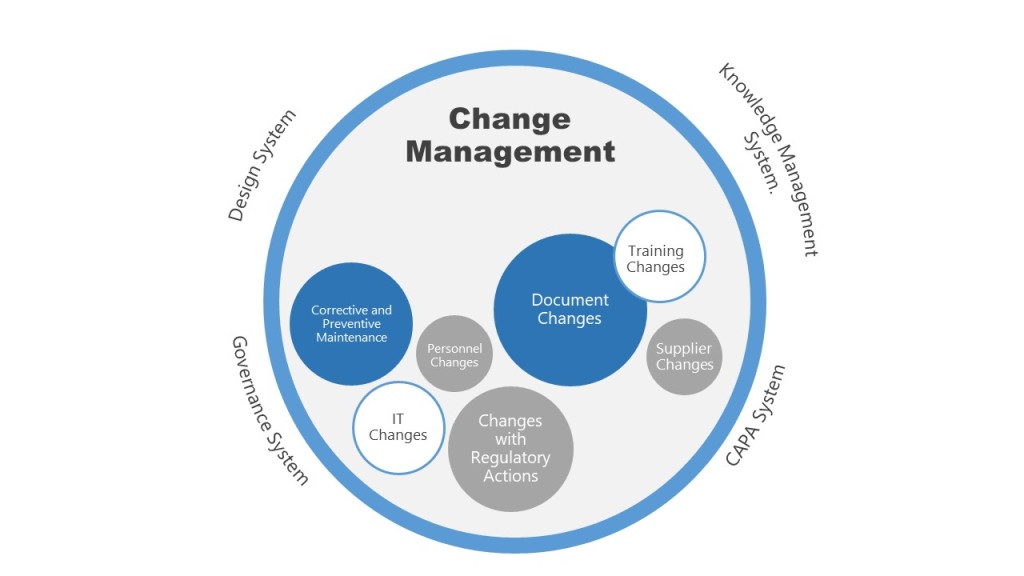
Change management is the how of change – assess, handle and release. Change control is the what, the execution steps. Change management is a big picture system that looks systematically at people, technology, process, and organization. Change control is the set of mechanisms for controlling the introduction of that change to the organization.
A lot of different systems and processes have change control elements. As many of these processes are supported with specific technologies, it can be very important to think about how they fit together like a puzzle.
This puzzle is usually made up of core requirements. Based on how much the change impacts them decides the rigor of the change control process.
Take for example a pharmaceutical manufacturing site. It is fairly typical to have one process for maintenance, another for IT, another for documents, etc. And then you have a change control system for things that impact established conditions, including validated state and regulatory submissions. Maybe you work at some technological utopia with a single system that manages all changes with all the deliverables, but at most places, you are trying to balance efficiency with effectiveness, and have a real need to avoid unnecessary duplication.
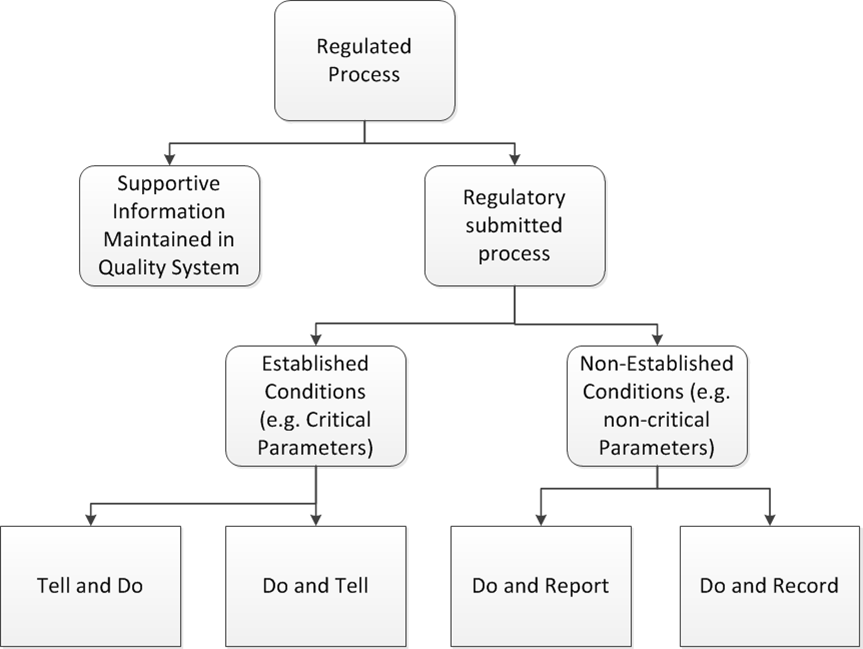
ICH Q12 helps by giving a nice breakdown of the major families of changes.
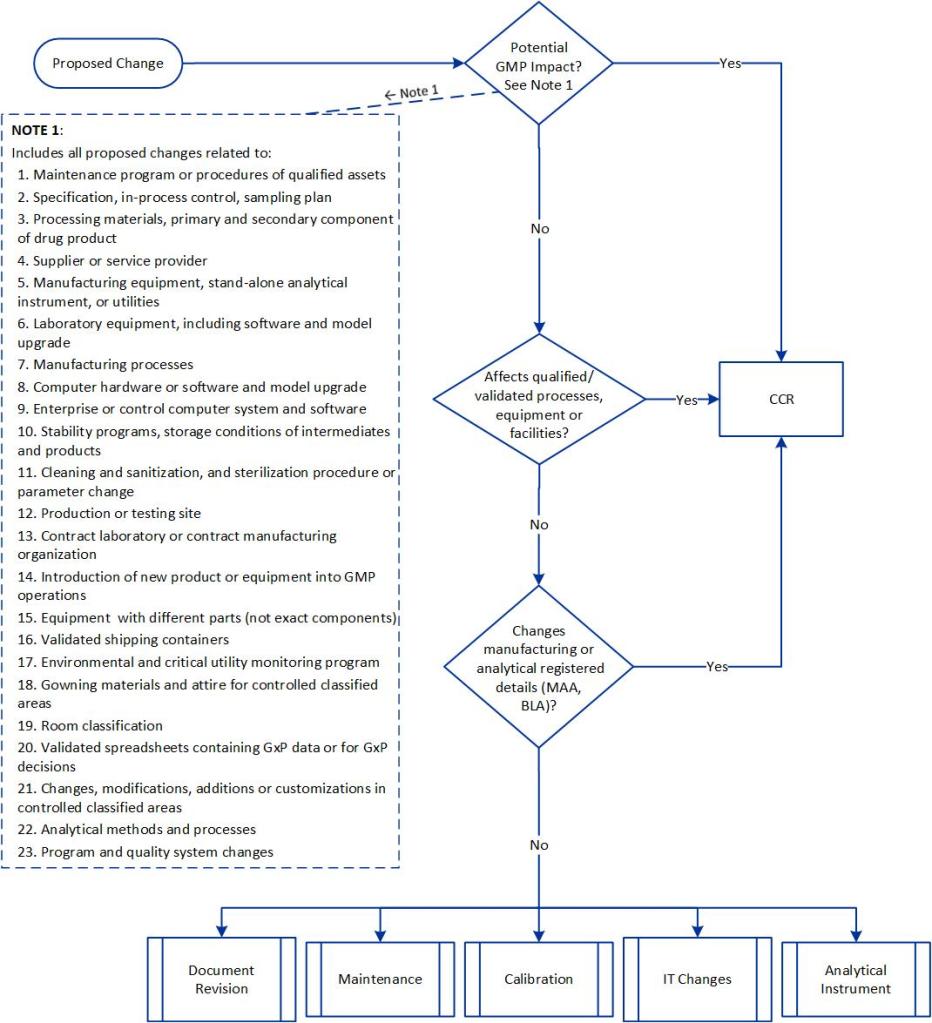
This helps somewhat, but for the average user it is not very specific. We need to translate it. First, we establish that only one system will be used for regulatory impact (“Tell and Do”, “Do and Tell” “Do and Report” and some of “Do and Record”), then we put the major activities that go into it. This breakdown might look like:
We are utilizing a few major criteria:
Impact of regulated state
Impact of validated state
Risk level of change
Scale of change to the organization
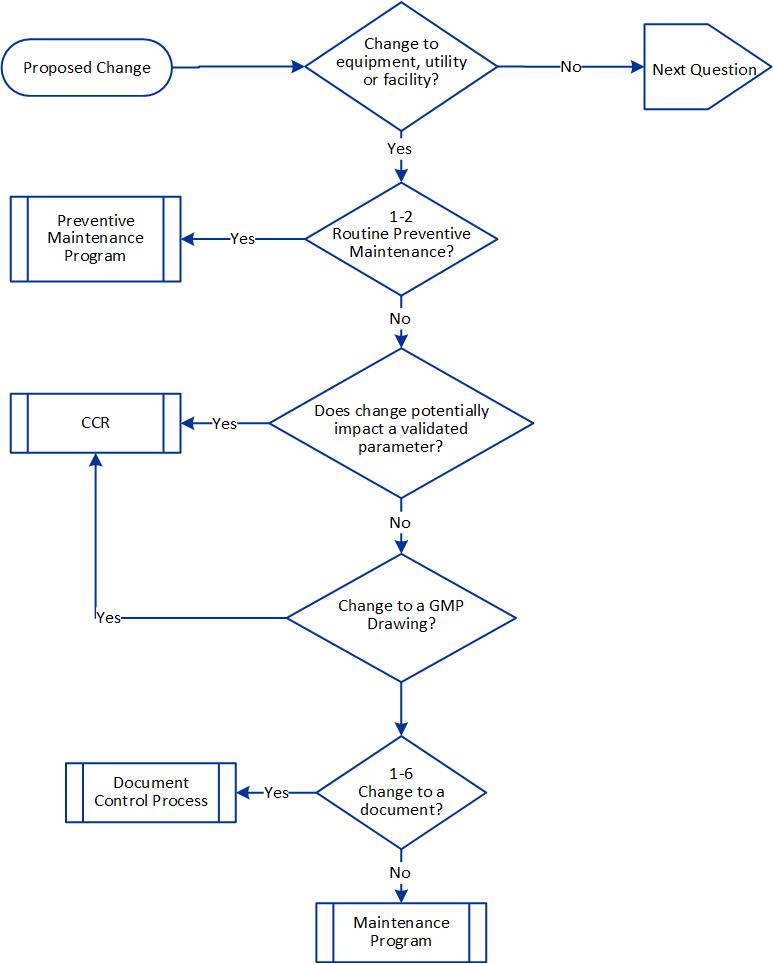
Using these criteria we can even drill down further, for example:
FEU Changes as a flowchart
It is usually a good idea to go down to an even deeper level to help the end-user.
Requires CCR
Does Not Require CCR
Any change that impacts the integrity of
controlled classified areas, including all room and equipment surfaces
Changes that do not impact
integrity of controlled classified areas by meeting the following criteria:
·Does not change airflow
·Does not impact structural integrity and maintains a smooth
cleanable surface
·Does not change means of ingress/egress
·Does not impact current sampling sites from the Environmental
Monitoring Program
·Materials used are resistant to cleaning agents used in the area
as defined in the building specifications
·Materials are included in disinfectant effectiveness study
Any change that impacts air balancing
Work that is part of routine or
preventive maintenance or calibration
Changes to equipment or replacements with a functional
equivalent or different component
Changes to equipment with an
exact component
Changes to facility floor layout
Instrument calibration including
adjustments to field instrumentation
Changes to equipment operating and control
parameters
Removal/storage of portable
equipment
Changes to equipment, material and personnel ingress,
egress and flow procedures
Replacement of system instrument
hardware with exact components (hardware)
Changes to room classifications
Engineering studies that do not
change the validated state or change anything requiring a CCR per this
procedure
Changes that impact the environmental
integrity of a room
Alarm set point changes that
return to the previous qualified/validated state
Replacement and/or decommissioning of equipment,
utilities or facilities
Remediation work (such as
mechanical polishing, weld repairs, electro-polishing, filling of pits,
de-rouging and chemical cleaning with already approved material)
Alarm set point or classification changes
Addition, modification or
deletion to Potable Water, Plant Steam, Chilled Water, Cogeneration System,
or pre-treatment reverse-osmosis
Changes in intended use of a room or area
Modification to piping tied to
Potable Water, Plant Steam, Chilled Water, Cogeneration System, or
pre-treatment reverse-osmosis
Changes to Preventive Maintenance that
includes:
·Decreasing
frequency of preventive maintenance (i.e. making less frequent)
·Change
in intent of a preventive maintenance task
·Adding
or removing tasks
Changes to Preventive Maintenance
that include:
·Increasing frequency of preventative maintenance (i.e. making
more frequent)
·Administrative changes
·Adding clarity to a task (e.g. changing instructions on how to
execute a task without altering the intent of the task)
·Reordering task(s) without changing intent of the task(s)
·Changes of tools needed to execute a task; room dedicated tools
must remain in the designated area
·Changes to quantity of materials
Changes that decrease the calibration
frequency (i.e. make less frequent) for GMP Critical equipment (e.g. directly
related to operational control of the product)
·Changes that increase calibration frequency (i.e. make more
frequent) for GMP Non-Critical equipment (e.g. indirectly related to
operational control of the product)
Tuning parameter, adjustment to the gain,
reset and rate of a PID controller
New or replacement analytical
equipment or instruments identified as Category A or Category B-Calibration
Only with an exact component
Changes to the calibration frequency of GMP
critical equipment (e.g. directly related to operational control of the
product)
Changes to manufacturing report
properties
Changes to the Environmental Monitoring
Program, including addition, deletion or change to a sample location
Changes to alarm
paging/notification recipients
Changes to the program for disinfection of a
facility or equipment exterior
Creating/modifying individual
user accounts
Change of materials of construction or class
of polymeric materials (e.g. elastomers, tubing, gaskets and diaphragms)
Add an instrument to the
calibration system during pre-commissioning
Changes to hardware or infrastructure
associated with a validated system, equipment or utility
Changes to requalification
frequency that do not change the intended use or validated state of the
equipment or utility
Upgrade of application software or operating
system for validated systems, equipment or utility
Corrective changes to an SOP to
align it to the validated state
Changes to an SOP to align it to the
validated state with impact to one or more regulatory filings
A corrective change to alarm set
points to align with the validated state
Creating user groups and/or modifying user
group privileges as part of a larger process change associated with validated
systems, equipment, or utilities
Addition of a new calibration
standard to be used with a new type of instrument at the Alachua site
Creating user groups and/or modifying user
group privileges associated with validated systems, equipment, or utilities
Changes to alarm paging/notification
recipients
Addition of a new calibration standard to be
used with a new type of instrument at the Cambridge and Lexington sites
Modifying a phase prompt or message
associated with validated systems, equipment, or utilities
Addition / change of a graphic associated
with validated systems, equipment, or utilities
Addition or changing an interlock/permissive
trigger
Addition/removal of I/O of validated systems
Changes to the Environmental Monitoring
Program, including addition, deletion or change to a sample location
Changes to alarm paging/notification
functionality
Historical data collection configuration
Change of equipment and spare parts storage
site, including transfers between facilities and transfers to a contracted
third party
All of this is change management. We utilize multiple change control mechanisms to manage the change.
Also, don’t forget that change controls can nest. For example a change to the EQMS has IT changes, document changes, training changes, and probably more.
It is sometimes unfortunate that ICHQ10 defines Change Management as “A systematic approach to proposing, evaluating, approving, implementing and reviewing changes.” This lifecycle approach can sometimes confuse people as they are used to the definition popular elsewhere that change management is “the discipline that guides how we prepare, equip and support individuals to successfully adopt change in order to drive organizational success and outcomes.”
I tend to think this is an issue of focus and lack of coherence in the organization that stems from:
Not understanding that all changes are to a system that involves people, organization, technology and process
Balkanized change processes leads to changes being atomized or channeled though discrete processes that do not drive system thinking
Both of these can lead to a change going to a default change control process and not appropriately dealing with all aspects of the change. Teams tend to have their default (IT puts everything in as a computer change, facilities always uses a an equipment change) but those defaults are not built to deal with a change holistically.
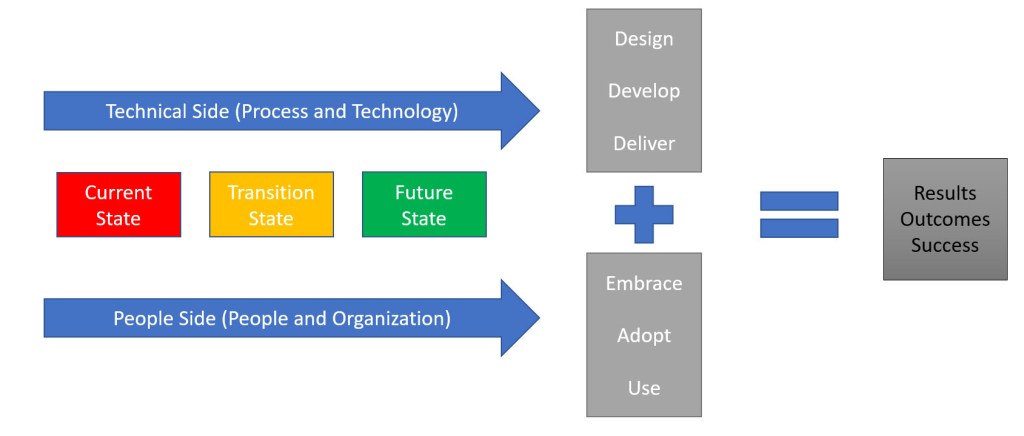
Change is a movement out of a current state (how things are today), through a transition state, and to a future state (how things will be done). Change management needs to be about how we manage that change from the entire system – people, organization, technology and process. Only by approaching change from a full system perspective do we ensure the full benefit and avoid unintended consequences.
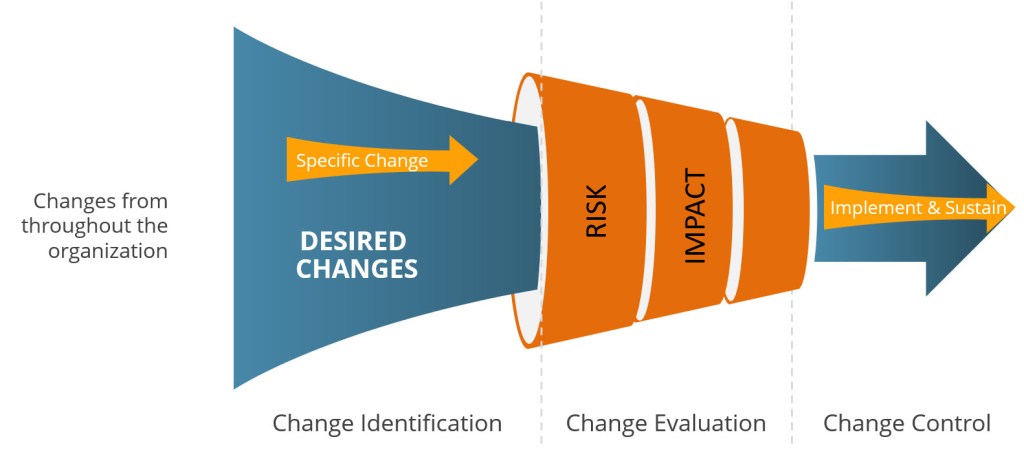
Change Identification
Changes come from everywhere. They are driven by other quality processes, by business needs, by innovation. To quickly address change it is important to have a good funnel system that will get the change to evaluation.
Change Evaluation
All changes should be evaluated for risk and impact. This evaluation is iterative and determines the level and form of evaluation.
Change Control
Right sized change control based on risk and impact. Some changes are one-and-done. But many are multi-faceted, and it is important to structure it appropriately.
I’ve written a lot on change management that covers this in more detail. Explore them here
The yearly database of 483s has been updated by the FDA. Lots will be written on themes as we end the year, so I decided to give a few of my immediate observations.
I find that over time what I focus in on changes, as my jobs evolve and change, and the interests I have shift. However, some things never change, so let us talk change.
Reference Number
Short Description
Long Description
2020 Frequency
2019 Frequency
2018 Frequency
21 CFR 211.100(a)
Changes to Procedures Not Reviewed, Approved
Changes to written procedures are not [drafted, reviewed and approved by the appropriate organizational unit] [reviewed and approved by the quality control unit]. Specifically, ***
8
13
9
21 CFR 211.160(a)
Lab controls established, including changes
The establishment of [specifications] [standards] [sampling plans] [test procedures] [laboratory control mechanisms] including any changes thereto, are not [drafted by the appropriate organizational unit] [reviewed and approved by the quality control unit]. Specifically, ***
4
18
17
21 CFR 212.20(c)
Adverse effects of changes made
You did not demonstrate that any change does not adversely affect the [identity] [strength] [quality] [purity] of your PET drug. Specifically,***
1
1
1
483s related to changes
I think its fair to say the decreases as a result of the pandemic and the reduced inspections.
Over on the device side of things we see:
Reference Number
Short Description
Long Description
Frequency
21 CFR 820.30(i)
Design changes – Lack of or Inadequate Procedures
Procedures for design change have not been [adequately] established. Specifically,***
26
21 CFR 820.40(b)
Document change records, maintained.
Records of changes to documents were not [adequately] maintained. Specifically, ***
6
21 CFR 820.70(b)
Production and Process Change Procedures, lack of or Inad.
Procedures for changes to a [specification] [method] [process] [procedure] have not been [adequately] established. Specifically, ***
5
21 CFR 820.75(c)
Process changes – review, evaluation and revalidation
A validated process was not [reviewed and evaluated] [revalidated] when changes or process deviations occurred. Specifically, ***
5
21 CFR 820.40(b)
Change records, content
Records of changes did not include [a description of the change] [identification of the affected documents] [the signature of the approving official(s)] [the approval date] [when the change became effective]. Specifically, ***
3
21 CFR 820.50(b)
Supplier notification of changes
There is no agreement with [suppliers] [contractors] [consultants] to notify you of changes in the product or service. Specifically, ***
3
21 CFR 820.75(c)
Documentation – review in response to changes or deviations
There is no documentation of the [review and evaluation of a process] [revalidation of a process] performed in response to changes or process deviations. Specifically, ***
1
Device 473s around change
I’m a firm believer that pharma should always pay attention to the medical device side for 483s. A lot of us are combination products now (or will be) and there is always good trends to be aware of.
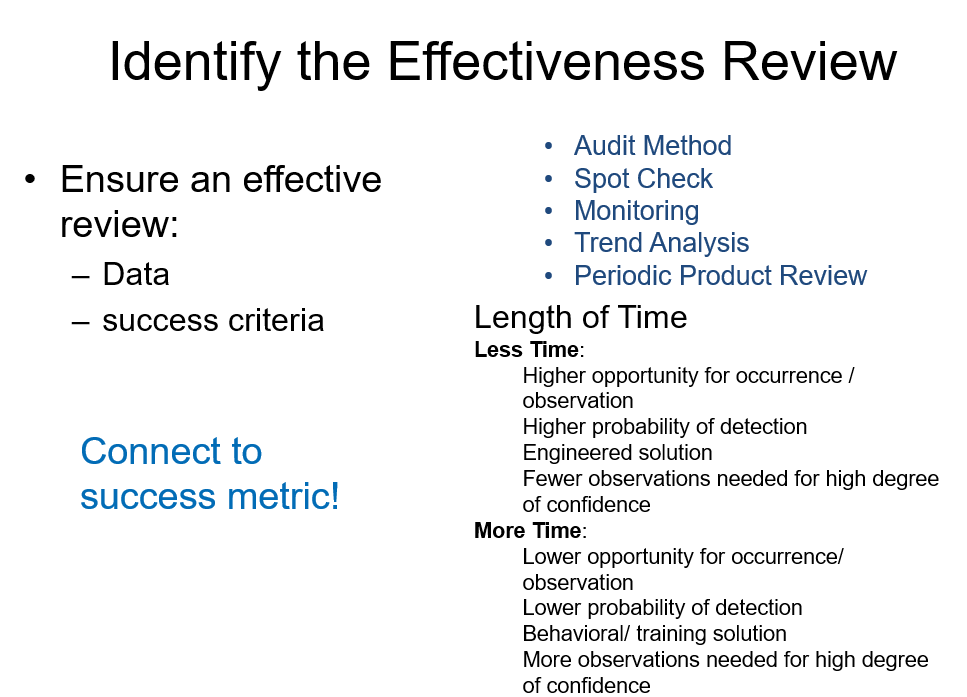
Changes meet their intended objectives and pre-defined effectiveness criteria. Any deviations from those criteria are adequately assessed, accepted and managed/justified. Whenever possible, quantitative data are leveraged to objectively determine change effectiveness (e.g. statistical confidence and coverage).
CQV activities can tell you if the intended objective is met. Effectiveness reviews must be made up of:
Sufficient data points, as described in the implementation plan, gathered to a described timeline, before an assessment of the change is made.
The success criteria should be achieved. If not, reasons why they have not been achieved should be assessed along with the mitigation steps to address the reasons why, including reverting to the previous operating state where appropriate. This may require the proposal of a subsequent change or amendment of the implementation plan to ensure success.
Data and knowledge gathered from implementation of the change should be shared with the development function and other locations, as appropriate, to ensure that learning can be applied in products under development or to similar products manufactured at the same or other locations
As part of the quality risk management activities, residual risks are assessed and managed to acceptable levels, and appropriate adaptations of procedures and controls are implemented.
These are action items in the change control.
As part of the closure activities, revise the risk assessment, clearly delineating risk assessment in two phases.
Any unintended consequences or risks introduced as a result of changes are evaluated, documented, accepted and handled adequately, and are subject to a pre-defined monitoring timeframe.
Leverage the deviation system.
Prior to or after change closure
Requirement
Important Points
Any post-implementation actions needed (including those for deviations from pre-defined acceptance criteria and/or CAPAs) are identified and adequately completed.
If you waterfall into a CAPA system, it is important to include effectiveness reviews that are to the change, and not just to the root cause.
Relevant risk assessments are updated post-effectiveness assessments. New product/process knowledge resulting from those risk assessments are captured in the appropriate Quality and Operations documents (e.g. SOPs, Reports, Product Control Strategy documents, etc.)
Changes are monitored via ongoing monitoring systems to ensure maintenance of a state of control, and lessons learned are captured and shared/communicated.

 Investigations of a Dog