Regulatory Focus on Change Management

November was an exciting month for change management!

ICH Q12 “Technical and Regulatory Considerations for Pharmaceutical Product Lifecycle Management” was adopted by the ICH in Singapore, which means Q12 is now in Stage 5, Implementation. Implementation should be interesting as concepts like “established conditions” and “product lifecycle management” which sit at the core of Q12 are still open for interpretation as Q12 is implemented in specific regulatory markets.

And then, to end the month, PIC/S published draft 1 of PI 054-1 “Recommendation on How to Evaluate / Demonstrate the Effectiveness of a Pharmaceutical Quality System in relation to Risk-based Change Management.”

This draft guidance is now in a review period by regulatory agencies. Which means no public comments, but it will be applied on a 6-month trial basis by PIC/S participating authorities, which include the US Food and Drug Administration and other regulators across Europe, Australia, Canada, South Africa, Turkey, Iran, Argentina and more.

This document is aligned to ICH Q10, and there should be few surprised in this. Given PIC/S concern that “ongoing continual improvement has probably not been realised to a meaningful extent. The PIC/S QRM Expert Circle, being well-placed to focus on the QRM concepts of the GMPs and of ICH Q10, is seeking to train GMP inspectors on what a good risk-based change management system can look like within the PQS, and how to assess the level of effectiveness of the PQS in this area” it is a good idea to start aligning to be ahead of the curve.

“Changes typically have an impact assessment performed within the change control system. However, an impact assessment is often not as comprehensive as a risk assessment for the proposed change.”

This is a critical thing that agencies have been discussing for years. There are a few key takeaways.

  1. The difference between impact and risk is critical. Impact is best thought of as “What do I need to do to make the change.” Risk is “What could go wrong in making this change?” Impact focuses on assessing the impact of the proposed change on various things such as on current documentation, equipment cleaning processes, equipment qualification, process validation, training, etc. While these things are very important to assess, asking the question about what might go wrong is also important as it is an opportunity for companies to try to prevent problems that might be associated with the proposed change after its implementation.
  2. This 8 page document is really focusing on the absence of clear links between risk assessments, proposed control strategies and the design of validation protocols.
  3. The guidance is very concerned about appropriately classifying changes and using product data to drive decisions. While not specifying it in so many words, one of the first things that popped to my mind was around how we designate changes as like-for-like in the absence of supporting data. Changes that are assigned a like-for-like classification are often not risk-assessed, and are awarded limited oversight from a GMP perspective. These can sometimes result in major problems for companies, and one that I think people are way to quick to rush to.

Much of my thoughts on implementing this can be found in my presentation on change management and change control.

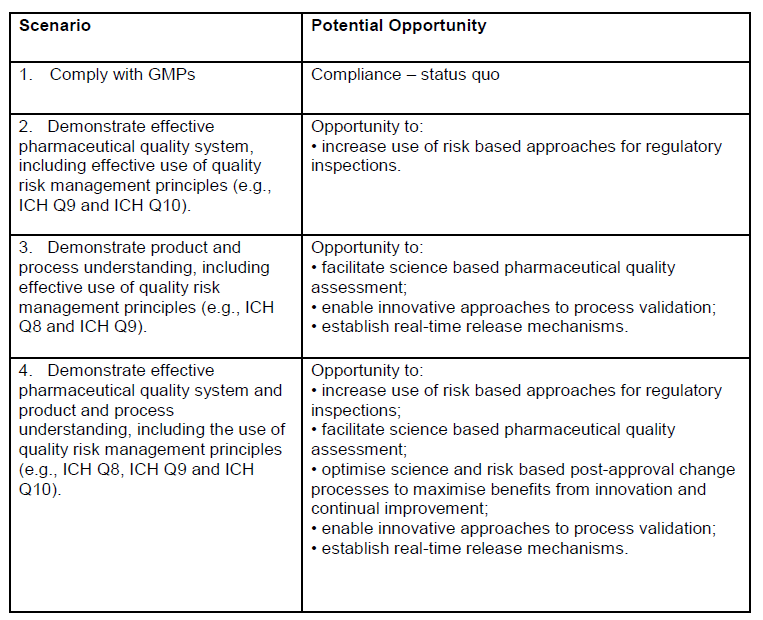
It is fascinating to look at appendix 1, which really lays out some critical goals of this draft guidance: better risk management, real time release, and innovative approaches to process validation. This is sort of the journey we are all on.
FDA 483 data

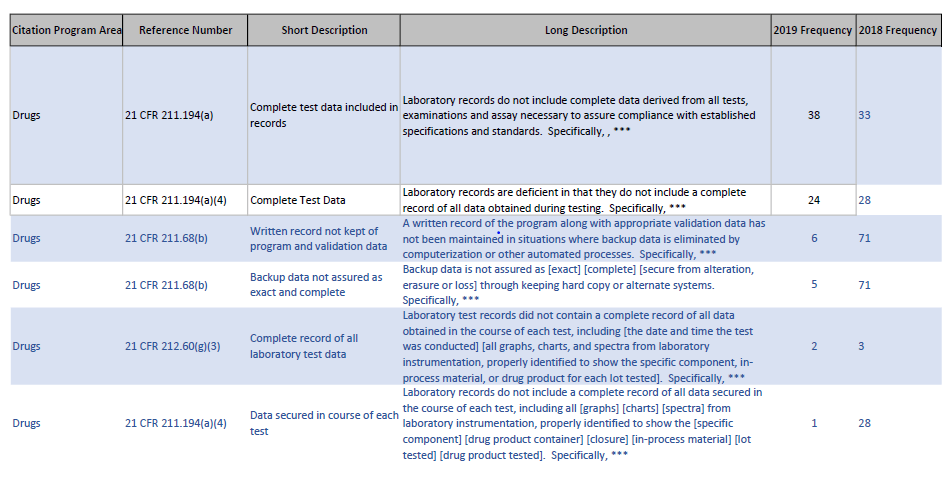
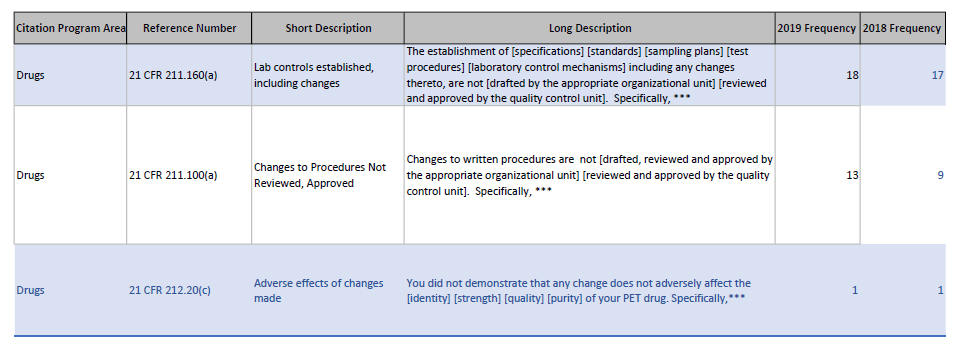
The FDA has posted the 2019 483 observations as an excel file. The FDA has made these files available every year since 2006 and I find them to be one of my favorite tools for evaluating regulatory trends.

So for example, looking at change related 483 I see:

2019 vs 2018 483 comparison for short description including “change”

Or for data integrity issues:

2019 vs 2018 483 comparison for short description including “data”

Very useful resource that should be in the bookmarks for every pharmaceutical quality professional.

ASQ Audit Conference – Day 1 Afternoon

I presented on change management and then I spent the afternoon focusing more on ASQ member leader stuff. So not much to report on sessions.

My session, Lessons on Change Management went well. I probably should have cut the slides way back instead of re-purposing slides from a longer presentation, but I think I hit a lot of key points and hopefully it was valuable for folks.

I ended up working the FDC Division table after that, so I skipped the final session of the day. Probably best, after presenting its always hard for me to focus for a little while.

Tomorrow is a full day, and I present on data integrity.

Top 5 Posts by Views in 2019 (first half)

With June almost over a look at the five top views for 2019. Not all of these were written in 2019, but I find it interesting what folks keep ending up at my blog to read.

  1. FDA signals – no such thing as a planned deviation: Since I wrote this has been a constant source of hits, mostly driven by search engines. I always feel like I should do a follow-up, but not sure what to say beyond – don’t do planned deviations, temporary changes belong in the change control system.
  2. Empathy and Feedback as part of Quality Culture: The continued popularity of this post since I wrote it in March has driven a lot of the things I am writing lately.
  3. Effective Change Management: Change management and change control are part of my core skill set and I’m gratified that this post gets a lot of hits. I wonder if I should build it into some sort of expanded master class, but I keep feeling I already have.
  4. Review of Audit Trails: Data Integrity is so critical these days. I should write more on the subject.
  5. Risk Management is about reducing uncertainty: This post really captures a lot of the stuff I am thinking about and driving action on at work.

Thinking back to my SWOT, and the ACORN test I did at the end of 2018, I feel fairly good about the first six months. I certainly wish I found time to blog more often, but that seems doable. And like most bloggers, I still am looking for ways to increase engagement with my posts and to spark conversations.

Identify and engage stakeholders

Every change (and lets be frank, most everything involves change) requires understanding the individuals and groups that will participate or are affected – directly or indirectly.

Stakeholder analysis involves identifying the stakeholders and analyzing their various characteristics. These characteristics can include:

  • Level of authority within the organization and the domain of change
  • Attitudes toward or interest in the change
  • Attitudes towards the process
  • Level of decision-making authority

The goal of stakeholder analysis is to choose the best collaboration and communication approaches and to appropriately plan for stakeholder risks.

There are a variety of mechanisms for doing this and then mapping it out.

Start by brainstorming a list of the stakeholders by answering these questions:

  • Who will be impacted?
  • Who will be responsible or accountable
  • Who will have decision authority
  • Who can support
  • Who can obstruct
  • Who has been involved in something similar in the past?

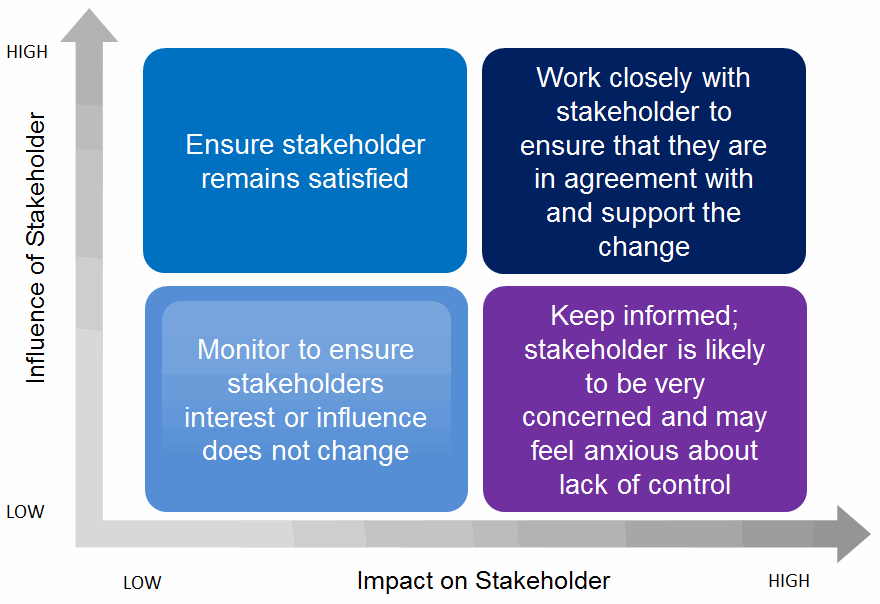
Map these on a stakeholder matrix based on relative power and interest. This should be an iterative process.

Stakeholder Matrix
  • High influence/High Impact: these are key players and effort should be focused here to engage this group regularly
  • High influence/Low impact: these stakeholders have needs that should be met so engage and consult with them while also attempting to increase their level of interest.
  • Low influence/High impact: these stakeholders are supporters and potential goodwill ambassadors. Engage the group for their input and show interests in their needs.
  • Low influence/Low impact: the stakeholders can be kept informed using general communications. Additional targeted engagement may move them into the goodwill ambassador quadrant.

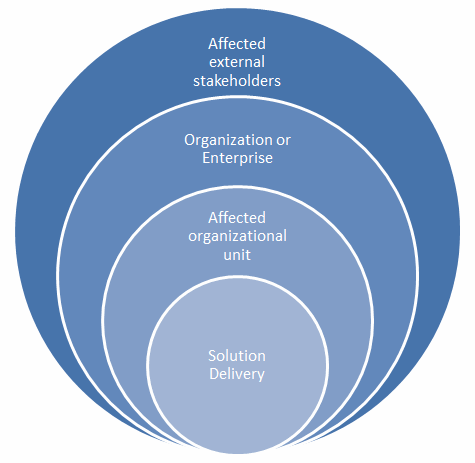
Another way to look at stakeholders is though an onion diagram.

A RACI is another popular way to look at stakeholders.

Once stakeholders are identified is is important to define how communication and engagement will achieved. There is usually no one sized fits all approach and it is important to meet the needs of each stakeholder group to ensure their interest and involvement is maintained. Some considerations include:

  • timing and frequency
  • location
  • tools
  • delivery methods (in-person or virtual)
  • preferences of the stakeholders
  • geographic considerations or impact

Document this in a communication plan, including:

  • what needs to be communicated
  • what is the appropriate delivery method
  • who the appropriate audience is
  • when communication should occur
  • frequency of communication
  • level of detail appropriate for the communication and stakeholder
  • level of formality of communication