Another building block to Quality Culture is conducive culture, which is an environment that promotes employee productivity, satisfaction, and well-being. There is a huge overlap between the concepts of a Just and Conducive Culture.
Physical Comfort and Resources: Ensuring employees have a comfortable physical environment and the necessary resources to perform their tasks effectively.
Open Communication: Encouraging transparent and open communication between employees and management helps build trust and fosters a sense of teamwork.
Recognition and Reward: Regularly acknowledging and rewarding individual contributions can maintain high levels of employee motivation and engagement.
Diversity, Equity, and Inclusion (DEI): Promoting a culture that values diversity, equity, and inclusion can lead to a more respectful and collaborative workplace, enhancing employee morale and productivity.
Work-Life Balance: Supporting employees in achieving a healthy work-life balance through flexible working hours and telecommuting opportunities can increase their engagement and motivation.
Positive Organizational Values: Establishing and operationalizing core values that align with collaboration, learning, and adapting (CLA) can create a supportive and innovative work environment.
Feedback and Development: Regular, constructive feedback and opportunities for professional growth help employees feel valued and supported in their roles.
Team Culture: Promoting teamwork and collective responsibility for outcomes can enhance the organization’s overall performance and success.
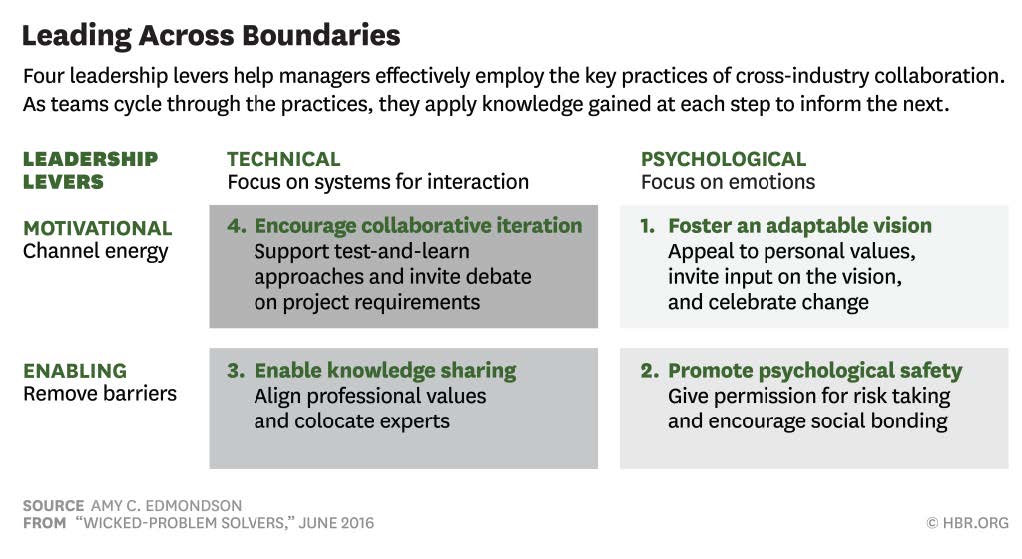
Professor Edmondson in this article is discussing cross-industry collaboration, but the central four levers apply in any organization.
Having a vision that strives for a True North of Quality is critical. Make it align to individual needs. Remember that vision grows and adapts as you go, and as others get the opportunity to shape. Vision has six criteria:
Stimulus: Vision needs to include actual benefits for those affected by it. String vision brings people together as community, not as strangers. Stimulus means people see themselves in the vision and understand how they will benefit.
Scale: Vision should be of great breadth and depth with potential for extension at later stages. Vision never leads to or accepts a dead end. It shows multiple potentials for expansion.
Spotlight: Vision assumes responsibility, immediate and extended. The greater the vision, then the greater the responsibility for its impact on people’s lives and the legacy that will be left afterwards. This responsibility needs to bring opportunity for people who are involved. This is part of the vision that will drive the volunteer army.
Scanning: A visionary sees the signs on the way to success. Pay attention to to pain points, spot trends and see where and how value can be added. Gemba walks are critical here.
Simplicity: Vision is elegant thinking about complicated and complex things. A vision is not a vision unless it’s understood. Simplicity lets people believe in vision. If the vision is complicated most people will ignore it. Vision operates and makes execution possible from its simplicity. The simpler the vision in its core meaning, the easier it can be shared with employees, customers and partners and thus, easier to scale inside and outside an organization.
Passion: Vision provokes strong emotions. A strong vision is always accompanied by excitement and passion. Excitement equals passion that gives an emotional power to a vision. A strong vision brings strong excitement that is difficult to contain. Strong excitement and passion are highly contagious. A simple and compelling vision excites more passion than any mere goal.
Psychological safety is the state where employees feel that there is safety in taking risks at work setting. In this safe environment employees will engage in risk-taking actions that are inherent to creative endeavors and if they perceive safety, then they are more comfortable to voice their opinions. This safety makes them more willing to take the chances to own the vision and try to experiment with making that vision a reality which motivates them to develop, promote, and implement new ideas.
This safety will enable knowledge sharing, which can come in many different styles, including combination which creates something new.
Through inclusive, democratic leaders who value the inclusion of employees in a particular work process, employees have the chance to raise their voice for generating, promoting, and implementing useful ideas Through leveraging vision these inclusive leaders exhibit openness attributes that communicates the importance of taking innovative actions and gives employees the guarantee that in case of negative consequences they will not be punished, experiencing greater psychological safety.
Employees experience non-defensive behavior, and feel high levels of self-worth and self-identity, motivating employees not only to generate new ideas, but also to promote and implement new ideas in the organization.
The organization that is structured to accept these ideas will continue to drive iterative cycles of improvement.
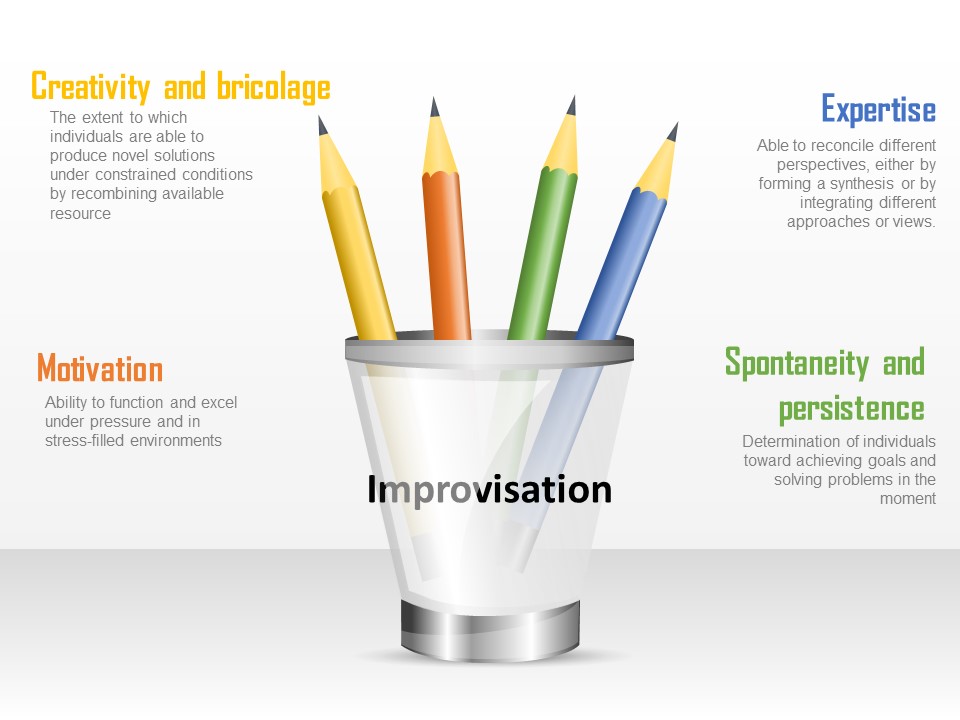
“Improvisation Takes Practice” in HBR is a great read. When I first read it, I chuckled at how it brings my gamer hobby and my quality practice together.
Employee creativity—the production of novel and useful solutions, procedures, products, and services—is critical to organizational success. I would argue, creativity drives excellence. Improvisation is a key employee behavior that drives creativity and innovation.
Improvisation is essential for navigating volatile, uncertain, and complex environments and dealing with unforeseen obstacles. Improvisation is also key to drawing distinctions, implementing new ideas, and converting knowledge and insights into action in real time. When confronted with critical and disruptive events, employees can resolve challenges by following existing protocols and procedures. In contrast, when faced with novel events, employees cannot rely on routines and conventions to respond. Rather, they will have to shift their focus to new perspectives, features, and behaviors.
The process of building expertise, when practices are assimilated, embodied, and rendered tacit, creates improvisational competence. Improvisation is an important source of action generating learning: people act to make events meaningful and situations understandable and, in the process, deepen their expertise through further learning, becoming reflective practitioners.
As we build quality culture we need to question our basic assumptions and build new principles of every day interactions. At the heart of this sits a culture where change is viewed as a good thing.
Willingness to change
To what extent are employees willing to continuously review and adapt their own behavior in response to a changing environment? The ideal scenario is for the entire workforce to be willing to change. This willingness to change should not be confined to situations where changes are already being implemented. It means that people should look at environment with open eyes, recognize when there is an opportunity or a need for change and initiate the relevant actions themselves. Willingness to change should be the first principle of culture and is a key enabler of the popular concept often called agility.
To what extent do employees think that their actions should be guided by data- and fact-based knowledge? The term “knowledge” encompasses any knowledge acquired through targeted observation, by chance, through data-based analysis or from practical experience.
Learning cultures attach great importance to mistakes. These organizations have understood that learning and change processes can only be triggered by mistakes. Mistakes provide an opportunity to gain a better understanding of the company’s processes and uncover previously unknown cause-and-effect relationships.
The way an organization deals with mistakes is therefore a key aspect of its culture. Two fundamentally different approaches to mistakes exist.
A negative attitude towards mistakes is reflected in a strategy based on the systematic avoidance of errors, strict penalties for making mistakes and the correction of errors as rapidly and unobtrusively as possible. Employees of companies where this culture prevails are not usually willing to disclose mistakes. This attitude inhibits their willingness to change.
On the other hand, a culture that recognizes the value of mistakes is characterized by open discussion of mistakes when they occur, systematic error documentation and a determination to find both the causes of the mistakes and their solutions. When investigating mistakes, it is critical to focus on understanding the causes rather than on finding out who is to blame.
Openness to Innovation
Openness to innovation and new ways of doing things is an important capability that is required in order to initiate change and adopt the right measures, even if they may sometimes be rather unconventional.
Social Collaboration
An environment characterized by trust and social relationships provides the basis for open, uninhibited knowledge sharing between employees. Social collaboration, helps to accelerate knowledge sharing within the organization. Good strong social networks build resilience and enable the ability to change.
Open Communication
In order for companies to respond rapidly and to be able to effectively change, employees need to have access to the necessary explicit and implicit knowledge. While explicit knowledge can be provided through the appropriate communication technology, the sharing of implicit knowledge calls for direct communication between the people who possess the knowledge and the people seeking it.
An effective organization needs to abandon the “us and them” mentality. Employees have acquired the capability of open communication if, having taken on board the fact that openly sharing knowledge and working together to achieve a vision increases the total sum of knowledge, they then also act accordingly. Once the organization’s entire workforce is willing to share knowledge with everyone, it becomes possible to significantly accelerate learning processes within the company.
What Does This Look Like?
Social collaboration exists between employees and with customers and partners. Confidence in systems and processes results in high process stability. People are willing to document their acquired knowledge and share it with others. The democratic leadership style values people for the contribution they make and there is a culture of open communication. The workforce is both receptive and willing to change. They learn systematically from the captured data, are open to innovative approaches and participate in shaping change processes. Employees are also conscious of the need to continuously develop their skills and competencies. While mistakes are still made, people recognize that they are valuable because they have the potential to trigger improvements.
An UnConference, otherwise known as a OpenSpace or BarCamp, is a tool I’m a huge fan of. They can really serve to generate action and build energy, commitment, and shared leadership with a group by unleashing self-organization. The idea is to make sure that ALL of the issues that are most important to the participants are raised, included in the agenda, and addressed, making it possible for participants to take responsibility for tackling the issues that they care about and for what does or doesn’t happen
Which makes it a great tool for the Team and Workplace Excellence Forum to really generate some activity. If you are interested please respond to the survey above.



 Investigations of a Dog