A central premise of the Quality mindset is that the means justify the ends and that how we work produces a better result.
At its core, a Quality mindset values the journey as much as the destination. It’s an understanding that the path taken to achieve results is integral to the quality of those results. This mindset shifts the focus from merely meeting targets to how those targets are met, emphasizing continuous improvement, attention to detail, and a commitment to excellence at every step of the process.
The Means Define the Culture
One of the most profound impacts of adopting a Quality mindset is on organizational culture. When a company prioritizes the means as much as the ends, it fosters a culture of integrity, responsibility, and continuous learning. Employees are encouraged to take ownership of their work, innovate, and find better ways to achieve objectives. This enhances the quality of work and boosts morale and engagement among team members.
Process Improvement as a Habit
Incorporating a Quality mindset means viewing process improvement as not a one-time initiative but an ongoing habit. It’s about making small, continuous adjustments that cumulatively lead to significant improvements.
Building Resilience through Quality
Another critical aspect of the Quality mindset is its role in building organizational resilience. Companies can create flexible and robust processes that withstand external pressures and disruptions by concentrating on the means. This resilience is crucial in today’s fast-paced and ever-changing business environment, where adaptability and agility are key to survival and success.
The Role of Leadership
Leadership plays a pivotal role in cultivating a Quality mindset within an organization. Leaders must set the tone by demonstrating a commitment to quality in their actions and decisions. They should encourage open communication, foster a culture of feedback and learning, and recognize and reward quality improvements. By leading by example, leaders can inspire their teams to adopt a Quality mindset and contribute to a culture of excellence.
Conclusion
Adopting a Quality mindset is a strategic choice that can lead to superior outcomes for organizations. By focusing on the means—how work is done—companies can improve processes, foster a positive culture, build resilience, and ultimately achieve higher-quality results. Embedding this mindset into the fabric of the company’s operations requires a commitment from all levels of the organization, especially leadership. In the end, a Quality mindset is not just about achieving better results; it’s about building a better organization.
There has been increasing evidence in recent years that research in life sciences is lacking in reproducibility and data quality. This raises the need for effective systems to improve data integrity in the evolving non-GxP research environment. Reproducibility is a defining principle of scientific research, and broadly refers to the ability of researchers, other than the original researchers, to achieve the same findings using the same data and analysis data reproducibility is key to the reinforcement and credibility of scientific evidence. All results should be replicable by different investigators in varied geographical settings, using independent data, instruments, and analytical methods.
Some examples:
In 2022 there were 11 Federal Register notices with ORI findings of research misconduct that involved Public Health Service support or funding. These cases included falsified data submitted in National Institutes of Health grant applications and PHS-supported publications. These cases resulted debarment periods of up to four years and supervision periods of up to 12 years.
Without a doubt it is critical to build a quality culturewithin our research organizations. Through educating our scientific staff we can continue to innovate and discover new pathways, new drugs and new treatments. Efficient processes enhance research effectiveness and lead to scientific discoveries. Data integrity supports good science, drug safety, products and treatment development for patients and customers. While this looks similar in research as in later phases there are 4 primary pillars:
Train researchers on basic documentation processes and good scientific practices to ensure data integrity and quality. Targeted training should be added on new guidelines, processes and regulations applied to their specific activities.
Bespalov, A., Bernard, R., Gilis, A., Gerlach, B., Guillén, J., Castagné, V., Lefevre, I. A., Ducrey, F., Monk, L., Bongiovanni, S., Altevogt, B., Arroyo-Araujo, M., Bikovski, L., Bruin, N. de, Castaños-Vélez, E., Dityatev, A., Emmerich, C. H., Fares, R., Ferland-Beckham, C., … Steckler, T. (2021, May 24). Introduction to the EQIPD Quality System. eLife. https://elifesciences.org/articles/63294
There is no term more misused and misunderstood than “Phase Appropriate.” It is one of those terms that just about everyone involved in FDA-regulated industries has an opinion on and one where we all get tripped up.
What do we mean by phase?
Drug development can be divided into discovery, preclinical studies, clinical development, and market approval.
Each one of these phases is further broken down.
It is also important to remember that certain activities may start in earlier phases. For example, for manufacturing, tech transfer, and commercial manufacturing can start in Phase 3 (and more and more these days even 2!).
An investigational drug for use in a phase 1 study, as described in § 312.21(a) of this chapter, is subject to the statutory requirements set forth in 21 U.S.C. 351(a)(2)(B). The production of such drug is exempt from compliance with the regulations in part 211 of this chapter. However, this exemption does not apply to an investigational drug for use in a phase 1 study once the investigational drug has been made available for use by or for the sponsor in a phase 2 or phase 3 study, as described in § 312.21(b) and (c) of this chapter, or the drug has been lawfully marketed. If the investigational drug has been made available in a phase 2 or phase 3 study or the drug has been lawfully marketed, the drug for use in the phase 1 study must comply with part 211.
Guideline on the responsibilities of the sponsor with regard to handling and shipping of investigational medicinal products for human use in accordance with Good Clinical Practice and Good Manufacturing Practice
Processes characterized and Production and Process Controls (PPC) identified
Analytical methods are qualified
Materials acceptance criteria
Critical vendors qualified
Phase 3:
Processes validated with Production and Process Controls (PPC) identified and controlled
Validation of analytical methods
Materials have been fully qualified and tested upon receipt as appropriate
What About the Quality System?
ICH Q10 clearly spells out the PQS requirements, breaking down into stages of Pharmaceutical Development (usually Phase 1 and earlier), Technology Transfer (usually phase 2), Commercial Manufacturing (which may start before approval) and Product Discontinuation. Q10 then lays out the expectations by these stages for the four key elements of:
Process performance and product quality monitoring system
Corrective action and preventive action (CAPA) system
Change management system
Management review of process performance and product quality.
Pharmaceutical Development
Technology Transfer
Commercial Manufacturing
Product Discontinuation
Process Performance and Product Quality
Process and product knowledge generated and process and product monitoring conducted throughout development can be used to establish a control strategy for manufacturing.
Monitoring during scale-up activities can provide a preliminary indication of process performance and the successful integration into manufacturing. Knowledge obtained during transfer and scale up activities can be useful in further developing the control strategy.
A well-defined system for process performance and product quality monitoring should be applied to assure performance within a state of control and to identify improvement areas.
Once manufacturing ceases, monitoring such as stability testing should continue to completion of the studies. Appropriate action on marketed product should continue to be executed according to regional regulations.
Corrective Action and Preventive Action
Product or process variability is explored. CAPA methodology is useful where corrective actions and preventive actions are incorporated into the iterative design and development process.
CAPA can be used as an effective system for feedback, feedforward and continual improvement.
CAPA should be used and the effectiveness of the actions should be evaluated.
CAPA should continue after the product is discontinued. The impact on product remaining on the market should be considered as well as other products which might be impacted.
Change Management
Change is an inherent part of the development process and should be documented; the formality of the change management process should be consistent with the stage of pharmaceutical development.
The change management system should provide management and documentation of adjustments made to the process during technology transfer activities.
A formal change management system should be in place for commercial manufacturing. Oversight by the quality unit should provide assurance of appropriate science and risk based assessments.
Any changes after product discontinuation should go through an appropriate change management system.
Management Review of Process Performance and Product Quality
Aspects of management review can be performed to ensure adequacy of the product and process design.
Aspects of management review should be performed to ensure the developed product and process can be manufactured at commercial scale.
Management review should be a structured system, as described above, and should support continual improvement.
Management review should include such items as product stability and product quality complaints.
ICH Stage appropriate quality system elements
Together with ICH Q9, this sets forth a framework of building knowledge and risk management into all aspects of the system together with a robust issue management mindset. There are really three things driving this.
Consistency in execution
Document decision making
Follow through
Some aspects remain pretty steady in all phases/stages, while others will grow as the organization develops.
The Difference Between Maturity and Phase Appropriate
People confuse phase appropriate with maturity all the time. Phase appropriate means doing the right activities in the right order. Maturity means the how is the most effective possible.
Quality Management Maturity (QMM) is the state attained when drug manufacturers have consistent, reliable, and robust business processes to achieve quality objectives and promote continual improvement. This is both composed of phase independent and phase dependent aspects.
Remember, a Quality Culture is the foundation that makes the rest of this happen.
Even a criminal organization like McKinsey can be occasionally right. So ocasionally I’ll read their stuff for free, but any organization that pays them is basically just paying the mob and should be ashamed of themselves and stop it.
Resiliency takes time and effort to build. I discussed how Business Continuity Planning is critical to an organization (and a regulatory requirement in Pharma). Building resilience deliberately, and leveraging it as part of change management, allows us to ensure our organizations can meet the challenges ahead of them and continue to transform. The conditions for building resilience and scaling up an organization’s change capacity are speed, learning, and integration. These three conditions are the principles of transformation. When organizations build around these first principles, they can enable the understanding, engagement, adoption, and endorsement needed for successful organizations. They can also simultaneously lay the foundation to achieve the speed, learning and integration needed to evolve.
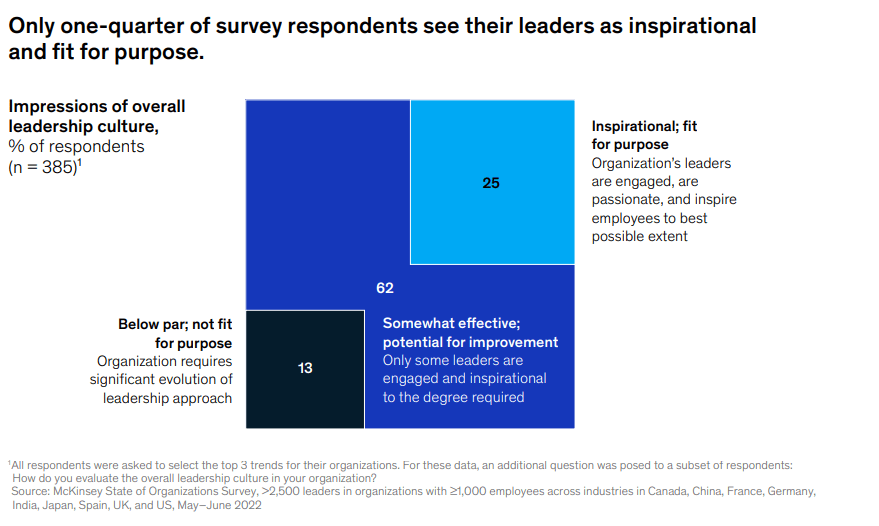
I assume the majority of the quarter of respondents seeing their leaders as inspirational and fit-for-purpose were in fact the leaders in their respective organizations.
We shouldn’t talk about organization efficency without talking about effectiveness and excellence. I relly wish folks would widely adapt the principles of organizational excellence.
As usual, interesting information with some poor or impartial takes published by an organization that should be RICO’ed out of existence and join the Arthur Anderson graveyard of consulting companies.
Discussions about Industry 4.0 and Quality 4.0 often focus on technology. However, technology is just one of the challenges that Quality organizations face. Many trends are converging to create constant disruption for businesses, and the Quality unit must be ready for these changes. Rapid changes in technology, work, business models, customer expectations, and regulations present opportunities to improve quality management but also bring new risks.
The widespread use of digital technology has raised the expectations of stakeholders beyond what traditional quality management can offer. As the lines between companies, suppliers, and customers become less distinct, the scope of quality management must expand beyond the traditional value chain. New work practices, such as agile teams and remote work, are creating challenges for traditional quality management governance and implementation strategies. To remain relevant, Quality leaders must adapt to these changes..
Challenge
Means
Impact to Quality Management
How to Prepare
Advanced Analytics
The increase in data sources and improved data processing has led to higher expectations from customers, regulators, business leaders, and employees. They expect companies to use data analytics to provide advanced insights and improve decision-making.
Requires a holistic approach that allows quality professionals to access, analyze and apply insights from structured and unstructured data
Quality excellence will be determined by how quickly data can be captured, analyzed, shared and applied
Develop a talent strategy to recruit, develop, rent or borrow individuals with data analytics capabilities, such as data science, coding and data visualization
Hyper-Automation
To become more efficient and agile in a competitive market, companies will increasingly use technologies like RPA, AI, and ML. These technologies will automate or enhance tasks that were previously done by humans. In other words, if a task can be automated, it will be.
How to ensure these systems meet intended use and all requirements
Algorithm-error-generated root causes
Develop a hyperautomation vision for quality management that highlights business outcomes and reflects the use cases of relevant digital technology
Perform a risk-based assessment with appropriate experts to identify critical failure points in machine and algorithm decision making
Virtualization of Work
The shift to remote work due to COVID-19, combined with advancements in cloud computing and AR/VR technology, will make work increasingly digital.
Rethink how quality is executed and governed in a digital environment.
Evaluate current quality processes for flexibility and compatibility with virtual work and create an action plan.
Uncover barriers to driving a culture of quality in a virtual working environment and incorporate virtual work-relevant objectives, metrics and activities into your strategy.
Shift to Resilient Operations
Prioritizing capabilities that improve resilience and agility.
Adapt in real-time to changing and simultaneously varying levels of risk without sacrificing the core purpose of Quality
Enable employees to make faster decisions without sacrificing quality by developing training to build quality-informed judgment and embedding quality guidance in employee workflows.
Identify quality processes that may prevent operational resilience and reinvent them by starting from scratch, ruthlessly challenging the necessity of every step and requirement.
Ensure employees and new hires have the right skill sets to design, build and operate a responsive network environment.
Rise of Inter-connected Ecosystems
The growth of interconnected networks of people, businesses, and devices allows companies to create value by expanding their systems to include customers, suppliers, partners, and other organizations.
Greater connectivity between customers, suppliers, and partners provides more visibility into the value chain. However, it also increases risk because it can be difficult to understand and manage different views of quality within the ecosystem.
Map out the entire quality management ecosystem model and its participants, as well as their interactions with customers.
Co-develop critical-to-quality behaviors with strategic partners.
Strengthen relationships with partners across the ecosystem to capture and leverage relevant information and data, while at the same time addressing data privacy concerns.
Digitally Native Workforce
Shift from digital immigrants (my generation and older) to digital natives who are those people who have grown up and are comfortable with computers and the internet. Unlike other generations, digital natives are so used to using technology in all areas of their lives that it is (and always has been) an integral, necessary part of their day-to-day.
Increased flexibility leads to a need to rethink the way we monitor, train, and incentivize quality.
Connecting the 4 Ps: People, Processes, Policies and Platforms
Identify and target existing quality processes to digitize to offer desired flexibility.
Adjust messages about the importance of quality to connect with values employees care about (e.g., autonomy, innovation, social issues).
Customer Expectation Multiplicity
Customer expectations evolve quickly and expand into new-in-kind areas as access to information and global connectedness increases.
Develop product portfolios, internal processes and company cultures that can quickly adapt to rapidly changing customer expectations for quality.
Identify where hyperautomation and predictive capabilities of quality management can enhance customer experience and prevent issues before they occur.
Increasing Regulatory Complexity
The global regulatory landscape is becoming more complex as countries introduce new regulations at different rates. Increased push for localization.
Need strong system to efficiently implement changes across different systems, locations, and regions while maintaining consistent quality management throughout the ecosystem.
Coordinate a structured regulatory tracking approach to monitor changing regulatory developments — highly regulated industries require a more comprehensive approach compared to organizations in a moderate regulatory environment
Challenges to Quality Management
The traditional Value Proposition of quality management is no longer sufficient to meet the expectations of stakeholders. With the rise of a digitally native workforce, there are new expectations for how work is done and managed. Business leaders expect quality leaders to have full command of operational data, diagnosing and anticipating quality problems. Regulators also expect high data transparency and traceability.
The value proposition of quality management lies in predicting problems rather than reacting to them. The primary objective of quality management should be to find hidden value by addressing the root causes of quality issues before they manifest. Quality organizations who can anticipate and prevent operational problems will meet or exceed stakeholder expectations.
Our organizations are on a journey towards utilizing predictive capabilities to unlock value, rather than one that retroactively solves problems. Our scope needs to be based on quality being predictive, connected, flexible, and embedded. For me this is the heart of Qualty 4.0.
Quality management should be applied across a multitude of systems, devices, products, and partners to create a seamless experience. This entails transforming quality from a function into an interdisciplinary, participatory process. The expanded scope will reach new risks in an increasingly complex ecosystem. The Quality unit cannot do this on its own; it’s all about breaking down silos and building autonomy within the organization.
To achieve this transformation, we need to challenge ourselves to move beyond top-down and regimented Governance Models and Implementation Strategies. We need to balance our core quality processes and workflows to achieve repeatability and consistency while continually adjusting as situations evolve. We need to build autonomy, critical thinking, and risk-based thinking into our organizational structures.
One way to achieve this is by empowering end-users to solve their own quality challenges through participatory quality management. This encourages personal buy-in and enables quality governance to adapt in real-time to different ways of working. By involving end-users in the process of identifying and solving quality issues, we can build a culture of continuous improvement and foster a sense of ownership over the quality of our products and services.
The future of quality management lies in being predictive, connected, flexible, and embedded.
Predictive: The value proposition of quality management needs to be predicting problems over problem-solving.
Connected: The scope of quality management needs to extend beyond the value chain and connect across the ecosystem
Flexible: The governance model needs to be based on an open-source model, rather than top-down.
Embedded: The implementation strategy needs to shift from viewing quality as a role to quality as a skill.
By embracing these principles and involving all stakeholders in the process of continuous improvement, we can unlock hidden value and exceed stakeholder expectations.
Deaing with these challenges and implications requires the Quality organization to treat transformation like a Program. This program should have four main initiative areas:
Build the capacity for targeted prevention through targeted data insights. This includes building alliances with IT and other teams to have the right data available in flexible ways but it also includes the building of capacity to actually use the data.
Expand quality management to cover the entire value network.
Localize Risk Management to Make Quality Governance Flexible and Open Source.
Distribute Tasks and Knowledge to Embed Quality Management in the Business.
Across these pillars the program approach will:
Assess the current state: Identify areas requiring attention and improvement by examining existing People, Processes, Policies and Platforms. This comprehensive assessment will provide a clear understanding of the organization’s current situation and help pinpoint areas where projects can have the most significant impact
Establish clear objectives: Establish clear objectives to h provide a clear roadmap for success.
Prioritize foundational elements: Prioritize building foundational elements. Avoid bells-and-whistles for their own sake.
Develop a phased approach: This is not an overnight process. Develop a phased approach that allows for gradual implementation, with clear milestones and measurable outcomes. This ensures that the organization can adapt and adjust as needed while maintaining ongoing operations and minimizing disruptions.
Collaborate with stakeholders: Engage stakeholders from across the organization,to ensure alignment and buy-in. Create a shared vision for the initiative to ensure that everyone is working towards the same goals. Regular communication and collaboration among stakeholders will foster a sense of ownership and commitment to the transformation process.
Continuously monitor progress: Regularly review the progress, measuring outcomes against predefined objectives. This enables organizations to identify any potential issues or roadblocks and make adjustments as necessary to stay on track. Establishing key performance indicators (KPIs) will help track progress and determine the effectiveness of the Program.
Embrace a culture of innovation: Encourage a culture that embraces innovation and continuous improvement. This helps ensure that the organization remains agile and adaptive, making it better equipped to take advantage of new technologies and approaches as they emerge. Fostering a culture of innovation will empower employees to seek out new ideas and solutions, driving long-term success.
Invest in employee training and development: It is crucial to provide employees with the necessary training and development opportunities to adapt to new technologies and processes. This will ensure that employees are well-equipped to handle the changes brought about by these challenges and contribute to the organization’s overall success.
Evaluate and iterate: As the Program unfolds, it is essential to evaluate the results of each phase and make adjustments as needed. This iterative approach allows organizations to learn from their experiences and continuously improve their efforts, ultimately leading to greater success.






 Investigations of a Dog