Self-checking is one of the most effective tools we can teach and use. Rooted in the four aspects of risk-based thinking (anticipate, monitor, respond, and learn), it refers to the procedures and checks that employees perform as part of their routine tasks to ensure the quality and accuracy of their work. This practice is often implemented in industries where precision is critical, and errors can lead to significant consequences. For instance, in manufacturing or engineering, workers might perform self-checks to verify that their work meets the required specifications before moving on to the next production stage.
A proactive approach enhances the reliability, safety, and quality of various systems and practices by allowing for immediate detection and correction of errors, thereby preventing potential failures or flaws from escalating into more significant issues.
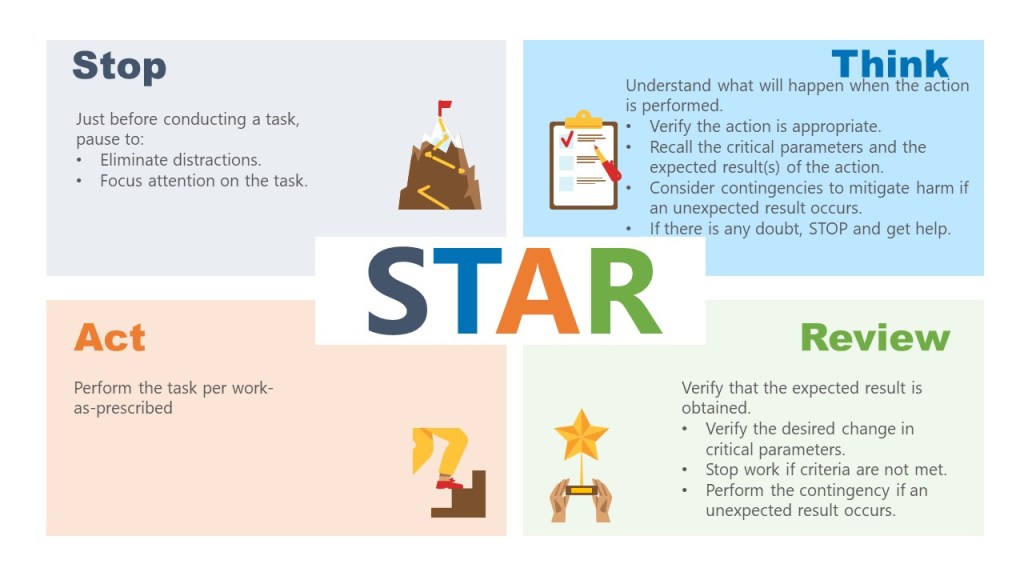
The memory aid STAR (stop, think, act, review) helps the user recall the thoughts and actions associated with self-checking.
Stop – Just before conducting a task, pause to:
Eliminate distractions.
Focus attention on the task.
Think – Understand what will happen when the action is performed.
Verify the action is appropriate.
Recall the critical parameters and the action’s expected result(s).
Consider contingencies to mitigate harm if an unexpected result occurs.
If there is any doubt, STOP and get help.
Act – Perform the task per work-as-prescribed
Review – Verify that the expected result is obtained.
Verify the desired change in critical parameters.
Stop work if criteria are not met.
Perform the contingency if an unexpected result occurs.
As part of his model for Proxies for Work-as-Done, Steven Shorrock covers Work-as-Instructed. I think the entire series is salient to the work of building a quality organization, so please spend the time to read the entire series. You’ll definitely see inspiration in many of the themes I’ve been discussing.
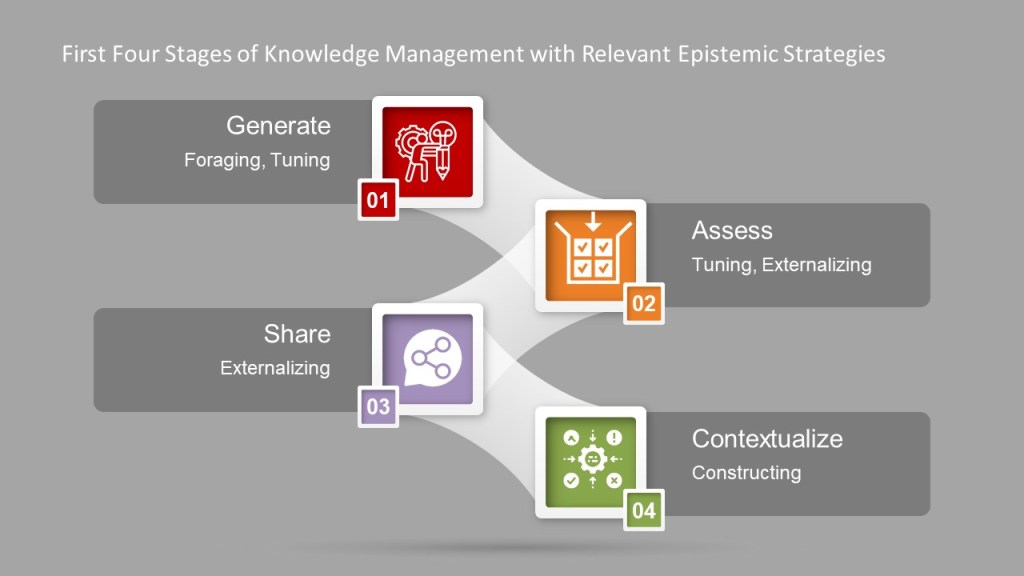
The first four phases of knowledge management are all about identifying and creating meaning and then making that meaning usable. Knowledge management is a set of epistemic actions, creating knowledge through interaction. This interaction is a way of creating a partnership between what happens in the head with everything in the world – Work-as-Imagined and Work-as-Done.
There are really four themes to a set of epistemic actions:
Foraging: Locating resources that will lead to understanding
Tuning: Adjusting resources to align with desired understanding
Externalizing: Moving resources out of the head and into the world
Constructing: Forming new knowledge structures in the world
Four Themes Mapped to Firts 4 Phases of Knowledge Management
Theme
Epistemic Interaction
Means
Foraging
Locating resources that will lead to understanding
Searching
Searching happens when you need information and
believe it exists somewhere.
Searching depends on how we articulate or
information needs.
Probing
“Tell me more.” Probing happens when the information
you have isn’t quite enough. You are probing when you take the next step,
move to the next level, and obtain more salient specifics. Probing is about
drilling down and saying “show, explain, and reveal more about this.”
We can probe to reveal new patterns, structures and
relationships. It brings to light new information that helps us to reconsider
what we already know.
Animating
Animating is when we initiate and control motion in
an information source. It includes learning-by-doing.
Collecting
Collecting is how we gather foraged information and
tuck it away for future use.
Tuning
Adjusting resources to align with desired
understanding
Collecting
Cloning
Cloning lets us take information from one situation
and use it in another.
Cutting
Cutting is the way we say “this matters”, that “I
need this part, but not the rest.”
Filtering
Filtering reduces complexity by reducing clutter to
expose salient details.
Externalizing
Moving resources out of the head and into the world
Annotating
Annotating is how we add context to information. How
we adapt and modify the information to the needed context.
Linking
Connecting bits of information together. Forming
conceptual maps.
Generating
Introducing new knowledge into the world.
Chunking
Grouping idenpendent yet related information together.
Constructing
Forming new knowledge structures in the world
Chunking
Composing
Producing a new, separate structure from the
information that has its own meaning and purpose.
Fragmenting
Taking information and breaking it apart into usable
components.
Rearranging
The art of creating meaningful order.
Repicturing
Changing the way the information is represented to
create understanding.
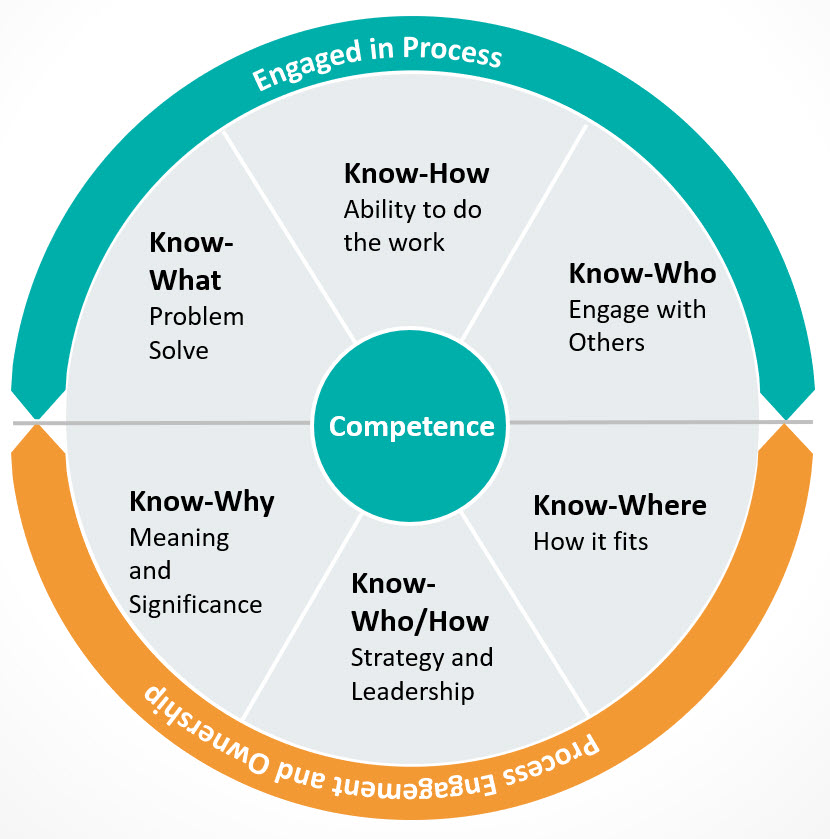
When developing training programs and cultural initiative sit is useful to break down what we really want people to know. I find it useful to think in terms of the following:
know-how: The technical skills to do the work
know-what: The ability to perform functional problem-solving, to adapt the process and innovate
know-who: networking and interpersonal skills, with social/emotional intelligence, for empathy or social network capacities
know-where: institutional and system knowledge of how the work fits into a larger ecosystem
know-who/how: strategic and leadership skills, for political ‘ nous’ in setting agendas, managing institutions, mobilizing resources;
know-why: creation of meaning, significance, identity, morality, with practical intuition for creative arts, sports, everyday social exchange.
To build all six elements requires a learning culture and a recognition that knowledge and awareness do not start and end at initial training on a process. We need to build the mechanisms to:
Communicate in a way to continually facilitate the assimilation of knowledge
Incorporate ongoing uses of tools such as coaching and mentoring in our processes and systems
ISO9001:2015 states “Top management shall review the organization’s quality management system, at planned intervals, to ensure its continuing suitability, adequacy, effectiveness and alignment with the strategic direction of the organization.”
Management review takes inputs of system performance and converts it to outputs that drive improvement.
Just about every standard and guidance aligns with the ISO9001:2015 structure.
The Use of PowerPoint in Management Review
Everyone makes fun of PowerPoint, and yet it is still with us. As a mechanism for formal communication it is the go-to form, and I do not believe that will change anytime soon.
One of the best pieces of research on PowerPoint and management review is Kaplan’s examination of PowerPoint slides used in a manufacturing firm. Kaplan found that generating slides was “embedded in the discursive practices of strategic knowledge production” and made up “part of the epistemic machinery that undergirds the know-ledge production culture.” Further, “the affordances of PowerPoint,” Kaplan pointed out, “enabled the difficult task of collaborating to negotiate meaning in an uncertain environment, creating spaces for discussion, making recombinations possible, [and] allowing for adjustments as ideas evolved”. She concluded that PowerPoint slide decks should be regarded not as merely effective or ineffective reports but rather as an essential part of strategic decision making.
Kaplan’s findings are not isolated, there is a broad wealth of relevant research in the fields of genre and composition studies as well as research on material objects that draw similar conclusions. Powerpoint, as a method of formal communication, can be effective.
Management Review as Formal Communication
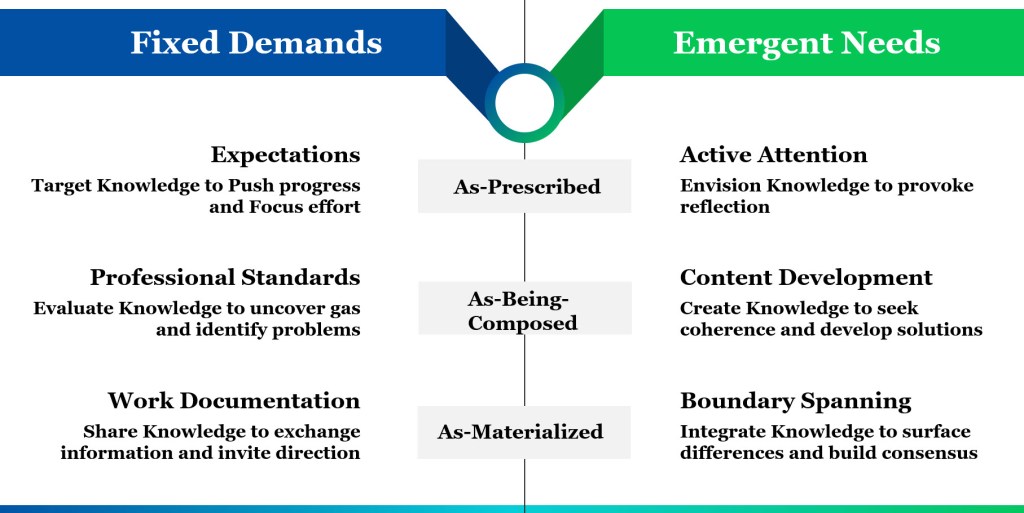
Management review is a formal communication and by understanding how these formal communications participate in the fixed and emergent conditions of knowledge work as prescribed, being-composed, and materialized-texts-in-use, we can understand how to better structure our knowledge sharing.
Management review mediates between Work-As-Imagined and Work-As-Done.
The quality management reviews have “fixity” and bring a reliable structure to the knowledge-work process by specifying what needs to become known and by when, forming a step-by-step learning process.
As-Being-Composed
Quality management always starts with a plan for activities, but in the process of providing analysis through management review, the organization learns much more about the topic, discovers new ideas, and uncover inconsistencies in our thinking that cause us to step back, refine, and sometimes radically change our plan. By engaging in the writing of these presentations we make the tacit knowledge explicit.
A successful management review imagines the audience who needs the information, asks questions, raises objections, and brings to the presentation a body of experience and a perspective that differs from that of the party line. Management review should be a process of dialogue that draws inferences and constructs relationships between ideas, apply logic to build complex arguments, reformulate ideas, reflects on what is already known, and comes to understand the material in a new way.
As-Materialized
Management review is a textually mediated conversation that enables knowledge integration within and across groups in, and outside of, the organization. The records of management review are focal points around which users can discuss what they have learned, discover diverse understandings, and depersonalize debate. Management review records drive the process of incorporating the different domain specific knowledge of various decision makers and experts into some form of systemic group knowledge and applies that knowledge to decision making and action.
Sources
Alvesson, M. (2004). Knowledge work and knowledge-intensive firms. Oxford University Press.
Bazerman, C. (2003). What is not institutionally visible does not count: The problem of making activity assessable, accountable, and plannable. In C. Bazerman & D. Russell (Eds.), Writing selves/writing societies: Research from activity perspectives (pp. 428–482). WAC Clearinghouse
Edmondson, A. C. (2012). Teaming: How organizations learn, innovate, and compete in the knowledge economy. Jossey-Bass
Kaplan, S. (2015). Strategy and PowerPoint: An inquiry into the epistemic culture and machinery of strategy making. Organization Science, 22, 320–346.
Levitin, D. J. (2014). The organized mind: Thinking straight in the age of information overload. Penguin
Mengis, J. (2007). Integrating knowledge through communication: The case of experts and decision makers. In Proceedings of the 2007 International Conference on Organizational Knowledge, Learning, and Capabilities (pp. 699–720). OLKC. Retrieved from https://warwick.ac.uk/fac/soc/wbs/conf/olkc/archive/olkc2/papers/mengis.pdf



 Investigations of a Dog