Happy International Workers Day. Let’s celebrate by Driving Out Fear!
Thirty-five years ago Deming wrote that “no one can put in his best performance unless he feels secure.” Unfortunately, today we still live in a corporate world where fear and management by fear is ubiquitous. That fear is growing after more than a year of a global pandemic. As quality professionals we must deal with it at every opportunity.
Competition: Many managers use competition to instill fear. Competition is about winners and losers. Success cannot exist without failure. Managers deem the anxiety generated by competition between co-workers a good thing as they compete for scarce resources, power and status. Therefore, management encourage competition between individuals, between groups and departments and between business units.
“Us and Them” Culture: The “us and them” culture that predominates in so many organizations proliferated by silos. Includes barriers between staff and supervisors.
Blame Culture: Fear predominates in a blame culture. Blame culture can often center around enshrining the idea of human error.
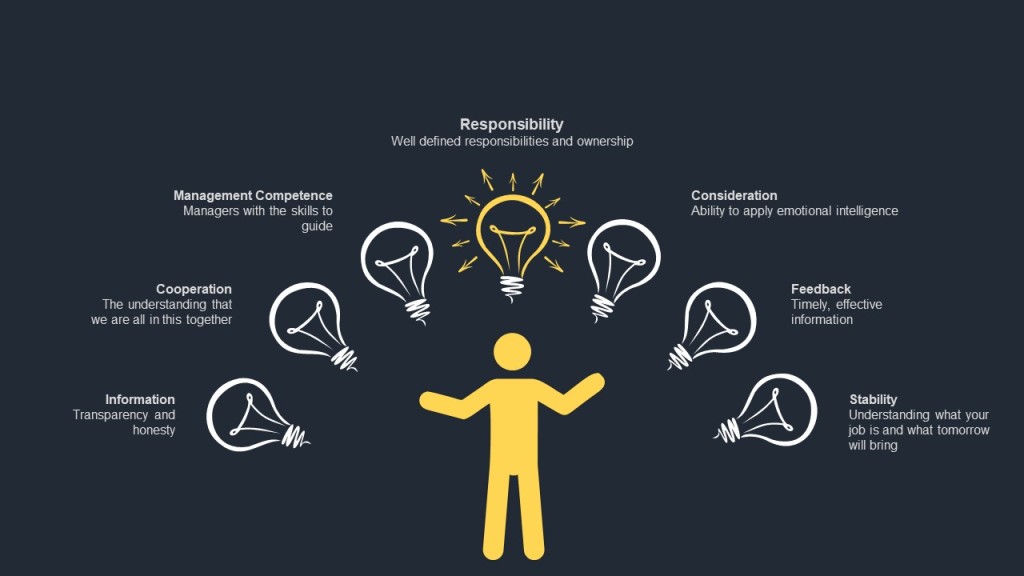
We drive out fear by building a culture centered on employee well-being. This is based on seven factors.
Factor
Means
Obtained by
Responsibility
Well defined responsibilities and ownership
The opportunity an employee has to provide input into decision making in his department An individual employees’ own readiness to set high personal standards An individual employee’s interest in challenging work assignments The opportunity an employee has to improve skills and capabilities Excellent career advancement opportunities The organization’s encouragement of problem-solving and innovative thinking
Management Competence
Managers trained with skills that lend themselves to contributing to the work of their team ensures that they will be looked to for help. Managers need to be able to guide.
Direct Supervisor/Manager Leadership Abilities Management is engaged and leads by example (Gemba walks) Management by Facts
Consideration
When managers act as if employees have no feelings and just expect them to do their work as if they are robots, it can make employees uneasy. Such behavior makes them feel detached and merely a tool to carry out an end. In such environments, many times the only times employees hear from the manager is when something goes well or really bad. In either case, the perception could be that the manager has mood swings and that also adds to the employee’s insecurity. They may feel reluctant to talk to their manager for fear he is in one of his bad moods.
Senior Management’s sincere interest in employee well-being An individual employee’s relationship with their supervisor Open and effective communication Trust in management and co-workers
The feeling that every person is on their own to look out for their interest is a sad state to be in. Yet when everyone has a fear that the other workers will take advantage of them or make them look bad at the first opportunity, a selfish and insecure environment will result. Employees should be able to work together for the benefit of the company. They should focus on group goals in addition to their personal goals, recognizing that individually there will be failures, but that the whole is more important than the individual parts.
Trust Well trained employees Collaboration as a process Organizational culture (psychological safety) Hire and promote the right behaviors & traits to match the culture
Transparency is critical. When employees know nothing about how a company is doing in terms of where they should be, it is a source of uneasiness. Without that knowledge, for all they know the company could be doing very poorly and that could be a bad thing for everyone. When they have a better sense of where the company is in the scheme of their objectives set by management, it helps them feel more secure. That is not to say it is the news being good or bad that affects their security, but rather the fact that they actually have the news.
Strategy and Mission — especially the freedom and autonomy to succeed and contribute to an organization’s success Organizational Culture and Core/Shared Values Feel that their job is important
Stability
Employees feel more secure when their role does not change frequently and they understand what tomorrow will mean.
Job Content — the ability to do what I do best Availability of Resources to Perform the Job Effectively Career development – opportunities to learn and grow
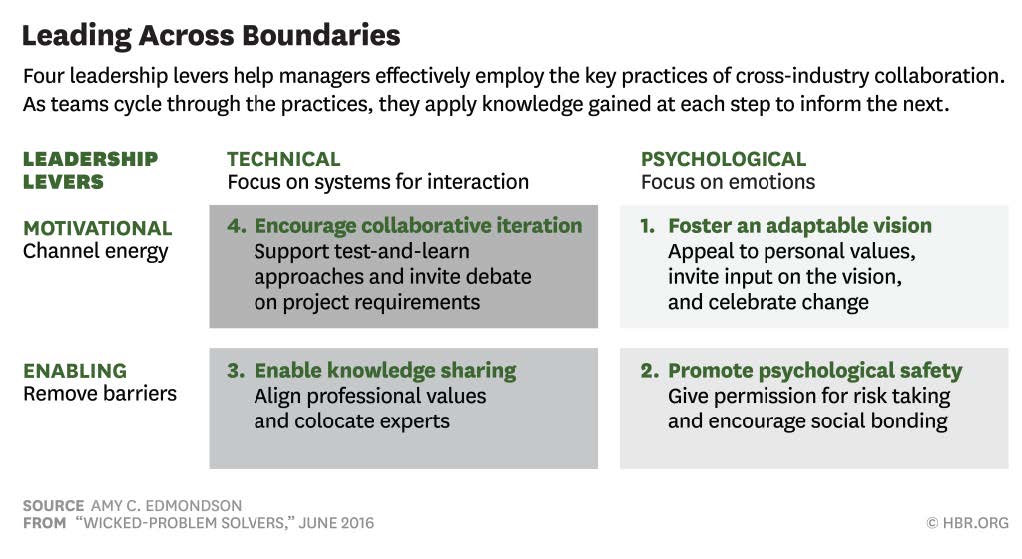
Professor Edmondson in this article is discussing cross-industry collaboration, but the central four levers apply in any organization.
Having a vision that strives for a True North of Quality is critical. Make it align to individual needs. Remember that vision grows and adapts as you go, and as others get the opportunity to shape. Vision has six criteria:
Stimulus: Vision needs to include actual benefits for those affected by it. String vision brings people together as community, not as strangers. Stimulus means people see themselves in the vision and understand how they will benefit.
Scale: Vision should be of great breadth and depth with potential for extension at later stages. Vision never leads to or accepts a dead end. It shows multiple potentials for expansion.
Spotlight: Vision assumes responsibility, immediate and extended. The greater the vision, then the greater the responsibility for its impact on people’s lives and the legacy that will be left afterwards. This responsibility needs to bring opportunity for people who are involved. This is part of the vision that will drive the volunteer army.
Scanning: A visionary sees the signs on the way to success. Pay attention to to pain points, spot trends and see where and how value can be added. Gemba walks are critical here.
Simplicity: Vision is elegant thinking about complicated and complex things. A vision is not a vision unless it’s understood. Simplicity lets people believe in vision. If the vision is complicated most people will ignore it. Vision operates and makes execution possible from its simplicity. The simpler the vision in its core meaning, the easier it can be shared with employees, customers and partners and thus, easier to scale inside and outside an organization.
Passion: Vision provokes strong emotions. A strong vision is always accompanied by excitement and passion. Excitement equals passion that gives an emotional power to a vision. A strong vision brings strong excitement that is difficult to contain. Strong excitement and passion are highly contagious. A simple and compelling vision excites more passion than any mere goal.
Psychological safety is the state where employees feel that there is safety in taking risks at work setting. In this safe environment employees will engage in risk-taking actions that are inherent to creative endeavors and if they perceive safety, then they are more comfortable to voice their opinions. This safety makes them more willing to take the chances to own the vision and try to experiment with making that vision a reality which motivates them to develop, promote, and implement new ideas.
This safety will enable knowledge sharing, which can come in many different styles, including combination which creates something new.
Through inclusive, democratic leaders who value the inclusion of employees in a particular work process, employees have the chance to raise their voice for generating, promoting, and implementing useful ideas Through leveraging vision these inclusive leaders exhibit openness attributes that communicates the importance of taking innovative actions and gives employees the guarantee that in case of negative consequences they will not be punished, experiencing greater psychological safety.
Employees experience non-defensive behavior, and feel high levels of self-worth and self-identity, motivating employees not only to generate new ideas, but also to promote and implement new ideas in the organization.
The organization that is structured to accept these ideas will continue to drive iterative cycles of improvement.
Curiosity is a superpower that enables us to improve our lives. Empathic curiosity allows people to listen thoughtfully and see problems or decisions from another’s perspective, not to criticize or judge, but to understand. Asking questions promotes more meaningful connections and more creative outcomes. When we carefully listen to the answers we seek, we build better relationships faster, fuel employee engagement, and reduce conflict.
George Mason and Patrick McKnight created a five-dimensional model of curiosity that can help us understand curiosity and how to nurture it.
The first dimension, deprivation sensitivity, causes us to recognize a gap in our knowledge. Filling it offers relief. This type of curiosity doesn’t necessarily feel good, but it causes us to feel better once we have a solution to a problem. For instance, a trip to the emergency room will give answers to the question about whether a person has had a heart attack. Both a “yes” or “no” answer will satisfy our curiosity.
The second dimension, joyous exploration, causes us to be consumed with wonder about the fascinating features of the world. This exploration produces pleasure among those curious enough to pursue answers.
The third dimension, social curiosity, encourages us to talk, listen, and observe others to learn what they are thinking and doing. Since we are inherently social animals, we find communication the most effective and efficient way to gain information that will allow us to determine whether someone is friend or foe. Some may even snoop, eavesdrop, or gossip to do so.
The fourth dimension, stress tolerance, relates to our willingness to accept and even harness the anxiety associated with novelty. People who lack stress tolerance see information gaps, experience wonder, and have an interest in others, but they don’t tend to satisfy their curiosity by stepping forward and exploring.
The fifth dimension, thrill seeking, goes beyond tolerating stress to embracing a willingness to take physical, social, and financial risks to acquire varied, complex, and intense experiences. For people with this capacity, the anxiety of confronting novelty is something to be amplified, not reduced.
Curiosity is the catalyst that brings job satisfaction, motivation, innovation, and high performance. It fosters collaboration and fortifies organizational resilience by prompting creative problem- solving in the face of uncertainty and pressure.
Good leaders build and reward curiosity in their organizations by:
Rewarding creative failures. Recognize the value of effort and experimentation, even when it fails.
Understand that curious people learn quickly and bore easily. Encourage continuous growth and learning.
Give ever-challenging work and real authority to make a difference.
Make organizations places where the curious choose to work and become magnets for other top performers.
Give direction in the form of democratic guidance, not an absence of direction. Don’t micromanage. If you try to micromanage a curious person just a little, you will lose that person.
Norm tells an engaging story where he shares a formative experience on the value of driving out fear. He then explains that we as managers grew up in these cultures and it requires work to build a new culture.
He hits on a great note, managers are part of the cultures they grew up in. We are like trees with many rings, and it can be very difficult just to change that.
Building culture means change. There are a lot of models for change out there, but for the work we pursue around building a culture of quality and excellence I think there are few better than John Kotter’s model.
Kotter sets forth Eight Accelerators of Change which can be leveraged in cultural change:
Accelerator
Focus when building Culture
Create a Sense of Urgency around a Big Opportunity
The urgency here is the strategic threats from having a less-than-robust quality culture and the opportunities it creates. This is the True North. With this accelerator working, large groups of people are committed to building and improving a culture of quality.
The translation of the sense of urgency from leadership down to the working level is a constant need. People must understand the argument laid out by leadership, but it needs to be linked with their own needs and less about the business need 5 years out. This is pretty fundamental, if folks don’t see how the culture vision will make immediate changes to their work then it will never be prioritized.
It is advantageous to have several different facets of this urgency that might appear to different segments in the organization. Manufacturing may be focused on human error reduction while research is excited around innovation. Both are moving forward in a similar direction.
Build and evolve a guiding coalition
You need a coalition throughout the organization deeply committed to a culture of quality and the benefits it will bring. Culture will never happen when it is viewed as a quality initiative only. Ideally there will be lots of branches and initiatives moving in the same direction. Communicating between these elements of the change initiatives and leveraging between initiatives is vital.
This is about fostering an environment that turns around the big opportunity and gives the member the opportunity to be different and creative. As a result, the participants of the coalition will find ways to work together different from their ordinary habits. This will increase the speed of decision-making and enables the organization to be more agile.
Form a change vision and strategic initiatives
Articulating the vision of culture shows a fit to strategic opportunities can move you with speed and agility to that vision. By choosing a few strategic opportunities around culture you can move quickly to them.
Enlist a volunteer army
Communicate in ways that lead large numbers of people to buy into the vision and want to help. You want to excite and mobilize as many active and passive members of the organization as possible.
Enable action by removing barriers
Work swiftly to achieve initiatives and continue to find new ones that are strategically relevant. Identify barriers that are slowing down the growth of a quality culture and remove them.
Generate (and celebrate) short-term wins
Look for wins big and most specially small and celebrate them. These wins, and their celebration, have psychological power and play a crucial role in building and sustaining culture transformation. The created credibility helps to develop a certain standing for the network within the organization and can also convince people, who did not have a positive attitude towards the network before.
Sustain acceleration
Don’t let a few wins slow you down. Keep going, keep growing, keep doing and celebrating. This accelerator helps to keep the spirit within the employees up and motivates them further to strive for the big opportunity of developing and reaping the benefits of a quality culture.
Many people active in the change, not just the usual few folks
The engagement of a large number of people for part-time involvement in the change, as opposed to relying on the same few people to work it full time.
A want-to and a get-to (not just a have-to) mind-set
People need to want to be change agents and feel that as change agents they have the power to make the change happen. They need to have the ‘spirit of volunteerism” and there needs to be enthusiasm for quality and excellence.
Action that is head and heart driven
People need to be motivated to participate not only by logical arguments based on a business case. Rather there must be an emotional element that drives their engagement.
The Burning Platform element of Culture will undoubtedly speak to the head but also must speak to the heart. In the pharmaceutical industry the Heart elements of the burning platform could include getting medicines to market quicker for the patient as well as making workers lives better.
Leadership is about vision and inspired action and management is about project management and budget reviews. The secondary operating system needs more of the former.
The network and the hierarchy must be inseparable and in constant communication. The idea of a network approach to change is critical here.. Change needs to sit next to traditional ways of working to truly be able to make a difference.
The network has a start-up character, which allows working flexible and agile on the change process and taking fast decisions.
Kotter’s Five Principles for Change
Creating the Movement
A central element of Kotter’s Accelerators is the secondary operating system which relies on a volunteer group of people who are there to propagate the change. These people don’t just magically appear, they are somehow motivated to get involved. How does an organization create the spirit of volunteerism, especially when most employees are disengaged from their organizations?
People will volunteer because they either want to do something for themselves or they want to do something for others.
Self-Enhancement
If someone wants to do something for themselves they are seeking self-enhancement. Self-Enhancement is the desire or observed reality of seeing oneself and by extension one’s actions, traits, and attitudes in the most positive light which can be an attempt to increase status and relationships with the leaders within the organization. This is a primary driver of engagement and behavior change.
Another element of the self-enhancement motive which plays into the formation of the volunteer army is whether we see this group as being part of the inner circle or a favorable group in the eyes of other high status people in the organization. This can be a driver to join the group and once joined we invariably see the group in a positive light and others not in the group are ‘black sheep’. Having the right leadership champions who talk about the efforts is critical.
Pro-Social and Intrinsic Motivation
Pro-social motivation means that the employee sees how their contributions have a positive impact. The underlying driver of this motivation can be because the employee feels it’s the right thing, because they care about the people who would benefit, and because it helps them maintain membership in a group
Intrinsic motivation, as the name suggests, comes from the areas of interest that people have within themselves and the desire to pursue those interests. When someone is intrinsically motivated they are more creative, motivated, and show greater persistence towards complex problems.
We want to be at the intersection of intrinsic motivation and pro-social motivation. Prosocial motivation strengthens and directs intrinsic motivation to be more useful.
Perspective taking, the cognitive process in which individuals adopt others’ viewpoints in an attempt to understand their preferences, values and needs, is a key element in developing pro-social motivation Perspective taking gives a framework to decide what ideas are more useful. If functionally diverse groups of employees can be given opportunities to discuss the strategic imperatives together and with immediate customers they can then find those areas which interest them at the same time they see the possible benefits. This may motivate them to get involved.
Kotter’s Eight Accelerators of change tell us to develop as many change agents and to do this people have to want to get involved and wanting to get involved is both a cognitive and emotional process. This ‘wanting to’ is really our intrinsic and pro-social motivations. Those motivations are stoked in several ways, such as by leadership and the vision they put forth. This vision may be better assimilated if employees have contact with its beneficiaries both internal and external, to see and hear their needs and how elements of the vision may have had a positive effect. This enhances leadership’s credibility with respect to their vision and also plays on the availability bias we all have towards strong examples. Additionally motivations are developed by perspective taking of others, so if employees know the needs of others this helps them filter creative ideas generated via their intrinsic motivation towards useful ideas that they will act on. These motivations must override our natural human tendency to be loss averse and to overweigh unlikely outcomes.
Leadership
The leadership of this volunteer army should be democratic. This style is critical to provide credibility to the vision of transforming culture, otherwise employees just hear new rhetoric which isn’t backed up by action.
There is a great opportunity here to shape the culture transformation as a development opportunity for people, allowing them the time to pursue it and coaching them through the process.
Leaders need to avoid extremely negative or extremely positive language, instead using vocabulary that is more neutral and does not try to seduce people by just manipulating the language.
Storytelling should be used but with the intention of reframing messages about the change and the organization.
Sources
Ackoff, R. L., Magidson, J., & Addison, H. J. (2006). Idealized Design: Creating an Organization’s Future. Upper Saddle River, NJ: Prentice Hall.
Grant, A. M. (2012). Leading with Meaning: Beneficiary Contact, Prosocial Impact, and the Performance Effects of Transformational Leadership. Academy of Management, 458-476.
Grant, A. M., & Berry, J. W. (2011). The necessity of others is the mother of invention: Instrinsic and Prosocial Motiviations, Perspective Taking and Creativity. Academy of Management Journal, 73-96.
Kotter, John P. (2002). The Heart of Change. Boston, MA: Harvard Business School Press.
Kotter, John P. (2014). Accelerate: Building Strategic Agility for a Faster-Moving World. Boston, MA: Harvard Business School Press.
Kotter, John P. (2016). That’s Not How We Do It Here!: A Story about How Organizations Rise and Fall–and Can Rise Again. Boston, MA: Harvard Business School Press.






 Investigations of a Dog