
The Failure Space of Clinical Trials – Protocol Deviations and Events

Let us turn our failure space model, and level of problems, to deviations in a clinical trial. This is one of those areas that regulations and tribal practice have complicated, perhaps needlessly. It is also complicated by the different players of clinical sites, sponsor, and usually these days a number of Contract Research Organizations (CRO).

What is a Protocol Deviation?

Protocol deviation is any change, divergence, or departure from the study design or procedures defined in the approved protocol.

Protocol deviations may include unplanned instances of protocol noncompliance. For example, situations in which the clinical investigator failed to perform tests or examinations as required by the protocol or failures on the part of subjects to complete scheduled visits as required by the protocol, would be considered protocol deviations.

In the case of deviations which are planned exceptions to the protocol such deviations should be reviewed and approved by the IRB, the sponsor, and by the FDA for medical devices, prior to implementation, unless the change is necessary to eliminate apparent immediate hazards to the human subjects (21 CFR 312.66), or to protect the life or physical well-being of the subject (21 CFR 812.150(a)(4)).

The FDA, July 2020. Compliance Program Guidance Manual for Clinical Investigator Inspections (7348.811).

In assessing protocol deviations/violations, the FDA instructs field staff to determine whether changes to the protocol were: (1) documented by an amendment, dated, and maintained with the protocol; (2) reported to the sponsor (when initiated by the clinical investigator); and (3) approved by the IRB and FDA (if applicable) before implementation (except when necessary to eliminate apparent immediate hazard(s) to human subjects).

Regulation/GuidanceStates
ICH E-6 (R2) Section 4.5.1-4.5.44.5.1“trial should be conducted in compliance with the protocol agreed to by the sponsor and, if required by the regulatory authorities…”
4.5.2 The investigator should not implement any deviation from, or changes of, the protocol without agreement by the sponsor and prior review and documented approval/favorable opinion from the IRB/IEC of an amendment, except where necessary to eliminate an immediate hazard(s) to trial subjects, or when the change(s) involves only logistical or administrative aspects of the trial (e.g., change in monitor(s), change of telephone number(s)).
4.5.3 The investigator, or person designated by the investigator, should document and explain any deviation from the approved protocol.
4.5.4 The investigator may implement a deviation from, or a change in, the protocol to eliminate an immediate hazard(s) to trial subjects without prior IRB/IEC approval/favorable opinion.
ICH E3, section 9.6The sponsor should describe the quality management approach implemented in the trial and summarize important deviations from the predefined quality tolerance limits and remedial actions taken in the clinical study report
21CFR 312.53(vi) (a)investigators selected “Will conduct the study(ies) in accordance with the relevant, current protocol(s) and will only make changes in a protocol after notifying the sponsor, except when necessary to protect the safety, the rights, or welfare of subjects.”
21CFR 56.108(a)IRB shall….ensur[e] that changes in approved research….may not be initiated without IRB review and approval except where necessary to eliminate apparent immediate hazards to the human subjects.
21 CFR 56.108(b)“IRB shall….follow written procedures for ensuring prompt reporting to the IRB, appropriate institutional officials, and the Food and Drug Administration of… any unanticipated problems involving risks to human subjects or others…[or] any instance of serious or continuing noncompliance with these regulations or the requirements or determinations of the IRB.”
45 CFR 46.103(b)(5)Assurances applicable to federally supported or conducted research shall at a minimum include….written procedures for ensuring prompt reporting to the IRB….[of] any unanticipated problems involving risks to subjects or others or any serious or continuing noncompliance with this policy or the requirements or determinations of the IRB.
FDA Form-1572 (Section 9)lists the commitments the investigator is undertaking in signing the 1572 wherein the clinical investigator agrees “to conduct the study(ies) in accordance with the relevant, current protocol(s) and will only make changes in a protocol after notifying the sponsor, except when necessary to protect the safety, the rights, or welfare of subjects… [and] not to make any changes in the research without IRB approval, except where necessary to eliminate apparent immediate hazards to the human subjects.”
A few key regulations and guidances (not meant to be a comprehensive list)

How Protocol Deviations are Implemented

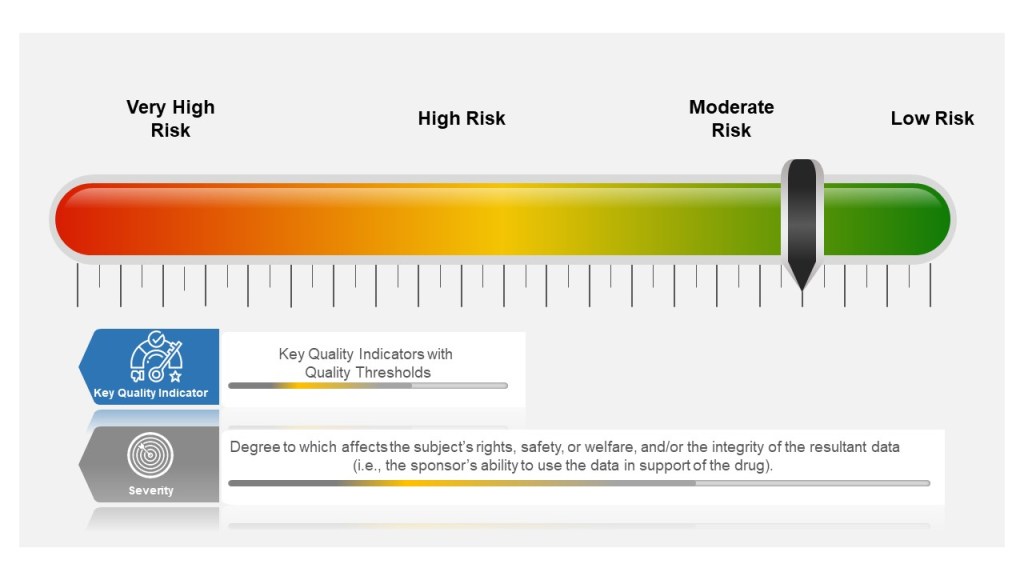
Many companies tend to have a failure scale built into their process, differentiating between protocol deviations and violations based on severity. Others use a minor, major, and even critical scale to denote differences in severity. The axis here for severity is the degree to which affects the subject’s rights, safety, or welfare, and/or the integrity of the resultant data (i.e., the sponsor’s ability to use the data in support of the drug).

Other companies divide into protocol deviations and violations:

  • Protocol Deviation: A protocol deviation occurs when, without significant consequences, the activities on a study diverge from the IRB-approved protocol, e.g., missing a visit window because the subject is traveling. Not as serious as a protocol violation.
  • Protocol Violation: A divergence from the protocol that materially (a) reduces the quality or completeness of the data, (b) makes the ICF inaccurate, or (c) impacts a subject’s safety, rights or welfare. Examples of protocol violations may include: inadequate or delinquent informed consent; inclusion/exclusion criteria not met; unreported SAEs; improper breaking of the blind; use of prohibited medication; incorrect or missing tests; mishandled samples; multiple visits missed or outside permissible windows; materially inadequate record-keeping; intentional deviation from protocol, GCP or regulations by study personnel; and subject repeated noncompliance with study requirements.

This is probably a place when nomenclature can serve to get in the way, rather than provide benefit. The EMA says pretty much the same in “ICH guideline E3 – questions and answers (R1).“

Principles of Events in Clinical Practice

  1. Severity of the event is based on degree to which affects the subject’s rights, safety, or welfare, and/or the integrity of the resultant data
  2. Events (problems, deviations, etc) will happen at all levels of a clinical practice (Sponsor, CRO, Site, etc)
  3. Events happen beyond the Protocol. These need to be managed appropriately as well.
  4. The event needs to be categorized, evaluated and trended by the sponsor

Severity of the Event

Starting in the study planning stage, ICH E6(R2) GCP requires sponsors to identify risks to critical study processes and study data and to evaluate these risks based on likelihood, detectability and impact on subject safety and data integrity.

Sponsors then establish key quality indicators (KQIs) and quality tolerance thresholds. KQI is really just a key risk indicator and should be treated similarly.

Study events that exceed the risk threshold should trigger an evaluation to determine if action is needed. In this way, sponsors can proactively manage risk and address protocol noncompliance.

The best practice here is to have a living risk assessment for each study. Evaluate across studies to understand your overall organization risk, and look for opportunities for wide-scale mitigations. Feedup into your risk register.
Event Classification for Clinical Protocols and GCPs

Where the Event happens

Deviations in the clinical space are a great example of the management of supplier events, and at the end of the day there is little difference between a GMP supplier event management, a GLP or a GCP. The individual requirements might be different but the principles and the process are the same.

Each entity in the trial organization should have their own deviation system where they investigate deviations, performing root cause investigation and enacting CAPAs.

This is where it starts to get tricky. first of all, not all sites have the infrastructure to do this well. Second the nature of reporting, usually through the Electronic Data Capture (EDC) system, can lead to balkanization at the site. Site’s need to have strong compliance programs through compiling deviation details into a single sitewide system that allows the site to trend deviations across studies in addition to following sponsor reporting requirements.

Unfortunately too many site’s rely on the sponsor’s program. Sponsors need to be evaluating the strength of this program during site selection and through auditing.

Events Happen
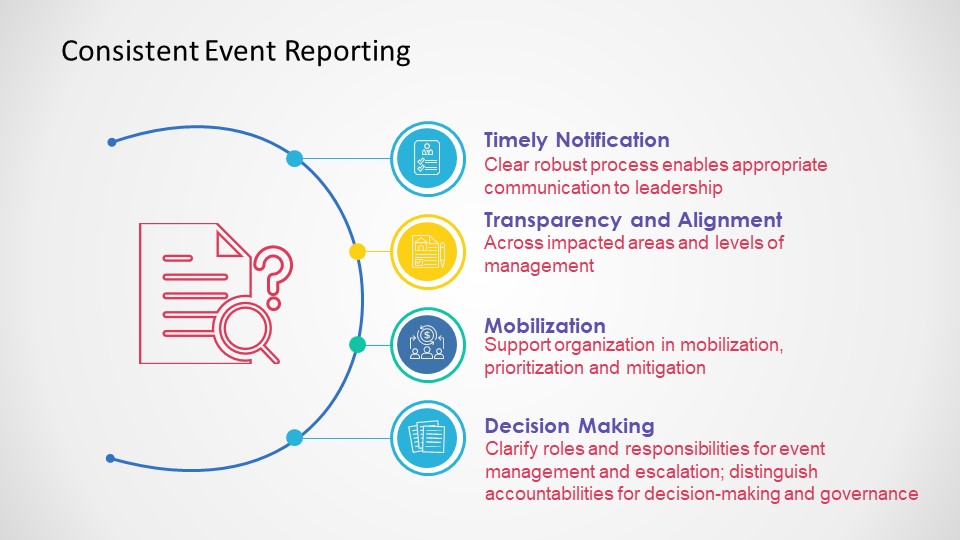
Consistent Event Reporting is Critical

Deviations should be to all process, procedure and plans, and just not the protocol.

Categorizing deviations is usually a pain point and an area where more consistency needs to be driven. I recommend first having a good standard set of categorizations. The industry would benefit from adopting a standard, and I think Norman Goldfarb’s proposal is still the best.

Once you have categories, and understand to your KQIs and other aspects you need to make sure they are consistently done. The key mechanisms of this are:

  1. Training
  2. Monitoring (in all its funny permutations)
  3. Periodic evaluations and Trending

Deviations should be trended, at a minimum, in several ways:

  1. Per site per study
  2. Per site all activities
  3. All sites per study
  4. All sites all activities

And remember, trending doesn’t count of you do not analyze the problem and take appropriate CAPAs.

This will allow trends to be identified and appropriate corrective and preventive actions identified to systematically improve.

Process Architecture

Building a good process requires clear ownership and a deliberate plan. There is a fair amount of work that goes into it, which can be broken down as follows:

   
Category   
   
Sub-category   
   
Basic theme   


Planning   


Process
   
Measurement   
   
Identify,   design, and implement balanced   process metrics and measurement   
   
Implement process   metrics and   measurement reporting mechanisms   
   
Identify and implement KPIs   (And KRIs)    aligned   to process   
   
Evaluate cycle times   and identify potential wastes   
   
Align   level and recognition of people involved in the   process to align with process   


Customer
   
Experience   
   
Process design   with customer interaction trigger mechanisms   
   
Design process in line with customer expectations   
   
Identify customer process performance expectations   
   
Design customer entry points and   define transaction types   


Process Change   
   
Identify incremental and re-engineering process   enhancement opportunities with staff involvement   
   
Design process with minimal process   hand-off’s   
   
Create and execute process improvement plans   
   
Identify process   automation opportunities   
   
Pilot process   design to ensure meeting performance objectives   
   
Governance   
   
Design efficient process with   governance & internal control considerations   
   
Capacity   
   
Conduct demand   and capacity planning   activities   


Staff Training   
   
Develop and conduct staff   training initiatives in line with customer,
   
process, product, and systems expectations   
   
Develop skills   matrix and staff capability requirements in line with process design   
   
Technology   
   
Define technology enablers   
   
Alignment   
   
Align process objectives with organizational goals   
   
Change
   
Management   
   
Engage impacted stakeholders on process changes   


Control   


Process
   
Measurement   
   
Process performance monitoring   
   
Report on process and staff performance with utilization of visual management tools   
   
Obtain continuous customer satisfaction and expectation of process   
   
Active management of process exceptions   
   
Monitor staff performance metrics   


Process Change   
   
Identify process   improvement opportunities on a continuous basis   
   
Focused process hand-off management and   tracking   
   
Capacity   
   
Demand and capacity planning and monitoring   


Governance   
   
Process Change   
   
Process maintenance and continuous update   
   
Define and conform to process documentation standards   
   
Change
   
Management   
   
Process communication and awareness   
   
Staff Training   
   
Utilize process documentation knowledge to facilitate staff training   

Like any activity, it helps to document it. I use a template like this.

Managing Events Systematically

Being good at problem-solving is critical to success in an organization. I’ve written quite a bit on problem-solving, but here I want to tackle the amount of effort we should apply.

Not all problems should be treated the same. There are also levels of problems. And these two aspects can contribute to some poor problem-solving practices.

It helps to look at problems systematically across our organization. The iceberg analogy is a pretty popular way to break this done focusing on Events, Patterns, Underlying Structure, and Mental Model.

Iceberg analogy

Events

Events start with the observation or discovery of a situation that is different in some way. What is being observed is a symptom and we want to quickly identify the problem and then determine the effort needed to address it.

This is where Art Smalley’s Four Types of Problems comes in handy to help us take a risk-based approach to determining our level of effort.

Type 1 problems, Troubleshooting, allows us to set problems with a clear understanding of the issue and a clear pathway. Have a flat tire? Fix it. Have a document error, fix it using good documentation practices.

It is valuable to work the way through common troubleshooting and ensure the appropriate linkages between the different processes, to ensure a system-wide approach to problem solving.

Corrective maintenance is a great example of troubleshooting as it involved restoring the original state of an asset. It includes documentation, a return to service and analysis of data. From that analysis of data problems are identified which require going deeper into problem-solving. It should have appropriate tie-ins to evaluate when the impact of an asset breaking leads to other problems (for example, impact to product) which can also require additional problem-solving.

It can be helpful for the organization to build decision trees that can help folks decide if a given problem stays as troubleshooting or if it it also requires going to type 2, “gap from standard.”

Type 2 problems, gap from standard, means that the actual result does not meet the expected and there is a potential of not meeting the core requirements (objectives) of the process, product, or service. This is the place we start deeper problem-solving, including root cause analysis.

Please note that often troubleshooting is done in a type 2 problem. We often call that a correction. If the bioreactor cannot maintain temperature during a run, that is a type 2 problem but I am certainly going to immediately apply troubleshooting as well. This is called a correction.

Take documentation errors. There is a practice in place, part of good documentation practices, for addressing troubleshooting around documents (how to correct, how to record a comment, etc). By working through the various ways documentation can go wrong, applying which ones are solved through troubleshooting and don’t involve type 2 problems, we can create a lot of noise in our system.

Core to the quality system is trending, looking for possible signals that require additional effort. Trending can help determine where problems lay and can also drive up the level of effort necessary.

Underlying Structure

Root Cause Analysis is about finding the underlying structure of the problem that defines the work applied to a type 2 problem.

Not all problems require the same amount of effort, and type 2 problems really have a scale based on consequences, that can help drive the level of effort. This should be based on the impact to the organization’s ability to meet the quality objectives, the requirements behind the product or service.

For example, in the pharma world there are three major criteria:

  •  safety, rights, or well-being of patients (including subjects and participants human and non-human)
  • data integrity (includes confidence in the results, outcome, or decision dependent on the data)
  • ability to meet regulatory requirements (which stem from but can be a lot broader than the first two)

These three criteria can be sliced and diced a lot of ways, but serve our example well.

To these three criteria we add a scale of possible harm to derive our criticality, an example can look like this:

ClassificationDescription
CriticalThe event has resulted in, or is clearly likely to result in, any one of the following outcomes:   significant harm to the safety, rights, or well-being of subjects or participants (human or non-human), or patients; compromised data integrity to the extent that confidence in the results, outcome, or decision dependent on the data is significantly impacted; or regulatory action against the company.
MajorThe event(s), were they to persist over time or become more serious, could potentially, though not imminently, result in any one of the following outcomes:  
harm to the safety, rights, or well-being of subjects or participants (human or non-human), or patients; compromised data integrity to the extent that confidence in the results, outcome, or decision dependent on the data is significantly impacted.
MinorAn isolated or recurring triggering event that does not otherwise meet the definitions of Critical or Major quality impacts.
Example of Classification of Events in a Pharmaceutical Quality System

This level of classification will drive the level of effort on the investigation, as well as drive if the CAPA addresses underlying structures alone or drives to addressing the mental models and thus driving culture change.

Mental Model

Here is where we address building a quality culture. In CAPA lingo this is usually more a preventive action than a corrective action. In the simplest of terms, corrective actions is address the underlying structures of the problem in the process/asset where the event happened. Preventive actions deal with underlying structures in other (usually related) process/assets or get to the Mindsets that allowed the underlying structures to exist in the first place.

Solving Problems Systematically

By applying this system perspective to our problem solving, by realizing that not everything needs a complete rebuild of the foundation, by looking holistically across our systems, we can ensure that we are driving a level of effort to truly build the house of quality.

Q9 (r1) Risk Management Draft

Q9 (r1) starts with all the same sections on scope and purpose. There are slight differences in ordering in scope, mainly because of the new sections below, but there isn’t much substantially different.

4.1 Responsibilities

This is the first major change with added paragraphs on subjectivity, which basically admits that it exists and everyone should be aware of that. This is the first major change that should be addressed in the quality system “All participants involved with quality risk management activities should acknowledge, anticipate, and address the potential for subjectivity.”

Aligned with that requirement is a third bullet for decision-makers: “assure that subjectivity in quality risk management activities is controlled and minimised, to facilitate scientifically robust risk-based decision making.”

Solid additions, if a bit high level. A topic of some interest on this blog, recognizing the impact of subjectivity is critical to truly developing good risk management.

Expect to start getting questions on how you acknowledge, anticipate and address subjectivity. It will take a few years for this to work its way through the various inspectorates after approval, but it will. There are various ways to crack this, but it will require both training and tools to make it happen. It also reinforces the need for well-trained facilitators.

5.1 Formality in Quality Risk Management

“The degree of rigor and formality of quality risk management should reflect available knowledge and be commensurate with the complexity and/ or criticality of the issue to be addressed.”

That statement in Q9 has long been a nugget of long debate, so it is good to see section 5.1 added to give guidance on how to implement it, utilizing 3 axis:

  • Uncertainty: This draft of Q9 utilizes a fairly simple definition of uncertainty and needs to be better aligned to ISO 31000. This is where I am going to definitely submit comments. Taking a straight knowledge management approach and defining uncertainty solely on lack of knowledge misses the other element of uncertainty that are important.
  • Importance: This was probably the critical determination folks applied to formality in the past.
  • Complexity: Not much said on complexity, which is worrisome because this is a tough one to truly analyze. It requires system thinking, and a ot of folks really get complicated and complex confused.

This section is important, the industry needs it as too many companies have primitive risk management approaches because they shoe-horn everything into a one size fits all level of formality and thus either go overboard or do not go far enough. But as written this draft of Q9 is a boon to consultants.

We then go on to get just how much effort should go into higher formality versus lower level of formality which boils down to higher formality is more stand alone and lower formality happens within another aspect of the quality system.

5.2 Risk-based Decision Making

Another new section, definitely designed to align to ISO 9001-2015 thinking. Based on the level of formality we are given three types with the first two covering separate risk management activities and the third being rule-based in procedures.

6. INTEGRATION OF QUALITY RISK MANAGEMENT INTO INDUSTRY AND REGULATORY OPERATIONS

Section 6 gets new subsection “The role of Quality Risk Management in addressing Product Availability Risks,” “Manufacturing Process Variation and State of Control (internal and external),” “Manufacturing Facilities,” “Oversight of Outsourced Activities and Suppliers.” These new subsections expand on what used to be solely a list of bullet points and provide some points to consider in their topic area. They are also good things to make sure risk management is built into if not already there.

Overall Thoughts

The ICH members did exactly what they told us they were going to do, and pretty much nothing else. I do not think they dealt with the issues deeply and definitively enough, and have added a whole lot of ambiguity into the guidance. which is better than being silent on the topic, but I’m hoping for a lot more.

Subjectivity, uncertainty, and formality are critical topics. Hopefully your risk management program is already taking these into account.

I’m hoping we will also see a quick revision of the PIC/S “Assessment of Quality Risk Management Implementation” to align to these concepts.

ICH Q9 Risk Management (r1) in consultation

ICH Q9 (r1) is in step 2, which means it is out for comments.

Section 5, “Risk Management Methodology” is greatly expanded, with a discussion on just what level of formality means in risk management using three criteria of uncertainty, complexity, and importance. Section 5 then goes into risk based decision making to a greater depth than seen previously in guidances.

Section 6 is greatly expanded as well.

I need to read this in more depth before providing a deeper analysis.