Common Ownership Challenges

Process Ownership Challenges

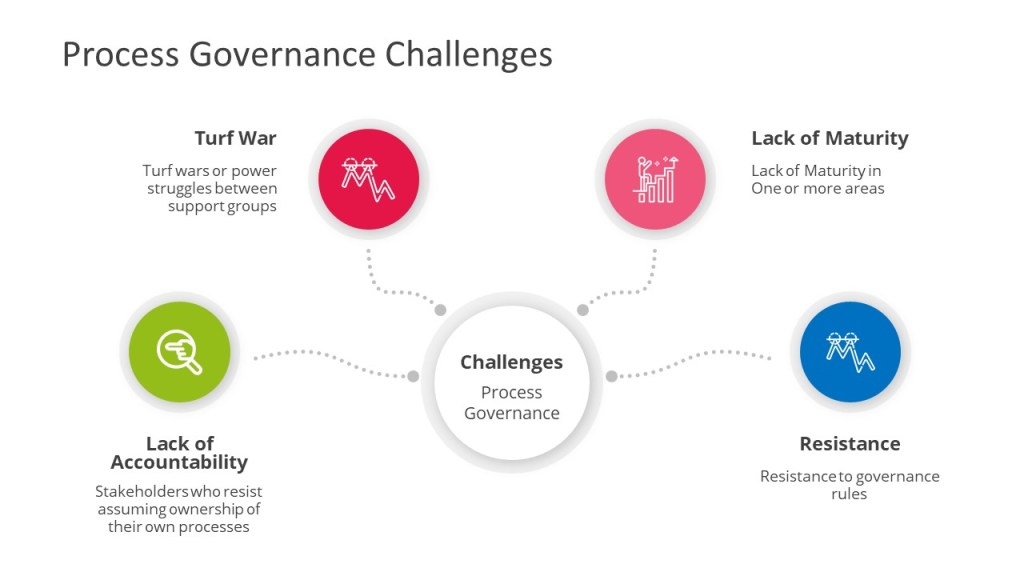
Governance and ownership challenges often arise in an organization for four reasons:

  1. Business stakeholders who resist assuming ownership of their own processes, data and/or knowledge, or have balkanized/siloed accountability
  2. Turf wars or power struggles between groups of stakeholders
  3. Lack of maturity in one or more areas
  4. Resistance to established governance rules

The Business Struggles with Accountability

Processes often have a number of stakeholders, but no apparent owners. This results in opportunity costs as compulsory process changes (e.g. legislative requirements, systems capacity, or company structural changes) or process improvements are not implemented because the business process owner is unaware of the change, or no clear business process owner has been identified which leads to an increase in risk.

Sometimes processes have a number of stakeholders who all think they are the owners of parts of the process or the whole process. When this overlap happens, each supposed owner often identifies their own strategy for the process and issues their own process change instructions to conform to their understanding of the purpose of the business process. These conflicting instructions lead to frustration and confusion by all parties involved.

Lack of accountability in process and system leads to inefficient processes, organizational disharmony, and wasted energy that can be better spent on process improvements.

Turf Wars

Due to silo thinking there can be subdivided processes, owned by different parts of the organization. For example, count how many types of change control your organization has. This requires silos to be broken down, and this takes time.

Lack of Maturity

Governance is challenging if process maturity is uneven across the organization.

Failure to Adhere to Governance

It can be hard to get the business to apply policy and standard consistently.
Process Owner Deliverables

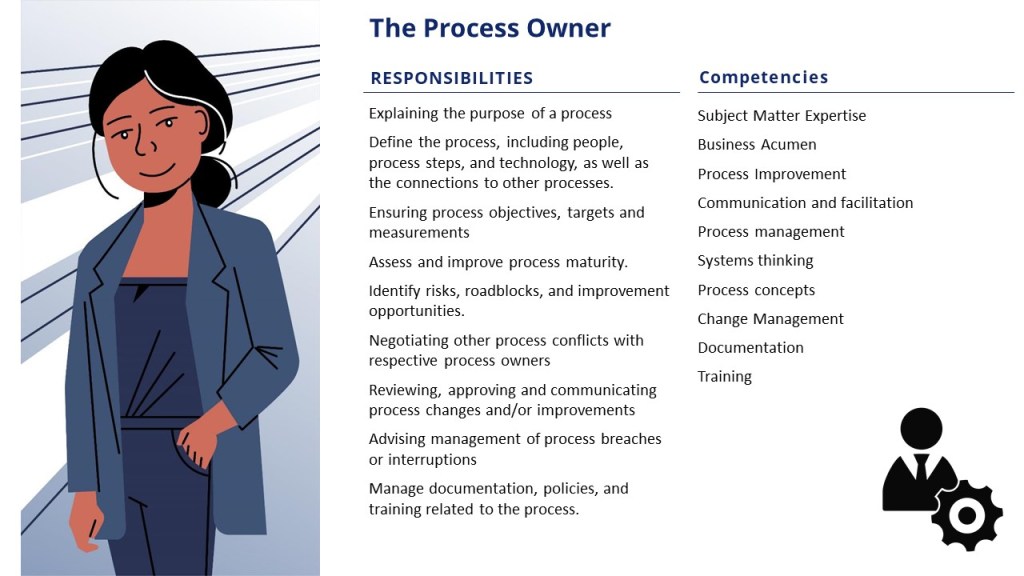
Process Owner implementations require a lot of work, but when used can drive maturity in an organization. To ensure success, it is important to have clear deliverables. Below are a few recommendations:

TaskDemonstrated by
Ensuring process objectives are metGap Assessment against relevant external (e.g. regulations, standards, benchmarks) and internal (e.g. policy, strategy) obligations Process Definition Document and Resource Requirements Plan
Developing, deploying, and managing process documentationProcess and procedure documented (e.g. SOP, WI, etc)
Determine training requirementsRole-based curricula in place
Determining, implementing and monitoring metricsMetrics plan in place and in use
Improving process performanceImprovement plan in place and in use
Representing Process to LeadershipCommunication plan in place and in use
Representing the process during internal audits and third-party audits and inspectionsInspection readiness plan in place and in use

The Program Level in the Document Hierarchy

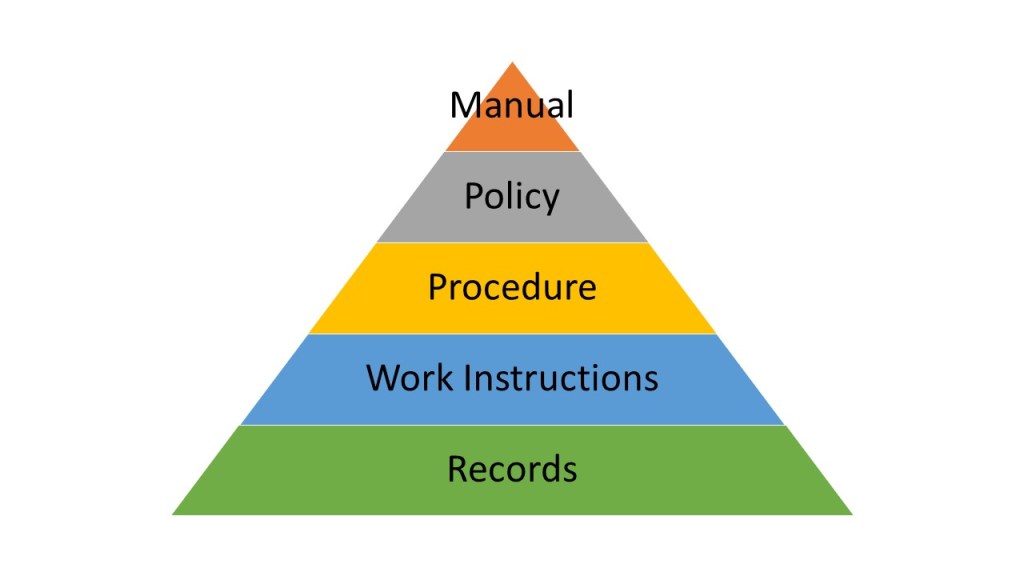
A fairly traditional document hierarchy, in line with ISO 9001 and other standards looks like this:

Document hierarchy

This process tends to support best an approach where there is a policy that states requirements to do X, a procedure that gives the who, what, when of X, and work instructions that provide the how of X, which results in a lot of records providing X was done.

But life is complicated, and there are sets of activities that combine the Xs in a wide variety, and in complicated environments there may be multiple ways to bundle the Xs.

This is why I add a layer between policy and procedure, called the program, which is a mapping requirement that shows the various ways to interpret the requirements to specific needs.

Document hierarchy with Programs

The program document level shouldn’t be a stranger to those in the GMP world, ICH Q11 control strategy and the Annex 1 contamination control strategy are two good examples. What this document does is tie together processes and demonstrates the design that went into it.

The beauty of this document is that it helps translate down from the requirements (internal and external) to the process and procedures (including technology), how they interact, and how they are supported by technical assessments, risk management, and other control activities. Think of it as the design document and the connective tissue.

Process Architecture

Building a good process requires clear ownership and a deliberate plan. There is a fair amount of work that goes into it, which can be broken down as follows:

   
Category   
   
Sub-category   
   
Basic theme   


Planning   


Process
   
Measurement   
   
Identify,   design, and implement balanced   process metrics and measurement   
   
Implement process   metrics and   measurement reporting mechanisms   
   
Identify and implement KPIs   (And KRIs)    aligned   to process   
   
Evaluate cycle times   and identify potential wastes   
   
Align   level and recognition of people involved in the   process to align with process   


Customer
   
Experience   
   
Process design   with customer interaction trigger mechanisms   
   
Design process in line with customer expectations   
   
Identify customer process performance expectations   
   
Design customer entry points and   define transaction types   


Process Change   
   
Identify incremental and re-engineering process   enhancement opportunities with staff involvement   
   
Design process with minimal process   hand-off’s   
   
Create and execute process improvement plans   
   
Identify process   automation opportunities   
   
Pilot process   design to ensure meeting performance objectives   
   
Governance   
   
Design efficient process with   governance & internal control considerations   
   
Capacity   
   
Conduct demand   and capacity planning   activities   


Staff Training   
   
Develop and conduct staff   training initiatives in line with customer,
   
process, product, and systems expectations   
   
Develop skills   matrix and staff capability requirements in line with process design   
   
Technology   
   
Define technology enablers   
   
Alignment   
   
Align process objectives with organizational goals   
   
Change
   
Management   
   
Engage impacted stakeholders on process changes   


Control   


Process
   
Measurement   
   
Process performance monitoring   
   
Report on process and staff performance with utilization of visual management tools   
   
Obtain continuous customer satisfaction and expectation of process   
   
Active management of process exceptions   
   
Monitor staff performance metrics   


Process Change   
   
Identify process   improvement opportunities on a continuous basis   
   
Focused process hand-off management and   tracking   
   
Capacity   
   
Demand and capacity planning and monitoring   


Governance   
   
Process Change   
   
Process maintenance and continuous update   
   
Define and conform to process documentation standards   
   
Change
   
Management   
   
Process communication and awareness   
   
Staff Training   
   
Utilize process documentation knowledge to facilitate staff training   

Like any activity, it helps to document it. I use a template like this.

Understanding How to Organize Process

Process drives the work we do. We can evaluate processes on two axis – complexity and strategy – that help us decide the best way to manage and improve the processes.

Process by Complexity and Strategy

Process complexity and dynamics are what types of tasks are involved in the process. Is it a simple, repetitive procedure with a few rules for handling cases outside of normal operation? Or is it a complex procedure with lots of decision points and special case rules? Think of this like driving somewhere. Driving to your local grocery is a simple procedure, with few possibilities of exceptions. Driving across the country has a ton of variables and dynamism to it.

While complexity can help drive the decision to automate, I strongly recommend that when thinking about it don’t ask if it can be automated, only ask what would be involved if a human were to do the job or how it is done with current technologies. Starting with the answer of automation leads to automation for automation’s sake, and that is a waste.

Dynamics is how much the process changes – some change rarely while others change rapidly to keep pace in response to changes in product or external factors (such as regulations).

Strategic importance asks about the value the process contributes to meeting requirements. Is the process a core competency, or an enabling process that needs to be accomplished to ensure that you can do something else that meets the core requirements? Needless to say, one company’s strategic process is another company’s routine process, which is why more and more we are looking at organizations as ecosystems.

Processes are in a hierarchy, and we use levels to describe the subdivision of processes. We’ve discussed the difference between process, procedure and task. At the process level we usually have the high-level process, the architecture level, which are the big things an organization does (e.g. research, manufacture, distribute), mid-level processes that are more discrete activities (e.g. perform a clinical study) to even more discrete processes (e.g. launch a study) which usually have several levels (e.g. select sites, manage TMF) to finally procedure and task.

Level of ProcessIncludesKey Ways to Address
High-Level ProcessHow key objectives are met, highly cross functionalOrganization design. System Design
Mid-level ProcessHow a specific set of departments do their major work blocksProcess Improvement
Low-level processHow individuals conduct their work in sub-blocksKnowledge management, task analysis, training
Levels of Process

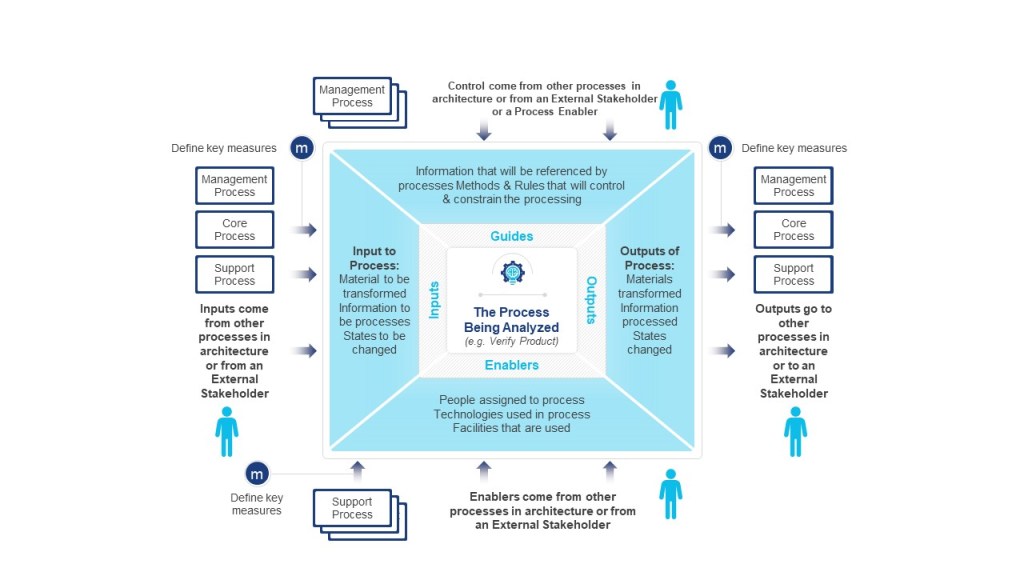
To truly get to this level of understanding of process, we need to understand just what our process is, which is where tools like the SIPOC or Process Scope diagram can come in handy.

Process Scope Diagram

To understand a process we want to understand six major aspects: Output, Input, Enablers, Controls, Process Flow, People.

Complex and Complicated as Tools for Process Understanding

Simple processes usually follow a consistent, well-defined sequence of steps with clearly defined rules. Each step or task can be precisely defined, and the sequence lacks branches or exceptions.

More complicated processes involve branches and exceptions, usually draw on many rules, and tend to be slightly less defined. Complicated processes require more initiative on the part of human performers.

Complex processes are ones that require a high level of initiative and creativity from people. These processes rapidly change and evolve as time passes. Successful performance usually requires a connection to an evolving body of knowledge. They are highly creative and have a large degree of unpredictability. Most complex processes are viewed at the system level.

Sources

  • Benedict, T. et al. BPM CBOK Version 4.0: Guide to the Business Process Management Common Body of Knowledge. ABMP International, 2019.
  • Harmon, Paul. Business Process Change. Morgan Kaufmann, 2019.
  • Nuland, Y. and Duffy, G. Validating a Best Practice. Productivity Press, 2020