
Navigating the New Era of Quality Management

One of the topics I’m passionate about is exploring the changing landscape of quality management and the challenges we face. The solutions that worked in the past decade won’t be as effective in our current era, marked by post-globalization, capital rationalization, spatial dispersion, shrinking workforces, and an increasing reliance on automation. This transformation calls for a new perspective on quality management, as traditional instincts and strategies may no longer be sufficient. The nature of opportunity and risk has fundamentally changed, and in order to thrive, we need to adapt our approach.

The New Rules of Engagement

In this era of volatility, several key trends are reshaping the business environment:

  • Post-Globalization: The shift towards localized operations and supply chains.
  • Capital Rationalization: More stringent allocation of financial resources. This is a huge trend in biotech.
  • Spatial Dispersion: Decentralized workforces and operations.
  • Shrinking Workforces: Reduced human resources due to demographic changes.
  • Dependence on Automation: Increased reliance on technologies like AI, ML, and RPA.

We need to reevaluate how we approach quality management in light of these trends.

Prediction: Anticipating the Future

In a volatile environment, it is crucial to predict and anticipate disruptions. Quality management must shift from being reactive to proactive. This involves:

  • Advanced Analytics: Utilizing data analytics to anticipate quality issues before they emerge. This necessitates a strong data foundation and the capability to analyze both structured and unstructured data.
  • Scenario Planning: Developing multiple scenarios to anticipate potential disruptions and their impacts on quality aids in making well-informed strategic decisions and preparing for various contingencies.

Adaptability: Embracing Change

Adaptability is crucial in a constantly changing world. Quality management systems need to be flexible and responsive to new challenges.

  • Agile Methodologies: Implementing agile practices to allow for quick adjustments to processes and workflows, fostering a culture of experimentation, and learning from failures.
  • Virtualization of Work: Adapting quality processes to support remote and hybrid work environments involves re-evaluating governance models and ensuring that quality standards are maintained regardless of the location of work.

Resilience: Building Robust Systems

Resilience ensures that organizations can withstand and recover from disruptions. This capability is built on strong foundations:

  • Robust Systems: Developing systems that can operate effectively under stress. This includes ensuring that automated processes are reliable and that there are contingencies for system failures.
  • Organizational Culture: Fostering a culture that values resilience and continuous improvement ensures that employees are prepared to handle disruptions and contribute to the organization’s long-term success.

Implementing the New Quality Paradigm

To effectively implement these principles, organizations should consider the following steps:

  1. Assess the Current State: Conduct a comprehensive assessment of existing quality processes, identifying areas for improvement and potential vulnerabilities.
  2. Set Clear Objectives: Establish clear, measurable objectives that align with the principles of prediction, adaptability, and resilience.
  3. Develop a Phased Approach: Implement changes gradually, with clear milestones and measurable outcomes to ensure smooth transitions.
  4. Engage Stakeholders: Involve all relevant stakeholders in the transformation process to ensure alignment and buy-in.
  5. Monitor Progress: Continuously monitor progress against predefined objectives and make adjustments as necessary to stay on track.
  6. Invest in Training: Provide employees with the necessary training and development opportunities to adapt to new technologies and processes.

Conclusion

It is important to change our mindset and strategy. Embracing the principles of prediction, adaptability, and resilience can help organizations navigate the complexities of a volatile environment and position themselves for long-term success. Going forward, it is essential to stay vigilant, flexible, and proactive in our approach to quality management. We must ensure that we not only meet but exceed stakeholder expectations in this rapidly changing world.

A Collaborative Learning Event I Might Run

To complete a thought on community of practices I did this weekend with “A CoP is Collaborative Learning, not Lecture” and “How I would Organize a Meeting of a CoP” I’m now going to build, from the group up, a collaborative learning event I would love to organize.

A little caveat: I really burnt out on professional obligations last year and have just started to peak my head out. So, it may be a little harder to turn this mad scientist dream into a reality. However, I think it is worth putting out as a thought experiment.

Theme and Scope

I’ve written a bit about the challenges to quality, and these challenges provide a framework for much of what I think and write about.

More specifically drawing from the “Challenges in Validation” focusing on the challenges of navigating a complex validation landscape characterized by rapid technological advancements, evolving regulatory standards, and the development of novel therapies.

This event would ask, “How do we rise to the challenges of validation in the next decade, leveraging technology and a risk management approach and drawing from the best practices of ASTM E2500, GAMP5, and others to meet and exceed changing regulatory requirements.”

Intended Audience

I go to events, and there are a lot of quality people, OR risk management people, OR computer systems (IT and Q) people, OR engineers, OR analytical method folks, OR process development people. Rarely do I see an event that looks at the whole picture. And rarely do I get to attend an event where we are sharing and blurring the lines between the various silos. So let us break down the silos and invite quality, IT, engineers, and process development individuals involved in the full spectrum of pharmaceutical (and possibly medtech) validation.

This holistic event is meant to blend boundaries, share best practices, challenge ourselves, and look across the entire validation lifecycle.

Structure

Opening/Networking (1 hour)

As people arrive, they go right into a poster event. These posters are each for a specific methodology/approach of ASTM E2500, ISPE Baseline Guides, FDA’s Guidance for Process Validation: General Principles and Practices, ICH’s QbD approach, and GAMP5. Maybe some other things.

These posters would each:

  • Provide an overview of what it is and why it is important
  • Overview of methodology
  • What challenges it overcomes
  • Lessons that can be applied
  • Challenges/problems inherent in the approach

These posters would be fun to develop and take a good squad of experts.

After an hour of mingling, sharing, and baselining, we could move to the next step.

Fish Bowl Debate (45 minutes)

Having earlier selected a specific topic and a panel of experts, hold a fish bowl debate. This would be excellent as a mock-inspection, maybe of a really challenging topic. Great place to bring those inspectors in.

During a fish bowl, everyone not in the center is taking notes. I love a worksheet to help with this by providing things to look for to get the critical thinking going.

Future Workshop (1.5 hour)

  1. Introduce the activity (10 min)
  2. Ask participants to reflect on their present-day situation, write down all their negative experiences on sticky notes, and place them on the wall. (15 min)
  3. Invite participants to list uncertainties they face by asking, “In your/our operating environment, what factors are impossible to predict or control their direction?” (5 min).
  4. Prioritize the most critical factors by asking, “Which factors threaten your/our ability to operate successfully?” (10 min)
  5. Based on the group’s history and experience, select the two most critical and most uncertain (X and Y). (5 min)
  6. Create a grid with two axes—X & Y—with a “more of <— —> less of” continuum to represent the factor on each axis. For example, suppose new modalities are a critically uncertain factor for the X-axis. In that case, one end of the X-axis is many new modalities, and the other is no new modalities. Repeat for the Y factor and axis. For instance, if patent protection is a critical factor, one end of the Y axis is strong patent protection, and the other has no patent protection. Four quadrants are created. (5 min)
  7. Break into four groups, and each group creatively names and writes a thumbnail scenario for one of the quadrants. (10 min)
  8. The four groups share their scenarios briefly. 2 min. each
  9. Participants fantasize about the desired future situation. How would the ideal situation be for them? At this stage, there are no limitations; everything is possible. Write on stick notes and apply them to the most likely quadrant. (10 minutes)
  10. Do a n/3 activity to find the top ideas (enough for groups of 4-5 each) (3 min)
  11. Explain the next activity (2 min)

Lunch (1 hour)

Open Space Solution (1 hour)

For each top idea, the participants vote with their feet and go to develop the concept. Each group is looking to come up with the challenge solved, a tool/methodology, and an example.

Review the Results of the Open Space Solutions (1 hour)

Each team presents for 5-8 minutes.

1-2-4-All (20 minutes)

  1. Silent self-reflection by individuals on the shared challenge, framed as a question “What opportunities do YOU see for making progress on this challenge? How would you handle this situation? What ideas or actions do you recommend?” (1 min)
  2. Generate ideas in pairs, building on ideas from self-reflection. (2 min)
  3. Share and develop ideas from your pair in foursomes (notice similarities and differences).( 4 min)
  4. Ask, “What is one idea that stood out in your conversation?” Each group shares one important idea with all (15 min)

Closing Commitment (5 min)

Where will this live? What comes next? Make a commitment to follow up electronically.

Networking

Spend an hour or so with drinks and food and discuss everything. Never enough socialization.

Challenges in Validation

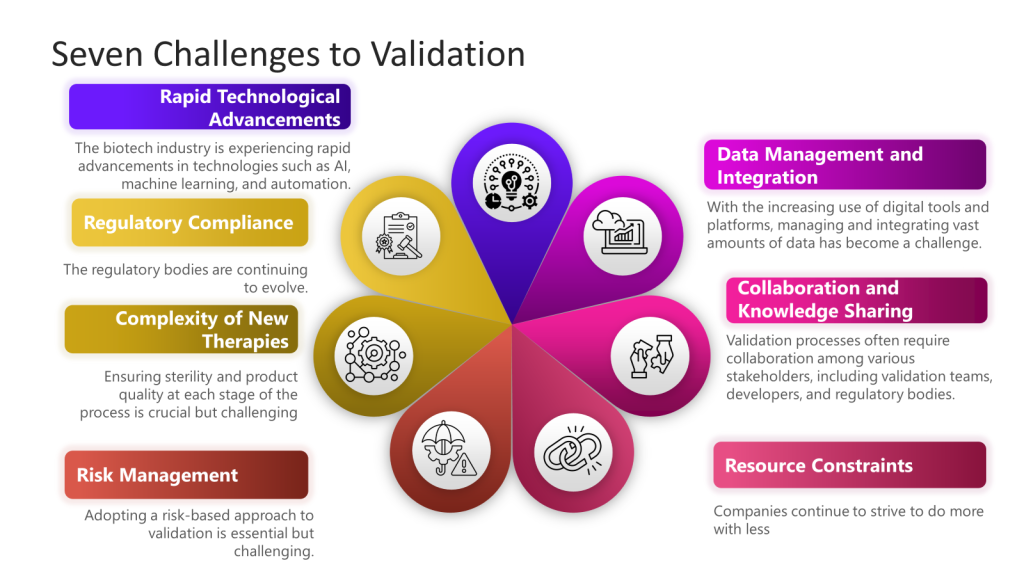
I often get asked why I moved from a broader senior role in Quality Management to a particular but deep role in Quality Engineering and Validation. There are many answers, but the biggest is that validation is poised for some exciting shifts due to navigating a complex validation landscape characterized by rapid technological advancements, evolving regulatory standards, and the development of novel therapies. Addressing these challenges requires innovation, collaboration, and a proactive approach to risk management and data integration. Topics near and dear to me.

Today’s Challenges in Biotech Validation

1. Rapid Technological Advancements

The biotech industry is experiencing rapid technological advancements such as AI, machine learning, and automation. Integrating these technologies into validation processes can be challenging due to the need for new validation frameworks and methodologies.

2. Regulatory Compliance

Maintaining compliance with evolving regulatory standards is a significant challenge. Regulatory bodies like the FDA continuously update guidelines for technological advancements.

3. Complexity of New Therapies

Developing novel therapies, such as cell and gene therapies, introduces additional complexity to the validation process. These therapies often require redesigned facilities and equipment to accommodate their sensitive and sterile nature. Ensuring sterility and product quality at each process stage is crucial but challenging.

4. Data Management and Integration

Managing and integrating vast amounts of data has become challenging with the increasing use of digital tools and platforms. Effective data management is essential for predictive modeling and risk management in validation processes. Organizations must adopt robust data analytics and machine learning tools to handle this data efficiently.

5. Collaboration and Knowledge Sharing

Validation processes often require collaboration among various stakeholders, including validation teams, developers, and regulatory bodies. Ensuring real-time communication and data sharing can be challenging but is essential for streamlining validation efforts and aligning goals.

6. Resource Constraints

Smaller biotech companies, in particular, face resource constraints regarding funding, personnel, and expertise. These constraints can hinder their ability to implement advanced validation techniques and maintain compliance with regulatory standards.

7. Risk Management

Adopting a risk-based approach to validation is essential but challenging. Companies must identify and mitigate risks throughout the product lifecycle, which requires a thorough understanding of potential risks and effective risk management strategies.

Let’s Avoid the Term Validation 4.0

Let’s avoid the 4.0 term. We are constantly evolving, and adding a current ‘buzziness’ to it does no one any favors. We are shifting from traditional, paper-heavy validation methods to a more dynamic, data-driven, and digitalized process. Yes, we are leveraging modern technologies such as automation, data analytics, artificial intelligence (AI), and the Internet of Things (IoT) to enhance validation processes’ efficiency, flexibility, and reliability. But we don’t need buzziness, we just need to give it some thought, experiment, and refine.