Fostering Critical Thinking

As a leader, fostering critical thinking in my team and beyond is a core part of my job. Fostering critical thinking means an approach that encourages open-mindedness, curiosity, and structured problem-solving.

Encourage Questioning and Healthy Debate

It is essential to create an environment where team members feel comfortable questioning assumptions and engaging in constructive debates. Encourage them to ask “why” and explore different perspectives. This open dialogue promotes deeper thinking and prevents groupthink.

Foster a Culture of Curiosity

Inspire your team to ask questions and seek deeper understanding. Role model this behavior by starting meetings with thought-provoking “what if” scenarios or sharing your own curiosities. Celebrate curiosity and reward those who think outside the box.

Assign Stretch Assignments

Provide your team with challenging tasks that push them beyond their comfort zones. These stretch assignments force them to think critically, analyze information from multiple angles, and develop innovative solutions.

Promote Diverse Perspectives

Encourage diversity of thought within your team. Diverse backgrounds, experiences, and viewpoints can challenge assumptions and biases, leading to a more comprehensive understanding and better decision-making.

Engage in Collaborative Problem-Solving

Involve your team in decision-making processes and problem-solving exercises. Techniques like role reversal debates, where team members argue a point they disagree with, can help them understand different perspectives and refine their argumentative skills.

Provide Training and Resources

Offer training sessions on critical thinking techniques, such as SWOT analysis, root cause analysis, and logical fallacies. Equip your team with the tools and frameworks they need to think critically.

Lead by Example

As a leader, model critical thinking behaviors. Discuss your thought processes openly, question your assumptions, and show the value of critical evaluation in real-time decision-making. Your team will be more likely to emulate these habits.

Encourage Continuous Learning

Recommend learning resources, such as courses, articles, and books from diverse fields. Continuous learning can broaden perspectives and foster multifaceted thinking.

Embrace Feedback and Mistakes

Establish feedback loops within the team and create a safe environment where mistakes are treated as learning opportunities. Receiving and giving feedback helps refine understanding and overcome biases.

Implement Role-Playing Scenarios

Use role-playing scenarios to simulate real-world challenges. This helps team members practice critical thinking in a controlled environment, enhancing their ability to apply these skills in actual situations.

Build Into the Team Charter

Building these expectations into the team charter holds you and your team accountable.
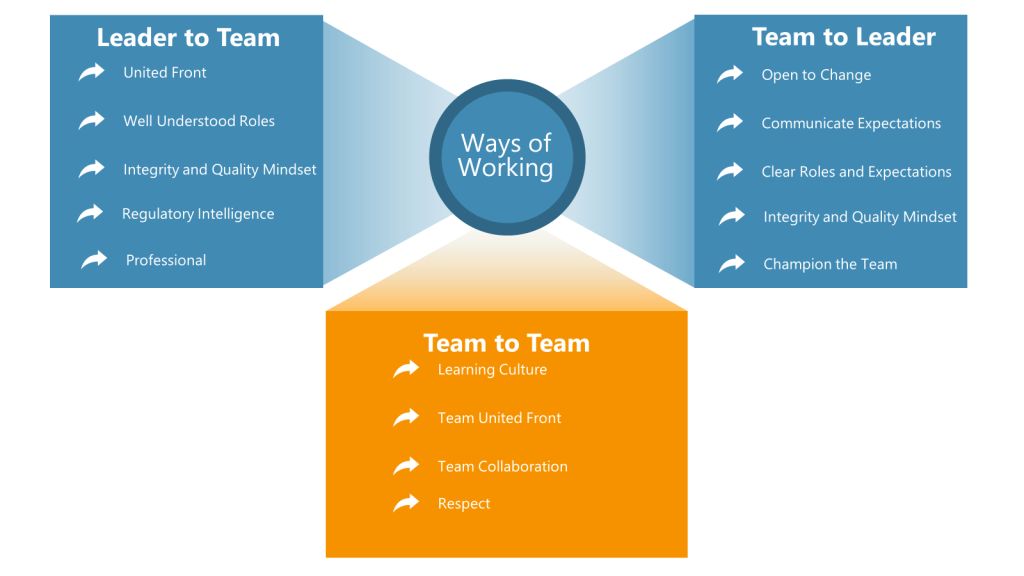
Value: Regulatory Intelligence

Definition: Stay current on industry regulations and guidances. 

Desired Behaviors:

  1. I will dedicate time to reading industry-related guidance and regulation publications related to my job.
  2. I will share publications that I find interesting or applicable to my job with the team
  3. I will present to the team on at least one topic per year to share learnings with the team (or wider organization)

Value: Learning Culture

Definition: Share lessons learned from projects so the team can grow together and remain aligned.  Engage in knowledge-sharing sessions.

Desired Behaviors:

  1. I will share lessons learned from each project with the wider team via the team channel and/or weekly team meeting.
  2. I will encourage team members to openly share their experiences, successes, and challenges without fear of judgement.
  3. I will update RAID log with decisions made by the team.
  4. I will identify possible process improvements and update the process improvement tracker.

Value: Team Collaboration

Definition: Willingness to help teammates when they reach out for input/help

Desired Behaviors:

  1. I will be supportive of my teammate’s requests for assistance
  2. I will engage and offer my SME advice when asked or help identify another SME to assist 
  3. I will not ignore requests for input/help
  4. I will contribute to an environment where teammates can request help

The Great Man Fallacy and Pharmaceutical Quality

Primary Investigator, Study Director, Qualified Person, Responsible Person – the pharmaceutical regulations are rife with a series of positions that are charged with achieving compliance and quality results. I tend to think of them as a giant Achilles heel created by the regulations.

The concept of an individual having all the accountability is nowhere near universal, for example, the term Quality Unit is a nice inclusive we – though I do have some quibbles on how it can end up placing the quality unit within the organization.

This is an application of the great man fallacy – the idea that one person by the brunt of education, experience, and stunning good looks can ensure product safety, efficacy and quality, and all the other aspects of patient and data integrity of trials.

That is, frankly, poppycock.

People only perform successfully when they are in a well-built system. Process drives success and leverages the right people at the right time making the right decisions with the right information. No one person can do that, and frankly thinking someone can is setting them up for failure. Which we see, a lot in the regulatory space.

Sure, the requirement exists, we need to meet it failing the agencies waking up and realizing the regulations are setting us up for failure. But we don’t need to buy into it. We build our processes to leverage the team, to democratize decisions, and to drive for reliable results.

Let’s leave the great man theory in the dustbins where it belongs.

dissolving crown

Leaders in the Way

In “How Leaders Get in the Way of Organizational Change” in Harvard Business Review, Ron Carucci discusses ways leaders can create problems in change.

The three main pain points he discusses are:

  • Scope naiveté: Underestimating the work
  • Change laziness: Overestimating the organization’s capacity
  • The perceived pet project: Misjudging how others see you

Great article, I strongly recommend reading it.

For each of these democratic leadership is an effective path to avoiding.

  • Idealized Influence: By holding oneself accountable you spend the time to understand the organization’s capacity
  • Inspirational Motivation: Moving from pet project to what is best for the organization
  • Intellectual Stimulation: Strive to overcome scope naiveté
  • Decentralized decision-making: Get the organization bought in to accelerating the change
Photo by Zen Chung on Pexels.com

Curiosity

Curiosity is a superpower that enables us to improve our lives. Empathic curiosity allows people to listen thoughtfully and see problems or decisions from another’s perspective, not to criticize or judge, but to understand. Asking questions promotes more meaningful connections and more creative outcomes. When we carefully listen to the answers we seek, we build better relationships faster, fuel employee engagement, and reduce conflict.

George Mason and Patrick McKnight created a five-dimensional model of curiosity that can help us understand curiosity and how to nurture it.

The first dimension, deprivation sensitivity, causes us to recognize a gap in our knowledge. Filling it offers relief. This type of curiosity doesn’t necessarily feel good, but it causes us to feel better once we have a solution to a problem. For instance, a trip to the emergency room will give answers to the question about whether a person has had a heart attack. Both a “yes” or “no” answer will satisfy our curiosity.

The second dimension, joyous exploration, causes us to be consumed with wonder about the fascinating features of the world. This exploration produces pleasure among those curious enough to pursue answers.

The third dimension, social curiosity, encourages us to talk, listen, and observe others to learn what they are thinking and doing. Since we are inherently social animals, we find communication the most effective and efficient way to gain information that will allow us to determine whether someone is friend or foe. Some may even snoop, eavesdrop, or gossip to do so.

The fourth dimension, stress tolerance, relates to our willingness to accept and even harness the anxiety associated with novelty. People who lack stress tolerance see information gaps, experience wonder, and have an interest in others, but they don’t tend to satisfy their curiosity by stepping forward and exploring.

The fifth dimension, thrill seeking, goes beyond tolerating stress to embracing a willingness to take physical, social, and financial risks to acquire varied, complex, and intense experiences. For people with this capacity, the anxiety of confronting novelty is something to be amplified, not reduced.

Curiosity is the catalyst that brings job satisfaction, motivation, innovation, and high performance. It fosters collaboration and fortifies organizational resilience by prompting creative problem-​ solving in the face of uncertainty and pressure.

Good leaders build and reward curiosity in their organizations by:

  • Rewarding creative failures. Recognize the value of effort and experimentation, even when it fails.
  • Understand that curious people learn quickly and bore easily. Encourage continuous growth and learning.
  • Give ever-​challenging work and real authority to make a difference.
  • Make organizations places where the curious choose to work and become magnets for other top performers.
  • Give direction in the form of democratic guidance, not an absence of direction. Don’t micromanage. If you try to micromanage a curious person just a little, you will lose that person.
Photo by Tatiana Syrikova on Pexels.com

Changes stems from learning from mistakes

As we build quality culture we need to question our basic assumptions and build new principles of every day interactions. At the heart of this sits a culture where change is viewed as a good thing.

Willingness to change

To what extent are employees willing to continuously review and adapt their own behavior in response to a changing environment? The ideal scenario is for the entire workforce to be willing to change. This willingness to change should not be confined to situations where changes are already being implemented. It means that people should look at environment with open eyes, recognize when there is an opportunity or a need for change and initiate the relevant actions themselves. Willingness to change should be the first principle of culture and is a key enabler of the popular concept often called agility.

Learning Culture

To what extent do employees think that their actions should be guided by data- and fact-based knowledge? The term “knowledge” encompasses any knowledge acquired through targeted observation, by chance, through data-based analysis or from practical experience.

Willingness to make mistakes

Learning cultures attach great importance to mistakes. These organizations have understood that learning and change processes can only be triggered by mistakes. Mistakes provide an opportunity to gain a better understanding of the company’s processes and uncover previously unknown cause-and-effect relationships.

The way an organization deals with mistakes is therefore a key aspect of its culture. Two fundamentally different approaches to mistakes exist.

  • A negative attitude towards mistakes is reflected in a strategy based on the systematic avoidance of errors, strict penalties for making mistakes and the correction of errors as rapidly and unobtrusively as possible. Employees of companies where this culture prevails are not usually willing to disclose mistakes. This attitude inhibits their willingness to change.
  • On the other hand, a culture that recognizes the value of mistakes is characterized by open discussion of mistakes when they occur, systematic error documentation and a determination to find both the causes of the mistakes and their solutions. When investigating mistakes, it is critical to focus on understanding the causes rather than on finding out who is to blame.

Openness to Innovation

Openness to innovation and new ways of doing things is an important capability that is required in order to initiate change and adopt the right measures, even if they may sometimes be rather unconventional.

Social Collaboration

An environment characterized by trust and social relationships provides the basis for open, uninhibited knowledge sharing between employees. Social collaboration, helps to accelerate knowledge sharing within the organization. Good strong social networks build resilience and enable the ability to change.

Open Communication

In order for companies to respond rapidly and to be able to effectively change, employees need to have access to the necessary explicit and implicit knowledge. While explicit knowledge can be provided through the appropriate communication technology, the sharing of implicit knowledge calls for direct communication between the people who possess the knowledge and the people seeking it.

An effective organization needs to abandon the “us and them” mentality. Employees have acquired the capability of open communication if, having taken on board the fact that openly sharing knowledge and working together to achieve a vision increases the total sum of knowledge, they then also act
accordingly. Once the organization’s entire workforce is willing to share knowledge with everyone, it becomes possible to significantly accelerate learning processes within the company.

What Does This Look Like?

Social collaboration exists between employees and with customers and partners. Confidence in systems and processes results in high process stability. People are willing to document their acquired knowledge and share it with others. The democratic leadership style values people for the contribution they make and there is a culture of open communication. The workforce is both receptive and willing to change. They learn systematically from the captured data, are open to innovative approaches and participate in shaping change processes. Employees are also conscious of the need to continuously develop their skills and competencies. While mistakes are still made, people recognize that they are valuable because they have the potential to trigger improvements.

Where we need to be