Navigating Metrics in Quality Management: Leading vs. Lagging Indicators, KPIs, KRIs, KBIs, and Their Role in OKRs

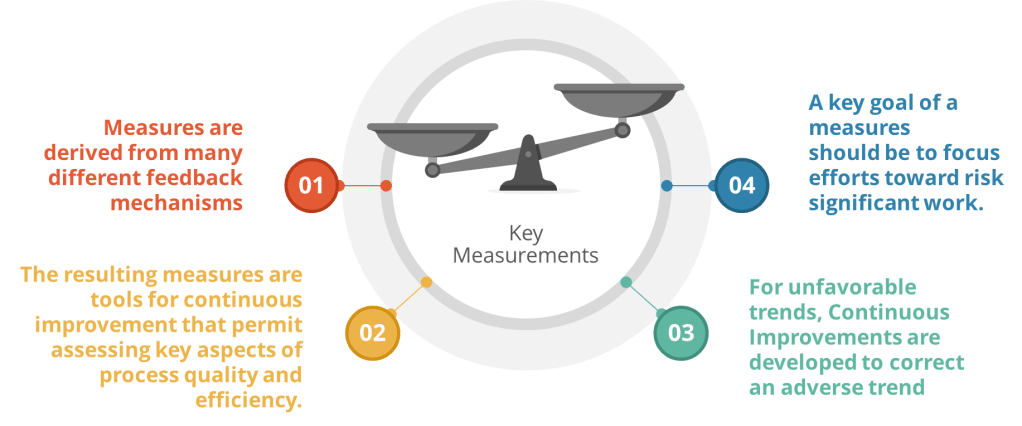
Understanding how to measure success and risk is critical for organizations aiming to achieve strategic objectives. As we develop Quality Plans and Metric Plans it is important to explore the nuances of leading and lagging metrics, define Key Performance Indicators (KPIs), Key Behavioral Indicators (KBIs), and Key Risk Indicators (KRIs), and explains how these concepts intersect with Objectives and Key Results (OKRs).
Leading vs. Lagging Metrics: A Foundation

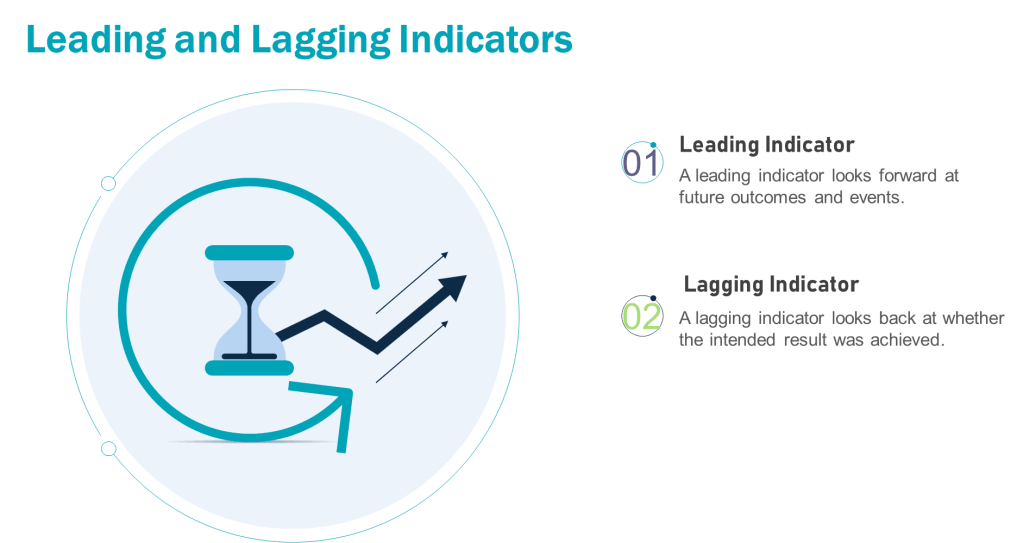
Leading metrics predict future outcomes by measuring activities that drive results. They are proactive, forward-looking, and enable real-time adjustments. For example, tracking employee training completion rates (leading) can predict fewer operational errors.

Lagging metrics reflect historical performance, confirming whether quality objectives were achieved. They are reactive and often tied to outcomes like batch rejection rates or the number of product recalls. For example, in a pharmaceutical quality system, lagging metrics might include the annual number of regulatory observations, the percentage of batches released on time, or the rate of customer complaints related to product quality. These metrics provide a retrospective view of the quality system’s effectiveness, allowing organizations to assess their performance against predetermined quality goals and industry standards. They offer limited opportunities for mid-course corrections

The interplay between leading and lagging metrics ensures organizations balance anticipation of future performance with accountability for past results.
Defining KPIs, KRIs, and KBIs

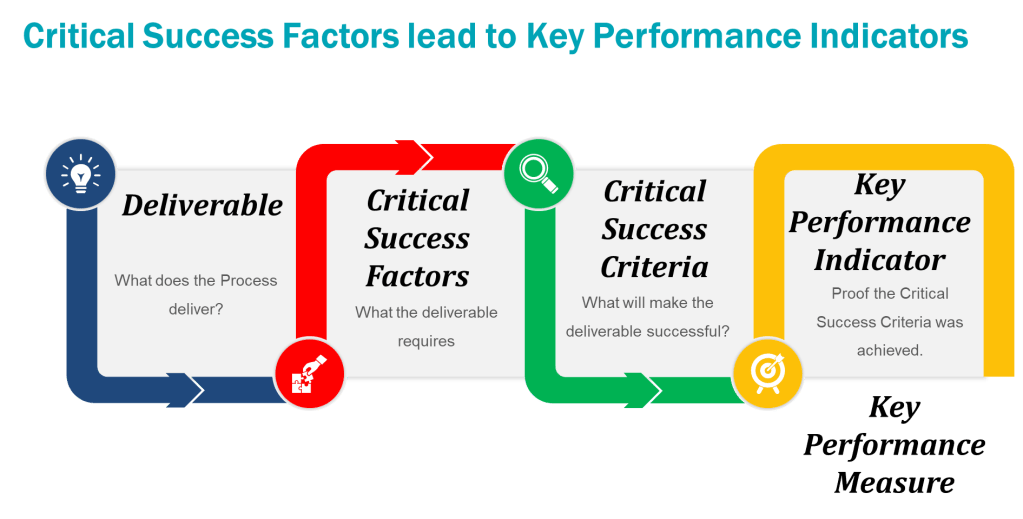
Key Performance Indicators (KPIs)

KPIs measure progress toward Quality System goals. They are outcome-focused and often tied to strategic objectives.

  • Leading KPI Example: Process Capability Index (Cpk) – This measures how well a process can produce output within specification limits. A higher Cpk could indicate fewer products requiring disposition.
  • Lagging KPI Example: Cost of Poor Quality (COPQ) -The total cost associated with products that don’t meet quality standards, including testing and disposition cost.
Key Risk Indicators (KRIs)

KRIs monitor risks that could derail objectives. They act as early warning systems for potential threats. Leading KRIs should trigger risk assessments and/or pre-defined corrections when thresholds are breached.

  • Leading KRI Example: Unresolved CAPAs (Corrective and Preventive Actions) – Tracks open corrective actions for past deviations. A rising number signals unresolved systemic issues that could lead to recurrence
  • Lagging KRI Example: Repeat Deviation Frequency – Tracks recurring deviations of the same type. Highlights ineffective CAPAs or systemic weaknesses

Key Behavioral Indicators (KBIs)

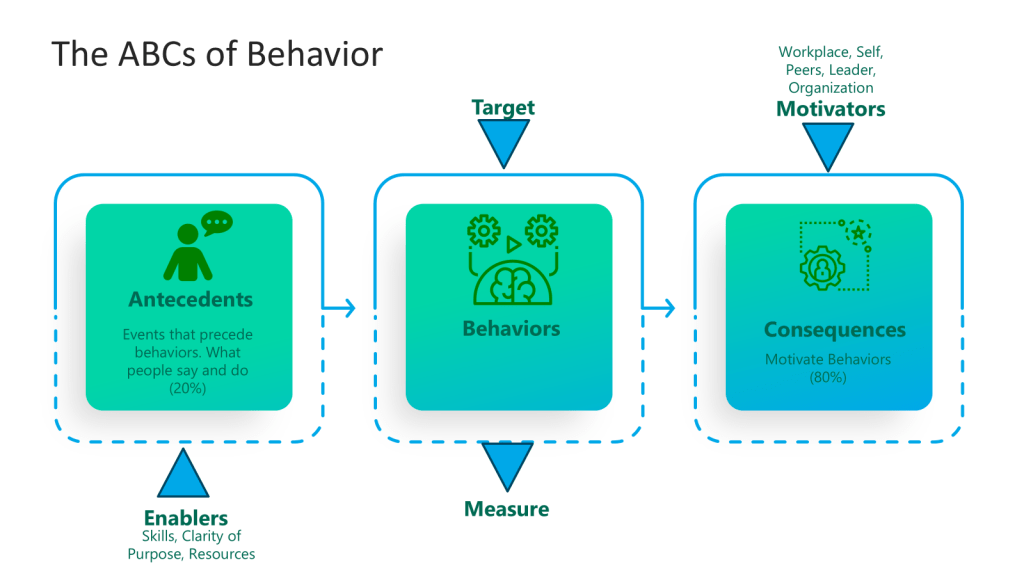
KBIs track employee actions and cultural alignment. They link behaviors to Quality System outcomes.

  • Leading KBI Example: Frequency of safety protocol adherence (predicts fewer workplace accidents).
  • Lagging KBI Example: Employee turnover rate (reflects past cultural challenges).
Applying Leading and Lagging Metrics to KPIs, KRIs, and KBIs

Each metric type can be mapped to leading or lagging dimensions:

  • KPIs: Leading KPIs drive action while lagging KPIs validate results
  • KRIs: Leading KRIs identify emerging risks while lagging KRIs analyze past incidents
  • KBIs: Leading KBIs encourage desired behaviors while lagging KBIs assess outcomes

Oversight Framework for the Validated State

An example of applying this for the FUSE(P) program.

CategoryMetric TypeFDA-Aligned ExamplePurposeData Source
KPILeading% completion of Stage 3 CPV protocolsProactively ensures continued process verification aligns with validation master plans Validation tracking systems
LaggingAnnual audit findings related to validation driftConfirms adherence to regulator’s “state of control” requirementsInternal/regulatory audit reports
KRILeadingOpen CAPAs linked to FUSe(P) validation gapsIdentifies unresolved systemic risks affecting process robustness Quality management systems (QMS)
LaggingRepeat deviations in validated batchesReflects failure to address root causes post-validation Deviation management systems
KBILeadingCross-functional review of process monitoring trendsEncourages proactive behavior to maintain validation stateMeeting minutes, action logs
LaggingReduction in human errors during requalificationValidates effectiveness of training/behavioral controlsTraining records, deviation reports

This framework operationalizes a focus on data-driven, science-based programs while closing gaps cited in recent Warning Letters.


Goals vs. OKRs: Alignment with Metrics

Goals are broad, aspirational targets (e.g., “Improve product quality”). OKRs (Objectives and Key Results) break goals into actionable, measurable components:

  • Objective: Reduce manufacturing defects.
  • Key Results:
    • Decrease batch rejection rate from 5% to 2% (lagging KPI).
    • Train 100% of production staff on updated protocols by Q2 (leading KPI).
    • Reduce repeat deviations by 30% (lagging KRI).

KPIs, KRIs, and KBIs operationalize OKRs by quantifying progress and risks. For instance, a leading KRI like “number of open CAPAs” (Corrective and Preventive Actions) informs whether the OKR to reduce defects is on track.


More Pharmaceutical Quality System Examples

Leading Metrics

  • KPI: Percentage of staff completing GMP training (predicts adherence to quality standards).
  • KRI: Number of unresolved deviations in the CAPA system (predicts compliance risks).
  • KBI: Daily equipment calibration checks (predicts fewer production errors).

Lagging Metrics

  • KPI: Batch rejection rate due to contamination (confirms quality failures).
  • KRI: Regulatory audit findings (reflects past non-compliance).
  • KBI: Employee turnover in quality assurance roles (indicates cultural or procedural issues).

Metric TypePurposeLeading ExampleLagging Example
KPIMeasure performance outcomesTraining completion rateQuarterly profit margin
KRIMonitor risksOpen CAPAsRegulatory violations
KBITrack employee behaviorsSafety protocol adherence frequencyEmployee turnover rate

Building Effective Metrics

  1. Align with Strategy: Ensure metrics tie to Quality System goals. For OKRs, select KPIs/KRIs that directly map to key results.
  2. Balance Leading and Lagging: Use leading indicators to drive proactive adjustments and lagging indicators to validate outcomes.
  3. Pharmaceutical Focus: In quality systems, prioritize metrics like right-first-time rate (leading KPI) and repeat deviation rate (lagging KRI) to balance prevention and accountability.

By integrating KPIs, KRIs, and KBIs into OKRs, organizations create a feedback loop that connects daily actions to long-term success while mitigating risks. This approach transforms abstract goals into measurable, actionable pathways—a critical advantage in regulated industries like pharmaceuticals.

Understanding these distinctions empowers teams to not only track performance but also shape it proactively, ensuring alignment with both immediate priorities and strategic vision.

Drive Out Fear on International Workers Day

Happy International Workers Day. Let’s celebrate by Driving Out Fear!

Thirty-five years ago Deming wrote that “no one can put in his best performance unless he feels secure.” Unfortunately, today we still live in a corporate world where fear and management by fear is ubiquitous. That fear is growing after more than a year of a global pandemic. As quality professionals we must deal with it at every opportunity.

Fear undermines quality, productivity, and innovation. The existence of fear leads to a vicious downward spiral.

Some sources of fear include:

  • Competition: Many managers use competition to instill fear. Competition is about winners and losers. Success cannot exist without failure. Managers deem the anxiety generated by competition between co-workers a good thing as they compete for scarce resources, power and status. Therefore, management encourage competition between individuals, between groups and departments and between business units.
  • “Us and Them” Culture: The “us and them” culture that predominates in so many organizations proliferated by silos. Includes barriers between staff and supervisors.
  • Blame Culture: Fear predominates in a blame culture. Blame culture can often center around enshrining the idea of human error.

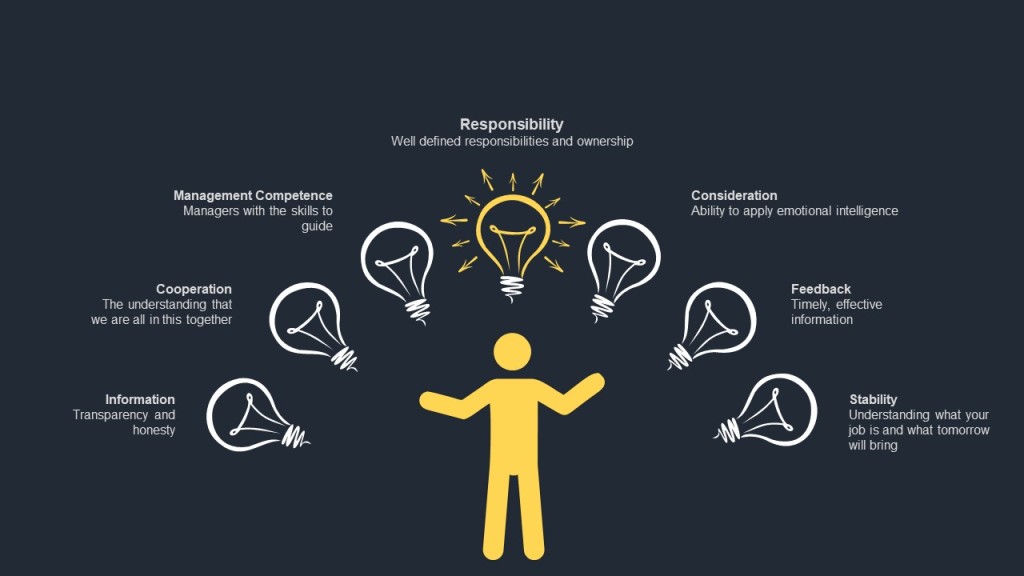
We drive out fear by building a culture centered on employee well-being. This is based on seven factors.

FactorMeansObtained by
ResponsibilityWell defined responsibilities and ownershipThe opportunity an employee has to provide input into decision making in his department
An individual employees’ own readiness to set high personal standards
An individual employee’s interest in challenging work assignments
The opportunity an employee has to improve skills and capabilities
Excellent career advancement opportunities
The organization’s encouragement of problem-solving and innovative thinking
Management CompetenceManagers trained with skills that lend themselves to contributing to the work of their team ensures that they will be looked to for help. Managers need to be able to guide.Direct Supervisor/Manager Leadership Abilities Management is engaged and leads by example (Gemba walks)
Management by Facts
ConsiderationWhen managers act as if employees have no feelings and just expect them to do their work as if they are robots, it can make employees uneasy. Such behavior makes them feel detached and merely a tool to carry out an end. In such environments, many times the only times employees hear from the manager is when something goes well or really bad. In either case, the perception could be that the manager has mood swings and that also adds to the employee’s insecurity. They may feel reluctant to talk to their manager for fear he is in one of his bad moods.Senior Management’s sincere interest in employee well-being
An individual employee’s relationship with their supervisor
Open and effective communication
Trust in management and co-workers
CooperationThe feeling that every person is on their own to look out for their interest is a sad state to be in. Yet when everyone has a fear that the other workers will take advantage of them or make them look bad at the first opportunity, a selfish and insecure environment will result. Employees should be able to work together for the benefit of the company. They should focus on group goals in addition to their personal goals, recognizing that individually there will be failures, but that the whole is more important than the individual parts.Trust Well trained employees Collaboration as a process Organizational culture (psychological safety) Hire and promote the right behaviors & traits to match the culture
FeedbackInformation that is given back to the employee regarding their performance on the job.Know what is expected of them (clear job descriptions)
Effective processes for timely feedback
Recognition
Know their opinion matters
InformationTransparency is critical. When employees know nothing about how a company is doing in terms of where they should be, it is a source of uneasiness. Without that knowledge, for all they know the company could be doing very poorly and that could be a bad thing for everyone. When they have a better sense of where the company is in the scheme of their objectives set by management, it helps them feel more secure. That is not to say it is the news being good or bad that affects their security, but rather the fact that they actually have the news.Strategy and Mission — especially the freedom and autonomy to succeed and contribute to an organization’s success
Organizational Culture and Core/Shared
Values
Feel that their job is important
StabilityEmployees feel more secure when their role does not change frequently and they understand what tomorrow will mean.Job Content — the ability to do what I do best
Availability of Resources to Perform the Job Effectively
Career development – opportunities to learn and grow
Photo by fauxels on Pexels.com

Visual Management

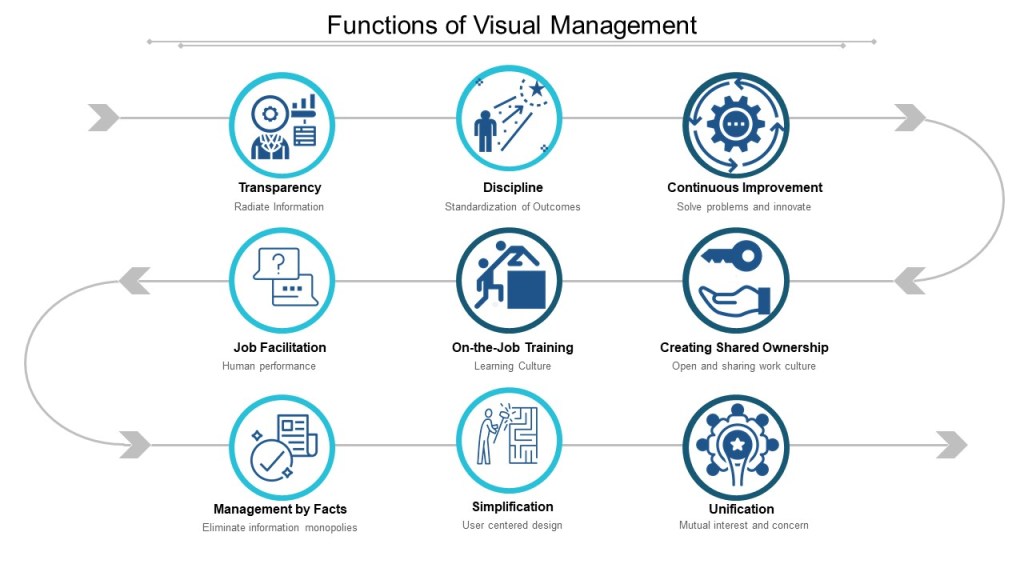
In the organizational world Visual Management is a management system that attempts to improve organizational performance through connecting and aligning organizational vision, core values, goals and culture with other management systems, work processes, workplace elements, and stakeholders, by means of stimuli, which directly address one or more of the five human senses (sight, hearing, feeling, smell and taste). These stimuli communicate quality information (necessary, relevant, correct, immediate, easy to-understand and stimulating), which helps people make sense of the organizational context at a glance by merely looking around. It is a management approach that utilizes either one or more of information giving, signaling, limiting or guaranteeing (mistake-proofing/ poka-yoke) visual devices to communicate with “doers”, so that places become self-explanatory, self-ordering, self-regulating and self-improving.

FunctionDefinitionReplaces the Practice of
TransparencyThe ability of a process (or its parts) to communicate with people through organizational and physical means, measurements, and public display of information

Transparency stimulates people to move outside the confines of particular job responsibilities and to see the larger scale of their work
Information held in people‟s minds and on the shelves.
DisciplineMaking a habit of properly maintaining correct procedures by transforming the abstract concept of discipline into directly observable concrete practices

Address the six basic questions (the what, the where, the who, the how, the how many and the when)
Warning, scolding, inflicting punishments, dismissing etc.
Continuous ImprovementFocused and sustained incremental innovation

Makes organizational learning visual with high ability to respond to people’s ideas
Static organizations or big improvement leaps through considerable investment.
Job FacilitationConscious attempt to physically and/or mentally ease people’s efforts on routine, already known tasks, by offering various visual aidsExpecting people to perform well at their jobs without providing them any aids.
On-the-Job TrainingLearning from experience or integrating working with learning.Conventional training practices or offering no training.
Creating Shared OwnershipA feeling of possessiveness and being psychologically tied to the objectivesManagement dictation for change efforts, vision and culture creation.
Management by FactsUse of facts and data based on statisticsManagement by subjective judgement or vague terms.
SimplificationConstant efforts on monitoring, processing, visualizing and distributing system wide information for individuals and teamsExpecting people to monitor, process and understand the complex system wide information on their own.
UnificationPartly removing the boundaries and creating empathy within an organization through effective information sharingFragmentation or “this is not my job” behavior
The functions of Visual Management