Validation Planning in the Quality System

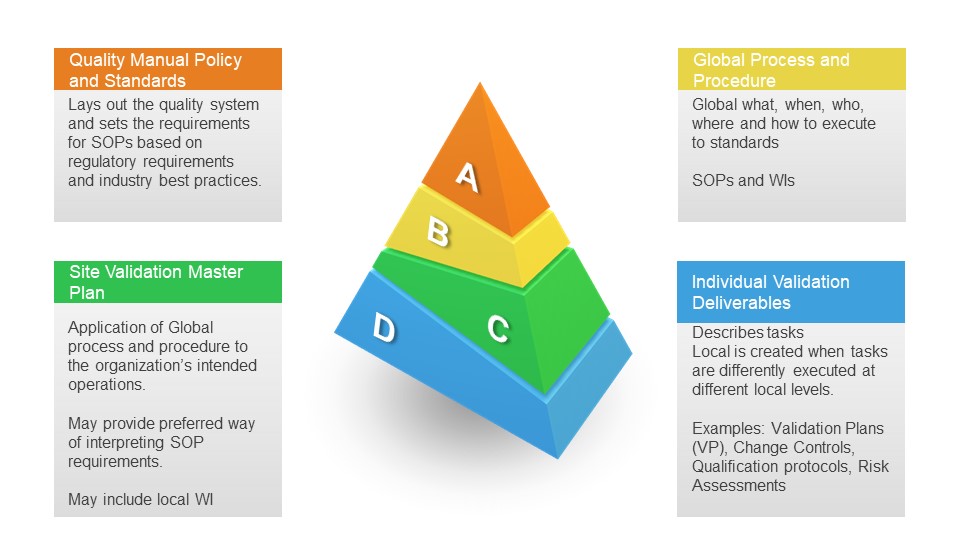
The Validation Master Plan (VMP) and Validation Plan (VP) are integral to the validation process but differ significantly in their scope, detail, and application. The VMP provides a strategic and comprehensive outline for validation activities (often capturing the whole commissioning/qualification/validation lifecycle) across an organization, ensuring compliance and coherence. The VP, derived from the VMP, focuses on specific validation projects, detailing the procedures, responsibilities, and requirements needed to achieve compliance for those specific systems or projects.

Validation Master Plan (VMP)

A Validation Master Plan is a high-level document that outlines the overall validation strategy for an entire site or organization. It is comprehensive and covers all aspects of validation activities across various departments and systems within the organization. The VMP is designed to ensure that all components of the validation process are appropriately planned, executed, and maintained to meet regulatory compliance requirements.

Key characteristics of a VMP include:

  • Scope and Purpose: It defines the scope and objectives of all validation activities within the organization.
  • Strategy and Approach: It outlines the validation strategy and approach, including integrating Good Manufacturing Practices (GMP).
  • Responsibilities: It details the organizational structure and responsibilities for validation activities.
  • Documentation: It references all applicable protocols, reports, and related documents.
  • Compliance and Review: It includes compliance requirements and specifies the frequency of reviews and updates to ensure the plan remains current.

A Subvalidation Master Plan (sVMP) is a deep dive into a specific area or validation, such as the analytical method lifecycle.

The purpose of a Validation Master Plan (VMP) is multifaceted, primarily serving as a comprehensive document that outlines the strategy for validation activities within an organization. It is designed to ensure that all validation processes are conducted correctly and comply with regulatory standards.

Here are the key purposes of a VMP:

  1. Documentation of Compliance Requirements: The VMP documents the organization’s compliance requirements, ensuring that all validation activities meet the necessary regulatory standards.
  2. Strategic Planning: Acts as a roadmap for validation, detailing what, how, and when validation activities will be executed. This includes the lifecycle of the manufacturing validation process and integrates Good Manufacturing Practices (GMP).
  3. Resource Planning: The VMP identifies anticipated resource needs and provides key input into scheduling project timelines, which is crucial for efficient validation execution.
  4. Control and Direction: The VMP controls and defines different parts of the production process to ensure consistency over time and directs validation strategies for instruments and systems.
  5. Risk Mitigation: The VMP helps mitigate risks associated with product manufacturing by outlining the validation approach and specific validation activities.
  6. Educational Tool: The VMP informs and educates senior management and other stakeholders about the importance of validation in terms of its impact on product quality, thereby fostering an understanding and support for validation activities.
  7. Regulatory Audit Support: It provides essential documentation regulators require during an audit, demonstrating the organization’s control over quality and compliance with GMPs.
  8. Organizational Alignment: The VMP enables stakeholders within the organization to unify around the details of the validation strategy, eliminating ambiguity and justifying validation activities internally and externally.

The Validation Master Plan is crucial for ensuring that all aspects of validation are planned, executed, and documented in accordance with regulatory requirements and organizational goals. It serves as a compliance tool and a strategic guide for managing and conducting validation activities effectively.

Validation Plan (VP)

A Validation Plan (VP) is more specific and detailed than a VMP and is typically written for a particular validation project or system. The VP focuses on the specific validation activities for individual pieces of equipment, systems, or processes and is derived from the broader directives set out in the VMP.

Key characteristics of a VP include:

  • Detailed Scope and Objectives: It describes what is to be validated, the specific tasks to be performed, and the expected outcomes.
  • Project-Specific Details: These include timelines, specific procedures, and responsibilities for the particular validation project.
  • Risk Assessments and Requirements: It details the risk assessments, quality parameters, and regulatory requirements specific to the system or project being validated.

Differences and Relationship

Level of Detail: The VMP is a high-level document that provides an overarching framework and strategy for validation activities across an organization. In contrast, a VP is a detailed, project-specific document that outlines the execution of validation activities for specific systems or projects.

Purpose and Use: The VMP sets the stage for all validation efforts within an organization and ensures consistency and compliance with industry standards. The VP, derived from the VMP, focuses on specific validation tasks and how they will be accomplished.

Scope: While the VMP covers an organization’s entire validation program, a VP is limited to a particular project or system.
Periodic Review and Updates

A Validation Master Plan (VMP) should be reviewed and updated regularly to remain current and effective. The specific frequency of these reviews can vary depending on the organization’s needs, the complexity of the systems, and regulatory requirements. However, it is generally recommended that a VMP be reviewed at least annually.

This annual review is crucial to address any changes in the manufacturing process, regulatory updates, or modifications in the validation strategy. The review process should include evaluating the progress of validation activities, assessing the impact of any changes in the process or equipment, and updating the plan to reflect new or altered validation requirements.

Additionally, the VMP should be updated whenever significant changes occur that could affect the validation status of the systems or processes described in the plan. This could include major equipment upgrades, product design changes, or regulatory standard shifts.

Validation Plans (VP) should be revised based on changes in the project’s scope. Sometimes, a VP may be opened for an extended period of time for a complex project, in which case it should be evaluated for accuracy and completeness based on the project lifecycle.

Implementing a Quality Ambassador Program

Quality ambassadors can influence their peers to prioritize quality, thereby strengthening the culture of quality in the organization. Quality leaders can use this guide to develop a quality ambassador program by identifying, training, and engaging ambassadors.

Utilizing Kotter’s eight accelerators for change, we can implement a Quality Ambassador program like this:

AcceleratorActions
Create a strong sense of urgency around a big opportunityDemonstrate the organizational value of Ambassadors by performing a needs analysis to assess the current state of employee engagement with quality.
Build and evolve a guiding coalitionBring together key stakeholders from across the organization who will provide input in the program’s design and support its implementation.
Form a change vision and strategic initiativesIdentify the key objectives for implementing a Quality Ambassador program and outline the lines of effort required to successfully design and pilot it.
Enlist a volunteer armyReach out and engage informal leaders at all levels of the organization. Find your current informal Ambassadors and draw them in.
Enable action by removing barriersBe vigilant for factors that impede progress. Work with your Ambassadors and senior leaders to give teams the freedom and support to succeed.
Generate and celebrate short-term winsPilot the program. Create success stories by looking at the successful outcomes of teams that have Quality Ambassadors and by listening to team members and their customers for evidence that quality culture is improving. Your goal will be to create an environment where teams that do not have Quality Ambassadors are asking how they can participate.
Sustain accelerationScale the impact of your program by implementing it more broadly within the organization.

Define the Key Responsibilities of Quality Ambassadors

  
What activities should Quality Ambassadors focus on?  Example: Reinforce key quality messages with co-workers. Drive participation in quality improvement projects. Provide inputs to improve culture of quality. Provide inputs to improve and maintain data integroty
What will Quality Ambassadors need from their managers?    Example: Approval to participate, must be renewed annually
What will Quality Ambassadors receive from the Quality team?    Example: Training on ways to improve employee engagement with quality. Support for any questions/objections that ariseTraining on data integrity  
What are Quality Ambassadors’ unique responsibilities?    Example: Acting as the point of contact for all quality-related queries. Reporting feedback from their teams to the Quality leadership. Conveying to employees the personal impact of quality on their effectiveness. Mitigating employee objections about pursuing quality improvement projects. Tackling obstacles to rolling out quality initiatives
What responsibilities do Quality Ambassadors share with other employees?    Example: Constantly prioritize quality in their day-to-day work  
Expected time commitment    Example: 8-10 hours/month, plus 6 hours of training at launch

Metrics to Measure Success

Type of MetricsList of MetricsDirect Impact of Ambassador’s workRecommendations
Active Participation LevelsPercentage of organizational units adopting culture of quality program.
The number of nominations for quality recognition programs. Quality observations were identified during Gemba walks. Participation or effectiveness of problem-solving or root-cause processes. The number of ongoing quality improvement projects. Percentage of employees receiving quality training  
HighAmbassadors should be directly held responsible for these metrics
Culture of Quality AssessmentsCulture of quality surveys. Culture of quality maturity assessmentsMediumThe Quality Ambassador program is a factor for improvement.
Overall Quality PerformanceKey KPI associated with Quality. Audit scoresCost of poor qualityLowThe Quality Ambassador program is a factor for improvement.

Design Lifecycle within PDCA – Planning

In the post “Review of Process/Procedure” I mentioned how the document draft and review cycle can be seen as an iterative design cycle. In this post I want to expand on the design lifecycle as a fundamental expression of PDCA that sits at the heart of all we do.

PDCA, a refresher

PDCA (and it’s variants) are a pretty tried and true model for process improvement. In the PDCA model a plan is structured in four steps: P (plan) D (do) C (check) A (act). The intention is create a structured cycle that allows the process to flow in accordance with the objectives to be achieved (P), execute what was planned (D), check whether the objectives were achieved with emphasis on the verification of what went right and what went wrong (C) and identify factors of success or failure to feed a new process of planning (A).

Conceptually, the organization will be a fast turning wheel of endlessly learning from mistakes and seeking to maximize processes in order to remain forever in pursuit of strategic objectives, endlessly searching for the maximum efficiency and effectiveness of the system.

PDCA cycle driving continuous improvement

Design Lifecycle

This design lifecycle just takes the PDCA spiral and spreads it across time. At the same time it breaks down a standard set of activities and recognizes the stage gates from moving between startup (or experiment) and continuous improvement.

Design Lifecycle

Identifying the Problem (Plan)

At it’s heart problem-solving requires understanding a set of requirements and building for success.

I always go back to the IEEE definition of “A requirement is a condition or capability needed by a user to solve a problem or achieve an objective; a condition or capability that must be met or possessed by a system or system component to satisfy a contract ,standard, specification , or other formally imposed document; a document representation of condition or capability “

A requirement can be explicitly stated, implicit, inherited or derived from other requirements.

The first place to look for requirements is the organization itself.

Understanding the needs of the organization

The cultural needs of the organization drives the whole problem-solving and requirement gathering activity and it starts by being clear on Strategy and understanding the goals and objectives and how these goals percolate to the different business processes that we are improving. This gives a good starting point to focus on what opportunities to be explored and what problems to be solved.

It is not uncommon in the problem-solving phase that the objectives/needs are not known, so we must work our way through figuring out what the initial need is. Go back to the fundamentals of understanding the business processes “as-is” and review existing regulations, standards, guidelines and other internal sources of requirements followed currently. This is the time to interview stakeholders and go the GEMBA.

We state the problem, and re-frame it. And now we can move on to Requirement Elicitation.

Identifying the Problem

Requirement Elicitation

Requirement Elicitation is the process of probing and facilitating the stakeholders to provide more clarity and granular details pertaining to the (usual) high-level requirement gathered so far. This is a discovery process, exploratory in nature, focusing on finding enough details so that a solution can be envisioned and developed. Elicitation is not an isolated activity, and has been happening throughout the process by all the discussion, interaction, analysis, verification and validation up to now.

You should be engaging with knowledge management throughout the cycle, but ensure there is specific engagement here.

It is a progressive process where the requirement clarity ushers in increments and may need multiple rounds of probing/discussions. As the new details are uncovered the requirements are further elaborated and detailed. There are a whole toolbox of elicitation techniques and like any engagement it is important to properly prepare.

Requirement Elicitation

Requirement Analysis

Requirement Analysis pertains to extracting the requirement out of the heaps of information acquired from various stakeholders and communicated and turned into documentation in a form that is easily understood by the stakeholders, including the project team. Here we are engaging in requirement refinement, modification, clarification, validation & finalization and engaging in extensive communication.

A requirement can be classified as:

We build for traceability here, so as we build and test solutions we can always trace back to the requirements.

Design the Solution

Building for the solution includes change management. Any solution focuses both on the technical, the organization and the people.

Ensure you leverage risk management.

Change Management Approach

The Place of Empathy

In this design process, we address and use empathy to acquire insight into users’ (stakeholders) needs and inform the design process and create a relevant solution. Using an approach informed by cognitive empathy, we apply different methods to build up that competence and insight, enabling us to prioritize the needs of the users and make the results of the process more desirable.

Psychological safety, reflexivity and sense-making inform our work.

Prepare for Startup

By engaging in Design Thinking we are ready for Startup. Moving through the three steps of:

We have created a plan to execute against. Startup, which can often be Experimentation, is it’s own, future, post.

Team Effectiveness

With much of the work in organizations accomplished through teams it is important to determine the factors that lead to effective as well as ineffective team processes and to better specify how, why, and when they contribute. It doesn’t matter if the team is brought together for a specific project and then disbands, or if it is a fairly permanent part of the organization, similar principles are at work.

Input-Process-Output model

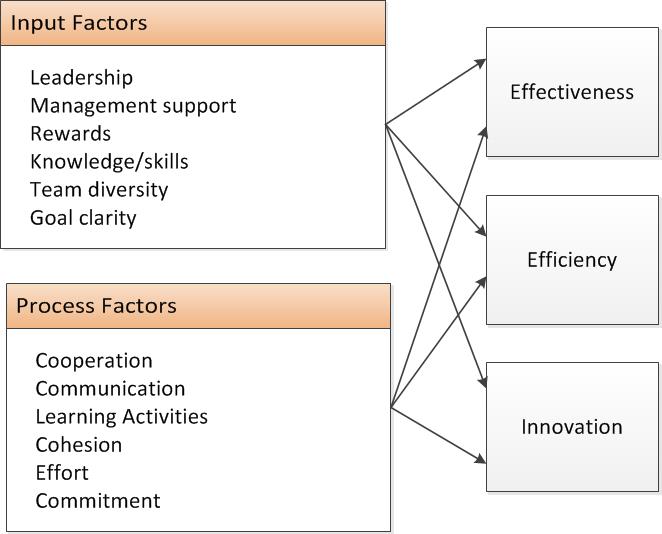
The input-process-output model of teams is a great place to start. While simplistic, it can offer a good model of what makes teams works and is applicable to the different types of teams.

Input factors are the organizational context, team composition, task design that influence the team. Process factors are what mediates between the inputs and desired outputs.

  • Leadership:  The leadership style(s) (participative, facilitative, transformational, directive, etc) of the team leader influences the team toward the achievement of goals.
  • Management support refers to the help or effort provided by senior management to assist the project team, including managerial involvement and resource support.
  • Rewards are the recompense that the organization gives in return for good work.
  • Knowledge/skills are the knowledge, experience and capability of team members to process, interpret, manipulate and use information.
  • Team diversity includes functional diversity as well as overall diversity.
  • Goal clarity is the degree to which the goals of the project are well defined and the importance of the goals to the organization is clearly communicated to all team members.
  • Cooperation is the measure of how well team members work with each other and with other groups.
  • Communication is the exchange of knowledge and information related to tasks with the team (internal) or between team members and external stakeholders (external).
  • Learning activities are the process by which a team takes action, contains feedback and makes changes to improve. Under this fits the PDCA lifecycle, including Lean, SixSigma and similar problem solving methodologies..
  • Cohesion is the spirit of togetherness and support for other team members that helps team members quickly resolve conflicts without residual hard feelings, also referred to as team trust, team spirit, team member support or team member involvement.
  • Effort includes the amount of time that team members devote to the project.
  • Commitment refers to the condition where team members are bound emotionally or intellectually to the project and to each other during the team process.

Process Factors are usually the focus on team excellence frameworks, such as the ASQ or the PMI.

Outputs, or outcomes, are the consequences of the team’s actions or activities:

  • Effectiveness is the extent a project achieves the performance expectations of key project stakeholders. Expectations are usually different for different projects and across different stake-holders; thus, various measures have been used to evaluate effectiveness, usually quality, functionality, or reliability. Effectiveness can be meeting customer/user requirements, meeting project goals or some other related set of measures.
  • Efficiency is the ability of the project team to meet its budget and schedule goals and utilize resources within constraints Measures include: adherence to budget, adherence to schedule, resource utilization within constraints, etc.
  • Innovation is the creative accomplishment of teams in generating new ideas, methods, approaches, inventions, or applications and the degree to which the project outputs were novel.

Under this model we can find a various levers to improve out outcomes and enhance the culture of our teams.

Personal Audits as part of team building for Projects

The personal audit is a tool used in change and project management (and such) to help team members and sponsors judge their strengths and weaknesses with respect to change leadership. It illustrates some skills from the full range necessary to introduce change into an organization.

This exercise is great to do at the beginning of the project, where it can help team members begin to understand some of the human issues applicable to all projects. As one mentor once told me – If this exercise strikes team members as inapplicable, then they really need to do it.

Domain What I do Well What I Need to Work On
Manage Attention: To what extent do I manage my time, energy, passion, focus and agenda?    
Adopt change roles? How much attention do I pay to matters like: Creating a need, Shaping a vision, Mobilizing commitment,  Monitoring progress, Finishing the job,  Anchoring the change)    
Technical competence: To what extent to I demonstrate competence in technical abilities?    
Interpersonal competence: how skilled am I at interacting with others?    
Vision: How well can I articulate the desired outcome of the project and the benefits to others?    
Teamwork: How often do I recognize good work done by teammates?    
Diplomacy: How closely am I working with all the groups affected by this project?    
Conflict management: Can I deal with disagreement without avoiding it or blowing up?    
Summary: Overall strengths and weaknesses