EMA GMP Plans for Regulation Updates

Like one does, I watch upcoming regulations like a hawk. Here are a few of the forthcoming GMP changes coming from the 3-year work plan for the Inspectors Working Group.

DocumentIntended ChangesWhenMy Thoughts
GMP Guide: Chapter 4 (Documentation)Assure data integrity in the context of GMP. This would be in parallel with similar consideration of Annex 11 (Computerised Systems).Q1 2026An update is needed to align with current thinking. Data Integrity has advanced significantly in the last five years, and Chapter 4 could benefit from alignment with the PIC/S guidance.
GMP Guide: Annex 11 (Computerised Systems)Assure data integrity in the context of GMP. This would be in parallel with similar consideration of Chapter 4 (Documentation).Q1 2026A necessary update. Will be curious to see how it aligns with the FDA’s CSA approach (which isn’t really all that new).

We pretty much know what will be in it from the concept paper. At least it will solidify this requirement for cloud systems “Regulated users should
26 have access to the complete documentation for validation and safe operation of a system and be able to present this during regulatory inspections, e.g. with the help of the service provider.”
Guidelines on GMP specific to ATMPSReview the Guidelines in collaboration with CAT and the European Commission
following the publication of a new regulation on standards of quality and safety for substances of human origin intended for human application and need to update legal references and definitions.
Review the Guidelines in the light of new Annex 1 Manufacture of Sterile Medicinal Products and consider whether any updates are necessary.
Q4 2026This is a fast area of change, and this update is called for.

Aligning to Annex 1 is overdue.
GMP Guide: Annex 3 Manufacture of RadiopharmaceuticalsA review and update of the Annex to reflect current state of the art.Q4 2026I’ve never worked in radiopharmaceuticals. Maybe someday.
GMP Guide: Annex 15 Qualification and ValidationIn the context of new technology in facilities, products and processes and following
up on LLE recommendations, and extend the scope to APIs.
Q4 2025LLE is the EMA’s lessons learnt report (LLE) on Nitrosamines.

I’d love to see significant changes to finally align with ATSM E2500 and other recent challenges in validation.
GMP Guide: Annex 16 Certification by a Qualified Person and Batch ReleaseFollowing up on LLE recommendations.Q4 2025I’m not a massive fan of QPs as structured. Not expecting that to change.
GMP and Marketing Authorisation HoldersTo revise the paper in line with recommendations from the Nitrosamines LLE, to strengthen guidance for MAHs in terms of having adequate quality agreement with manufactures.Q4 2025Anything to strengthen quality agreements is probably a good thing.

Anytime we see a major chapter update in the Eudralex Volume 4 is an exciting year, and the next few promise to be big. Maybe not Annex 1 big, but maybe the EMA and PIC/S will surprise us.

Challenges in Validation

I often get asked why I moved from a broader senior role in Quality Management to a particular but deep role in Quality Engineering and Validation. There are many answers, but the biggest is that validation is poised for some exciting shifts due to navigating a complex validation landscape characterized by rapid technological advancements, evolving regulatory standards, and the development of novel therapies. Addressing these challenges requires innovation, collaboration, and a proactive approach to risk management and data integration. Topics near and dear to me.

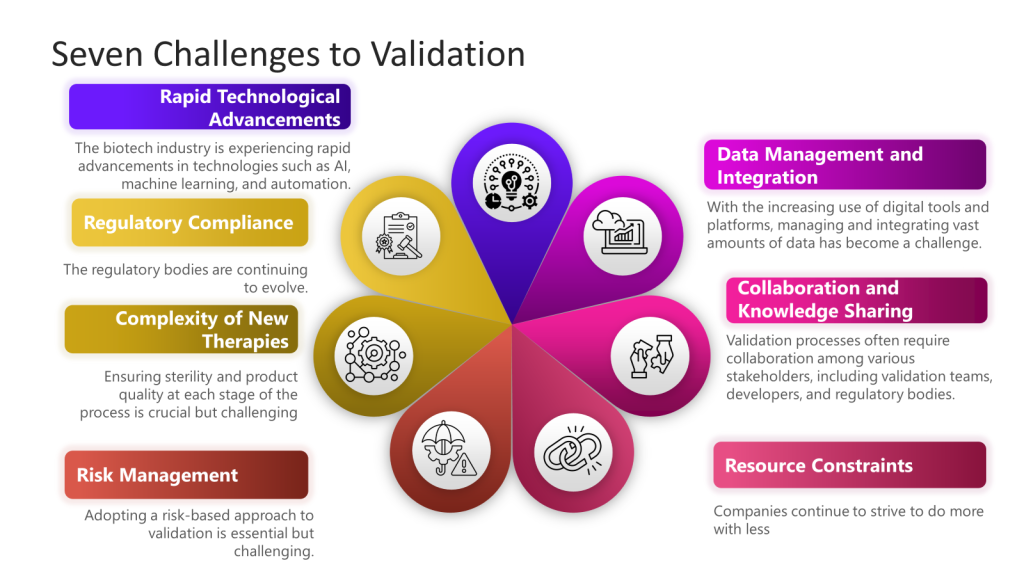
Today’s Challenges in Biotech Validation

1. Rapid Technological Advancements

The biotech industry is experiencing rapid technological advancements such as AI, machine learning, and automation. Integrating these technologies into validation processes can be challenging due to the need for new validation frameworks and methodologies.

2. Regulatory Compliance

Maintaining compliance with evolving regulatory standards is a significant challenge. Regulatory bodies like the FDA continuously update guidelines for technological advancements.

3. Complexity of New Therapies

Developing novel therapies, such as cell and gene therapies, introduces additional complexity to the validation process. These therapies often require redesigned facilities and equipment to accommodate their sensitive and sterile nature. Ensuring sterility and product quality at each process stage is crucial but challenging.

4. Data Management and Integration

Managing and integrating vast amounts of data has become challenging with the increasing use of digital tools and platforms. Effective data management is essential for predictive modeling and risk management in validation processes. Organizations must adopt robust data analytics and machine learning tools to handle this data efficiently.

5. Collaboration and Knowledge Sharing

Validation processes often require collaboration among various stakeholders, including validation teams, developers, and regulatory bodies. Ensuring real-time communication and data sharing can be challenging but is essential for streamlining validation efforts and aligning goals.

6. Resource Constraints

Smaller biotech companies, in particular, face resource constraints regarding funding, personnel, and expertise. These constraints can hinder their ability to implement advanced validation techniques and maintain compliance with regulatory standards.

7. Risk Management

Adopting a risk-based approach to validation is essential but challenging. Companies must identify and mitigate risks throughout the product lifecycle, which requires a thorough understanding of potential risks and effective risk management strategies.

Let’s Avoid the Term Validation 4.0

Let’s avoid the 4.0 term. We are constantly evolving, and adding a current ‘buzziness’ to it does no one any favors. We are shifting from traditional, paper-heavy validation methods to a more dynamic, data-driven, and digitalized process. Yes, we are leveraging modern technologies such as automation, data analytics, artificial intelligence (AI), and the Internet of Things (IoT) to enhance validation processes’ efficiency, flexibility, and reliability. But we don’t need buzziness, we just need to give it some thought, experiment, and refine.

MHRA GCP Inspection Metrics

The MHRA published in March 2023 their ‘GCP Inspections Metrics Report’, covering the period from 1 April 2019 to 31 March 2020.

I am pretty sure no regulatory agency would accept my 2019-2020 Annual Product Quality Review (APR/PQR) being published 3 years late. Regulatory agencies need to hold themselves accountable and are fairly poor at doing so. The EMA is not alone at this, the recent EMA report was two year old data.

The MHRA GCP inspectors reported the following observations in the two-year period:

  • Commercial sponsors: 4 critical, 17 major, 34 other. All critical observations were related to pharmacovigilance (PV).
  • CROs: 4 critical, 25 major, 41 other. Critical observations were related to data integrity, IMP management, and protocol compliance.
  • Non-commercial sponsors: 4 critical, 12 major, 26 other. Critical observations were related to clinical sample analysis, data integrity, sponsor oversight, and PV.
  • Phase I Units: 1 critical, 8, major, 28 other. The critical observation was related to dose escalation.
  • Investigator Sites: 0 critical, 17 major, 64 other.

As always, a very good document to perform a gap assessment against.

ASQ FD&C Boston Poster session – 28Feb2023

Yesterday the Food, Drug, and Cosmetic Division of the ASQ hosted a poster session on the question “What are you proud of in your eQMS? What about your implementation or continued use stands out and that you want to share?”

This was our first try and it also happened in one of the few winter weather events we’ve had this season in Boston, but I was incredibly pleased by the turnout and the five posters were all superlative.

I was actually so busy that the only photo I remembered to take was this one, which was actually 10 minutes before our official start time.

There were five posters:

  • Visual Hierarchy (Jeremiah Genest, Amylyx Pharmaceuticals)
  • Smart Numbering & Page Layouts (Kevin Kao, AVROBIO)
  • Minor Deviation Process (Jamie Dupuis, Agios)
  • Supplier Change Notifications – Requirements & Challenges (Russ Jacob, Resilience)
  • Electronic Forms – utilizing templates, tokens, and connectivity (Greg Greene, Amylyx Pharmaceuticals)

I thought each of the posters brought a different bit to the conversation, and wow were there a lot of conversations going on!

I definitely learned that next time I need to get recorded talks from folks. I had originally planned this, but it didn’t happen mostly because I was just too involved in talking about my poster.

I want to say an immense thank you to our very gracious hosts Veeva Systems, who provided a great spot and a whole lot of hospitality. Will Gould was great to work with and really went above-and-beyond as a host.

With the great attendance and the on-the-site feedback, definitely planning on doing this again. A quick survey to gauge interest and help select a topic is here: https://forms.office.com/r/rUf7VRE6Dy

WCQI Day 4

Last day.

Disciplined Problem Solving Demands Disciplined Communication by Frasier Pruitt

The Minto Pyramid Principle as a tool for problem communication. I guess I shouldn’t be snarky at a tool that came out of McKinsey. I’m sure organized crime has provided many useful tools for society.

Structuring information is critical, there are lots of tools out there to help utilize storytelling, I’m a big fan of the work of Nancy Duarte, and I have praised the A3 many a time for its use as for structured narrative around problems and solutions.

The Two Elements

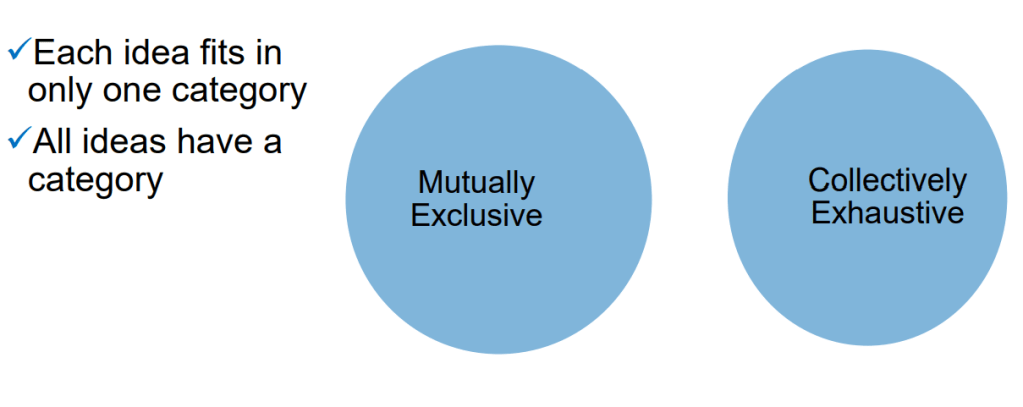
Mutually Exclusive, Collectively Exhaustive (MECE) is a concept that we cannot stress enough as it fundamentally gets to issues of cognitive load, and forms a great example of externalizing and constructing.

Mutually Exclusive, Collectively Exhaustive (MECE)

Great structure, which originally appeared in Quality Progress, for utilizing this with a DMAIC.

Well done structure, this was a great writing training. This could be expanded into a workshop focusing on narrative structure. One recommendation for Fraser would be using a simpler paper for the writing exercise.

The Innovation Management Principles of ISO 56000 by Peter Merrill

Innovation is one of those things that requires system and process to truly be successful. I appreciate the ideas beyond ISO 56000, and the basis of the Innovation Management System

  1. Realization of value; and benefit
  2. Future-focused leaders; curious, courageous
  3. Strategic direction; will change
  4. Culture; creativity and execution to co-exist
  5. Exploiting insights for unmet needs
  6. Managing uncertainty through a portfolio
  7. Adaptability as context changes
  8. Systems approach; serial innovation

Love the focus on how QMS and Innovation interlink.

Closing Keynote by Jose Morey

Okay, I’ve fan-boyed Leonardo da Vinci in the past, but this did not work for me as an ending keynote. It was shallow and rather generic.

But I got my Bingo card completed.

Which is sad.

Good conference. It was great to be back in person.