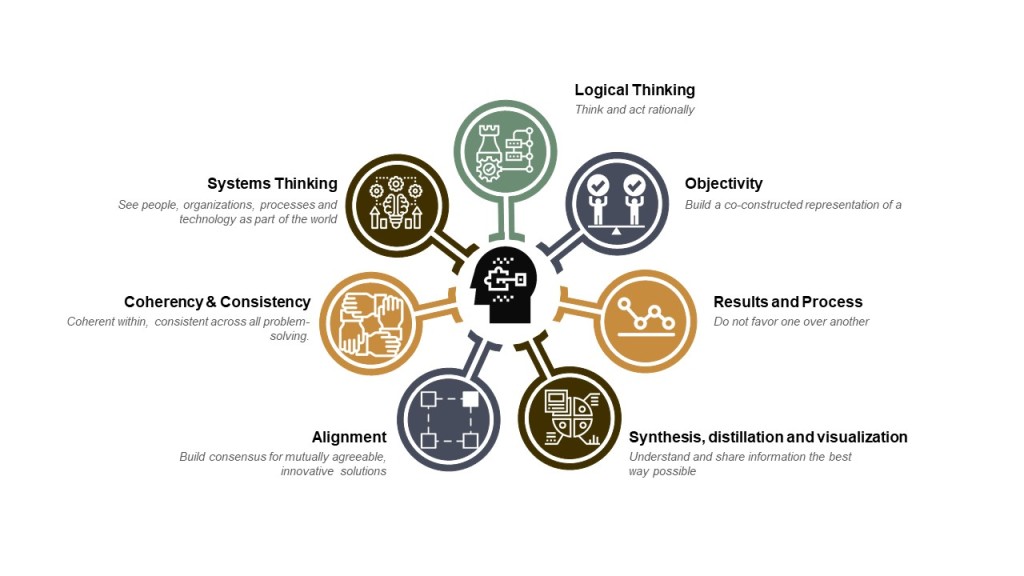
Seven elements of good problem-solving

Logic

Perhaps more than anything else, we want our people to be able to think and then act rationally in decision making and problem-solving. The basic structure and technique embodied in problem solving is a combination of discipline when executing PDCA mixed with a heavy dose of the scientific method of investigation.

Logical thinking is tremendously powerful because it creates consistent, socially constructed approaches to problems, so that members within the organization spend less time spinning their wheels or trying to figure out how another person is approaching a given situation. This is an important dynamic necessary for quality culture.

The right processes and tools reinforce this as the underlying thinking pattern, helping to promote and reinforce logical thought processes that are thorough and address all important details, consider numerous potential avenues, take into account the effects of implementation, anticipate possible stumbling blocks, and incorporate contingencies. The processes apply to issues of goal setting, policymaking, and daily decision making just as much as they do to problem-solving.

Objectivity

Because human observation is inherently subjective, every person sees the world a little bit differently. The mental representations of the reality people experience can be quite different, and each tends to believe their representation is the “right” one. Individuals within an organization usually have enough common understanding that they can communicate and work together to get things done. But quite often, when they get into the details of the situation, the common understanding starts to break down, and the differences in how we see reality become apparent.

Problem-solving involves reconciling those multiple viewpoints – a view of the situation that includes multiple perspectives tends to be more objective than any single viewpoint. We start with one picture of the situation and make it explicit so that we can better share it with others and test it. Collecting quantitative (that is, objective) facts and discussing this picture with others is a key way in verifying that the picture is accurate. If it is not, appropriate adjustments are made until it is an accurate representation of a co-constructed reality. In other words, it is a co-constructed representation of a co-constructed reality.

Objectivity is a central component to the problem solving mindset. Effective problem-solvers continually test their understanding of a situation for assumptions, biases, and misconceptions. The process begins by framing the problem with relevant facts and details, as objectively as possible. Furthermore, suggested remedies or recommended courses of action should promote the organizational good, not (even if subconsciously) personal agendas.

Results and Process

Results are not favored over the process used to achieve them, nor is process elevated above results. Both are necessary and critical to an effective organization.

Synthesis, Distillation and and Visualization

We want to drive synthesis of the learning acquired in the course of understanding a problem or opportunity and discussing it with others. Through this multiple pieces of information from different sources are integrated into a coherent picture of the situation and recommended future action.

Visual thinking plays a vital role in conveying information and the act of creating the visualization aids the synthesis and distillation process.

Alignment

Effective implementation of a change often hinges on obtaining prior consensus among the parties involved. With consensus, everyone pulls together to overcome obstacles and make the change happen. Problem-solving teams communicates horizontally with other groups in the organization possibly affected by the proposed change and incorporates their concerns into the solution. The team also communicates vertically with individuals who are on the front lines to see how they may be affected, and with managers up the hierarchy to determine whether any broader issues have not been addressed. Finally, it is important that the history of the situation be taken into account, including past remedies, and that recommendations for action consider possible exigencies that may occur in the future. Taking all these into consideration will result in mutually agreeable, innovative solutions.

Coherency and Consistency

Problem-solving efforts are sometimes ineffective simply because the problem-solvers do not maintain coherency. They tackle problems that are not important to the organization’s goals, propose solutions that do not address the root causes, or even outline implementation plans that leave out key pieces of the proposed solution. So coherency within the problem-solving approach is paramount to effective problem resolution.

Consistent approaches to problem-solving speed up communication and aid in establishing shared understanding. Organizational members understand the implicit logic of the approach, so they can anticipate and offer information that will be helpful to the problem-solvers as they move through the process.

Systems Thinking

Good system thinking means good problem-solving.

Principles behind a good system

System Thinking requires operating in a paradigm where we see our people, organizations, processes and technology as part of the world, a set of dynamic entities that display continually emerging patterns arising from the interactions among many interdependent connecting components.

PrincipleDescription
BalanceThe system creates value for the multiple stakeholders. While the ideal is to develop a design that maximizes the value for all the key stakeholders, the designer often has to compromise and balance the needs of the various stakeholders.
CongruenceThe degree to which the system components are aligned and consistent with each other and the other organizational systems, culture, plans, processes, information, resource decisions, and actions.
ConvenienceThe system is designed to be as convenient as possible for the participants to implement (a.k.a. user friendly). System includes specific processes, procedures, and controls only when necessary.
CoordinationSystem components are interconnected and harmonized with the other (internal and external) components, systems, plans, processes, information, and resource decisions toward common action or effort. This is beyond congruence and is achieved when the individual components of a system operate as a fully interconnected unit.
EleganceComplexity vs. benefit — the system includes only enough complexity as is necessary to meet the stakeholder’s needs. In other words, keep the design as simple as possible and no more while delivering the desired benefits. It often requires looking at the system in new ways.
HumanParticipants in the system are able to find joy, purpose and meaning in their work.
LearningKnowledge management, with opportunities for reflection and learning (learning loops), is designed into the system. Reflection and learning are built into the system at key points to encourage single- and double-loop learning from experience to improve future implementation and to systematically evaluate the design of the system itself.
SustainabilityThe system effectively meets the near- and long-term needs of the current stakeholders without compromising the ability of future generations of stakeholders to meet their own needs.
Pillars of Good System Design

Process Owners

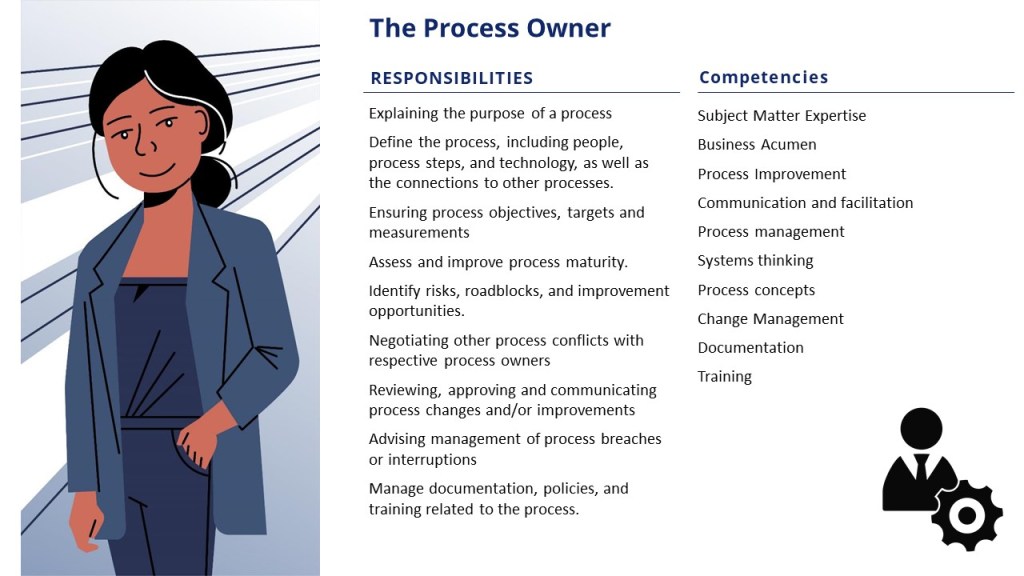
Process owners are a fundamental and visible difference part of building a process oriented organizations and are crucial to striving for an effective organization. As the champion of a process, they take overall responsibility for process performance and coordinate all the interfaces in cross-functional processes.

Being a process owner should be the critical part of a person’s job, so they can shepherd the evolution of processes and to keep the organization always moving forward and prevent the reversion to less effective processes.

The Process Owner’s Role

The process owner plays a fundamental role in managing the interfaces between key processes with the objective of preventing horizontal silos and has overall responsibility of the performance of the end-to-end process, utilizing metrics to track, measure and monitor the status and drive continuous improvement initiatives. Process owners ensure that staff are adequately trained and allocated to processes. As this may result in conflicts arising between process owners, teams, and functional management it is critical that process owners exist in a wider community of practice with appropriate governance and senior leadership support.

Process owners are accountable for designing processes; day-to-day management of processes; and fostering process related learning.

Process owners must ensure that process staff are trained to have both organizational knowledge and process knowledge. To assist in staff training, processes, standards and procedures should be documented, maintained, and reviewed regularly.

Process Owners should be supported by the right infrastructure. You cannot be a SME on a end-to-end-process, provide governance and drive improvement and be expected to be a world class tech writer, training developer and technology implementer. The process owner leads and sets the direction for those activities.

The process owner sits in a central role as we build culture and drive for maturity.

Sensemaking, Foresight and Risk Management

I love the power of Karl Weick’s future-oriented sensemaking – thinking in the future perfect tense – for supplying us a framework to imagine the future as if it has already occurred. We do not spend enough time being forward-looking and shaping the interpretation of future events. But when you think about it quality is essentially all about using existing knowledge of the past to project a desired future.

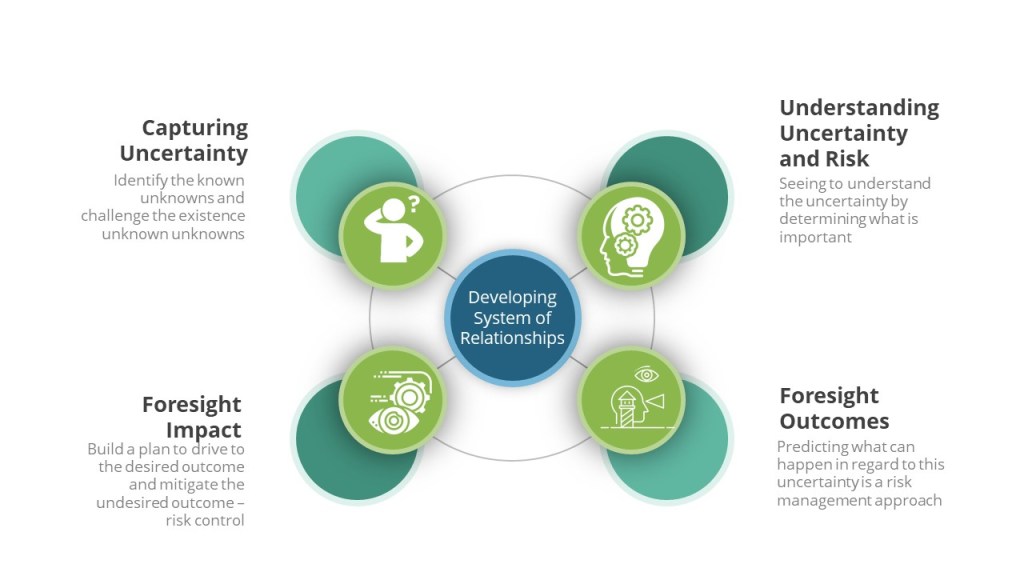
This making sense of uncertainty – which should be a part of every manager’s daily routine – is another name for foresight. Foresight can be used as a discipline to help our organizations look into the future with the aim of understanding and analyzing possible future developments and challenges and supporting actors to actively shape the future.

Sensemaking is mostly used as a retrospective process – we look back at action that has already taken place, Weick himself acknowledged that people’s actions may be guided by future-oriented thoughts, he nevertheless asserted that the understanding that derives from sensemaking occurs only after the fact, foregrounding the retrospective quality of sensemaking even when imagining the future.

“When one imagines the steps in a history that will realize an outcome, then there is more likelihood that one or more of these steps will have been performed before and will evoke past experiences that are similar to the experience that is imagined in the future perfect tense.”

R.B. MacKay went further in a fascinating way by considering the role that counterfactual and prefactual processes play in future-oriented sensemaking processes. He finds that sensemaking processes can be prospective when they include prefactual “whatifs” about the past and the future. There is a whole line of thought stemming from this that looks at the meaning of the past as never static but always in a state of change.

Foresight concerns interpretation and understanding, while simultaneously being a process of thinking the future in order to improve preparedness. Though seeking to understand uncertainty, reduce unknown unknowns and drive a future state it is all about knowledge management fueling risk management.

Do Not Ignore Metaphor

A powerful tool in this reasoning, imagining and planning the future, is metaphor. Now I’m a huge fan of metaphor, though some may argue I make up horrible ones – I think my entire team is sick of the milk truck metaphor by now – but this underutilized tool can be incredibly powerful as we build stories of how it will be.

Think about phrases such as “had gone through”, “had been through” and “up to that point” as commonly used metaphors of emotional experiences as a physical movement or a journey from one point to another. And how much that set of journey metaphors shape much of our thinking about process improvement.

Entire careers have been built on questioning the heavy use of sport or war metaphors in business thought and how it shapes us. I don’t even watch sports and I find myself constantly using it as short hand.

To make sense of the future find a plausible answer to the question ‘what is the story?’, this brings a balance between thinking and acting, and allows us to see the future more clearly.

Bibliography

  • Cornelissen, J.P. (2012), “Sensemaking under pressure: the influence of professional roles and social accountability on the creation of sense”, Organization Science, Vol. 23 No. 1, pp. 118-137, doi: 10. 1287/orsc.1100.0640.
  • Greenberg, D. (1995), “Blue versus gray: a metaphor constraining sensemaking around a restructuring”, Group and Organization Management, Vol. 20 No. 2, pp. 183-209, available at: http://doi-org.esc-web.lib.cbs.dk:8443/10.1177/1059601195202007
  • Luscher, L.S. and Lewis, M.W. (2008), “Organizational change and managerial sensemaking: working through paradox”, Academy of Management Journal, Vol. 51 No. 2, pp. 221-240, doi: 10.2307/20159506.
  • MacKay, R.B. (2009), “Strategic foresight: counterfactual and prospective sensemaking in enacted environments”, in Costanzo, L.A. and MacKay, R.B. (Eds), Handbook of Research on Strategy and Foresight, Edward Elgar, Cheltenham, pp. 90-112, doi: 10.4337/9781848447271.00011
  • Tapinos, E. and Pyper, N. (2018), “Forward looking analysis: investigating how individuals “do” foresight and make sense of the future”, Technological Forecasting and Social Change, Vol. 126 No. 1, pp. 292-302, doi: 10.1016/j.techfore.2017.04.025.
  • Weick, K.E. (1979), The Social Psychology of Organizing, McGraw-Hill, New York, NY.
  • Weick, K.E. (1995), Sensemaking in Organizations, Sage, Thousand Oaks, CA.

What prevents us from improving systems?

Improvement is a process and sometimes it can feel like it is a one-step-forward-two-steps-back sort of shuffle. And just like any dance, knowing the steps to avoid can be critical. Here are some important ones to consider. In many ways they can be considered an onion, we systematically can address a problem layer and then work our way to the next.

Human-error-as-cause

The vague, ambiguous and poorly defined bucket concept called human error is just a mess. Human error is never the root cause; it is a category, an output that needs to be understood. Why did the human error occur? Was it because the technology was difficult to use or that the procedure was confusing? Those answers are things that are “actionable”—you can address them with a corrective action.

The only action you can take when you say “human error” is to get rid of the people. As an explanation the concept it widely misused and abused. 

Human performance instead of human error
AttributePerson ApproachSystem Approach
FocusErrors and violationsHumans are fallible; errors are to be expected
Presumed CauseForgetfulness, inattention, carelessness, negligence“Upstream” failures, error traps; organizational failures that contribute to these
Countermeasure to applyFear, more/longer procedures, retraining, disciplinary measures, shamingEstablish system defenses and barriers
Options to avoid human error

Human error has been a focus for a long time, and many companies have been building programmatic approaches to avoiding this pitfall. But we still have others to grapple with.

Causal Chains

We like to build our domino cascades that imply a linear ordering of cause-and-effect – look no further than the ubiquitous presence of the 5-Whys. Causal chains force people to think of complex systems by reducing them when we often need to grapple with systems for their tendency towards non-linearity, temporariness of influence, and emergence.

This is where taking risk into consideration and having robust problem-solving with adaptive techniques is critical. Approach everything like a simple problem and nothing will ever get fixed. Similarly, if every problem is considered to need a full-on approach you are paralyzed. As we mature we need to have the mindset of types of problems and the ability to easily differentiate and move between them.

Root cause(s)

We remove human error, stop overly relying on causal chains – the next layer of the onion is to take a hard look at the concept of a root cause. The idea of a root cause “that, if removed, prevents recurrence” is pretty nonsensical. Novice practitioners of root cause analysis usually go right to the problem when they ask “How do I know I reached the root cause.” To which the oft-used stopping point “that management can control” is quite frankly fairly absurd.  The concept encourages the idea of a single root cause, ignoring multiple, jointly necessary, contributory causes let alone causal loops, emergent, synergistic or holistic effects. The idea of a root cause is just an efficiency-thoroughness trade-off, and we are better off understanding that and applying risk thinking to deciding between efficiency and resource constraints.

In conclusion

Our problem solving needs to strive to drive out monolithic explanations, which act as proxies for real understanding, in the form of big ideas wrapped in simple labels. The labels are ill-defined and come in and out of fashion – poor/lack of quality culture, lack of process, human error – that tend to give some reassurance and allow the problem to be passed on and ‘managed’, for instance via training or “transformations”. And yes, maybe there is some irony in that I tend to think of the problems of problem solving in light of these ways of problem solving.