Quality-as-Imagined versus Quality-as-Done

Assumptions about how work is carried out is often very different from the reality of the work. This is the difference between work-as-imagined and work-as-done. Assumptions about work as imagined often turn out to be wrong because they are based on a fundamental misunderstanding. Steven Shorrock on Humanistic Systems has been doing a great series on proxies for work-as-done that I recommend you read for more details.

The complexity of our organizations implies a certain level of inevitable unexpected variability and thus a gap between Work-as-Imagined and Work-as-Done. Work-as-Imagined reflects how work is understood by those who are separated from it by time or space; it is an over-simplified version of what is actually going on. Work-as-Done takes account of what it means to function effectively, despite resource-constrained circumstances. The analysis of the gap between Work-As-Imagined and Work-as-Done usually indicates that performance variability is present in both desired and undesired outcomes and, therefore, successful outcomes do not necessarily occur because people are behaving according to Work-as-Imagined.

The same concept applies to the nature and implications of the gap between the prescribed quality practices and policies, Quality-as-Imagined, and the way they are deployed in practice, Quality-as-Done.

This gap should be no surprise. Our organizations are complex systems, and complexity can give rise to unintended consequences.

The interesting thing is that quality can drive a reduction of that gap, solving for complexity.

The Influence of Complexity on Quality
Dynamic InteractionsWide DiversityUnexpected VariabilityResilience
SocialInteractions between employeesEmployees with varying skill levels
Employee turnover
Diversity of functions performed by employees
(e.g. multiskilling)
Errors when operating equipment and tools
Unexpected behaviors
Absenteeism
Variability in human labor demand
Unexpected outcomes from
social interactions (e.g. conflicts and alliances)
Employees’ ability to
anticipate risks
Critical analysis of data
Informal agreements between workers to distribute the workload
TechnicalInteractions between production resources
Interactions due to tightly coupled operations (e.g. time constraints, low inventories, capacity constraints)
Product diversity
Diversity of quality requirements
Diversity of client requirements
Technical disruptions
Resource availability (e.g. maintenance staff)
Variability in production times (e.g. cycle time, lead time)
Dimensional variability (e.g. potential for defects)
Inspection readiness
Corrective, preventive and predictive measures
Work OrganizationInteractions between information sources
Interactions between functions
Interactions between processes
Interactions between performance indicators
Diversity in managerial controls
Diversity in relationships with external agents
Diversity of rules and procedures
Variability in the hiring of new workers
Changing priorities (e.g. frequent rescheduling due to unexpected conditions)
Variability in timing and
accuracy of information
Negotiation, partnership and bargaining power with suppliers and clients
Investments on new resources
Multidisciplinary problem-solving meetings
External EnvironmentInteractions between the organization, suppliers, and clients
Interactions with regulatory bodies
Diversity in suppliers
Diversity in clients
Variability in Demand/Need
Variability in logistics
Capacity and slack management
Examples of Complexity Impact

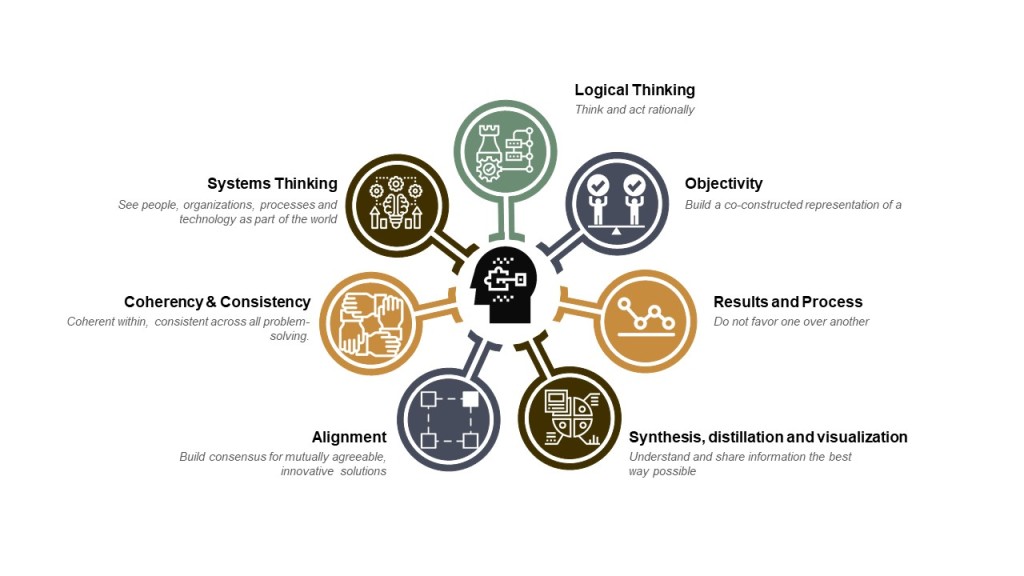
Seven elements of good problem-solving

Logic

Perhaps more than anything else, we want our people to be able to think and then act rationally in decision making and problem-solving. The basic structure and technique embodied in problem solving is a combination of discipline when executing PDCA mixed with a heavy dose of the scientific method of investigation.

Logical thinking is tremendously powerful because it creates consistent, socially constructed approaches to problems, so that members within the organization spend less time spinning their wheels or trying to figure out how another person is approaching a given situation. This is an important dynamic necessary for quality culture.

The right processes and tools reinforce this as the underlying thinking pattern, helping to promote and reinforce logical thought processes that are thorough and address all important details, consider numerous potential avenues, take into account the effects of implementation, anticipate possible stumbling blocks, and incorporate contingencies. The processes apply to issues of goal setting, policymaking, and daily decision making just as much as they do to problem-solving.

Objectivity

Because human observation is inherently subjective, every person sees the world a little bit differently. The mental representations of the reality people experience can be quite different, and each tends to believe their representation is the “right” one. Individuals within an organization usually have enough common understanding that they can communicate and work together to get things done. But quite often, when they get into the details of the situation, the common understanding starts to break down, and the differences in how we see reality become apparent.

Problem-solving involves reconciling those multiple viewpoints – a view of the situation that includes multiple perspectives tends to be more objective than any single viewpoint. We start with one picture of the situation and make it explicit so that we can better share it with others and test it. Collecting quantitative (that is, objective) facts and discussing this picture with others is a key way in verifying that the picture is accurate. If it is not, appropriate adjustments are made until it is an accurate representation of a co-constructed reality. In other words, it is a co-constructed representation of a co-constructed reality.

Objectivity is a central component to the problem solving mindset. Effective problem-solvers continually test their understanding of a situation for assumptions, biases, and misconceptions. The process begins by framing the problem with relevant facts and details, as objectively as possible. Furthermore, suggested remedies or recommended courses of action should promote the organizational good, not (even if subconsciously) personal agendas.

Results and Process

Results are not favored over the process used to achieve them, nor is process elevated above results. Both are necessary and critical to an effective organization.

Synthesis, Distillation and and Visualization

We want to drive synthesis of the learning acquired in the course of understanding a problem or opportunity and discussing it with others. Through this multiple pieces of information from different sources are integrated into a coherent picture of the situation and recommended future action.

Visual thinking plays a vital role in conveying information and the act of creating the visualization aids the synthesis and distillation process.

Alignment

Effective implementation of a change often hinges on obtaining prior consensus among the parties involved. With consensus, everyone pulls together to overcome obstacles and make the change happen. Problem-solving teams communicates horizontally with other groups in the organization possibly affected by the proposed change and incorporates their concerns into the solution. The team also communicates vertically with individuals who are on the front lines to see how they may be affected, and with managers up the hierarchy to determine whether any broader issues have not been addressed. Finally, it is important that the history of the situation be taken into account, including past remedies, and that recommendations for action consider possible exigencies that may occur in the future. Taking all these into consideration will result in mutually agreeable, innovative solutions.

Coherency and Consistency

Problem-solving efforts are sometimes ineffective simply because the problem-solvers do not maintain coherency. They tackle problems that are not important to the organization’s goals, propose solutions that do not address the root causes, or even outline implementation plans that leave out key pieces of the proposed solution. So coherency within the problem-solving approach is paramount to effective problem resolution.

Consistent approaches to problem-solving speed up communication and aid in establishing shared understanding. Organizational members understand the implicit logic of the approach, so they can anticipate and offer information that will be helpful to the problem-solvers as they move through the process.

Systems Thinking

Good system thinking means good problem-solving.

Here, There, Everywhere

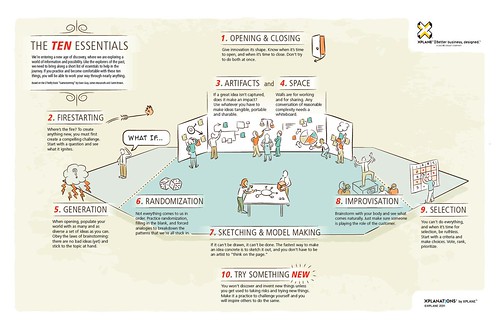
I’m doing a Gamestorming Expeditions right now, and it is a lot of fun. I’ve been a fan of gamestorming techniques for years, and it is great to be able to do this program with a bunch of other facilitators and have a space to learn. One of the best virtual events I’ve done during the pandemic and I highly recommend it.

One of the great games we’ve learned is a wrap-up, “Here, There and everywhere”

Here something in our time together that caught your attention, piqued your curiosity or, at the very least, you noticed. It might be a game, a comment from a fellow participant, a concept, a visual framework, etc… 

There how you might take that specific example and implement it at work or in your personal life. Bring in as much detail as you can to make for easy implementation; imagine your future self doing it and the outcome it generates

Everywhere would be a generalized interpretation of this thing that would allow for more universal application – an underlying principle absent context 

I love it for the elegance and simplicity and have already used it in my own practice.

Changes stems from learning from mistakes

As we build quality culture we need to question our basic assumptions and build new principles of every day interactions. At the heart of this sits a culture where change is viewed as a good thing.

Willingness to change

To what extent are employees willing to continuously review and adapt their own behavior in response to a changing environment? The ideal scenario is for the entire workforce to be willing to change. This willingness to change should not be confined to situations where changes are already being implemented. It means that people should look at environment with open eyes, recognize when there is an opportunity or a need for change and initiate the relevant actions themselves. Willingness to change should be the first principle of culture and is a key enabler of the popular concept often called agility.

Learning Culture

To what extent do employees think that their actions should be guided by data- and fact-based knowledge? The term “knowledge” encompasses any knowledge acquired through targeted observation, by chance, through data-based analysis or from practical experience.

Willingness to make mistakes

Learning cultures attach great importance to mistakes. These organizations have understood that learning and change processes can only be triggered by mistakes. Mistakes provide an opportunity to gain a better understanding of the company’s processes and uncover previously unknown cause-and-effect relationships.

The way an organization deals with mistakes is therefore a key aspect of its culture. Two fundamentally different approaches to mistakes exist.

  • A negative attitude towards mistakes is reflected in a strategy based on the systematic avoidance of errors, strict penalties for making mistakes and the correction of errors as rapidly and unobtrusively as possible. Employees of companies where this culture prevails are not usually willing to disclose mistakes. This attitude inhibits their willingness to change.
  • On the other hand, a culture that recognizes the value of mistakes is characterized by open discussion of mistakes when they occur, systematic error documentation and a determination to find both the causes of the mistakes and their solutions. When investigating mistakes, it is critical to focus on understanding the causes rather than on finding out who is to blame.

Openness to Innovation

Openness to innovation and new ways of doing things is an important capability that is required in order to initiate change and adopt the right measures, even if they may sometimes be rather unconventional.

Social Collaboration

An environment characterized by trust and social relationships provides the basis for open, uninhibited knowledge sharing between employees. Social collaboration, helps to accelerate knowledge sharing within the organization. Good strong social networks build resilience and enable the ability to change.

Open Communication

In order for companies to respond rapidly and to be able to effectively change, employees need to have access to the necessary explicit and implicit knowledge. While explicit knowledge can be provided through the appropriate communication technology, the sharing of implicit knowledge calls for direct communication between the people who possess the knowledge and the people seeking it.

An effective organization needs to abandon the “us and them” mentality. Employees have acquired the capability of open communication if, having taken on board the fact that openly sharing knowledge and working together to achieve a vision increases the total sum of knowledge, they then also act
accordingly. Once the organization’s entire workforce is willing to share knowledge with everyone, it becomes possible to significantly accelerate learning processes within the company.

What Does This Look Like?

Social collaboration exists between employees and with customers and partners. Confidence in systems and processes results in high process stability. People are willing to document their acquired knowledge and share it with others. The democratic leadership style values people for the contribution they make and there is a culture of open communication. The workforce is both receptive and willing to change. They learn systematically from the captured data, are open to innovative approaches and participate in shaping change processes. Employees are also conscious of the need to continuously develop their skills and competencies. While mistakes are still made, people recognize that they are valuable because they have the potential to trigger improvements.

Where we need to be

Types of Uncertainty

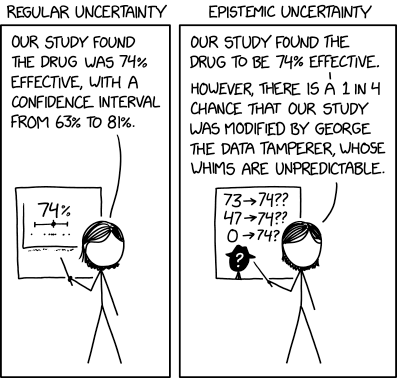
XKCD “Epistemic Uncertainty” https://xkcd.com/2440/

An important part of innovation, risk management, change management, continuous improvement is overcoming the fear of the unknown. We humans are wired with an intense aversion to both risk and uncertainty. Research shows that both have separate neural reactions and that choices with ambiguous outcomes trigger a stronger fear response than do risky choices. Additional research shows that the risk itself isn’t so much the problem, but the uncertainty is: we are afraid primarily because we don’t know the outcome and less so because of the risk.

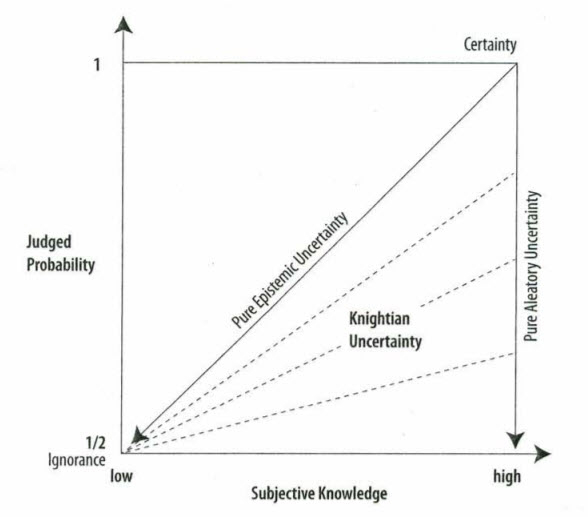
There are three types of uncertainty:

  • Aleatoric Uncertainty: The uncertainty of quantifiable probabilities.
  • Epistemic Uncertainty: The uncertainty of knowledge. 
  • Knightian Uncertainty: The uncertainty of nonquantifiable risk.
A Two-Dimensional Framework for Characterizing Uncertainty from “Distinguishing Two Dimensions of Uncertainty” by Craig R. Fox and Gülden Ülkümen

I wrote more on this in my post “Uncertainty and Subjectivity in Risk Management.” This post mostly stems from wanting an excuse to share a funny comic.