Challenges in Validation

I often get asked why I moved from a broader senior role in Quality Management to a particular but deep role in Quality Engineering and Validation. There are many answers, but the biggest is that validation is poised for some exciting shifts due to navigating a complex validation landscape characterized by rapid technological advancements, evolving regulatory standards, and the development of novel therapies. Addressing these challenges requires innovation, collaboration, and a proactive approach to risk management and data integration. Topics near and dear to me.
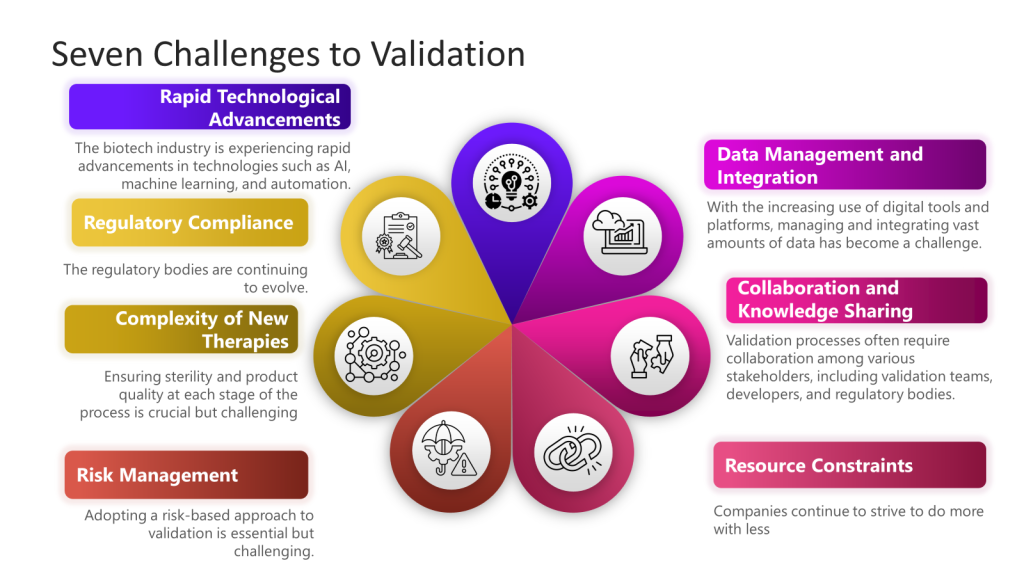
Today’s Challenges in Biotech Validation

1. Rapid Technological Advancements

The biotech industry is experiencing rapid technological advancements such as AI, machine learning, and automation. Integrating these technologies into validation processes can be challenging due to the need for new validation frameworks and methodologies.

2. Regulatory Compliance

Maintaining compliance with evolving regulatory standards is a significant challenge. Regulatory bodies like the FDA continuously update guidelines for technological advancements.

3. Complexity of New Therapies

Developing novel therapies, such as cell and gene therapies, introduces additional complexity to the validation process. These therapies often require redesigned facilities and equipment to accommodate their sensitive and sterile nature. Ensuring sterility and product quality at each process stage is crucial but challenging.

4. Data Management and Integration

Managing and integrating vast amounts of data has become challenging with the increasing use of digital tools and platforms. Effective data management is essential for predictive modeling and risk management in validation processes. Organizations must adopt robust data analytics and machine learning tools to handle this data efficiently.

5. Collaboration and Knowledge Sharing

Validation processes often require collaboration among various stakeholders, including validation teams, developers, and regulatory bodies. Ensuring real-time communication and data sharing can be challenging but is essential for streamlining validation efforts and aligning goals.

6. Resource Constraints

Smaller biotech companies, in particular, face resource constraints regarding funding, personnel, and expertise. These constraints can hinder their ability to implement advanced validation techniques and maintain compliance with regulatory standards.

7. Risk Management

Adopting a risk-based approach to validation is essential but challenging. Companies must identify and mitigate risks throughout the product lifecycle, which requires a thorough understanding of potential risks and effective risk management strategies.

Let’s Avoid the Term Validation 4.0

Let’s avoid the 4.0 term. We are constantly evolving, and adding a current ‘buzziness’ to it does no one any favors. We are shifting from traditional, paper-heavy validation methods to a more dynamic, data-driven, and digitalized process. Yes, we are leveraging modern technologies such as automation, data analytics, artificial intelligence (AI), and the Internet of Things (IoT) to enhance validation processes’ efficiency, flexibility, and reliability. But we don’t need buzziness, we just need to give it some thought, experiment, and refine.

AI Can Create Value, but Only If You Bring Employees Along

Great article in HBR by Behnam Tabrizi and Babak PahlavanCompanies That Replace People with AI Will Get Left Behind” that makes excellent points about how companies should be looking for AI to free up employees to create new value, and not to replace employees.

Automation has been a truism throughout my career. Organizations that leveraged that automation to create value were superior to the ones which used that automation as an excuse to cut jobs.

As we move oh so quickly to dealing with the impact of hyper-automation on our organizations it is important to have a vision and a strategy. Apply quality principles, and remember to drive out fear through the strategic execution.

Quality vs Quality

The word quality is a loaded word in organizations, and I’m sure most of my readers have been in a least one major discussion that has felt like an Abbott and Costello routine.

The difference between “quality” and the “Quality department” is that “quality” refers to the overall level of excellence or excellence in a product, service, or process, while the “Quality department” is part of an organization that is responsible for ensuring that the organization’s products, services, or processes meet certain quality standards.

In other words, “quality” is a general concept that refers to the level of excellence or excellence in something, while the “Quality department” is a specific part of an organization that is responsible for managing and improving the quality of that organization’s products, services, or processes.

The Quality department typically plays a key role in ensuring that an organization’s products, services, or processes meet the required quality standards. This might involve activities such as conducting quality assurance audits, implementing quality control measures, or providing training and support to help employees understand and comply with quality standards.

Overall, the difference between “quality” and the “Quality department” is that “quality” is a broad concept that refers to the overall level of excellence or excellence in something, while the “Quality department” is the specific part of an organization that is responsible for managing and improving the quality of that organization’s products, services, or processes.

In FDA-regulated industries, this continues to be a stressful point. We have some regulations that specifically call out the Quality Unit or Quality Control (a different point of fun), while others provide quality expectations that may or may not be the responsibility of the Quality Unit, depending on the way your organization is built.

Add to this that quality is a culturally sensitive term. It gets to the heart of what people consider integral to themselves. That they have quality in their work. And there can be gaps between people’s perceptions and the reality of the organization. The whole concept of what quality is in an organization gets to three central aspects:

  • Role Conception:  what people think their jobs are and how they have been trained to perform them
  • Role Expectation:  what others in the organization think another person’s job is and how it should be carried out
  • Role Behavior:  what people actually do in carrying out their job

So we have quality as a set of habits and practices and Quality as a concept of a role within an organization. And the boundaries between the two can be contentious. Add in the quality control layer (and how quality control does not require a department called quality control) and we can have a whole fun set of arguments.

This post was brought to you by me being in a meeting where someone referenced a version of the golden triangle and I instantly wondered what work someone else was trying to foist off onto me.

Build Your Knowledge Base

Engaging with knowledge and Knowledge Management are critical parts of development. The ability to navigate the flood of available data to find accurate information is tied directly to individuals’ existing knowledge and their skills at distinguishing credible information from misleading content.

There is ample evidence that many individuals lack the ability to accurately judge their understanding or the quality and accuracy of their performance (i.e., calibration). To truly develop our knowledge, we need to be engaged in deliberative practice. But to truly calibrate requires feedback, guidance, and coaching that you may not have access to within our organizations. This requires effort and deliberate building of a system and processes.

Information can be found with little mental effort but without critical analysis of its legitimacy or validity, the ease of information can actually work against the development of deeper-processing strategies. It is really easy to go-online and get an answer, but unless learners put themselves in positions to struggle cognitively with an issue, and unless they have occasions to transform or reframe problems, their likelihood of progressing into competence is jeopardized.

The more learners forge principled knowledge in a professional domain, the greater their reported interest in and identity with that field. Therefore, without the active pursuit of knowledge, these individuals’ interest in professional development may wane and their progress toward expertise may stall. This is why I find professional societies so critical, and why I am always pushing people to step up.

My constant goal as a mentor is to help people do the following:

  • Refuse to be lulled into accepting a role as passive consumers of information, striving instead to be active producers of knowledge
  • Probe and critically analyze the information they encounter, rather
    than accepting quick, simple answers
  • Forge a meaningful interest in the profession and personal connections to members
    of professional communities, instead of relying on moment-by-moment stimulation and superficial relationships

If we are going to step up to the challenges ahead of us, to address the skill gaps we are seeing, we each need to be deliberate in how we develop and deliberate in how we build our organizations to support development.

You, Yes You! Speak at a Conference

The process of writing and speaking is a core part of the Quality profession. Only through these activities can we truly contemplate and learn from our accomplishments to propel us forward to new heights.

There are some great speaking opportunities for folks around the Boston area coming up:

BOSCON is November 6 and 7th and is looking for speakers. I’m a huge fan of this regional convention and strongly recommend it. Submissions are due August 15th, 2023.

The ASQ’s Quality Innovations Summit (formerly the Quality 4.0 Summit) is September 19–21 in Boston, MA with a theme of “Innovations and Future Trends for Excellence.” Submission deadline is June 9th, 2023, with more information here.

I’m quite happy to help coach potential new speakers, both in the development of your proposal and in your presentation.