Culture of Quality Initiatives

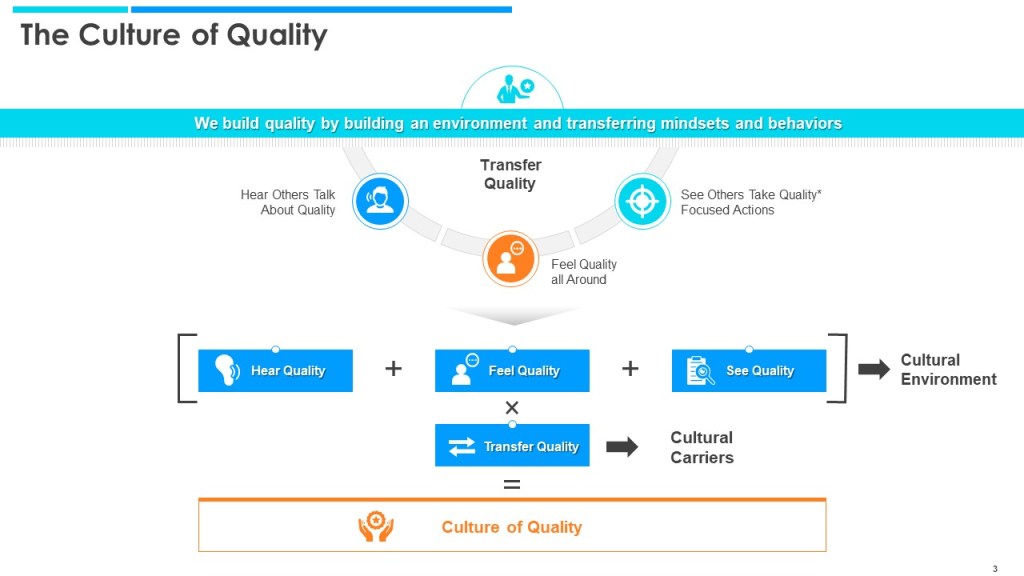
At the heart of culture is a set of behaviors and beliefs, that indicate what is important to the organization and drive all decision-making. Culture, and weaknesses within it, drive the root cause of many problems, and improving quality culture is an essential part of continuous improvement.

Culture is often the true reason for the behavior of people within an organization and it can often be deeply unconscious and not rationally recognized by most members. These ideas are so integrated that they can be difficult to confront or debate and thus difficult to change.

How we Build Quality

A critical part for improving culture is being able to measure the current situation. A great place to start is using a survey-based to gather input from employees on the current culture of quality. Some of the topic areas can include:

Some of the feedback methods to utilize once you have a baseline can include:

Feedback MethodWhen to use
Focus GroupsYou want detailed feedback on a number if issues AND employees are generally willing to speak on the record
Short, targeted surveysYou have a number of close-ended findings to test AND your organization is not suffering survey fatigue
Informal conversationsYou want to gain context of a few data points AND you have a trusted circle

As you build improvements, you will introduce better metrics of success.

Once you a good set of findings select 2-3 key ones and design experiments.

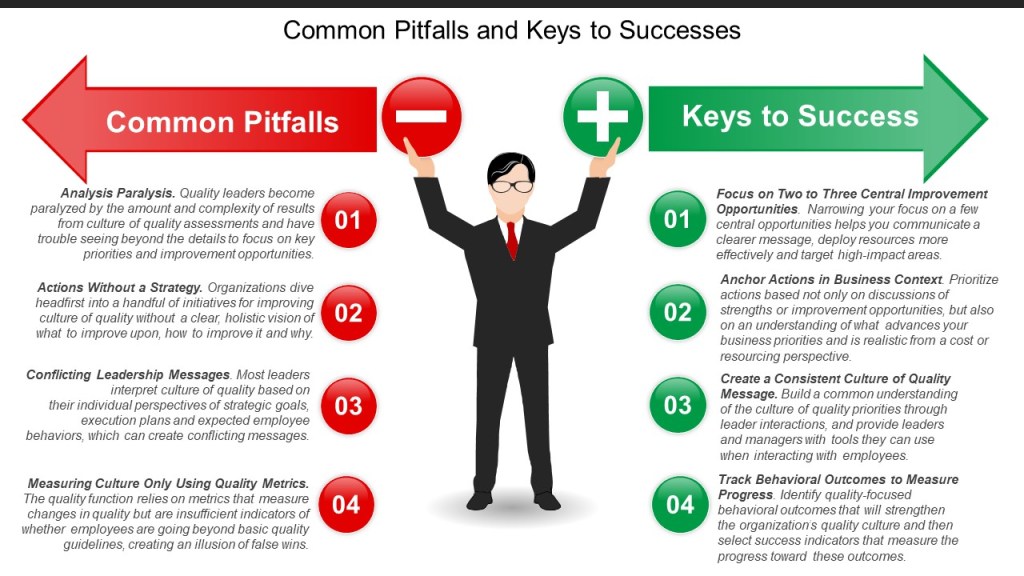
Pitfalls and Keys to Success for Experiments in Quality Culture
Experiment for Success

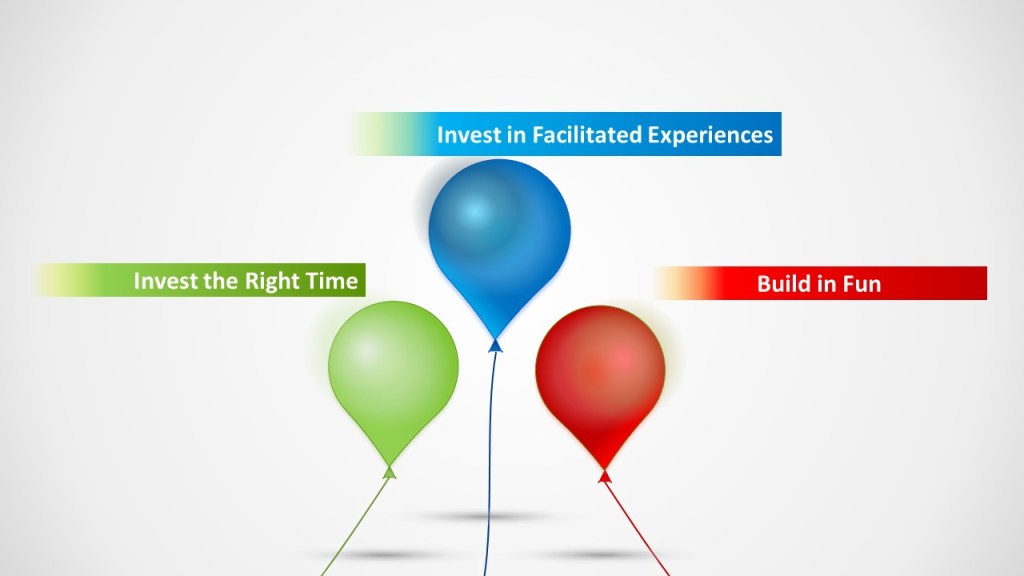
Three things that get in the way of good training

Culture of Delivery

Does training in your organization seem like death by PowerPoint? Is learning viewed as something an expert dumps in the lap of the learner.? However, that’s not what learning is – lectures and one-way delivery end up resulting in very little learning.

For deeper meaning to occur, invest in professionally facilitated experiences that enable staff to form mental models they remember. Get people thinking before and after the training to ensure that the mental model stays fresh in the mind.

Culture of Cutting Time

Avoid the desire for training in shorter and shorter chunks. The demands of the workplace are increasingly complex and stressful, so any time out of the office is a serious cost. The paradox is that by shortening the training, we don’t give the time for structured learning, which sabotages the investment when the training program could be substantially improved by adding the time to allow the learning to be consolidated.

Culture of Un-Fun

We know that learning takes place when people have fun, stress is low, and the environment encourages discovery. Make training cheerful and open rather than dull and quiet. Encourage lots of informal learning opportunities. Give more control to the learner to shape their experience. Have fun!

Quality, Decision Making and Putting the Human First

Quality stands in a position, sometimes uniquely in an organization, of engaging with stakeholders to understand what objectives and unique positions the organization needs to assume, and the choices that are making in order to achieve such objectives and positions.

The effectiveness of the team in making good decisions by picking the right choices depends on their ability of analyzing a problem and generating alternatives. As I discussed in my post “Design Lifecycle within PDCA – Planning” experimentation plays a critical part of the decision making process. When designing the solution we always consider:

  • Always include a “do nothing” option: Not every decision or problem demands an action. Sometimes, the best way is to do nothing.
  • How do you know what you think you know? This should be a question everyone is comfortable asking. It allows people to check assumptions and to question claims that, while convenient, are not based on any kind of data, firsthand knowledge, or research.
  • Ask tough questions Be direct and honest. Push hard to get to the core of what the options look like.
  • Have a dissenting option. It is critical to include unpopular but reasonable options. Make sure to include opinions or choices you personally don’t like, but for which good arguments can be made. This keeps you honest and gives anyone who see the pros/cons list a chance to convince you into making a better decision than the one you might have arrived at on your own.
  • Consider hybrid choices. Sometimes it’s possible to take an attribute of one choice and add it to another. Like exploratory design, there are always interesting combinations in decision making. This can explode the number of choices, which can slow things down and create more complexity than you need. Watch for the zone of indifference (options that are not perceived as making any difference or adding any value) and don’t waste time in it.
  • Include all relevant perspectives. Consider if this decision impacts more than just the area the problem is identified in. How does it impact other processes? Systems?

A struggle every organization has is how to think through problems in a truly innovative way.  Installing new processes into an old bureaucracy will only replace one form of control with another. We need to rethink the very matter of control and what it looks like within an organization. It is not about change management, on it sown change management will just shift the patterns of the past. To truly transform we need a new way of thinking. 

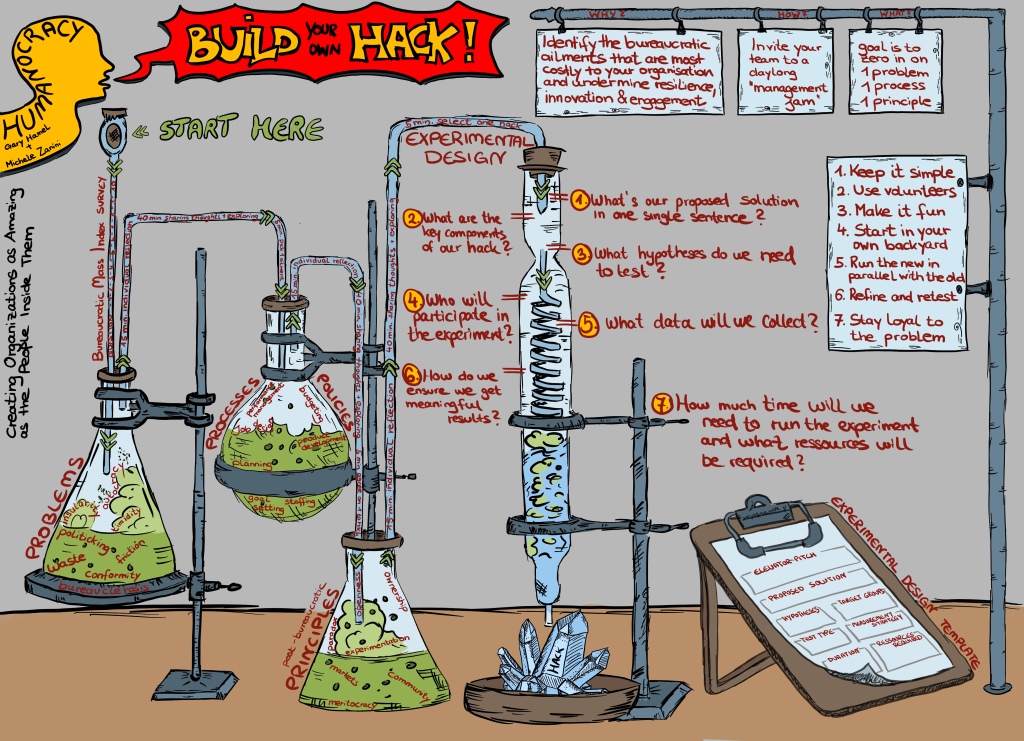
One of my favorite books on just how to do this is Humanocracy: Creating Organizations as Amazing as the People Inside Them by Gary Hamel and Michele Zanini. In this book, the authors advocate that business must become more fundamentally human first.  The idea of human ability and how to cultivate and unleash it is an underlying premise of this book.

Visualized by Rose Fastus

it’s possible to capture the benefits of bureaucracy—control, consistency, and coordination—while avoiding the penalties—inflexibility, mediocrity, and apathy.

Gary Hamel and Michele Zanini, Humanocracy, p. 15

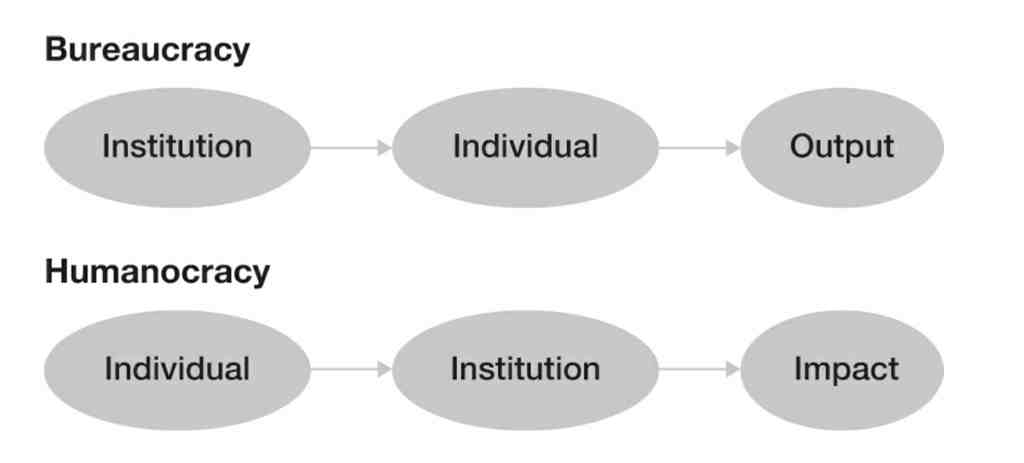
The above quote really encapsulates the heart of this book, and why I think it is such a pivotal read for my peers. This books takes the core question of a bureaurcacy is “How do we get human beings to better serve the organization?”. The issue at the heart of humanocracy becomes: “What sort of organization elicits and merits the best that human beings can give?” Seems a simple swap, but the implications are profound.

Bureaucracy versus Humanocracy. Source: Gary Hamel and Michele Zanini, Humanocracy, p. 48

I would hope you, like me, see the promise of many of the central tenets of Quality Management, not least Deming’s 8th point. The very real tendency of quality to devolve to pointless bureaucracy is something we should always be looking to combat.

Humanocracy’s central point is that by truly putting the employee first in our organizations we drive a human-centered organization that powers and thrives on innovation. Humanocracy is particularly relevant as organizations seek to be more resilient, agile, adaptive, innovative, customer centric etc. Leaders pursuing such goals seek to install systems like agile, devops, flexible teams etc.  They will fail, because people are not processes.  Resiliency, agility, efficiency, are not new programming codes for people.  These goals require more than new rules or a corporate initiative.  Agility, resilience, etc. are behaviors, attitudes, ways of thinking that can only work when you change the deep ‘systems and assumptions’ within an organization.  This book discusses those deeper changes.

Humanocracy lays out seven tips for success in experimentation. I find they align nicely with Kotter’s 8 change accelerators.

Humanocracy’s TipKotter’s Accelerator
Keep it SimpleGenerate (and celebrate) short-term wins
Use VolunteersEnlist a volunteer army
Make it FunSustain Acceleration
Start in your own backyardForm a change vision and strategic initiatives
Run the new parallel with the oldEnable action by removing barriers
Refine and RetestSustain acceleration
Stay loyal to the problemCreate a Sense of Urgency around a
Big Opportunity
Comparison to Kotter’s Eight Accelerators for Change

Share your stories

As we move through of careers we all have endless incidents that can either be denied and suppressed or acknowledged and framed as “falls,” “failures,” or “mistakes.” These so-called falls all enhance our professional growth. By focusing on the process of falling, and then rising back up, we are able to have a greater understanding of the choices we have made, and the consequences of our choices.

Sharing and bearing witness to stories of failure from our professional and personal lives provide opportunities for us to explore and get closer to the underlying meaning of our work, our questions of what is it that we are trying to accomplish in our work as quality professionals. Our missteps allow us to identify paths we needed to take or create new stories and new pathways to emerge within the context of our work. As we share stories of tensions, struggles, and falling down, we realized how important these experiences are in the process of learning, of crafting one’s presence as a human being among human beings, of becoming a quality professional.

We may not have asked for a journey of struggle when we decided to become quality professionals, but the process of becoming tacitly involves struggle and difficulty. There is a clear pattern among individuals who demonstrate the ability to rise strong pain and adversity in that they are able to describe their experiences, and lay meaning to it.

It is important to recognize that simply recognizing and affirming struggle, or that something is not going as it should, does not necessarily lead to productive change. To make a change and to work towards a culture of excellence we must recognize that emotions and feelings are in the game. Learning to lead is an emotionally-laden process. And early-stage professionals feel exceptionally vulnerable within this process. This field requires early-stage professionals to hone their interpersonal, technical, and organizational skills, all while turning their gaze inward to understanding how their positioning in the organization impacts can be utilized for change. Novice professionals often struggle in terms of communicating ideas orally or in writing, being able to manage multiple tasks at once, staying on top of their technical content, or even thinking critically about who they are in the broader world. Early-stage professionals are always on the brink of vulnerability.

Share your stories. Help others share theirs.

I’m organizing a PechaKucha/Ignite event as part of the ASQ’s Team and Workplace Excellence Forum to sharpen our stories. More details coming soon. Start thinking of your stories to share!

Royalty-free stock photo ID: 642783229

Knowledge Transfer

Our organizations are based on the interactions of individuals, teams and other organizations into a complex adaptive environment. We need to manage productive relationships as part of a complex system and interactions among parts can produce valuable, new, and unpredictable capabilities that are not inherent in any of the parts acting alone. This is why knowledge management, having a learning culture, is such a fundamental part of the work we do.

There are seven major categories we engage in when we manage, maintain, and create knowledge.

ActivityConvertsInvolvingMeaning
SocializationTacit-to-Tacitdifferent agentsSharing of tacit knowledge between individuals
IntrospectionTacit-to-Tacit same agentThe conscious or unconscious examination of one’s own tacit knowledge, as taken at an individual level
ExternalizationTacit-to-Explicitagent to knowledge managementThe expression of tacit knowledge and its translation into comprehensible forms interpretable by external agents
CombinationExplicit-to-ExplicitAll usersThe conversion of explicit knowledge into other variants of explicit knowledge
InternalizationExplicit-to-TacitTraining and deliberate practiceThe conversion of explicit knowledge into tacit knowledge
ConceptualizationAction-to-TacitContinuous ImprovementThe creation of tacit knowledge from aspects related to real work actions.
ReificationTacit-to-ActionProcess/ProcedureThe activity of bringing tacit knowledge into action (e.g. translating a mental model of a process activity into the actual operating tasks)
Knowledge Work Activities

As can be seen in the table above these seven activities involve moving between tacit and explicit knowledge. The apply to both declarative and procedural knowledge.

Examples of tacit and explicit knowledge

Socialization

Socialization is the level of interaction between, and communication of, various actors within an organization, which leads to the building of personal familiarity, improved communication, and problem solving. Often called learning the roles, this is the the process by which an individual acquires the social knowledge and skills necessary to assume an organizational role. Socialization encourages two-way information exchange, builds and establishes relationship trust, and enable transparency of information.

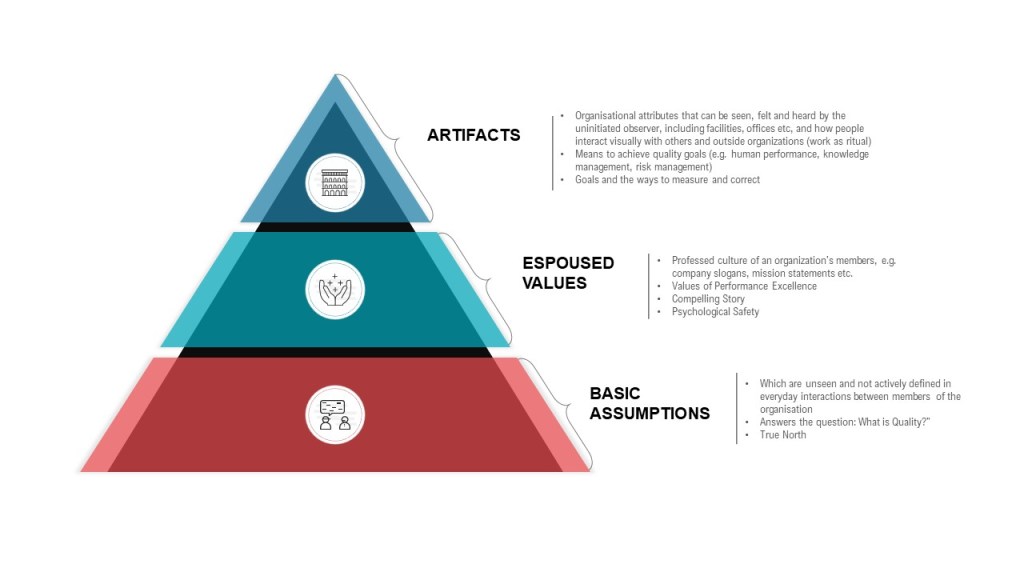
Socialization creates an operating style, enabling people to communicate with each other, have a language that they all understand and behavioral styles that are compatible. It reinforces basic assumptions and shares espoused values by helping create common norms and compatible cultures.

Socialization enables many influencing tactics which makes it critical for change management activities.

Introspection

The exploration of our experiences. Introspection can arise naturally but it can also arise deliberatively, for example journaling.

Introspection can also include retrospection, especially as a group activity. This is the strength of lessons learned.

Externalization

The work of making the tacit explicit. Knowledge management as continuous improvement.

Combination

The combination of knowledge drives innovation and a learning culture. This includes the ability to identify different sources of knowledge, understand different learning processes, and combine internal and external knowledge effectively.

Knowledge combination capability generates through exchange of knowledge between individuals and work teams is a process that allows the transfer of knowledge to the organization and that can be applied to develop and improve products and processes.

Internalization

As we move towards qualification we internalize knowledge.

Conceptualization

The insights gained from doing and observing work. Deliberative learning.

Reification

The process of translating work-as-imagined into work-as-done through work-as-prescribed on a continuous loop of improvement. The realm of transformative learning.