Know the Knows

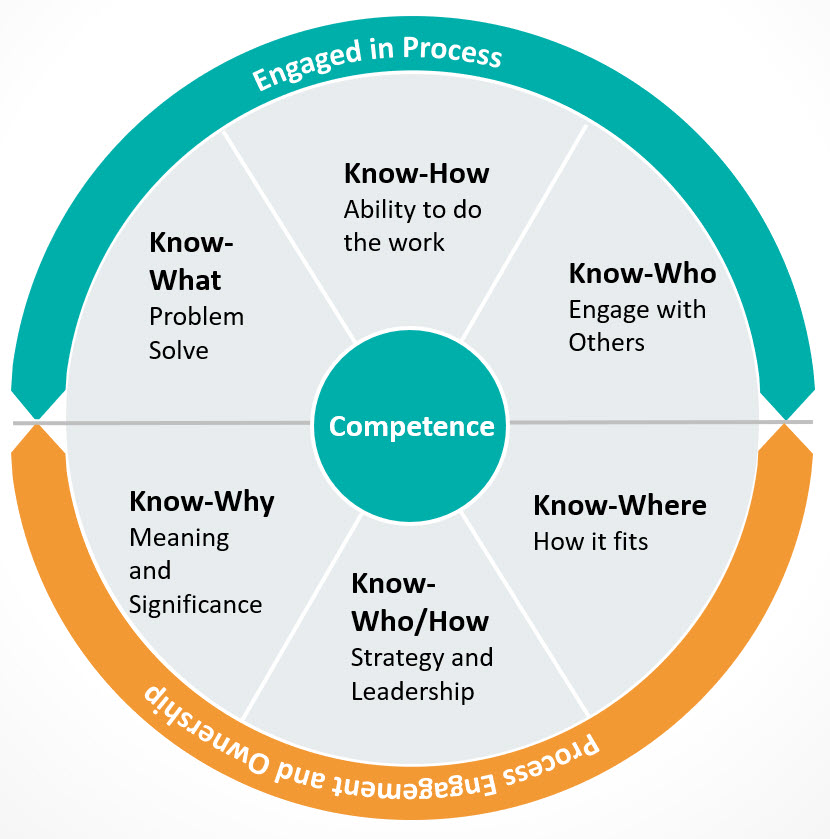
When developing training programs and cultural initiative sit is useful to break down what we really want people to know. I find it useful to think in terms of the following:

  • know-how: The technical skills to do the work
  • know-what: The ability to perform functional problem-solving, to adapt the process and innovate
  • know-who: networking and interpersonal skills, with social/emotional intelligence, for empathy or social network capacities
  • know-where: institutional and system knowledge of how the work fits into a larger ecosystem
  • know-who/how: strategic and leadership skills, for political ‘ nous’ in setting agendas, managing institutions, mobilizing resources;
  • know-why: creation of meaning, significance, identity, morality, with practical intuition for creative arts, sports, everyday social exchange.

To build all six elements requires a learning culture and a recognition that knowledge and awareness do not start and end at initial training on a process. We need to build the mechanisms to:

  • Communicate in a way to continually facilitate the assimilation of knowledge
  • Incorporate ongoing uses of tools such as coaching and mentoring in our processes and systems
  • Motivate the ongoing enhancement of learning
  • Nurture the development and retention of knowledge

We are striving at building competence, to be able to grow and apply the knowledge and abilities of our workers to solve problems and innovate.

Training, Development, Knowledge Management, Problem-Solving – these are a continuum but too often we balkanize responsibility of these in our organizations when what we need is an ecosystem approach.

Changes stems from learning from mistakes

As we build quality culture we need to question our basic assumptions and build new principles of every day interactions. At the heart of this sits a culture where change is viewed as a good thing.

Willingness to change

To what extent are employees willing to continuously review and adapt their own behavior in response to a changing environment? The ideal scenario is for the entire workforce to be willing to change. This willingness to change should not be confined to situations where changes are already being implemented. It means that people should look at environment with open eyes, recognize when there is an opportunity or a need for change and initiate the relevant actions themselves. Willingness to change should be the first principle of culture and is a key enabler of the popular concept often called agility.

Learning Culture

To what extent do employees think that their actions should be guided by data- and fact-based knowledge? The term “knowledge” encompasses any knowledge acquired through targeted observation, by chance, through data-based analysis or from practical experience.

Willingness to make mistakes

Learning cultures attach great importance to mistakes. These organizations have understood that learning and change processes can only be triggered by mistakes. Mistakes provide an opportunity to gain a better understanding of the company’s processes and uncover previously unknown cause-and-effect relationships.

The way an organization deals with mistakes is therefore a key aspect of its culture. Two fundamentally different approaches to mistakes exist.

  • A negative attitude towards mistakes is reflected in a strategy based on the systematic avoidance of errors, strict penalties for making mistakes and the correction of errors as rapidly and unobtrusively as possible. Employees of companies where this culture prevails are not usually willing to disclose mistakes. This attitude inhibits their willingness to change.
  • On the other hand, a culture that recognizes the value of mistakes is characterized by open discussion of mistakes when they occur, systematic error documentation and a determination to find both the causes of the mistakes and their solutions. When investigating mistakes, it is critical to focus on understanding the causes rather than on finding out who is to blame.

Openness to Innovation

Openness to innovation and new ways of doing things is an important capability that is required in order to initiate change and adopt the right measures, even if they may sometimes be rather unconventional.

Social Collaboration

An environment characterized by trust and social relationships provides the basis for open, uninhibited knowledge sharing between employees. Social collaboration, helps to accelerate knowledge sharing within the organization. Good strong social networks build resilience and enable the ability to change.

Open Communication

In order for companies to respond rapidly and to be able to effectively change, employees need to have access to the necessary explicit and implicit knowledge. While explicit knowledge can be provided through the appropriate communication technology, the sharing of implicit knowledge calls for direct communication between the people who possess the knowledge and the people seeking it.

An effective organization needs to abandon the “us and them” mentality. Employees have acquired the capability of open communication if, having taken on board the fact that openly sharing knowledge and working together to achieve a vision increases the total sum of knowledge, they then also act
accordingly. Once the organization’s entire workforce is willing to share knowledge with everyone, it becomes possible to significantly accelerate learning processes within the company.

What Does This Look Like?

Social collaboration exists between employees and with customers and partners. Confidence in systems and processes results in high process stability. People are willing to document their acquired knowledge and share it with others. The democratic leadership style values people for the contribution they make and there is a culture of open communication. The workforce is both receptive and willing to change. They learn systematically from the captured data, are open to innovative approaches and participate in shaping change processes. Employees are also conscious of the need to continuously develop their skills and competencies. While mistakes are still made, people recognize that they are valuable because they have the potential to trigger improvements.

Where we need to be

Process Owners

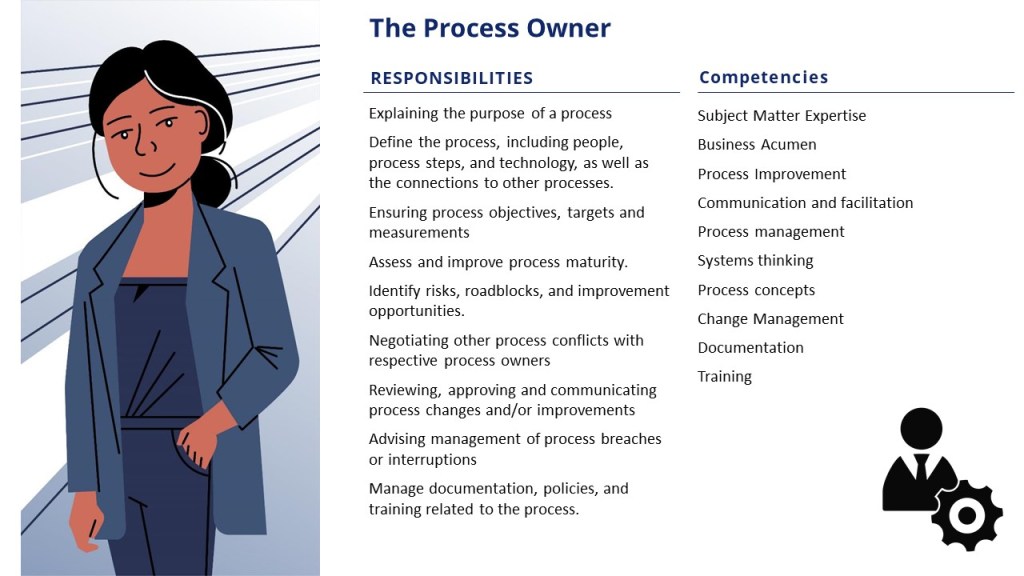
Process owners are a fundamental and visible difference part of building a process oriented organizations and are crucial to striving for an effective organization. As the champion of a process, they take overall responsibility for process performance and coordinate all the interfaces in cross-functional processes.

Being a process owner should be the critical part of a person’s job, so they can shepherd the evolution of processes and to keep the organization always moving forward and prevent the reversion to less effective processes.

The Process Owner’s Role

The process owner plays a fundamental role in managing the interfaces between key processes with the objective of preventing horizontal silos and has overall responsibility of the performance of the end-to-end process, utilizing metrics to track, measure and monitor the status and drive continuous improvement initiatives. Process owners ensure that staff are adequately trained and allocated to processes. As this may result in conflicts arising between process owners, teams, and functional management it is critical that process owners exist in a wider community of practice with appropriate governance and senior leadership support.

Process owners are accountable for designing processes; day-to-day management of processes; and fostering process related learning.

Process owners must ensure that process staff are trained to have both organizational knowledge and process knowledge. To assist in staff training, processes, standards and procedures should be documented, maintained, and reviewed regularly.

Process Owners should be supported by the right infrastructure. You cannot be a SME on a end-to-end-process, provide governance and drive improvement and be expected to be a world class tech writer, training developer and technology implementer. The process owner leads and sets the direction for those activities.

The process owner sits in a central role as we build culture and drive for maturity.

Psychological Safety, Reflexivity and Problem Solving

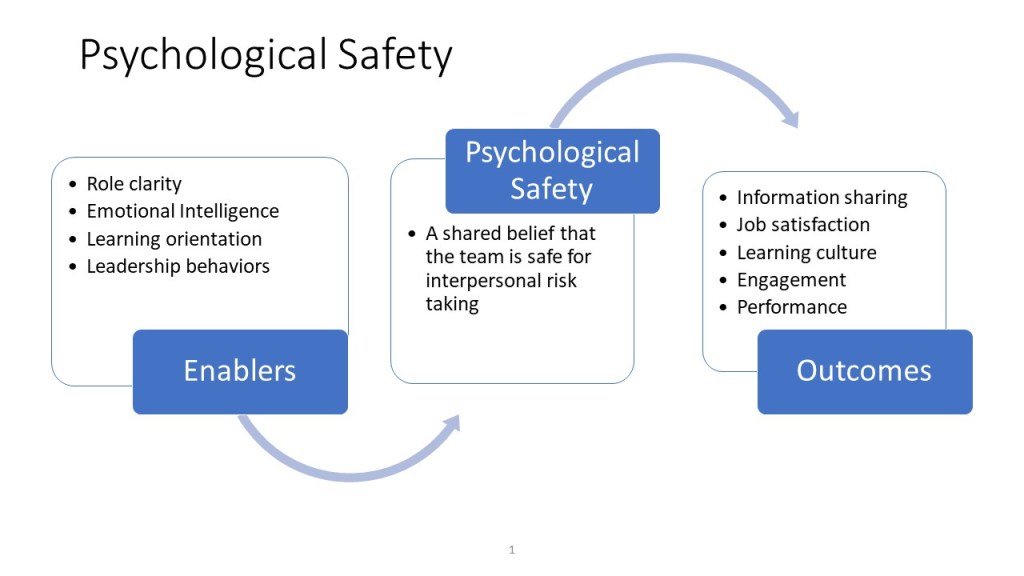
Psychological safety enables individuals to behave authentically, take risks and express themselves candidly. In the workplace, psychological safety captures how comfortable employees feel as team members. Timothy Clark gives four elements of psychological safety:

  • Being included
  • Feeling safe to experiment
  • Contributing
  • Challenging the status quo

This is done through four pillars:

What is psychological safety?

Psychological safety, Reflexivity and a Learning Culture

Reflexivity is the extent employees reflect upon the work tasks they have completed and identify ways of improving performance – it is the information-processing activity. Using reflexivity, employees develop a better sense of what is done, why and how, and can adjust their behaviors and actions accordingly. Reflexivity is a powerful process that can drive performance in a learning culture that  requires psychological safety to flourish. When employees reflect upon their work tasks, they need to have a deeper and better understanding of what they have done, what was done well and not as well, why they engaged in these behaviors, and changes and adaptations needed to result in better performance. People are not likely to engage in reflexivity unless they feel psychologically safe to take interpersonal risks, speak up, and admit failures without feeling uncomfortable or fearful of status and image loss.

Psychological Safety is the magic glue that makes transformative learning possible. Psychological Safety and reflexivity enables a problem solving culture.

Bibliography

Clark, T.R. 2020. The 4 Stages of Psychological Safety. Oakland, CA: Barrett-Koehler

Edmondson, A. 2018. The Fearless Organization: Creating Psychological Safety in the Workplace for Learning, Innovation and Growth. Hoboken, NJ: John Wiley and Sons

West, M.A. 1996. Reflexivity and work group effectiveness: A conceptual integration. In M.A. West (Ed.), Handbook of work group psychology. Chichester, UK: Wiley.

Zak, P.J. 2018. “The Neuroscience of High-Trust Organizations.” Consulting Psychology Journal: Practice and Research 70(1): 45-48

Building a learning culture

Our organizations are either growing or they’re dying. The key thing that drives growth in organizations is when their employees are learning. To strengthen our organizations, our teams, ourselves we need to ensure our culture allows people to be exposed to new and challenging opportunities to learn.

We learn constantly. Most of that learning, however, is incremental, improvements that build on what we already know and do. We expand our knowledge and refine our skills in ways that strengthen our identities and commitments. This process sharpens competence and broadens expertise, and is key in building subject matter experts.

Incremental learning can allow people to grow in a workplace until they reach the limit on their resources for new learning – think of it as an S-curve. Eventually, there isn’t enough opportunities to learn. Furthermore, learning that broadens our expertise is valuable, but it is not enough. Incremental learning does not alter the way we see others, the world, and ourselves.

The second type of learning is called transformative, it changes our perspectives laying the foundations for growth and innovative leaps.

Both kinds of learning are necessary. Incremental learning helps us deliver, while transformative learning helps us develop. Both are necessary, but too often we allow incremental learning to be haphazard and make no space for transformative learning.

In both cases we need to build spaces to drive learning.

We often see incremental in our training programs, while transformative is critical for culture building.

Incremental LearningTransformative Learning
Good forKnowledge and SkillsPurpose and Presence
Source of LearningExperts (models)Experience (moments)
Work requiredDeliberate PracticeReflective engagement
Aim of processNew action (a better way)New meaning (a better why)
Role of othersFocusing practiceInviting Interpretation
Key aspects of the two styles

Bibliography

References

  • Bersin. (2018, July 08). A new paradigm for corporate training: Learning in the flow of work. Retrieved December 31, 2019, from https://joshbersin.com/2018/06/a-new-paradigm-for-corporate-training-learning-in-the-flow-of-work/
  • Boyatzis E., & Akrivou, K. (2006). The ideal self as the driver of intentional change. Journal of Management Development, 25(7), 624-642. doi:10.1108/02621710610678454
  • Brown D., & Starkey, K. (2000). Organizational identity and learning: A psychodynamic perspective. The Academy of Management Review, 25(1), 102. doi:10.2307/259265
  • Hoffman, R., Yeh, C., & Casnocha, B. (2019). Learn from people, not classes. Harvard Business Review, 97(3). Retrieved December 31, 2019, from https://hbr.org/2019/03/educating-the-next-generation-of-leaders
  • Mezirow, J. (1991). Transformative dimensions of adult learning. San Francisco, CA: Jossey-Bass.
  • Petriglieri, G., Petriglieri, J. L., & Wood, J. D. (2017). Fast tracks and Inner Journeys: Crafting Portable selves for contemporary careers. Administrative Science Quarterly, 63(3), 479-525. doi:10.1177/0001839217720930