Previously I’ve talked about defining the values and behavior associated with quality culture. Once you’ve established these behaviors, a key way to make them happen is through microfeedback, a skill each quality professional, supervisor, and leader in your organization should be trained on.
We are all familiar with the traditional feedback loop: you receive feedback, reflect on it, make a plan, and then take action. This means feedback is given after a series of actions have taken place. Feedback addresses a few key observations for future improvements. In a situation when actions and sequences are quite complicated and interdependent, feedback can fail to provide useful insights to improve performance. Micro-feedback potentially canbe leveraged to prevent critical mistakes and mitigate risks, which makes it a great way to build culture and drive performance.
Micro-feedback is a specific and just-in-time dose of information or insights that can reduce gaps between the desired behavioral goals and reality. Think of it as a microscope used to evaluate an individuals comprehension and behavior and prescribe micro-interventions to adjust performance and prevent mistakes.
Microfeedback, provided during the activity observed, is a fundamental aspect of the Gemba walk. These small tweaks can be adapted, and utilized to provide timely insights and easy-to-accomplish learning objectives, to drive deep clarity and stay motivated to modify their performance.
Where and when the microfeedback happens is key:
1. Task–based microfeedback focuses corrective or suggestive insights on the content of a task. To provide higher impact focus micro-feedback on the correct actions rather than incorrect performance. For example “Report this issue as an incident…”
2. Process-based micro-feedback focuses on the learning processes and works best to foster critical thinking in a complex environment. For example, “This issue can be further processed based on the decision tree strategies we talked about earlier.”
3. Self-regulation-based micro-feedback focuses on giving suggestive or directive insights helping individuals to better manage and regulate their own learning. For example, “Pause once you have completed the task and ask yourself a set of questions following the 5W2H formula.”
For microfeedback to be truly successful it needs to be in the context of a training program, where clear behavorial goals has been set. This training program should include a specific track for managers that allows them to provide microfeedback to close the gap between where the learner is and where the learner aims to be. This training will provide specific cues or reinforcement toward a well-understood task and focus on levels of task, process, or self-regulation.
During change management, provide positive micro-feedback on correct, rather than incorrect, performance. This can be very valuable as you think about sustainability of the change.
Leveraged sucessful, but well trained observers and peers, microfeedback will provide incremental and timely adjustments to drive behavior.
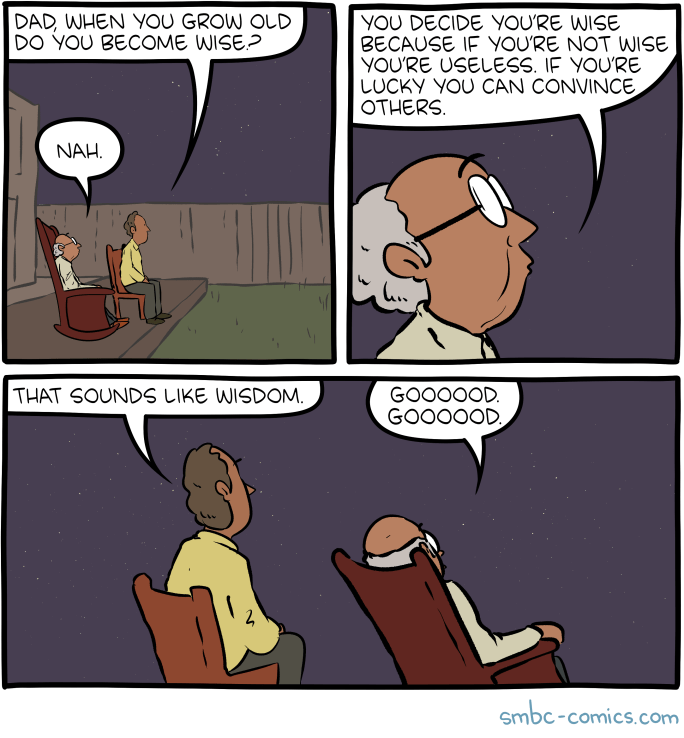
A question I ponder a lot – “Is the Process Owner supposed to be wise?” This is followed closely by “What is wisdom even supposed to be?” followed by “Darn that pyramid.” Honestly, I more and more think “darn that pyramid.”
No answers here, I really just wanted to share a comic I like.
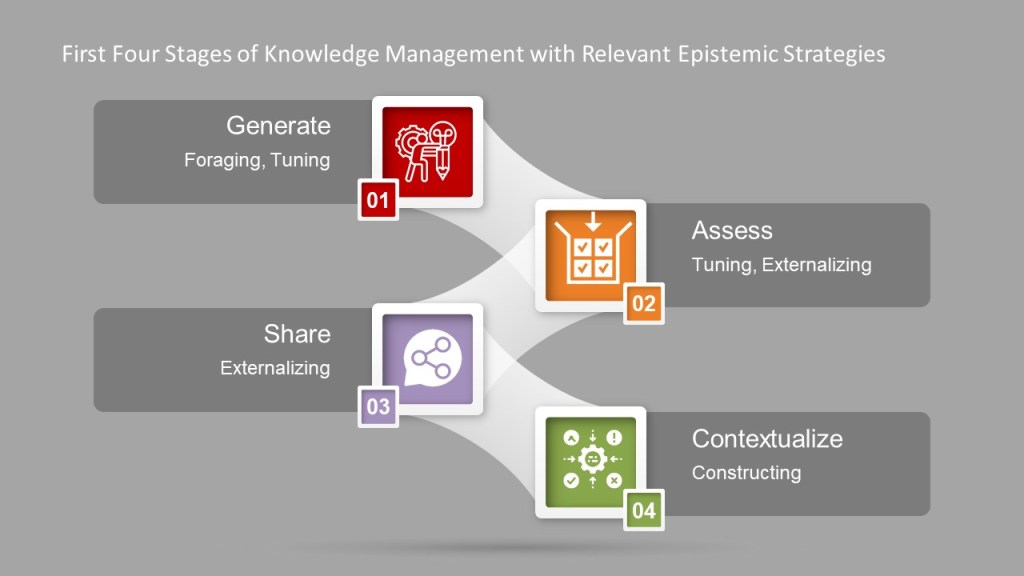
The first four phases of knowledge management are all about identifying and creating meaning and then making that meaning usable. Knowledge management is a set of epistemic actions, creating knowledge through interaction. This interaction is a way of creating a partnership between what happens in the head with everything in the world – Work-as-Imagined and Work-as-Done.
There are really four themes to a set of epistemic actions:
Foraging: Locating resources that will lead to understanding
Tuning: Adjusting resources to align with desired understanding
Externalizing: Moving resources out of the head and into the world
Constructing: Forming new knowledge structures in the world
Four Themes Mapped to Firts 4 Phases of Knowledge Management
Theme
Epistemic Interaction
Means
Foraging
Locating resources that will lead to understanding
Searching
Searching happens when you need information and
believe it exists somewhere.
Searching depends on how we articulate or
information needs.
Probing
“Tell me more.” Probing happens when the information
you have isn’t quite enough. You are probing when you take the next step,
move to the next level, and obtain more salient specifics. Probing is about
drilling down and saying “show, explain, and reveal more about this.”
We can probe to reveal new patterns, structures and
relationships. It brings to light new information that helps us to reconsider
what we already know.
Animating
Animating is when we initiate and control motion in
an information source. It includes learning-by-doing.
Collecting
Collecting is how we gather foraged information and
tuck it away for future use.
Tuning
Adjusting resources to align with desired
understanding
Collecting
Cloning
Cloning lets us take information from one situation
and use it in another.
Cutting
Cutting is the way we say “this matters”, that “I
need this part, but not the rest.”
Filtering
Filtering reduces complexity by reducing clutter to
expose salient details.
Externalizing
Moving resources out of the head and into the world
Annotating
Annotating is how we add context to information. How
we adapt and modify the information to the needed context.
Linking
Connecting bits of information together. Forming
conceptual maps.
Generating
Introducing new knowledge into the world.
Chunking
Grouping idenpendent yet related information together.
Constructing
Forming new knowledge structures in the world
Chunking
Composing
Producing a new, separate structure from the
information that has its own meaning and purpose.
Fragmenting
Taking information and breaking it apart into usable
components.
Rearranging
The art of creating meaningful order.
Repicturing
Changing the way the information is represented to
create understanding.
The format is pivotal. The difficulties we have in quality are really not much different from elsewhere in society in that we are surrounded by confusing documentation and poorly presented explanations everywhere we look, that provide information but not understanding. Oftentimes we rely on canards of “this is what is expected,” “this is what works” – but rarely is that based on anything more than anecdotal. And as the high incidence of issues and the high cost of training shows, less than adequate.
There is a huge body-of-knowledge out there on cognitive-friendly design of visuals, including documentation. This is an area we as a quality profession need to get comfortable with. Most important, we need to give ourselves permission to adapt, modify and transform the information we need into a shape that aids understanding and makes everyone a better thinker.
Work-as-Prescribed (and work-as-instructed) is the creation of tools and technologies to help us think better, understand more and perform at our peak.
Locus of Understanding
Looking at the process at the right level is key. Think of Work-as-Prescribed as a lens. Sometimes you need a high-powered lens so that you can zoom in on a single task. Other times, you need to zoom out to see a set of tasks, a whole process, or how systems interact.
This is the locus of understanding, where understanding happens. When we take this position, we see how understanding is created. Adopting the locus of understanding means going to the right level for the problem at hand. When we apply it to Work-as-Prescribed we are applying the same principles as we do in problem-solving to developing the right tools to govern the work.
An important way to look is distributed cognitive resources, which means anything that contributes to the cognitive work being done. Adjusting the locus of understanding means that you can, and should, treat an SOP as a cognitive resource. Some of the memory is in your head and some is in the SOP. Work-as-prescribed is a cognitive resource that we distribute, routinely and casually across the brain and our quality system in the form of documents and other execution aids.
Other tools, like my favorite whiteboard, also serve as distributed cognitive resources.
So, as our documents and other tools are distributed cognitive resources it behooves us to ensure they are based on the best cognitive principles possible to drive the most benefit.
As an aside, there is a whole line of thought about why some physical objects are better at distributed cognitive resources than electronic. Movement actually matters.
Taking it even further (shifting the locus) we can see the entire quality system as a part of a single distributed cognitive system where cognitive work is performed via the cognitive functions of communicating, deciding, planning, and problem-solving. These cognitive functions are supported by cognitive processes such as perceiving, analyzing, exchanging, and manipulating.
Cognitive Activity in Work-As-Prescribed
The tools we develop to provide distributed cognitive activity strive to:
Provide short-term or long-term memory aids so that memory load can be reduced.
Provide information that can be directly perceived and used such that little effort is needed to interpret and formulate the information explicitly.
Provide knowledge and skills that are unavailable from internal representations.
Support perceptual operators that can recognize features easily and make inferences directly.
Anchor and structure cognitive behavior without conscious awareness.
Change the nature of a task by generating more efficient action sequences.
Stop time and support perceptual rehearsal to make invisible and transient information visible and sustainable.
Aid processibility by limiting abstraction.
Determine decision making strategies through accuracy maximization and effort minimization.
Driving Work-As Prescribed
As we build our requirements documents, our process and procedure, there are a few principles to keep in mind to better tap into distributed cognitive resources.
Plan for the flow of information: Think about paths, relationships, seams, edges and other hand-offs. Focus on the flow of information. Remember that we learn in a spiral, and the content needed for a novice is different from that of an expert and build our documents and the information flow accordingly. This principle is called Sequencing.
Break information down into pieces: Called, Chunking, the grouping together of information into ideally sized pieces. When building Work-As-Prescribed pay close attention to which of these chunks are reusable and build accordingly.
The deeply about context: How a tool is used drives what the tool should be.
Think deeply about information structures: Not all information is the same, not every example of Work-as-Prescribed should have the same structure.
Be conscientiousabout the digital and physical divide: Look for opportunities to integrate or connect these two worlds. Be honest of how enmeshed they are at any point in the system.
We are building our Work-as-Prescribed through leveraging our quality culture, our framework for coordinating work. Pay attention to:
Shared Standards – Ways we communicate
Invisible Environments – Ways we align, conceptually
When design process, procedure and task documentation leverage this principles by build blocks, or microcontent, that is:
about one primary idea, fact, or concept
easily scannable
labeled for clear identification and meaning, and
appropriately written and formatted for use anywhere and any time it is needed.
There is a common miscomprehension that simple means short. That just isn’t true. Simple means that it passes a test for the appropriateness of the size of a piece of content of providing sufficient details to answer a specific question for the targeted audience. The size of the content must effectively serve its intended purpose with efficiency, stripping off any unnecessary components.
We need to strive to apply cognitive thinking principles to our practice. The day of judging a requirements document by its page length is long over.
Constituents of cognitive thinking applied to Work-As-Prescribed
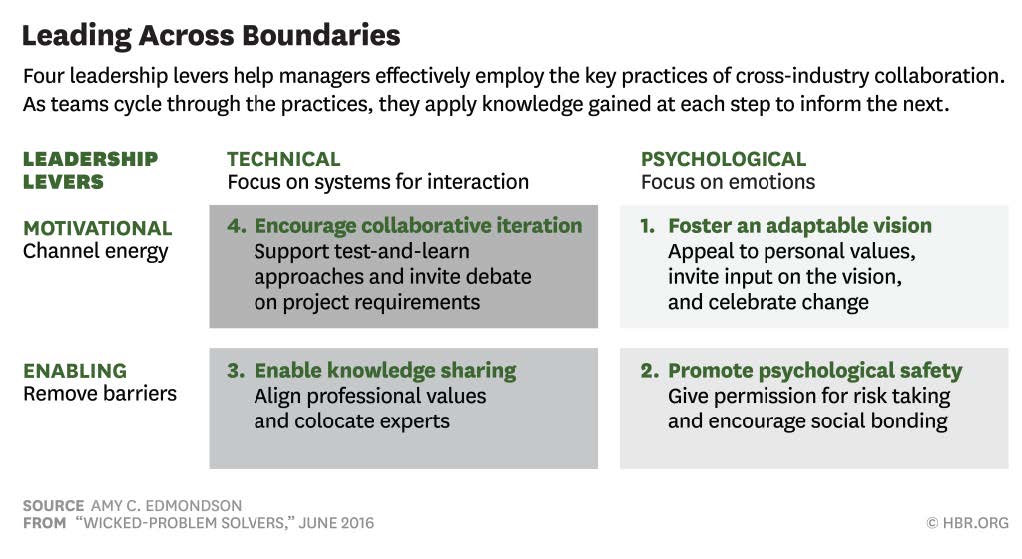
Professor Edmondson in this article is discussing cross-industry collaboration, but the central four levers apply in any organization.
Having a vision that strives for a True North of Quality is critical. Make it align to individual needs. Remember that vision grows and adapts as you go, and as others get the opportunity to shape. Vision has six criteria:
Stimulus: Vision needs to include actual benefits for those affected by it. String vision brings people together as community, not as strangers. Stimulus means people see themselves in the vision and understand how they will benefit.
Scale: Vision should be of great breadth and depth with potential for extension at later stages. Vision never leads to or accepts a dead end. It shows multiple potentials for expansion.
Spotlight: Vision assumes responsibility, immediate and extended. The greater the vision, then the greater the responsibility for its impact on people’s lives and the legacy that will be left afterwards. This responsibility needs to bring opportunity for people who are involved. This is part of the vision that will drive the volunteer army.
Scanning: A visionary sees the signs on the way to success. Pay attention to to pain points, spot trends and see where and how value can be added. Gemba walks are critical here.
Simplicity: Vision is elegant thinking about complicated and complex things. A vision is not a vision unless it’s understood. Simplicity lets people believe in vision. If the vision is complicated most people will ignore it. Vision operates and makes execution possible from its simplicity. The simpler the vision in its core meaning, the easier it can be shared with employees, customers and partners and thus, easier to scale inside and outside an organization.
Passion: Vision provokes strong emotions. A strong vision is always accompanied by excitement and passion. Excitement equals passion that gives an emotional power to a vision. A strong vision brings strong excitement that is difficult to contain. Strong excitement and passion are highly contagious. A simple and compelling vision excites more passion than any mere goal.
Psychological safety is the state where employees feel that there is safety in taking risks at work setting. In this safe environment employees will engage in risk-taking actions that are inherent to creative endeavors and if they perceive safety, then they are more comfortable to voice their opinions. This safety makes them more willing to take the chances to own the vision and try to experiment with making that vision a reality which motivates them to develop, promote, and implement new ideas.
This safety will enable knowledge sharing, which can come in many different styles, including combination which creates something new.
Through inclusive, democratic leaders who value the inclusion of employees in a particular work process, employees have the chance to raise their voice for generating, promoting, and implementing useful ideas Through leveraging vision these inclusive leaders exhibit openness attributes that communicates the importance of taking innovative actions and gives employees the guarantee that in case of negative consequences they will not be punished, experiencing greater psychological safety.
Employees experience non-defensive behavior, and feel high levels of self-worth and self-identity, motivating employees not only to generate new ideas, but also to promote and implement new ideas in the organization.
The organization that is structured to accept these ideas will continue to drive iterative cycles of improvement.






 Investigations of a Dog