Utilizing the Nadler-Tushman Model for Culture of Quality Initiatives

The Nadler-Tushman Congruence model is a diagnostic tool developed by organizational theorists David A. Nadler and Michael L. Tushman in the early 1980s. It analyzes and identifies the root causes of performance issues within an organization and can be a helpful model for diagnosing and improving a culture of quality.

Nadler-Tushman Congruence Framework

The Nadler-Tushman Congruence model is based on several assumptions that are common to modern organizational diagnostic models:

  • Organizations are open social systems within a larger environment.
  • Organizations are dynamic entities (i.e., change is possible and occurs).
  • Organizational behavior occurs at the individual, group, and systems level.
  • Interactions occur between the individual, group, and systems levels of organizational behavior

The model is based on the premise that an organization can achieve high performance when four key elements – work, people, structure, and culture – are aligned or congruent with each other. These elements are defined as:

Work

This refers to the core tasks and activities that the organization performs to achieve its goals. It includes the processes, workflows, and the skills/knowledge required to carry out the work effectively.

People

This element focuses on the individuals within the organization, their skills, knowledge, personalities, work styles, and how well they fit with the work requirements.

Structure

This encompasses the formal aspects of the organization, such as its hierarchy, reporting lines, policies, procedures, and systems that govern how work gets done.

Culture

This includes the shared values, beliefs, behaviors, and norms that shape how people interact and work together within the organization. The basic premise is that when these four elements are well-aligned and congruent, the organization operates smoothly and performs at a high level. However, a misalignment or incongruence among these elements can lead to friction, inefficiencies, and poor organizational performance.

Use

The Nadler-Tushman Congruence model can be effectively used for root cause analysis of organizational performance issues by following these steps:

  1. Identify the symptoms or performance gaps within the organization, such as low productivity, high employee turnover, quality issues, etc.
  2. Analyze the four key elements of the model – work, people, structure, and culture – to understand their current state within the organization.
  3. Assess the level of congruence or alignment among these four elements by examining their interactions in pairs:
  • Work and people: Do employees have the right skills/knowledge for the work? Is the work meaningful to them?
  • Work and structure: Does the organizational structure support efficient work processes?
  • Structure and people: Does the structure enable or hinder employee engagement/motivation?
  • People and culture: Are employee values/behaviors aligned with the organizational culture?
  • Culture and work: Does the culture facilitate or impede effective work practices?
  • Structure and culture: Is there harmony or conflict between the structure and cultural norms?
  1. Identify areas of incongruence or misalignment among these elements that could be the root causes of the performance issues. For example, a misalignment between people’s skills and work requirements or between an innovative culture and a rigid hierarchical structure.
  2. Conduct a root cause analysis by further investigating the specific reasons behind the identified incongruences using techniques like fishbone diagrams or Why-Why analysis.
  3. Develop an action plan to address the root causes by realigning the incongruent elements. This may involve changes to work processes, training programs, organizational policies, cultural initiatives, etc.

The key strength of the Nadler-Tushman model is its ability to provide a comprehensive framework for diagnosing performance problems by examining the interactions among the critical organizational elements. This systemic approach helps uncover root causes that may be overlooked in a siloed analysis of individual elements.

New Ways of Working Symposium

It is critical to carve out the time to develop and challenge oneself, to listen to external exertise and to share with peers. You cannot wait for others to make the time for you to engage in learning.

The learning I am looking forward to is the New Way of Working virtual conference next week co-hosted by two of my favorite thinkers in this space – Elise Keith and Dave Mastronardi.

I’m looking forward to challenging myself on the best ways to work in-person, virtually and hybrid.

I’m told there is still time to register!

Resilience

In the current world scenario, which is marked by high volatility, uncertainty, complexity, and ambiguity (VUCA), threats are increasingly unforeseen. As organizations, we are striving for this concept of Resilience.

Resilience is one of those hot words, and like many hot business terms it can mean a few different things depending on who is using it, and that can lead to confusion. I tend to see the following uses, which are similar in theme.

Where usedMeaning
PhysicsThe property of a material to absorb energy when deformed and not fracture nor break; in other words, the material’s elasticity.
EcologyThe capacity of an ecosystem to absorb and respond to disturbances without permanent damage to the relationships between species.
PsychologyAn individual’s coping mechanisms and strategies.
Organizational and Management studiesThe ability to maintain an acceptable level of service in the face of periodic or catastrophic systemic and singular faults and disruptions (e.g. natural disasters, cyber or terrorist attacks, supply chain disturbances).

For our purposes, resilience can be viewed as the ability of an organization to maintain quality over time, in the face of faults and disruptions. Given we live in a time of disruption, resilience is obviously of great interest to us.

In my post “Principles behind a good system” I lay out eight principles for good system development. Resilience is not a principle, it is an outcome. It is through applying our principles we gain resilience. However, like any outcome we need to design for it deliberately.

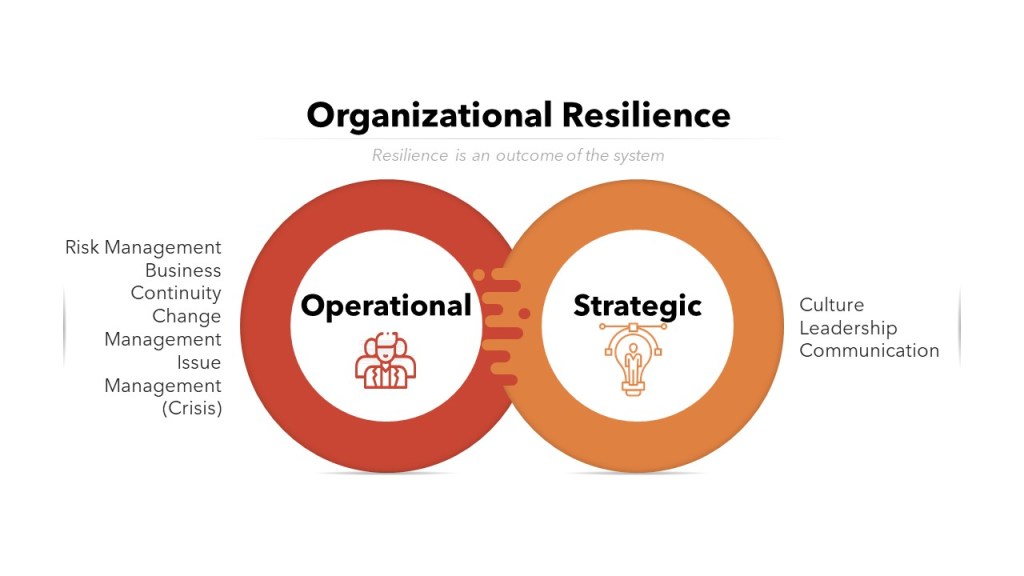
We gain resilience in the organization through levers that can be lumped together as operational and organizational.

The attributes that give resilience are the same that we build as part of our quality culture:

On the operational side, we have processes to drive risk management, business continuity, and issue management. A set of activities that we engage in.

Like many activities they key is to think of these as holistic endeavors proactively building resiliency into the organizaiton.

Competence

We can break down people’s abilities into four areas:

CapabilityWhat people need to do to produce results
SkillBroken into technical knowledge and practiced performance
InterestPassion
Required behaviorsOperationalize the organization’s vision, culture, or way of being in behavioral terms. 

Competence is a combination of Capability and Skill. If I do not have the capability for the work, no amount of developmental training will be helpful. And, I don’t have the skill, you will never see my capability. Competence is a combination of both.

Interest or passion for the work will influence the amount of time for practice. The more interested I am, the more time I will spend in practice. And if I don’t practice a skill, the skill goes away, and competence diminishes.

There is also a set of required behaviors. Practice arrives with many qualities, frequency of practice, duration of practice, depth of practice, and accuracy of practice. Accuracy of practice relates to required behaviors. Practice doesn’t make perfect, only perfect practice makes perfect.

Deliberate practice allows us to influence all four attributes.

Microfeedback for Adjusting Behaviors

Previously I’ve talked about defining the values and behavior associated with quality culture. Once you’ve established these behaviors, a key way to make them happen is through microfeedback, a skill each quality professional, supervisor, and leader in your organization should be trained on.

We are all familiar with the traditional feedback loop: you receive feedback, reflect on it, make a plan, and then take action. This means feedback is given after a series of actions have taken place. Feedback addresses a few key observations for future improvements. In a situation when actions and sequences are quite complicated and interdependent, feedback can fail to provide useful insights to improve performance. Micro-feedback potentially can be leveraged to prevent critical mistakes and mitigate risks, which makes it a great way to build culture and drive performance.

Micro-feedback is a specific and just-in-time dose of information or insights that can reduce gaps between the desired behavioral goals and reality. Think of it as a microscope used to evaluate an individuals comprehension and behavior and prescribe micro-interventions to adjust performance and prevent mistakes.

Microfeedback, provided during the activity observed, is a fundamental aspect of the Gemba walk. These small tweaks can be adapted, and utilized to provide timely insights and easy-to-accomplish learning objectives, to drive deep clarity and stay motivated to modify their performance

Where and when the microfeedback happens is key:

1. Taskbased microfeedback focuses corrective or suggestive insights on the content of a task. To provide higher impact focus micro-feedback on the correct actions rather than incorrect performance. For example “Report this issue as an incident…”

2. Process-based micro-feedback focuses on the learning processes and works best to foster critical thinking in a complex environment. For example, “This issue can be further processed based on the decision tree strategies we talked about earlier.”

3. Self-regulation-based micro-feedback focuses on giving suggestive or directive insights helping individuals to better manage and regulate their own learning. For example, “Pause once you have completed the task and ask yourself a set of questions following the 5W2H formula.”

For microfeedback to be truly successful it needs to be in the context of a training program, where clear behavorial goals has been set. This training program should include a specific track for managers that allows them to provide microfeedback to close the gap between where the learner is and where the learner aims to be. This training will provide specific cues or reinforcement toward a well-understood task and focus on levels of task, process, or self-regulation.

During change management, provide positive micro-feedback on correct, rather than incorrect, performance. This can be very valuable as you think about sustainability of the change.

Leveraged sucessful, but well trained observers and peers, microfeedback will provide incremental and timely adjustments to drive behavior.