Teamwork, collaboration, and involvement are the norm
Emphasis on constant improvement and state-of-the-art knowledge and practices
Willingness to change, adapt, learn from successes and mistakes, take reasonable risk, and try new things
Attributes of a High Performing Culture
There is a dark underbelly to aspiring to this, leaders who either fail to meet these standards or demonstrate hypocrisy and “do-as-I-say-not-as-I-do” attitudes. Organizations that aspire, can easily be hoisted by their own petard, and there is an excellent term for this “Moral Injury.”
Moral injury is understood to be the strong cognitive and emotional response that can occur following events that violate a person’s moral or ethical code. Potentially morally injurious events include a person’s own or other people’s acts of omission or commission, or betrayal by a trusted person in a high-stakes situation. For example, look at healthcare staff working during the COVID-19 pandemic who experienced a moral injury because they perceive that they received inadequate protective equipment, or when their workload is such that they deliver care of a standard that falls well below what they would usually consider to be good enough. This is causing a mass exodus of employees.
Give some thought to how to resolve moral injuries when they happen. Include them in your change plan and make them sustainable. They can happen, and when they do they will cripple your organization.
Quality professionals are often defined by our technical knowledge, and with that can come a genuine and intense love and interest in the work. In the pharmaceutical/med-device work, I work in this is defined by both a knowledge of the science and of the regulations (and that stuff inbetween – regulatory science).
The challenge here is that we start defining ourselves by our role as we progress as representing the highest level of expertise in this technical expertise, which means senior Quality (as in the department) jobs are defined in terms of in service to our function – patient safety and product quality (safety, efficacy, and quality). This can then lead to seeing people as the “means” to that end. This inevitably leads to prioritizing that outcome over people.
Do not get me wrong, results matter, and I am a firm proponent of product quality and patient safety. But this approach is reductionist and does not serve to drive fear out of the organization. How can people be safe if they are considered a means to produce value? We need to shift so that we realize we can only get to quality by focusing on our people.
Quality stands in a position, sometimes uniquely in an organization, of engaging with stakeholders to understand what objectives and unique positions the organization needs to assume, and the choices that are making in order to achieve such objectives and positions.
Always include a “do nothing” option: Not every decision or problem demands an action. Sometimes, the best way is to do nothing.
How do you know what you think you know? This should be a question everyone is comfortable asking. It allows people to check assumptions and to question claims that, while convenient, are not based on any kind of data, firsthand knowledge, or research.
Ask tough questions! Be direct and honest. Push hard to get to the core of what the options look like.
Have a dissenting option. It is critical to include unpopular but reasonable options. Make sure to include opinions or choices you personally don’t like, but for which good arguments can be made. This keeps you honest and gives anyone who see the pros/cons list a chance to convince you into making a better decision than the one you might have arrived at on your own.
Consider hybrid choices. Sometimes it’s possible to take an attribute of one choice and add it to another. Like exploratory design, there are always interesting combinations in decision making. This can explode the number of choices, which can slow things down and create more complexity than you need. Watch for the zone of indifference (options that are not perceived as making any difference or adding any value) and don’t waste time in it.
Include all relevant perspectives. Consider if this decision impacts more than just the area the problem is identified in. How does it impact other processes? Systems?
A struggle every organization has is how to think through problems in a truly innovative way. Installing new processes into an old bureaucracy will only replace one form of control with another. We need to rethink the very matter of control and what it looks like within an organization. It is not about change management, on it sown change management will just shift the patterns of the past. To truly transform we need a new way of thinking.
One of my favorite books on just how to do this is Humanocracy: Creating Organizations as Amazing as the People Inside Them by Gary Hamel and Michele Zanini. In this book, the authors advocate that business must become more fundamentally human first. The idea of human ability and how to cultivate and unleash it is an underlying premise of this book.
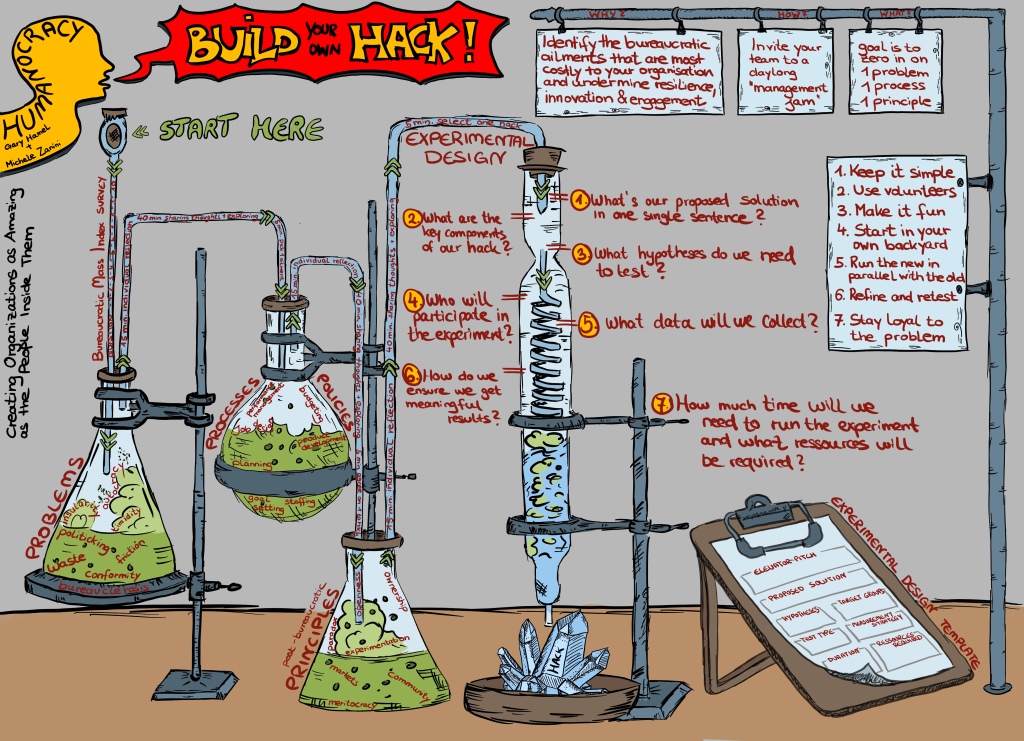
Visualized by Rose Fastus
it’s possible to capture the benefits of bureaucracy—control, consistency, and coordination—while avoiding the penalties—inflexibility, mediocrity, and apathy.
Gary Hamel and Michele Zanini, Humanocracy, p. 15
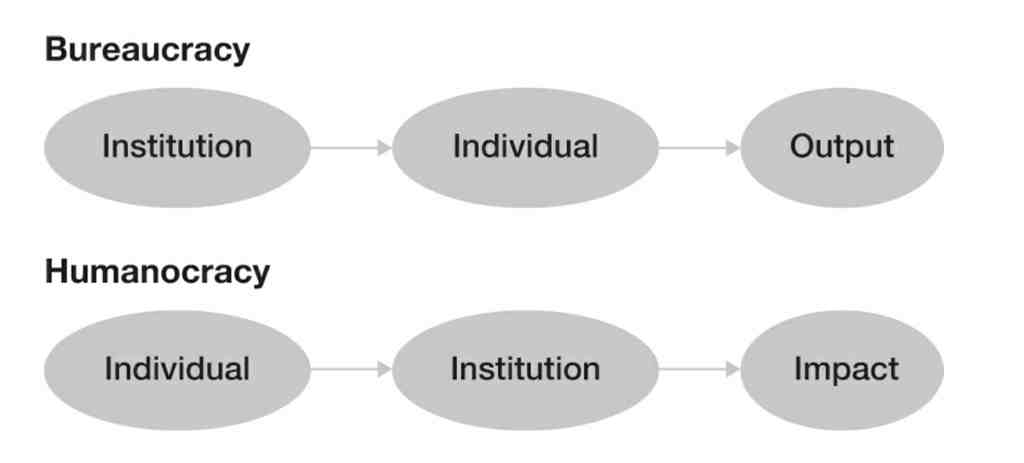
The above quote really encapsulates the heart of this book, and why I think it is such a pivotal read for my peers. This books takes the core question of a bureaurcacy is “How do we get human beings to better serve the organization?”. The issue at the heart of humanocracy becomes: “What sort of organization elicits and merits the best that human beings can give?” Seems a simple swap, but the implications are profound.
Bureaucracy versus Humanocracy. Source: Gary Hamel and Michele Zanini, Humanocracy, p. 48
I would hope you, like me, see the promise of many of the central tenets of Quality Management, not least Deming’s 8th point. The very real tendency of quality to devolve to pointless bureaucracy is something we should always be looking to combat.
Humanocracy’s central point is that by truly putting the employee first in our organizations we drive a human-centered organization that powers and thrives on innovation. Humanocracy is particularly relevant as organizations seek to be more resilient, agile, adaptive, innovative, customer centric etc. Leaders pursuing such goals seek to install systems like agile, devops, flexible teams etc. They will fail, because people are not processes. Resiliency, agility, efficiency, are not new programming codes for people. These goals require more than new rules or a corporate initiative. Agility, resilience, etc. are behaviors, attitudes, ways of thinking that can only work when you change the deep ‘systems and assumptions’ within an organization. This book discusses those deeper changes.
Humanocracy lays out seven tips for success in experimentation. I find they align nicely with Kotter’s 8 change accelerators.
Humanocracy’s Tip
Kotter’s Accelerator
Keep it Simple
Generate (and celebrate) short-term wins
Use Volunteers
Enlist a volunteer army
Make it Fun
Sustain Acceleration
Start in your own backyard
Form a change vision and strategic initiatives
Run the new parallel with the old
Enable action by removing barriers
Refine and Retest
Sustain acceleration
Stay loyal to the problem
Create a Sense of Urgency around a Big Opportunity
Comparison to Kotter’s Eight Accelerators for Change
Happy International Workers Day. Let’s celebrate by Driving Out Fear!
Thirty-five years ago Deming wrote that “no one can put in his best performance unless he feels secure.” Unfortunately, today we still live in a corporate world where fear and management by fear is ubiquitous. That fear is growing after more than a year of a global pandemic. As quality professionals we must deal with it at every opportunity.
Competition: Many managers use competition to instill fear. Competition is about winners and losers. Success cannot exist without failure. Managers deem the anxiety generated by competition between co-workers a good thing as they compete for scarce resources, power and status. Therefore, management encourage competition between individuals, between groups and departments and between business units.
“Us and Them” Culture: The “us and them” culture that predominates in so many organizations proliferated by silos. Includes barriers between staff and supervisors.
Blame Culture: Fear predominates in a blame culture. Blame culture can often center around enshrining the idea of human error.
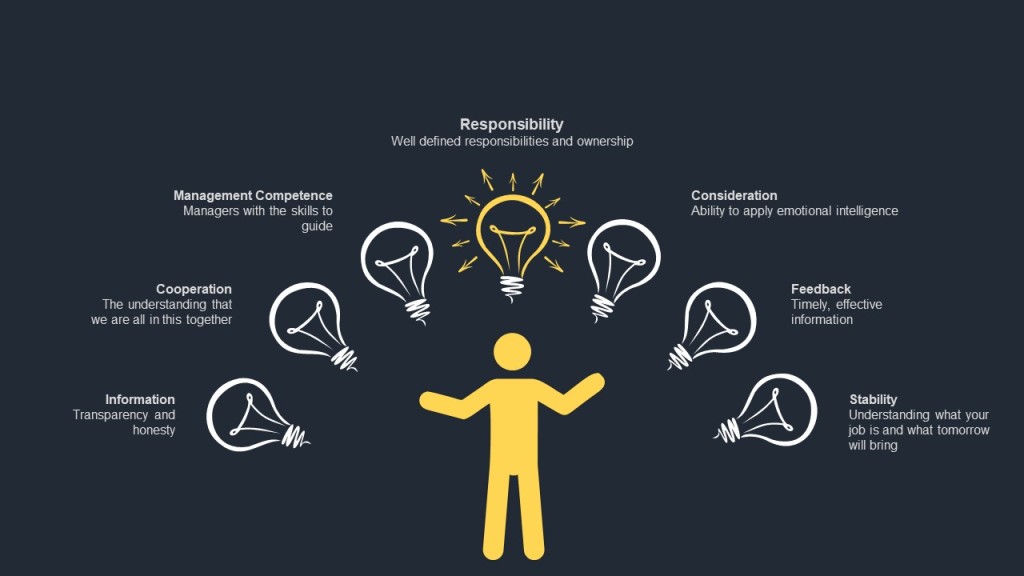
We drive out fear by building a culture centered on employee well-being. This is based on seven factors.
Factor
Means
Obtained by
Responsibility
Well defined responsibilities and ownership
The opportunity an employee has to provide input into decision making in his department An individual employees’ own readiness to set high personal standards An individual employee’s interest in challenging work assignments The opportunity an employee has to improve skills and capabilities Excellent career advancement opportunities The organization’s encouragement of problem-solving and innovative thinking
Management Competence
Managers trained with skills that lend themselves to contributing to the work of their team ensures that they will be looked to for help. Managers need to be able to guide.
Direct Supervisor/Manager Leadership Abilities Management is engaged and leads by example (Gemba walks) Management by Facts
Consideration
When managers act as if employees have no feelings and just expect them to do their work as if they are robots, it can make employees uneasy. Such behavior makes them feel detached and merely a tool to carry out an end. In such environments, many times the only times employees hear from the manager is when something goes well or really bad. In either case, the perception could be that the manager has mood swings and that also adds to the employee’s insecurity. They may feel reluctant to talk to their manager for fear he is in one of his bad moods.
Senior Management’s sincere interest in employee well-being An individual employee’s relationship with their supervisor Open and effective communication Trust in management and co-workers
The feeling that every person is on their own to look out for their interest is a sad state to be in. Yet when everyone has a fear that the other workers will take advantage of them or make them look bad at the first opportunity, a selfish and insecure environment will result. Employees should be able to work together for the benefit of the company. They should focus on group goals in addition to their personal goals, recognizing that individually there will be failures, but that the whole is more important than the individual parts.
Trust Well trained employees Collaboration as a process Organizational culture (psychological safety) Hire and promote the right behaviors & traits to match the culture
Transparency is critical. When employees know nothing about how a company is doing in terms of where they should be, it is a source of uneasiness. Without that knowledge, for all they know the company could be doing very poorly and that could be a bad thing for everyone. When they have a better sense of where the company is in the scheme of their objectives set by management, it helps them feel more secure. That is not to say it is the news being good or bad that affects their security, but rather the fact that they actually have the news.
Strategy and Mission — especially the freedom and autonomy to succeed and contribute to an organization’s success Organizational Culture and Core/Shared Values Feel that their job is important
Stability
Employees feel more secure when their role does not change frequently and they understand what tomorrow will mean.
Job Content — the ability to do what I do best Availability of Resources to Perform the Job Effectively Career development – opportunities to learn and grow
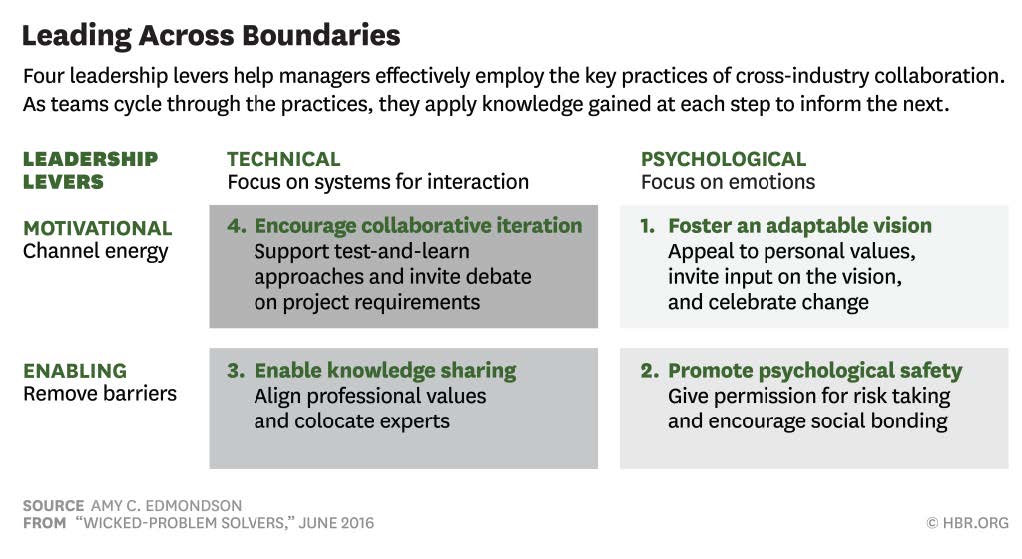
Professor Edmondson in this article is discussing cross-industry collaboration, but the central four levers apply in any organization.
Having a vision that strives for a True North of Quality is critical. Make it align to individual needs. Remember that vision grows and adapts as you go, and as others get the opportunity to shape. Vision has six criteria:
Stimulus: Vision needs to include actual benefits for those affected by it. String vision brings people together as community, not as strangers. Stimulus means people see themselves in the vision and understand how they will benefit.
Scale: Vision should be of great breadth and depth with potential for extension at later stages. Vision never leads to or accepts a dead end. It shows multiple potentials for expansion.
Spotlight: Vision assumes responsibility, immediate and extended. The greater the vision, then the greater the responsibility for its impact on people’s lives and the legacy that will be left afterwards. This responsibility needs to bring opportunity for people who are involved. This is part of the vision that will drive the volunteer army.
Scanning: A visionary sees the signs on the way to success. Pay attention to to pain points, spot trends and see where and how value can be added. Gemba walks are critical here.
Simplicity: Vision is elegant thinking about complicated and complex things. A vision is not a vision unless it’s understood. Simplicity lets people believe in vision. If the vision is complicated most people will ignore it. Vision operates and makes execution possible from its simplicity. The simpler the vision in its core meaning, the easier it can be shared with employees, customers and partners and thus, easier to scale inside and outside an organization.
Passion: Vision provokes strong emotions. A strong vision is always accompanied by excitement and passion. Excitement equals passion that gives an emotional power to a vision. A strong vision brings strong excitement that is difficult to contain. Strong excitement and passion are highly contagious. A simple and compelling vision excites more passion than any mere goal.
Psychological safety is the state where employees feel that there is safety in taking risks at work setting. In this safe environment employees will engage in risk-taking actions that are inherent to creative endeavors and if they perceive safety, then they are more comfortable to voice their opinions. This safety makes them more willing to take the chances to own the vision and try to experiment with making that vision a reality which motivates them to develop, promote, and implement new ideas.
This safety will enable knowledge sharing, which can come in many different styles, including combination which creates something new.
Through inclusive, democratic leaders who value the inclusion of employees in a particular work process, employees have the chance to raise their voice for generating, promoting, and implementing useful ideas Through leveraging vision these inclusive leaders exhibit openness attributes that communicates the importance of taking innovative actions and gives employees the guarantee that in case of negative consequences they will not be punished, experiencing greater psychological safety.
Employees experience non-defensive behavior, and feel high levels of self-worth and self-identity, motivating employees not only to generate new ideas, but also to promote and implement new ideas in the organization.
The organization that is structured to accept these ideas will continue to drive iterative cycles of improvement.





 Investigations of a Dog