Whiteboards as Artifacts

In “An Ode to the Whiteboard, Corporate America’s Least Appreciated Office Tool” Rob Walker says “And even for more workaday whiteboards, there’s an additional factor that the pandemic era has actually underscored: the value and appeal of whiteboarding as an analog, tactile experience.”

He then goes on to compare the whiteboard to a campfire, a gathering place that drives collaboration and creativity.

Whiteboards are a great visual artifact of quality culture.

Whiteboard are shared spaces for problem-solving and innovation.

They form an important part of visual management.

Share your thoughts on whiteboards in the comments!

Visual Management

In the organizational world Visual Management is a management system that attempts to improve organizational performance through connecting and aligning organizational vision, core values, goals and culture with other management systems, work processes, workplace elements, and stakeholders, by means of stimuli, which directly address one or more of the five human senses (sight, hearing, feeling, smell and taste). These stimuli communicate quality information (necessary, relevant, correct, immediate, easy to-understand and stimulating), which helps people make sense of the organizational context at a glance by merely looking around. It is a management approach that utilizes either one or more of information giving, signaling, limiting or guaranteeing (mistake-proofing/ poka-yoke) visual devices to communicate with “doers”, so that places become self-explanatory, self-ordering, self-regulating and self-improving.

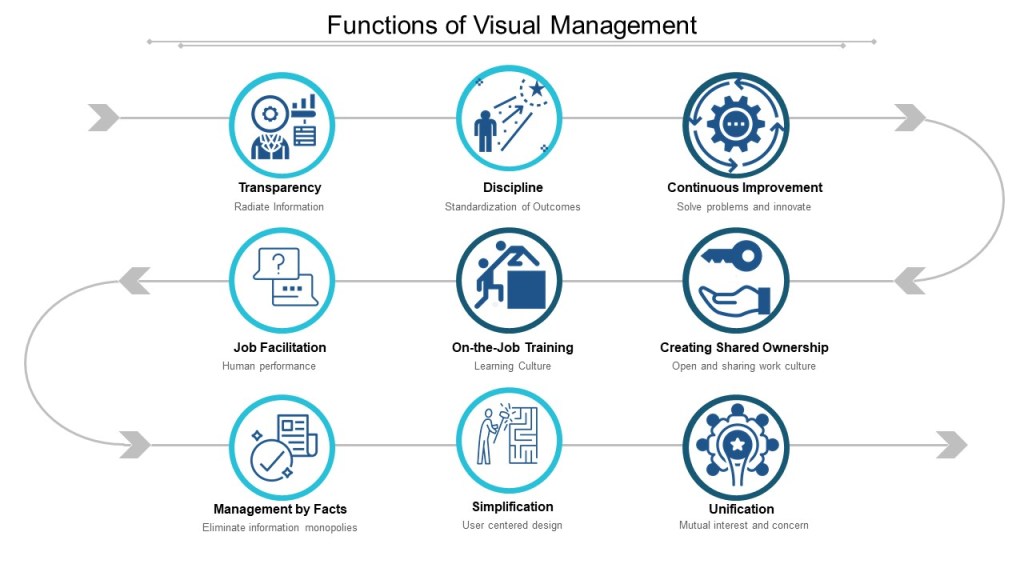
FunctionDefinitionReplaces the Practice of
TransparencyThe ability of a process (or its parts) to communicate with people through organizational and physical means, measurements, and public display of information

Transparency stimulates people to move outside the confines of particular job responsibilities and to see the larger scale of their work
Information held in people‟s minds and on the shelves.
DisciplineMaking a habit of properly maintaining correct procedures by transforming the abstract concept of discipline into directly observable concrete practices

Address the six basic questions (the what, the where, the who, the how, the how many and the when)
Warning, scolding, inflicting punishments, dismissing etc.
Continuous ImprovementFocused and sustained incremental innovation

Makes organizational learning visual with high ability to respond to people’s ideas
Static organizations or big improvement leaps through considerable investment.
Job FacilitationConscious attempt to physically and/or mentally ease people’s efforts on routine, already known tasks, by offering various visual aidsExpecting people to perform well at their jobs without providing them any aids.
On-the-Job TrainingLearning from experience or integrating working with learning.Conventional training practices or offering no training.
Creating Shared OwnershipA feeling of possessiveness and being psychologically tied to the objectivesManagement dictation for change efforts, vision and culture creation.
Management by FactsUse of facts and data based on statisticsManagement by subjective judgement or vague terms.
SimplificationConstant efforts on monitoring, processing, visualizing and distributing system wide information for individuals and teamsExpecting people to monitor, process and understand the complex system wide information on their own.
UnificationPartly removing the boundaries and creating empathy within an organization through effective information sharingFragmentation or “this is not my job” behavior
The functions of Visual Management

Three year retrospective

This blog is three years old and my experiences as a practitioner of quality and as a leader has been driven during this time by narrative writing. Writing gives the space and time to look back, re-live and re-experience, and ultimately reflect upon our work. Writing these blog posts is an effective way of digesting experience on the job. Through
writing this blog I have attempted to understand situations from various viewpoints and perspectives.

I get asked a lot why I do this, and how I make time for writing. Let’s be honest, there are long periods of time where I do not. But when I do make the time it is for these reasons.

Writing as a catalyst for reflective thought

In an era where lifelong professional learning is continuously promoted, professionals need to continuously learn and take the role of practitioner-researcher. The narrative writing I engage in on this blog plays an important role that aids this ongoing development. Through writing I enhance my reflective awareness.

Writing helps reduce the imbalance I feel between theory and practice. Too often we need to make immediate decisions and it is difficult to balance what-must-happen with what-should-happen. Writing this blog allows me to think critically about my past actions and how these together with theory can inform future practice.

Writing this blog is a way of thinking that helps me in understanding myself; my own actions; my thoughts; my emotions; my experiences. Apart from self-understanding, self-reflective narrative also assists professional learning because it aids professional thinking. In short, writing helps me think, reflect, and develop. I write, therefore I think.

First-order narratives: promoting self-understanding

The narratives in this blog are first-order narratives where I write about my own experiences, as opposed to second-order narratives where the author writes about the experiences of others. Everything I write starts as a challenge or an experience I am processing. This blog rarely engages in journalistic reporting, and when it does report on the news it is always part of reflection.

Through writing about my experiences as a quality professional, and reflecting on them, I strive to construct meanings, interpretations, new knowledge and understandings.

By engaging in systematic reflection I am promoting questioning, and questioning encourages me to think of new possibilities. This is where ideas come from, and this drives my professional quality practice forward.

Conversing with oneself

Conversing with someone else offers the possibility of feedback and exposure to different viewpoints. This is why I look to professional societies as one way to enhance my work. I’ll be honest though that is not as easy as I would like it to be.

Unfortunately, I often feel isolated. People are busy and it is difficult to carve out the time for reflection and discussion. It can often feel that collaboration and sharing about non-project deliverables are limited to non-existent at worst. By blogging I am conversing with myself in public. It would be great to engage in dialogue with people, but I feel this public dialogue is a way to engage with the larger body of knowledge.

I think this is one of the reasons I blogged less after starting my current job. All my time was going into collaborative narratives as I strove to determine what came next in this new role.

Looking deeper into issues

Sitting down and writing a blog post offers time for reflective thought. Sure, I talk about these issues all day, but writing journal entries, because I tend to think about it a lot more, allows me to explore additional dimensions of the issue. Narrative writing affords me the space for focused reflective thinking. This blog is my medium for reflection, questioning, critical analysis, thinking, reasoning, and the building of arguments.

Often I write in preparation for some task or project. Or to analyze how it is progressing and to solve problems.

Creating causal links

A narrative should have an evaluative function; offering valuable information about how the author interprets and connects meanings to lived situations and experiences. A narrative must add up to something; it is more than the sum
of its parts. Through writing this blog I am connecting the various parts of quality that are important to me in a wider whole. And by crafting that whole, develop new learnings to apply.

Blogging is tiring but valuable

I have experienced periods of tiredness, frustration, and a lessened motivation to blog, and this resonates with the argument that practitioners are usually so busy that they have little time for their own writing. This has especially been true during the last year of this pandemic.

However, I strongly view this blog as a core part of my learning, and that learning benefits from the longitudinal process of blogging. Writing about my experiences as a quality professional has promoted detailed observations of my work, analysis of that work, imagined solutions, implementation of such imagined solutions, and re-analysis of alterations to practice. Writing this blog has been an ideal way of showing experiential learning and my own development.

What comes next?

I set myself a goal of writing at least one post a day in March, and I found that amazingly rewarding. Not sure if I can keep that pace up but I am committed to continuing to use this blog space for reflection and development. I hope folks find some use out of that, and I look forward to the various communities this space engenders.

Photo by Andrea Piacquadio on Pexels.com

annex 11 ASQ ASTM E2500 change control change management collaboration communication computer system lifecycle conference contamination control cqv cultural excellence data integrity decision making decision quality Ethics expertise fda ICH knowledge management leadership learning culture metrics Problem solving process psychological safety quality culture quality intelligence quality systems regulatory regulatory inspections regulatory state resilience risk assessment risk management root cause analysis speaking system design system thinking team Team excellence training transparency validation warning letter

Knowledge Transfer

Our organizations are based on the interactions of individuals, teams and other organizations into a complex adaptive environment. We need to manage productive relationships as part of a complex system and interactions among parts can produce valuable, new, and unpredictable capabilities that are not inherent in any of the parts acting alone. This is why knowledge management, having a learning culture, is such a fundamental part of the work we do.

There are seven major categories we engage in when we manage, maintain, and create knowledge.

ActivityConvertsInvolvingMeaning
SocializationTacit-to-Tacitdifferent agentsSharing of tacit knowledge between individuals
IntrospectionTacit-to-Tacit same agentThe conscious or unconscious examination of one’s own tacit knowledge, as taken at an individual level
ExternalizationTacit-to-Explicitagent to knowledge managementThe expression of tacit knowledge and its translation into comprehensible forms interpretable by external agents
CombinationExplicit-to-ExplicitAll usersThe conversion of explicit knowledge into other variants of explicit knowledge
InternalizationExplicit-to-TacitTraining and deliberate practiceThe conversion of explicit knowledge into tacit knowledge
ConceptualizationAction-to-TacitContinuous ImprovementThe creation of tacit knowledge from aspects related to real work actions.
ReificationTacit-to-ActionProcess/ProcedureThe activity of bringing tacit knowledge into action (e.g. translating a mental model of a process activity into the actual operating tasks)
Knowledge Work Activities

As can be seen in the table above these seven activities involve moving between tacit and explicit knowledge. The apply to both declarative and procedural knowledge.

Examples of tacit and explicit knowledge

Socialization

Socialization is the level of interaction between, and communication of, various actors within an organization, which leads to the building of personal familiarity, improved communication, and problem solving. Often called learning the roles, this is the the process by which an individual acquires the social knowledge and skills necessary to assume an organizational role. Socialization encourages two-way information exchange, builds and establishes relationship trust, and enable transparency of information.

Socialization creates an operating style, enabling people to communicate with each other, have a language that they all understand and behavioral styles that are compatible. It reinforces basic assumptions and shares espoused values by helping create common norms and compatible cultures.

Socialization enables many influencing tactics which makes it critical for change management activities.

Introspection

The exploration of our experiences. Introspection can arise naturally but it can also arise deliberatively, for example journaling.

Introspection can also include retrospection, especially as a group activity. This is the strength of lessons learned.

Externalization

The work of making the tacit explicit. Knowledge management as continuous improvement.

Combination

The combination of knowledge drives innovation and a learning culture. This includes the ability to identify different sources of knowledge, understand different learning processes, and combine internal and external knowledge effectively.

Knowledge combination capability generates through exchange of knowledge between individuals and work teams is a process that allows the transfer of knowledge to the organization and that can be applied to develop and improve products and processes.

Internalization

As we move towards qualification we internalize knowledge.

Conceptualization

The insights gained from doing and observing work. Deliberative learning.

Reification

The process of translating work-as-imagined into work-as-done through work-as-prescribed on a continuous loop of improvement. The realm of transformative learning.

Storytelling and Leaders

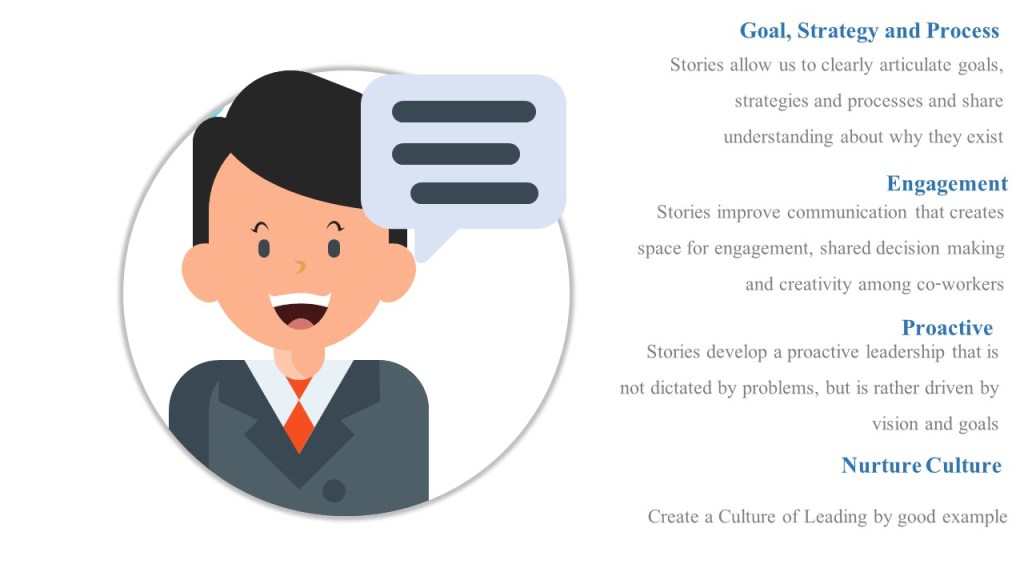
As leaders a big part of our work is ensuring the know-why – fostering and sharing an understanding of work culture and values. This is a continuing, long-term co-creative process that does not happen overnight. An important part of this work is shaping and sharing stories, using the past as a shaper of the future to give meaning to events. As stories are told in the present, they become a partner in shaping the future.

To successfully change, it is important to understand the past as well as dream for the future. Storytelling as a method and tool has real power to foster dialogue, reveal culture and create a shared vision:

  • Storytelling makes complex situations and phenomena accessible and provides details that can be used to build action plans for change and improvement.
  • Stories reveal values and principles embedded in a culture that are often hidden from the naked eye.
  • Stories make visible driving forces for change that are not revealed when direct questions are asked.
  • Stories provides a platform for understanding different perspectives. It breaks down barriers and builds bridges of trust.
  • Stories highlight turning points that can be used to facilitate innovation and change.

Through storytelling and dialog, we strengthen structure, identity and culture. It is how we tell our story.